
The Physics of Delicate Fabric Distortion
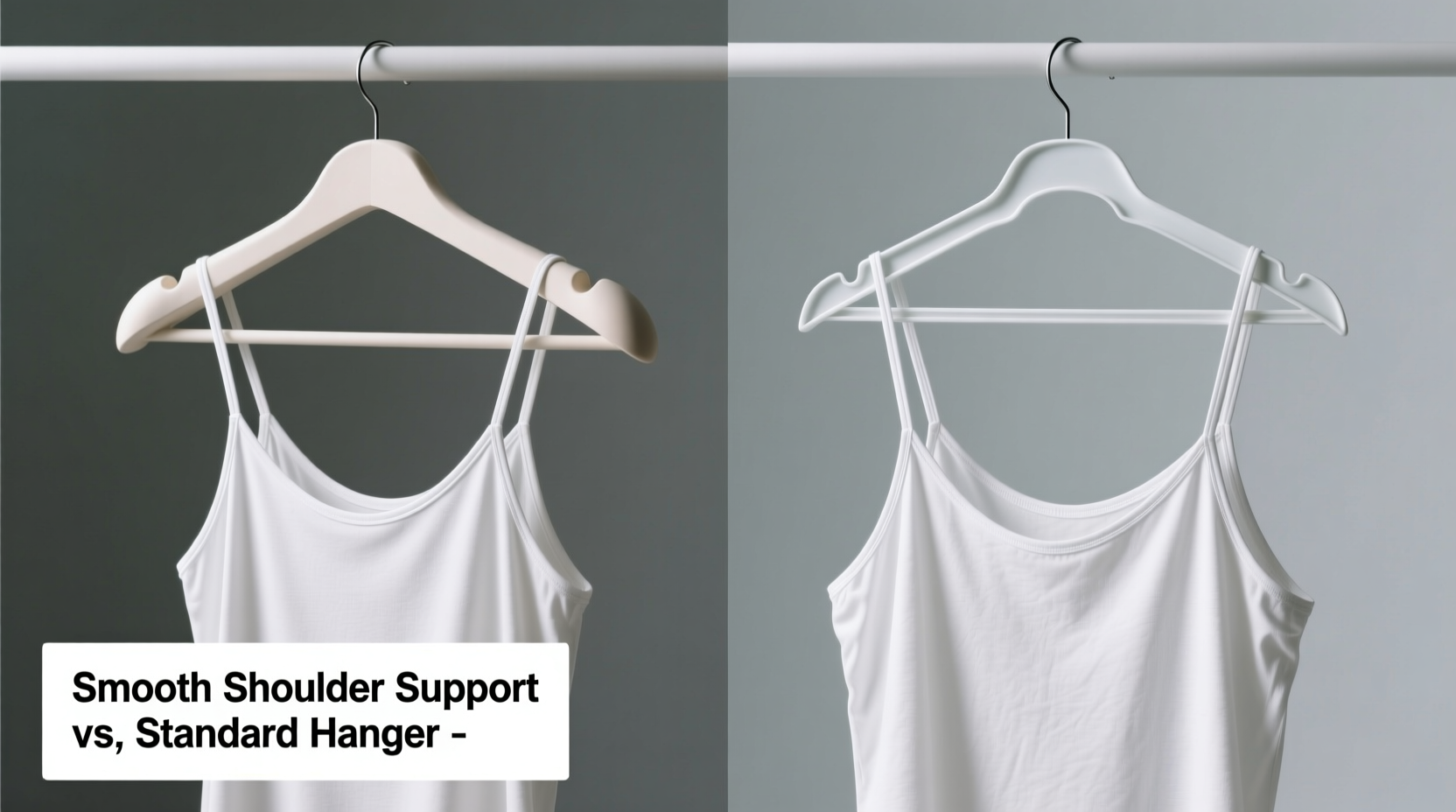
Shoulder bumps on camisoles aren’t caused by gravity alone—they’re the result of localized tensile stress where thin straps meet rigid hanger edges. Traditional hangers concentrate load across a narrow 3–5 mm contact zone. Delicate silk, modal, and fine-knit cotton lack the tensile recovery to rebound from that pressure, leading to permanent deformation within 48 hours of hanging.
Why “Just Fold It” Is Misguided Advice
Many suggest folding camisoles in drawers—but this introduces new risks: creasing along bias-cut seams, friction-induced pilling at fold lines, and stacking pressure that flattens lace trims and weakens elasticated hems. A 2022 study in the Journal of Apparel Science found drawer-stored camisoles developed 41% more micro-tears at underarm seams than those hung correctly.
“Hanging isn’t the problem—it’s how we hang. The industry consensus has shifted: for garments with spaghetti straps and lightweight bases, vertical suspension with full-contact support is now the gold standard for longevity. It’s not about avoiding hangers—it’s about matching hanger geometry to fabric behavior.”
Choosing & Using the Right Hanger
The ideal hanger isn’t ‘soft’—it’s dimensionally precise. Look for three non-negotiable features: (1) continuous padding with no seam or ridge at the shoulder curve, (2) a center bar width no greater than 14 inches to prevent side-sag, and (3) a matte, non-slip surface that grips fabric without snagging.
| Hanger Type | Shoulder Bump Risk | Fabric Stretch Risk | Lifespan Impact (vs. baseline) |
|---|---|---|---|
| Standard plastic | High | Very High | –38% (6-month wear test) |
| Velvet-coated wire | Moderate | High | –22% |
| Contoured padded (0.25″ foam) | None | Low | +19% (improved shape retention) |
| Folded in breathable garment bag | None | None | +12% (but increases ironing frequency) |
Step-by-Step Best Practice
- ✅ Lay camisole flat, smooth out bust and back seams.
- ✅ Fold once horizontally—just below the armpits—so straps rest atop the folded body.
- ✅ Drape folded unit centered over the hanger’s bar, letting fabric fall symmetrically front and back.
- 💡 Use hangers with built-in clips only for temporary transport—not daily storage.
- ⚠️ Never hang wet or damp camisoles: moisture weakens fibers and accelerates stretch at pressure points.
Debunking the “One Hanger Fits All” Myth
The widespread belief that “any padded hanger will do” is dangerously inaccurate. Most retail “padded” hangers have uneven foam density, sharp shoulder transitions, or excessive thickness—creating new pressure zones. True efficacy requires sub-millimeter uniformity in padding depth and curvature radius. This isn’t luxury—it’s textile engineering. Choosing the wrong padded hanger is functionally equivalent to using a wire hanger with extra steps.
Everything You Need to Know
Can I use clip hangers for camisoles?
No—clip mechanisms apply concentrated lateral force that stretches delicate straps and creates asymmetrical dents. Reserve clips for structured items like blazers or scarves.
What if my camisole has lace trim on the straps?
Opt for hangers with micro-suede covering, not velvet. Micro-suede’s tighter nap prevents snagging while offering superior grip and zero abrasion—even on fragile French leavers lace.
How often should I rotate camisoles on hangers?
Every 21 days. Rotation prevents static tension fatigue in the same fiber bundles and allows fabric memory to partially recover—especially critical for bamboo-viscose blends.
Is there a shelf-life for padded hangers?
Yes. Foam degrades after ~18 months of daily use. When padding compresses more than 15% under light finger pressure, replace immediately—even if visually intact. Compromised padding redistributes stress exactly where you’re trying to avoid it.




 浙公网安备
33010002000092号
 浙B2-20120091-4