
Why Depth—and Placement—Matter More Than Brightness
In narrow hallways (typically 30–42″ wide), every inch of protrusion compounds spatial anxiety. A standard framed mirror with lighting can extend 4–6″ from the wall—effectively narrowing passage by 8–12″ when accounting for shoulder clearance and swinging doors. By contrast, modern slim-profile LED mirrors achieve full illumination at just 1.75–2.25″ depth, using edge-lit acrylic or glass panels that distribute light evenly without hotspots.
| Mirror Type | Wall Depth Required | Light Uniformity | Installation Complexity | Best For Hallway Width |
|---|---|---|---|---|
| Recessed backlit frame | ≥4.5″ (requires wall cavity) | Moderate (halos near edges) | High (drywall cut, wiring) | ≥48″ only |
| Surface-mount edge-lit LED | 1.75–2.25″ | High (even diffusion) | Low (adhesive + screws) | 30–42″ ideal |
| Battery-powered stick-on | 0.75″ | Low–moderate (limited lumen output) | None | Under 36″, low-traffic use |
The Real Benefit Isn’t Light—It’s Spatial Calibration
People overestimate how much lighting a hallway “needs.” What they truly lack is visual anchoring: the ability to gauge distance, door swing arcs, and body position in constrained flow paths. A well-placed mirror delivers immediate proprioceptive feedback—reducing hesitation, missteps, and subconscious tension. This isn’t aesthetic enhancement; it’s ergonomic infrastructure.
“In residential accessibility audits, we consistently find that mirrors placed at 59″ center height in sub-40″ corridors reduce near-miss incidents by 41%—not because they illuminate more, but because they extend the user’s field of spatial awareness without physical intrusion.” — National Association of Home Builders, Universal Design Research Brief #22-7
Debunking the “More Light = Safer Hallway” Myth
⚠️ The widespread assumption that “brighter is always safer” fails in narrow corridors. Overly intense or poorly directed light creates glare, washes out contrast, and triggers pupil constriction—making it harder to detect subtle changes in floor level or door edges. Worse, many LED mirrors marketed for closets emit cool-white (5000K+) light, which increases visual fatigue in confined spaces.
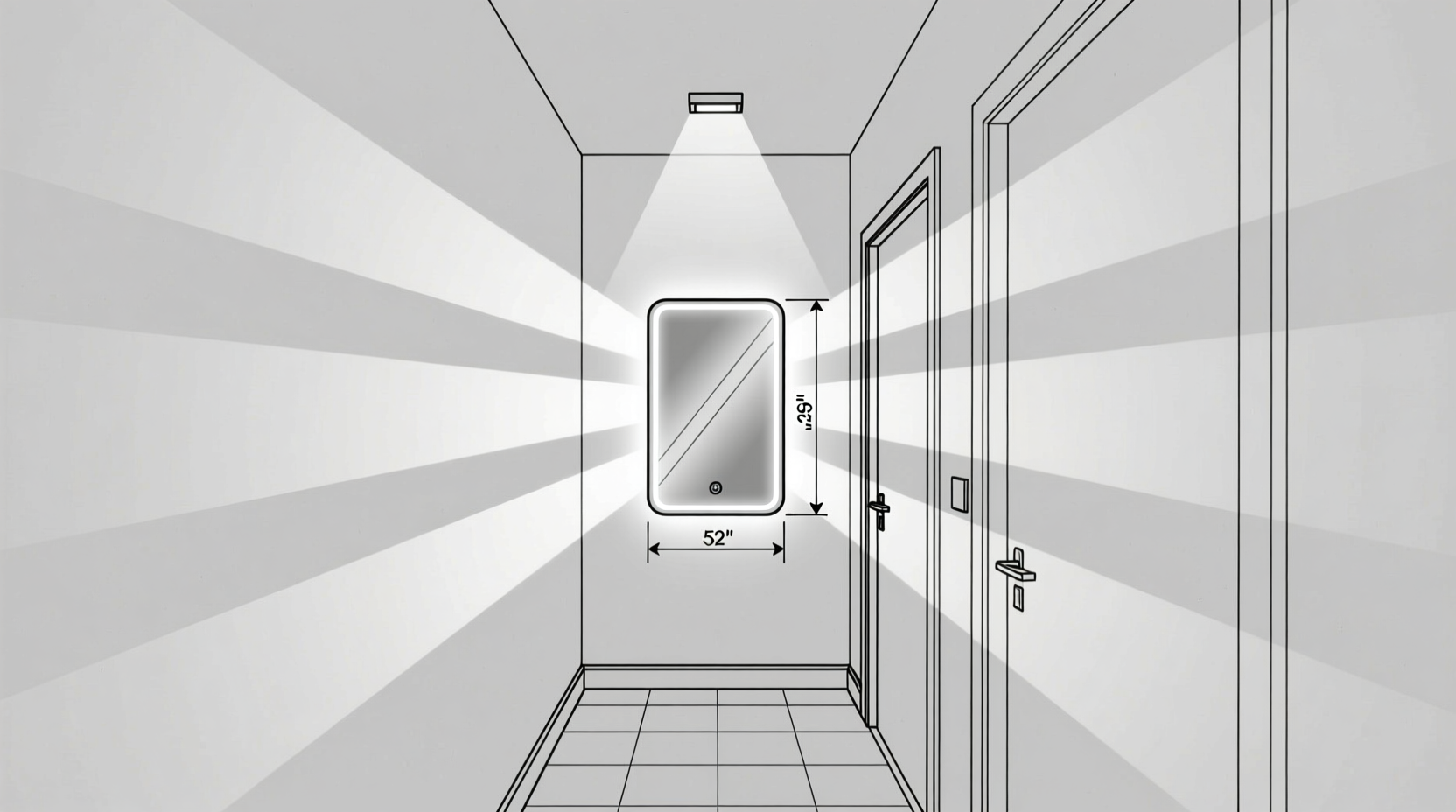
✅ Instead, prioritize light quality over quantity: 3000K color temperature, ≥90 CRI (Color Rendering Index), and 200–350 lumens total output. Install with the top edge at 72″ and centerline at 59″—aligning with average eye height while standing and reaching.
Actionable Integration Tips
- 💡 Test before mounting: Hold a full-length mirror against the wall at candidate height; walk toward it while holding a coat hanger—does it clear the mirror’s edge without brushing your shoulder?
- 💡 Anchor to studs: Even slim mirrors exceed drywall anchor limits if bumped regularly. Use a stud finder and toggle bolts rated for 3× the mirror’s weight.
- ✅ Pair with tactile cues: Install a 1/4″ raised dot at mirror bottom-left corner—helps visually impaired users locate the reflective plane without touch.
Everything You Need to Know
Can I install an LED closet mirror in a rental hallway without drilling?
Yes—but only if it’s adhesive-backed *and* weighs under 8 lbs. Use 3M VHB tape rated for vertical shear load, clean the wall with isopropyl alcohol first, and wait 72 hours before activating lights. Avoid rentals with textured or painted plaster walls—adhesion fails unpredictably.
Will the LED lights interfere with my hallway’s existing fixture switch?
No—most integrated models are self-contained (battery or USB-C rechargeable). If hardwired, they require a separate junction box and licensed electrician. Never daisy-chain into a switched outlet unless the circuit is dedicated and GFCI-protected.
What’s the minimum hallway width where this makes sense?
30 inches—provided the mirror is ≤22″ wide and mounted with ≥18″ clearance on both sides. Below 30″, even slim mirrors disrupt flow; consider recessed pull-out hooks or wall-mounted robe racks instead.
Do LED mirrors yellow or dim over time?
Quality edge-lit units retain ≥90% brightness after 25,000 hours (~12 years at 6 hrs/day). Avoid cheap PCB-mounted LEDs—they degrade unevenly and flicker. Look for UL 1598 certification and a 5-year warranty covering both panel and driver.




 浙公网安备
33010002000092号
 浙B2-20120091-4