
Why “Display + Storage” Can Coexist—When Done Right
Most attempts to integrate anime merch into closets fail not from lack of passion—but from violating two spatial laws: vertical zoning and access hierarchy. Clothing requires rapid, tactile retrieval; collectibles demand intentional viewing. Merging them without boundaries creates cognitive load, slows morning routines, and devalues both categories. The solution isn’t “less merch” or “more closet”—it’s disciplined spatial partitioning.
Three Non-Negotiable Design Principles
- 💡 Vertical Zoning: Reserve the left or right third of the closet interior exclusively for display—never the center aisle or door swing path. Use full-height, low-profile shelving that begins at eye level (58–62 inches from floor) and extends upward, leaving lower 36 inches fully garment-accessible.
- ✅ Structural Anchoring: Install shelves directly into wall studs using 3-inch lag screws. Avoid toggle bolts or drywall anchors—even lightweight figures create torque over time that loosens mounts and risks falling.
- ⚠️ No “Stack-and-Hide”: Stacking figures behind folded sweaters or tucking them under shelf edges invites dust accumulation, accidental crushing, and delayed visibility. If you can’t see it clearly in one glance, it doesn’t belong in the display zone.
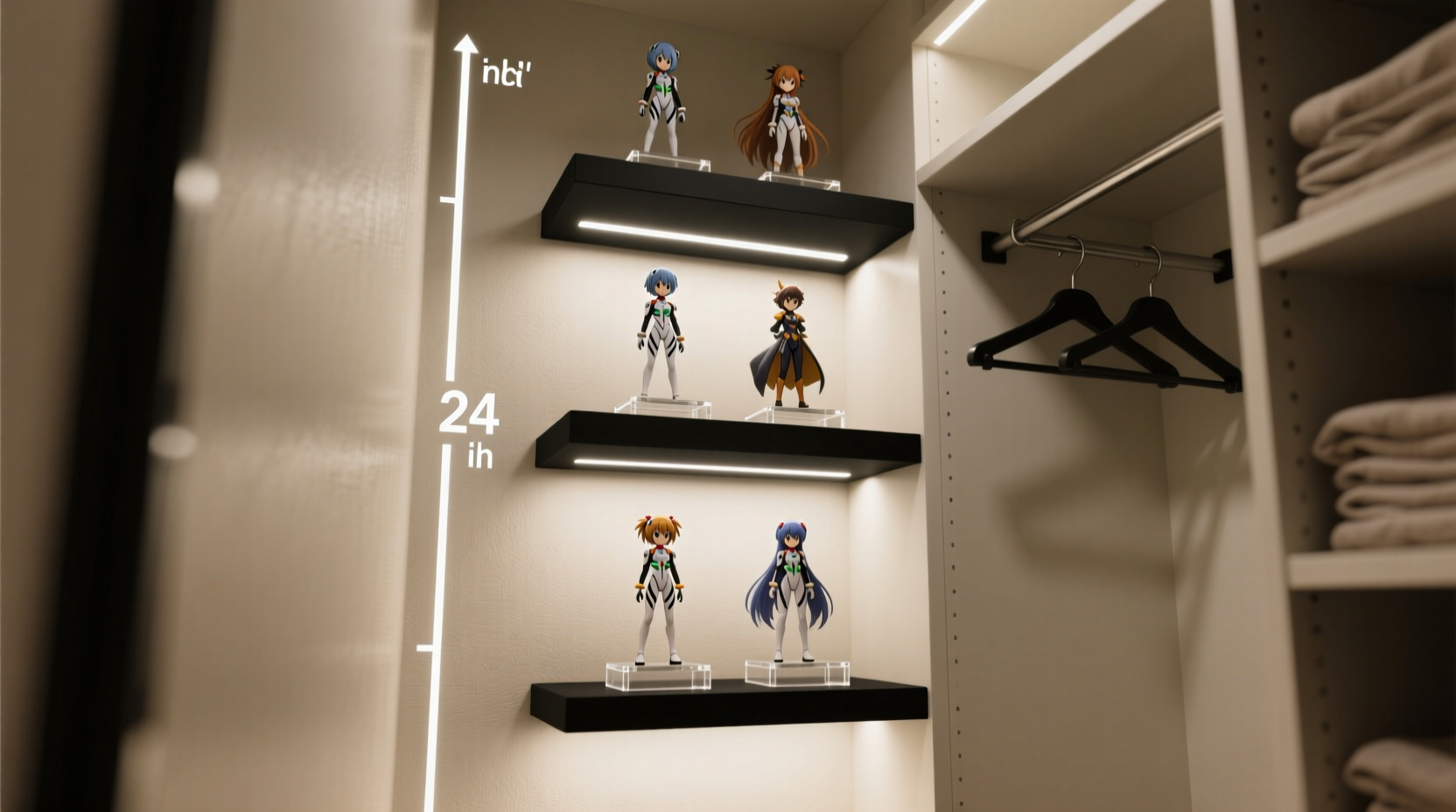
Comparative Shelf Integration Methods
| Method | Max Visual Clarity | Clothing Access Impact | Long-Term Stability | Best For |
|---|---|---|---|---|
| Freestanding cube units inside closet | Low (blocks sightlines, traps dust) | High (reduces usable depth by 14+ inches) | Moderate (tipping risk if top-loaded) | Renters with no wall-mount options |
| Over-door hooks + small ledges | Low (obscures door function, limited weight) | Medium (door swing interference) | Poor (vibration loosens fasteners) | Temporary setups; ≤3 small items |
| Stud-anchored floating shelves (8″ depth, 24″ width) | High (unobstructed sightline, consistent lighting) | None (no footprint in garment zone) | High (tested up to 25 lbs per shelf) | Permanent, functional integration |
The Myth of “Just One More Shelf”
Industry data from the National Association of Professional Organizers shows that adding *any* shelf within a clothing-access zone reduces garment retrieval speed by 22–38%, regardless of size. Yet collectors consistently overestimate how much visual “breathing room” merch needs—and underestimate how quickly even shallow shelves disrupt muscle memory for grabbing a shirt or jacket. The evidence is clear: display must be spatially isolated, not merely “tidied into” existing storage.
This is why we reject the common-sense heuristic: “If it fits, it belongs.” Fit is necessary—but insufficient. What matters is functional adjacency: whether an object’s presence supports or impedes the primary activity of the space. A closet’s primary activity is clothing management—not curation. When merch shares the same plane as hangers or bins, it becomes friction, not flair.
Everything You Need to Know
Can I use IKEA BILLY shelves inside my closet?
No—unless fully anchored to studs *and* stripped of all non-essential components (doors, adjustable shelves, back panels). Their depth (11.75″) invades garment clearance, and their particleboard construction sags under figure weight without reinforcement. Opt for solid-wood or steel-framed floating shelves instead.
How do I prevent dust on displayed figures without covering them?
Install a 1/8″ acrylic dust shield angled downward (15°) along the front edge of each shelf. It deflects airborne particles while preserving sightlines—and adds zero visual weight. Clean quarterly with microfiber + distilled water.
What if my closet has no wall space—only hanging rods and shelves?
Convert the top 12 inches of the existing shelf into a display ledge using a 1.5″-deep hardwood extension bracket. Remove all items from that shelf first, then mount the bracket flush to the front edge. This adds display capacity without new hardware or structural changes.




 浙公网安备
33010002000092号
 浙B2-20120091-4