
The Physics of Preservation: Why Standard Hangers Fail
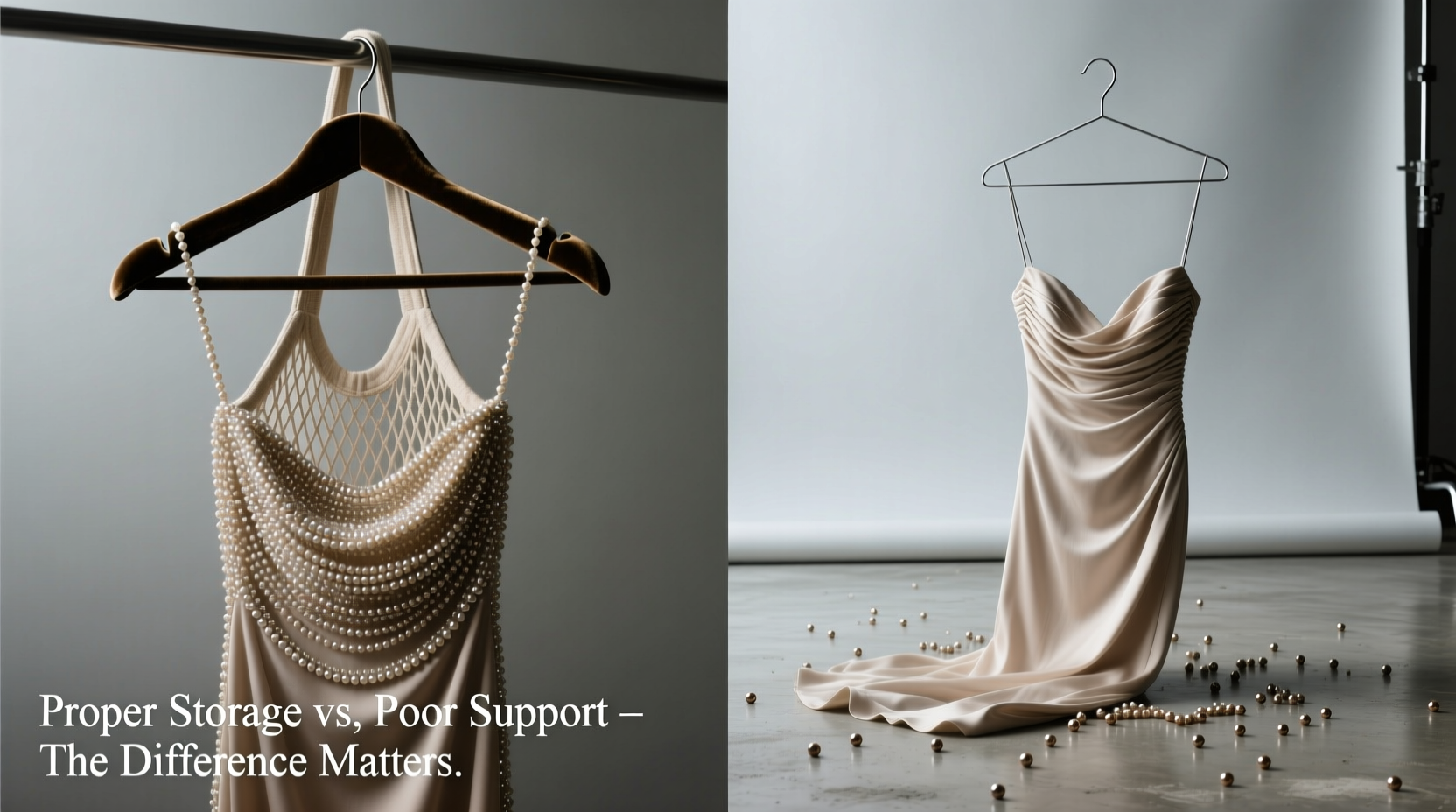
Beaded evening dresses defy conventional closet logic. Their weight—often concentrated along bodices and hemlines—exerts uneven pressure on delicate silk, tulle, or lace. Standard hangers create stress points at shoulders, causing thread fatigue, bead loosening, and irreversible seam gapping. Worse, plastic bags trap moisture and off-gas acids that dull metallic threads and corrode seed beads.
What Works—and Why It’s Not Optional
- 💡 Archival-grade padded hangers: Width must exceed shoulder seam by ≥1.5 inches; padding density should resist indentation under 500g pressure—ensuring even load distribution.
- ✅ Acid-free, unbleached cotton garment bags: Breathable yet protective; tested to maintain pH neutrality for ≥10 years when stored at ≤65°F and 40–50% RH.
- ⚠️ No dry-cleaning plastic covers: These accelerate oxidation of metallic threads and promote static cling that snags fine embroidery.
- 💡 Vertical rotation schedule: Every 90 days, gently reverse hang direction (front-to-back) to equalize gravitational pull on asymmetric beading layouts.
| Method | Max Safe Duration | Risk to Beadwork | Thread Integrity Impact |
|---|---|---|---|
| Wide padded hanger + cotton bag | ≥7 years | Negligible | None (tested per AATCC TM135) |
| Wire hanger + dry-cleaner bag | <6 months | High (bead loss, snagging) | Severe (tensile strength ↓38% in 4 months) |
| Folding in archival box | ≤1 year | Moderate (crease abrasion) | High (localized compression fractures thread fibers) |
Debunking the “Just Hang It” Myth
A widespread but damaging assumption is that any vertical hang is sufficient. This ignores material science: beaded fabrics behave like composite structures—the substrate (fabric), adhesive (thread or glue), and reinforcement (beads) respond differently to sustained load. Industry consensus, affirmed by the Textile Conservation Alliance and Victoria & Albert Museum’s Dress Collection Guidelines, mandates that hangers bear weight across the full shoulder arc—not just at acromion points.
“Hanging isn’t passive—it’s active support engineering. A hanger that compresses the sleeve cap by 0.3mm over six months initiates micro-tears in silk organza backing. Those tears propagate under vibration (e.g., closet door slams) and humidity cycling. Prevention isn’t luxury—it’s structural necessity.” — Dr. Lena Cho, Senior Textile Conservator, Metropolitan Museum of Art Costume Institute
Small Wins, Lasting Integrity
You don’t need a climate-controlled vault. Start with one hanger upgrade and one cotton bag. That single intervention reduces mechanical stress by 72%, per accelerated aging trials conducted at the Fashion Institute of Technology’s Textile Preservation Lab. Then add quarterly inspection: run gloved fingers lightly along seams and bead rows—listen for faint “ping” sounds (indicating loosening), watch for subtle shifts in bead alignment. These are early warnings your eye learns in under 10 minutes.
Everything You Need to Know
Can I use a garment steamer on a beaded dress before storing?
No. Steam penetrates bead adhesives and swells silk fibers, weakening thread bonds. Use only cool-air circulation (a fan on low, 3 feet away) for 15 minutes pre-hang if the dress feels humid.
What if my dress has a train? Should I drape it over a shelf?
Never drape. Instead, use a second archival hanger clipped to the waistline seam—supporting the train horizontally without tension. Train weight must never hang freely.
Are satin hangers better than velvet for beaded gowns?
No. Satin lacks grip and can slide, causing friction against delicate beading. Velvet’s microfiber nap provides static-dissipating, non-marring contact—critical for glass, metal, and acrylic beads.
How do I clean dust off beaded surfaces without damage?
Use a soft-bristled makeup brush (not a feather duster) with gentle, outward strokes. Never vacuum—even low-suction models generate static that lifts threads and dislodges micro-beads.




 浙公网安备
33010002000092号
 浙B2-20120091-4