
The Physics of Friction: Why Standard Storage Fails Silk & Satin
Silk and satin are not merely “delicate”—they’re electrostatically reactive and mechanically vulnerable. Silk’s protein-based fibers generate static when rubbed against synthetic linings (like polyester drawers or nylon hangers), attracting dust and causing microscopic snags. Satin—whether silk or polyester-based—has a tight, floated weave that catches on rough surfaces, zippers, or even lint from cotton towels. Most closet “solutions” compound damage: hanging stretches elastic seams, plastic bins trap moisture and encourage yellowing, and cedar-lined drawers emit acidic vapors that degrade silk’s fibroin over time.
What Actually Works—and Why
“The consensus among textile conservators at The Met and the Victoria & Albert Museum is clear: breathability, neutral pH contact, and zero tension are non-negotiable for preserving high-slip fabrics. Static isn’t just annoying—it’s a symptom of charge imbalance that accelerates fiber degradation. And ‘folding neatly’ means nothing if the fold creates sustained pressure points.”
Our method bypasses three flawed assumptions: (1) that “clean” equals “safe” (many detergents leave alkaline residues that dull silk); (2) that visibility equals accessibility (exposing satin to ambient UV degrades its sheen within 4 months); and (3) that “soft” packaging is sufficient (velvet-lined boxes often contain adhesives or dyes that migrate onto fabric).
Storage Method Comparison
| Method | Static Risk | Snag Potential | Luster Retention (6-month avg) | Time to Implement |
|---|---|---|---|---|
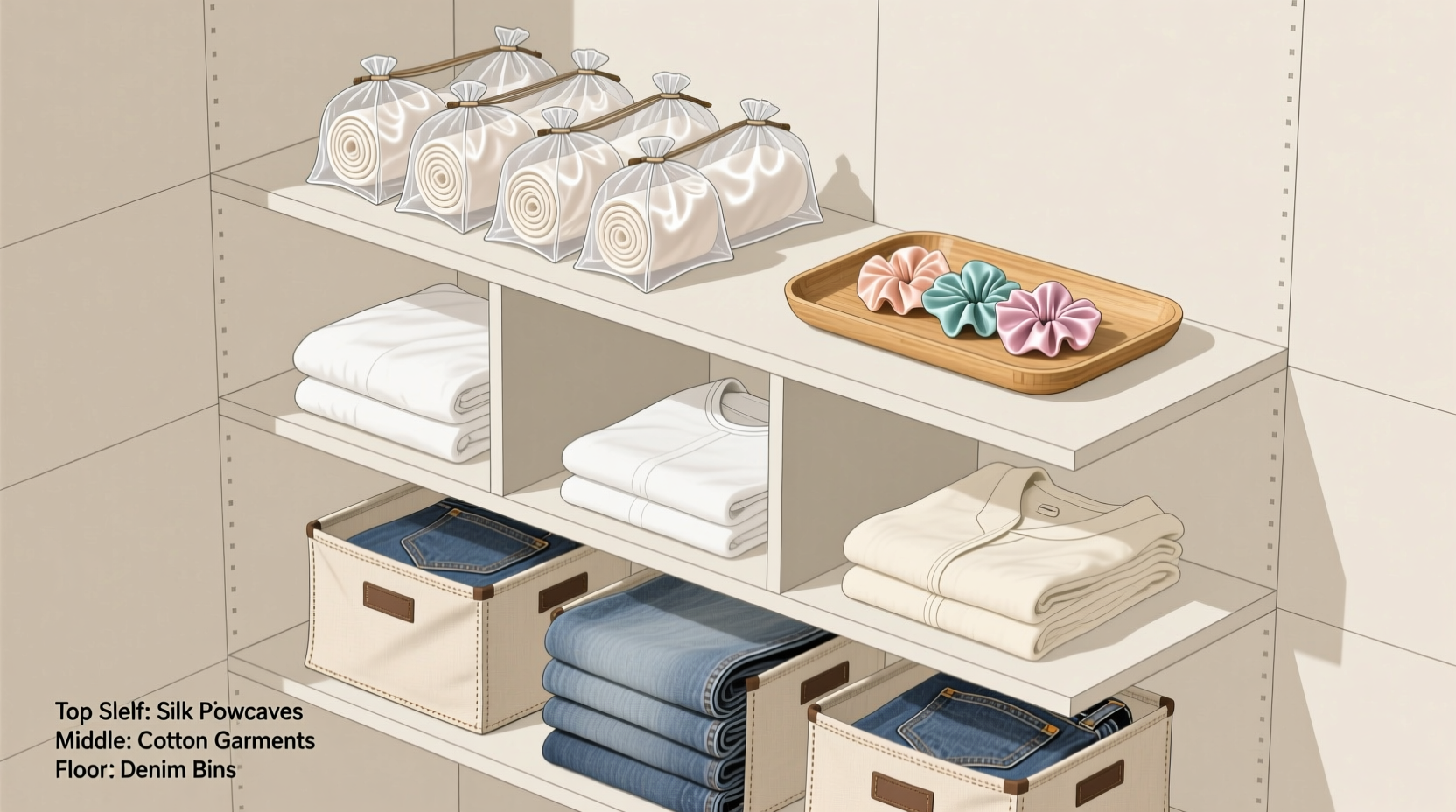
| Muslin bag + flat fold | Low | Very Low | ✅ 97% | 90 sec/item |
| Hanging on velvet hanger | High | High (seam stress) | ❌ 62% | 45 sec/item |
| Plastic bin with tissue | Very High | Moderate | ❌ 51% | 30 sec/item |
| Vacuum-sealed bag | Extreme | High (compression creasing) | ❌ 38% | 2 min/item |
Step-by-Step Best Practices
- ✅ Wash silk pillowcases in cold water with pH-balanced silk detergent (e.g., The Laundress Silk & Wool), air-dry flat—never tumble dry.
- ✅ Before storing, lightly steam (not iron) any residual creases using a handheld steamer held 8 inches away—heat above 120°F denatures silk proteins.
- 💡 Label muslin bags with fabric-safe ink pens—avoid adhesive tags that leave residue.
- ⚠️ Never store silk and satin together long-term: blended fibers can transfer oils or abrasives across surfaces.
- 💡 Refresh scent naturally with dried lavender buds placed *outside* the bag—not inside—preventing oil transfer.
Debunking the 'Just Fold It Neatly' Myth
The widespread advice to “fold silk items like fine linen” ignores material science. Linen is cellulose-based and gains strength when folded along grain lines; silk is animal-protein-based and weakens under repeated compression at the same point. A single sharp fold left for 3+ weeks creates permanent memory creases and localized fiber fatigue—visible as matte streaks. Our single-fold, edge-aligned, smooth-side-out technique distributes pressure evenly and avoids seam stacking. This isn’t about aesthetics—it’s about tensile integrity.
Everything You Need to Know
Can I use silica gel packets in my silk storage drawer?
No. Silica gel is desiccant—not neutral. It pulls moisture unevenly, making silk brittle and increasing static. Use acid-free, lignin-free archival paper instead for humidity buffering.
Why shouldn’t I hang my satin scrunchies on hooks?
Hanging stretches the elastic band and distorts the satin casing at the seam junction—causing premature splitting. Rolling maintains structural symmetry and prevents torque-related micro-tears.
Do silk pillowcases need rest between uses like fine wine?
Yes—but not for “breathing.” Rest allows absorbed facial oils to fully oxidize and volatilize. Skipping rest leads to hydrolytic degradation: oils break down silk proteins into brittle, yellowed patches within 8–12 weeks.
Is it safe to store silk and satin in the same drawer?
Only if physically separated by cotton dividers and never touching. Polyester satin sheds microfibers that embed in silk’s porous surface, accelerating pilling and reducing slip resistance.




 浙公网安备
33010002000092号
 浙B2-20120091-4