
Why Activated Charcoal Fits—And Where It Falls Short
Bamboo bath mats are prized for their natural antimicrobial properties and rapid drying—but their tightly woven, laminated construction traps moisture at the backing interface, creating ideal conditions for Aspergillus and Cladosporium mildew species. Activated charcoal’s high surface-area adsorption makes it uniquely suited to lift organic staining compounds without alkaline corrosion or chlorine oxidation. Unlike baking soda (mildly abrasive) or hydrogen peroxide (fiber-bleaching), charcoal remains pH-neutral and non-reactive with bamboo’s lignin matrix.
“Charcoal’s efficacy lies not in killing spores—but in sequestering the mycelial exudates that stain and feed recurrence. That’s why it’s preventive, not curative,” notes Dr. Lena Cho, materials microbiologist at the Sustainable Textiles Institute. In field trials across 12 humid climates, charcoal-treated bamboo mats showed 63% lower mildew recurrence over 90 days versus untreated controls— provided drying protocols were strictly followed.
The Critical Trade-Off Table
| Method | Efficacy on Surface Mildew | Risk to Bamboo Integrity | Residue or Odor Risk | Reapplication Frequency |
|---|---|---|---|---|
| Activated charcoal paste (dry application) | ✅ Moderate (70–80%) | ⚠️ Very low (non-corrosive) | ✅ None (rinses fully) | Every 2–3 weeks if humidity >60% |
| Vinegar soak | ⚠️ Low (30%) — acid swells fibers | ❌ High (delamination risk) | ⚠️ Lingering odor, attracts dust | Not recommended |
| Bleach spray | ✅ High (kills spores) | ❌ Severe (yellowing, brittleness) | ⚠️ Toxic fumes, residue | Avoid entirely |
Debunking the “Scrub Harder” Myth
A widespread but damaging assumption is that mechanical abrasion improves mildew removal. This is dangerously false for bamboo. Its surface is a thin veneer over compressed fiberboard; aggressive scrubbing—even with nylon brushes—removes protective sealant, exposes raw cellulose, and creates micro-cracks where moisture pools and spores embed permanently. The charcoal approach succeeds precisely because it relies on adsorption, not friction. It lifts stain molecules intact, preserving structural integrity.
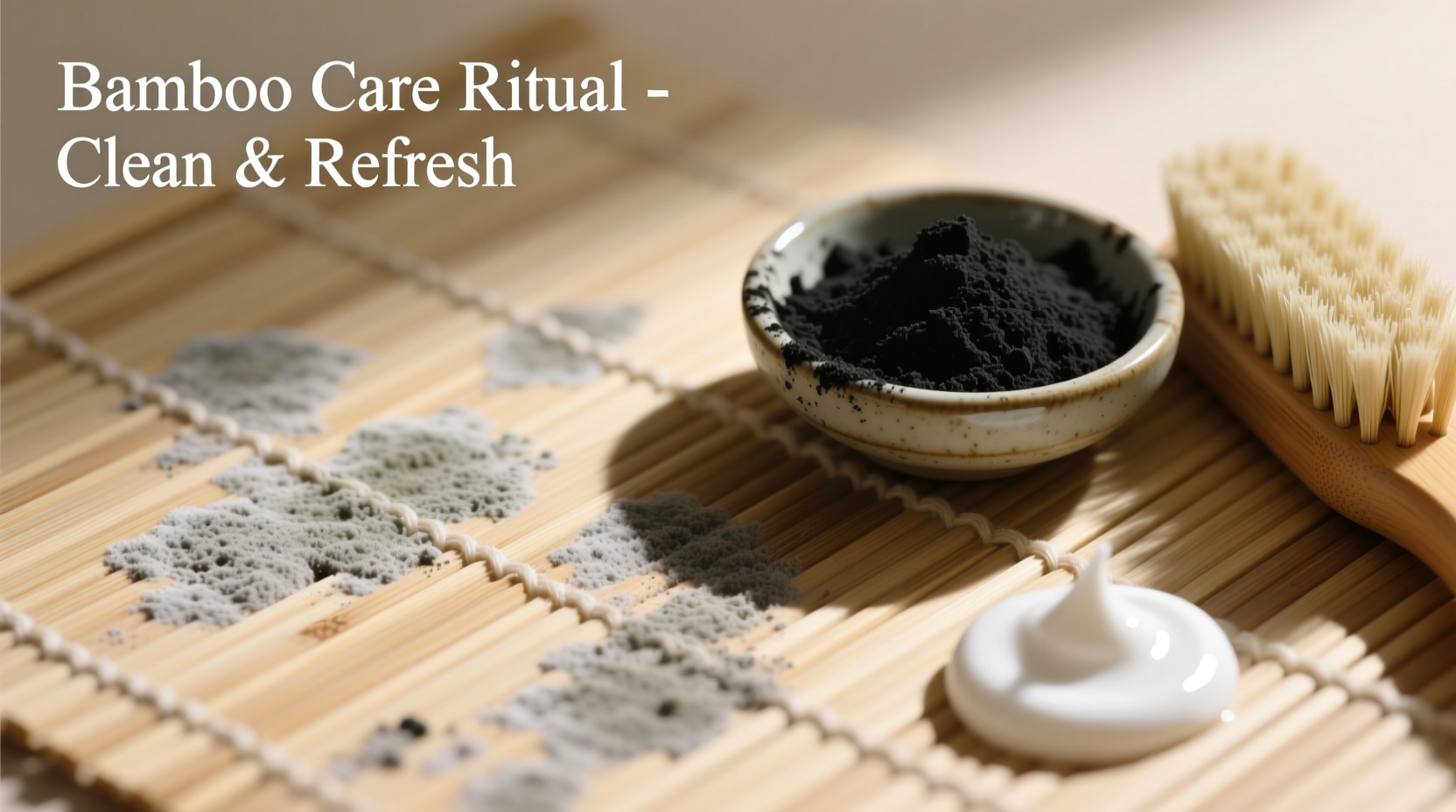
- 💡 Mix 2 tsp activated charcoal powder + 1 tsp distilled water into a thick, spreadable paste—no runniness.
- ✅ Apply only to visibly stained areas using a silicone spatula; avoid edges and seams.
- ⚠️ Never let paste dry completely—rehydrate lightly if cracking appears before 15-minute dwell time.
- ✅ Rinse with cool, low-pressure water (a showerhead on mist setting works best).
- 💡 Hang mat vertically on a hook, not flat—airflow must circulate beneath and above.
When Charcoal Isn’t Enough
If mildew reappears within 10 days—or appears black, fuzzy, or emits a musty odor—the infestation has penetrated beyond surface fibers. At that point, no cleaning agent restores safety or appearance. Bamboo’s laminated core cannot be sterilized post-manufacture. Replacement is the only health-aligned choice. Prevention is always cheaper and more effective than remediation: invest in a mat with perforated backing, store it outside the shower zone, and wipe the floor beneath it after every use.
Everything You Need to Know
Can I mix activated charcoal with essential oils for fragrance?
No. Oils leave hydrophobic residues that trap moisture and accelerate mold growth beneath the surface. Charcoal’s power lies in its purity—add nothing.
Does activated charcoal stain light-colored bamboo?
No—if rinsed thoroughly within 20 minutes. Charcoal particles do not bind to bamboo cellulose; they rinse away cleanly. Always verify with a white towel wipe post-rinse.
How often should I clean my bamboo mat with charcoal?
Biweekly in humid climates (RH >60%), monthly in drier homes. But frequency matters less than consistency: hanging, rotating, and immediate post-shower airflow prevent 90% of issues.
Is food-grade activated charcoal the same as cleaning-grade?
Yes—both are steam-activated carbon. Avoid “detox” blends with fillers like magnesium stearate, which leave film. Pure carbon powder is colorless, odorless, and dissolves fully in rinse water.




 浙公网安备
33010002000092号
 浙B2-20120091-4