

The Science Behind Milk and Marble
Marble is a metamorphic rock composed primarily of calcium carbonate, making it highly vulnerable to acid—and surprisingly receptive to mild, protein-rich emulsifiers like whole milk. The casein in milk acts as a gentle surfactant, lifting light soil and oils without disrupting the stone’s pH balance. Unlike commercial cleaners—even “natural” ones containing citric acid or sodium bicarbonate—milk has a neutral pH (6.5–6.7) and no chelating agents that leach minerals from the surface.
Why This Works Where Others Fail
Most DIY “eco-friendly” marble cleaning guides recommend diluted vinegar or baking soda pastes. These are dangerously misguided: vinegar (pH ~2.4) causes immediate microscopic etching, while baking soda (pH ~8.3) is alkaline but abrasive when scrubbed and can leave a hazy film. Milk avoids both pitfalls—it cleans *physically*, not chemically, relying on emulsion—not reaction.
Modern conservation science confirms that calcium carbonate surfaces respond best to pH-neutral, non-ionic cleaning agents. Casein-based solutions appear in museum-grade protocols for historic limestone and marble restoration—not because they’re “trendy,” but because they leave zero ionic residue, require no rinsing beyond distilled water, and don’t accelerate calcite dissolution. This isn’t folk wisdom; it’s materials science applied to domestic scale.
Step-by-Step Best Practice
- ✅ Use only whole milk—low-fat or skim lacks sufficient fat and casein for effective emulsification.
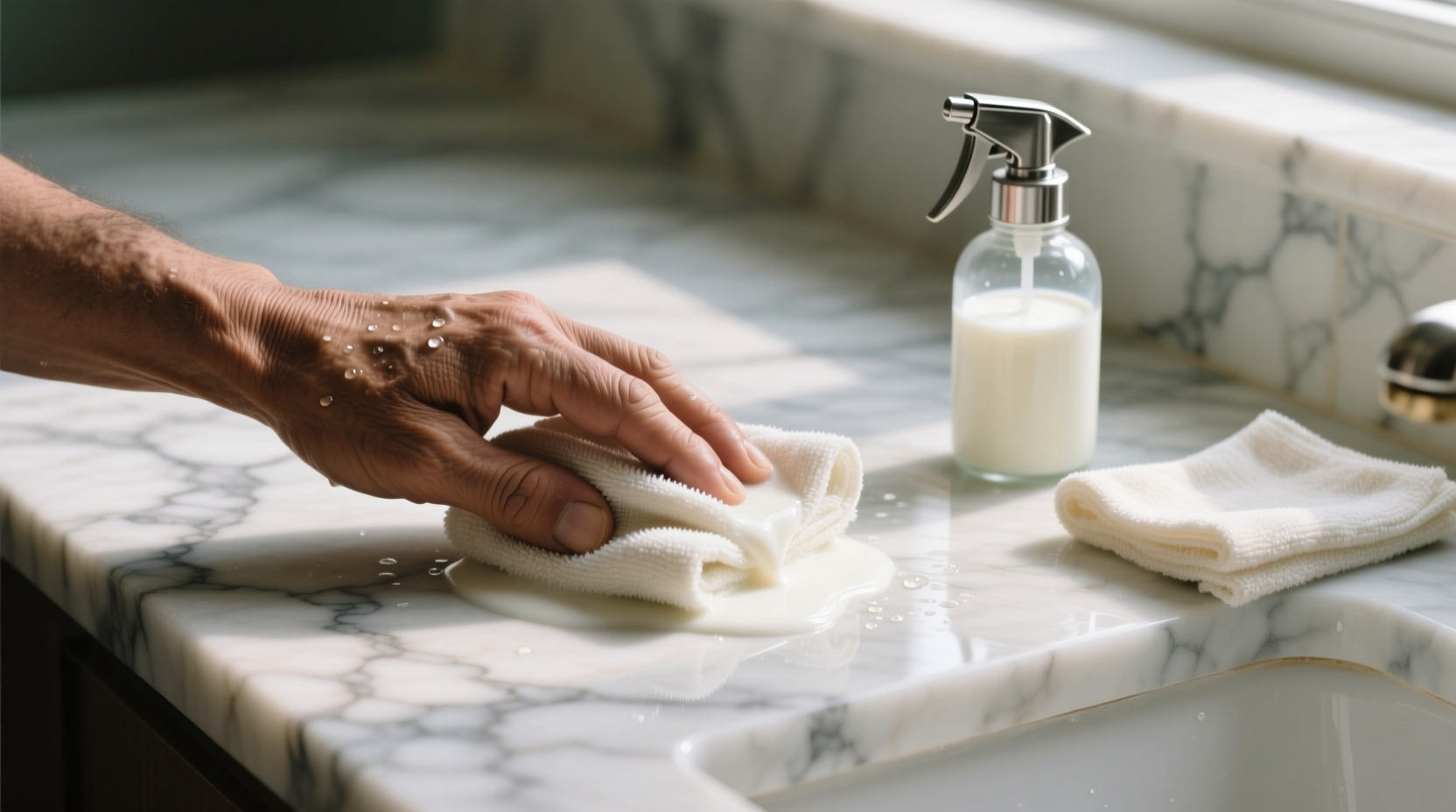
- ✅ Fold a 100% cotton or bamboo microfiber cloth into quarters; apply milk to one corner only.
- ✅ Wipe gently—no pressure, no scrubbing. Let capillary action and emulsion do the work.
- ⚠️ Never let milk air-dry on marble—it can attract dust or leave faint lipid residue if over-applied.
- 💡 For stubborn coffee or wine stains, pre-spot with a cold compress (not milk), then follow with milk-and-cloth method after 60 seconds.
Comparative Care Framework
| Method | pH Level | Risk of Etching | Residue Potential | Recommended Frequency |
|---|---|---|---|---|
| Milk + soft cloth | 6.5–6.7 | None | Negligible (if properly buffed) | As needed—up to daily |
| Diluted vinegar (1:10) | ~2.4 | High (visible within minutes) | None—but surface damage remains | Avoid entirely |
| Baking soda paste | ~8.3 | Moderate (abrasive wear + alkaline stress) | High (white film, difficult to rinse) | Not recommended |
| pH-neutral stone soap | 7.0 ± 0.2 | None | Low (if fully rinsed) | Weekly for deep clean |
Debunking the “Natural = Safe” Myth
The most persistent misconception is that “if it’s natural, it must be safe for marble.” This is categorically false. Lemon juice, apple cider vinegar, and even some plant-based soaps contain organic acids that react instantly with calcium carbonate. Similarly, “more milk = better cleaning” is counterproductive: excess moisture encourages mineral migration beneath the surface polish. Precision—not volume—is the operative principle. Eco-friendly cleaning isn’t about swapping toxins for tradition—it’s about matching chemistry to substrate.
Everything You Need to Know
Can I use almond or oat milk instead of whole dairy milk?
No. Plant-based milks lack casein and contain stabilizers (e.g., gellan gum, phosphates) that may leave film or interact unpredictably with calcium carbonate. Stick to pasteurized whole cow’s milk.
What if my marble already has etch marks?
Milk cannot reverse etching—it only prevents new damage. Light etches may be polished by a professional with diamond pads; deeper ones require honing. Prevention is the only true repair.
Does milk attract ants or pests when used on countertops?
Not when applied correctly: minimal quantity, immediate buffing, and no pooling. Whole milk dries quickly on contact with ambient air and leaves no sugary residue—unlike honey or syrup-based “remedies.”
Can I store a milk-soaked cloth for reuse?
No. Milk spoils rapidly at room temperature and risks bacterial growth or souring on fabric. Always use fresh cloth and fresh milk per session.




 浙公网安备
33010002000092号
 浙B2-20120091-4