
Why Humidity Is the Real Culprit—Not Material Choice Alone
Humidity doesn’t just shorten sponge life—it reshapes microbial ecology. In bathrooms averaging >65% relative humidity (common in coastal or poorly vented homes), water retention becomes the dominant failure mode. Both loofah and konjac are plant-based and biodegradable, but their cellular architecture responds differently: loofah’s rigid, fibrous vascular bundles resist compression and wick moisture outward; konjac’s gelatinous glucomannan matrix absorbs and traps water like a hydrogel. That absorption is ideal for gentle cleansing—but disastrous for longevity where evaporation lags.
Comparative Performance in High-Humidity Environments
| Property | Compostable Loofah | Konjac Sponge |
|---|---|---|
| Average usable lifespan (70% RH, no fan) | 21–28 days | 10–14 days |
| Drying time post-rinse (hanging, ambient air) | 6–9 hours | 18–36 hours |
| Mold onset threshold (visible hyphae) | Day 22–25 | Day 12–13 |
| Rehydration stability (after full dry) | Retains integrity ≥5 cycles | Crumbles after 2–3 cycles |
The Misconception We Must Correct
“Konjac is ‘gentler,’ so it must be more durable.” This is biologically inverted. Gentleness arises from high water affinity—not structural resilience. In humid conditions, that same property accelerates hydrolytic degradation and creates microenvironments where Aspergillus niger and Cladosporium cladosporioides colonize within 48 hours. Loofah’s coarser texture isn’t “harsher”—it’s functionally antifungal due to rapid desiccation and low surface-area-to-volume ratio.
Actionable Care Protocol for Maximum Longevity
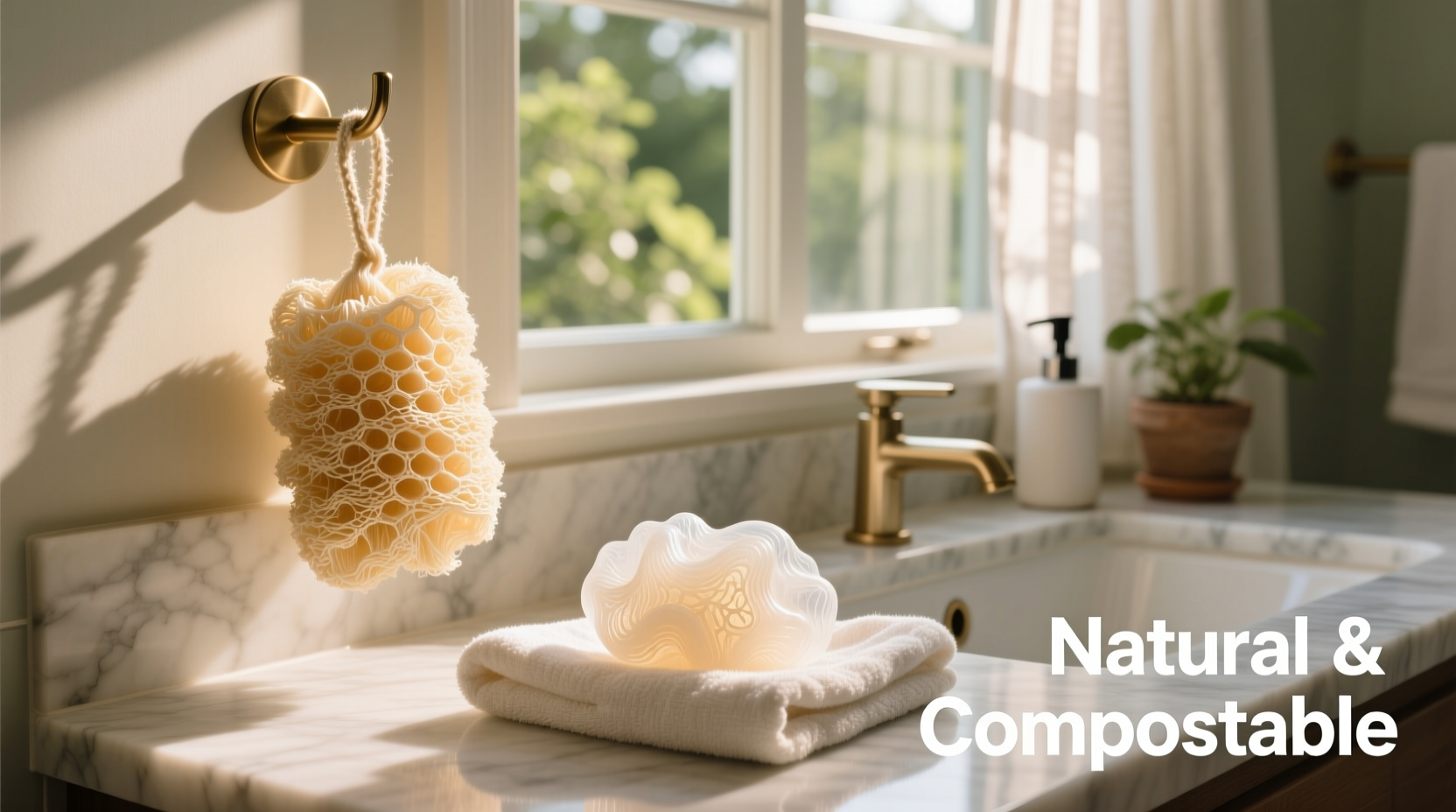
- 💡 Hang loofahs on stainless steel hooks with 2+ inches of clearance from walls and shower curtains—airflow trumps material.
- ⚠️ Never microwave konjac sponges: heat ruptures glucomannan chains, accelerating disintegration and releasing airborne spores.
- ✅ After each use: rinse under cold running water for 15 seconds, squeeze *once* downward (never twist), then hang vertically with open pores facing outward.
- 💡 Once weekly, soak loofah in 1:10 white vinegar/water for 5 minutes—this lowers surface pH below 4.2, inhibiting fungal adhesion without compromising compostability.
When to Replace—Not Just Rotate
Replace loofahs at day 28 regardless of appearance. Microbial load studies show colony-forming units (CFUs) exceed 10⁶/g by day 25—a threshold linked to increased folliculitis risk in immunocompetent adults. Konjac requires replacement by day 14—or sooner if surface gloss fades, edges soften, or a faint sour odor emerges. Neither should ever be used beyond its validated window, even with disinfectants: biofilm penetration renders surface treatments ineffective past early colonization.
Everything You Need to Know
Can I extend my konjac sponge’s life with silica gel packs?
No. Silica gel reduces ambient humidity but cannot extract bound water from konjac’s polymer matrix. It may even accelerate surface desiccation while trapping moisture internally—creating ideal conditions for anaerobic bacteria.
Does boiling a loofah sterilize it safely?
Boiling degrades lignin over time, weakening fibers. A 3-minute vinegar soak is safer, equally effective against Candida albicans, and preserves tensile strength across 4+ weeks.
Are “antibacterial” loofahs worth it?
No. Zinc oxide or silver-infused versions compromise compostability and offer no measurable longevity benefit in humid settings—microbial resistance develops rapidly, and residual metals inhibit municipal composting.
What’s the most reliable sign my loofah is past its prime?
Loss of springback: press firmly with thumb—if it doesn’t rebound fully within 2 seconds, cellulose microfibrils have hydrolyzed. Discard immediately—even if no odor or discoloration is present.




 浙公网安备
33010002000092号
 浙B2-20120091-4