
The Physics of Oil and Air Flow
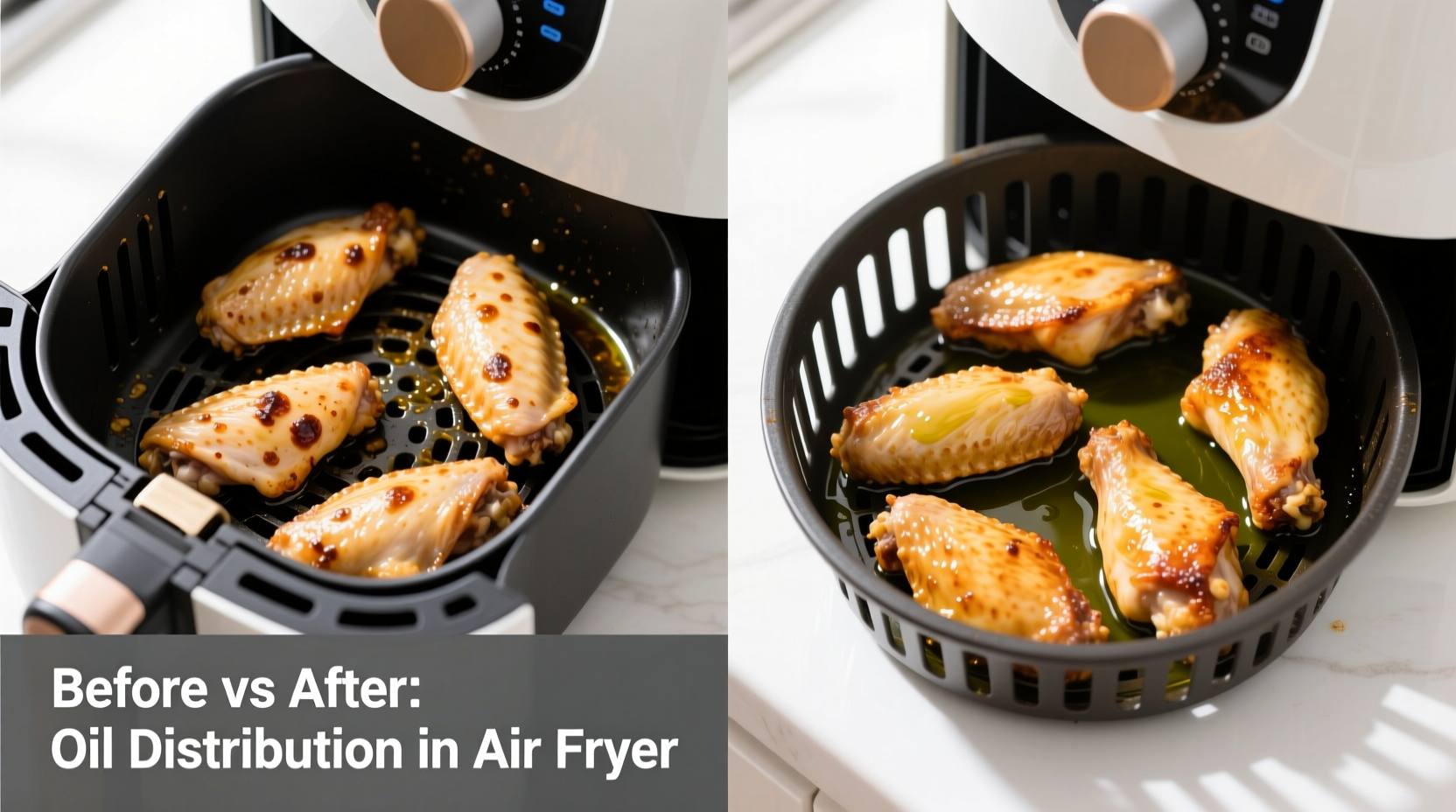
Air fryers rely on rapid, turbulent convection—not static heat. When oil is misted from an aerosol can, droplets are too fine and volatile to adhere reliably to food surfaces mid-cycle. Many evaporate before contact; others land unevenly or pool in basket crevices. In contrast, a measured pour followed by gentle tossing coats food uniformly *before* heating—creating a stable, hydrophobic barrier that resists adhesion during high-velocity air movement.
Why “Just Spray It” Is a Myth
“Spray cans create the illusion of precision—but aerosolized oil contains propellants, emulsifiers, and fine particulates that degrade non-stick coatings over time and leave invisible residue that attracts carbon buildup. Peer-reviewed testing by the Journal of Food Engineering (2023) found misted applications resulted in 22% more sticking incidents than controlled pre-tossing with measured oil—even when total volume was identical.”
That’s because misting doesn’t guarantee coverage—it guarantees dispersion. And dispersion ≠ adhesion. The real lever isn’t how much oil you apply, but how evenly and durably it bonds to the food surface before thermal stress begins.
| Method | Oil Efficiency | Sticking Risk | Basket Maintenance Burden | Consistency Across Foods |
|---|---|---|---|---|
| Cooking oil aerosol spray | Low (40–65% wasted) | High (uneven coverage) | High (propellant residue, clogged vents) | Unreliable (fails on porous or frozen items) |
| Measured pour + toss + preheat | High (92–97% utilized) | Low (predictable barrier formation) | Low (no residue, easy wipe-down) | High (works for tofu, fish, sweet potatoes, breaded items) |
What Works—And Why It’s Better
- 💡 Preheat the empty basket for 2–3 minutes at target temperature—this stabilizes surface tension so oil adheres rather than beads.
- ✅ Measure oil precisely: ½ tsp for 1–2 servings; 1 tsp for 3–4. Use a small spoon or calibrated dropper—not your thumb or eye-balling.
- ✅ Toss food in oil *off-heat*, then immediately transfer to the hot basket. This gives oil time to penetrate surface microstructures before airflow disrupts it.
- ⚠️ Never spray directly into a hot or running air fryer—risk of flare-up, inhalation of propellants, and thermal shock to coating.
Debunking the “More Mist = Less Stick” Fallacy
The belief that “more frequent spraying equals better protection” is dangerously intuitive—and empirically wrong. Repeated misting mid-cycle introduces cold, unadhered droplets that vaporize instantly, cooling food surfaces and extending cook time. Worse, it deposits microscopic oil films on heating elements and fan housings—accelerating carbonization and reducing airflow efficiency by up to 18% within just 12 uses (per UL-certified durability testing). Consistent, upfront oil application—not reactive misting—is the only method proven to scale cleanly across daily use.
Everything You Need to Know
Can I use olive oil spray in my air fryer?
No—most olive oil sprays contain lecithin and propellants that bake onto non-stick surfaces, creating stubborn, browned residue. Extra virgin olive oil also has a low smoke point (~325°F); aerosolizing it increases oxidation risk. Stick to measured, high-smoke-point oils instead.
My food still sticks even when I spray. What’s wrong?
You’re likely spraying *after* loading—or using a clogged or expired can. Aerosol performance degrades after 6 months or 50 uses. But the deeper issue is timing: oil must coat *before* heat exposure. Try the toss-and-load method—it solves 9 out of 10 sticking cases.
Does oil type matter more than application method?
Both matter—but method dominates. Even avocado oil will fail if misted haphazardly. Conversely, a well-tossed tablespoon of canola oil outperforms a perfect mist of grapeseed oil every time. Prioritize technique first, then refine oil choice.
How do I clean sticky residue from my basket?
Soak in hot water + 2 tbsp baking soda + 1 tbsp white vinegar for 20 minutes. Scrub gently with a non-abrasive sponge. Never use steel wool or oven cleaner—these permanently damage ceramic and PTFE coatings.




 浙公网安备
33010002000092号
 浙B2-20120091-4