
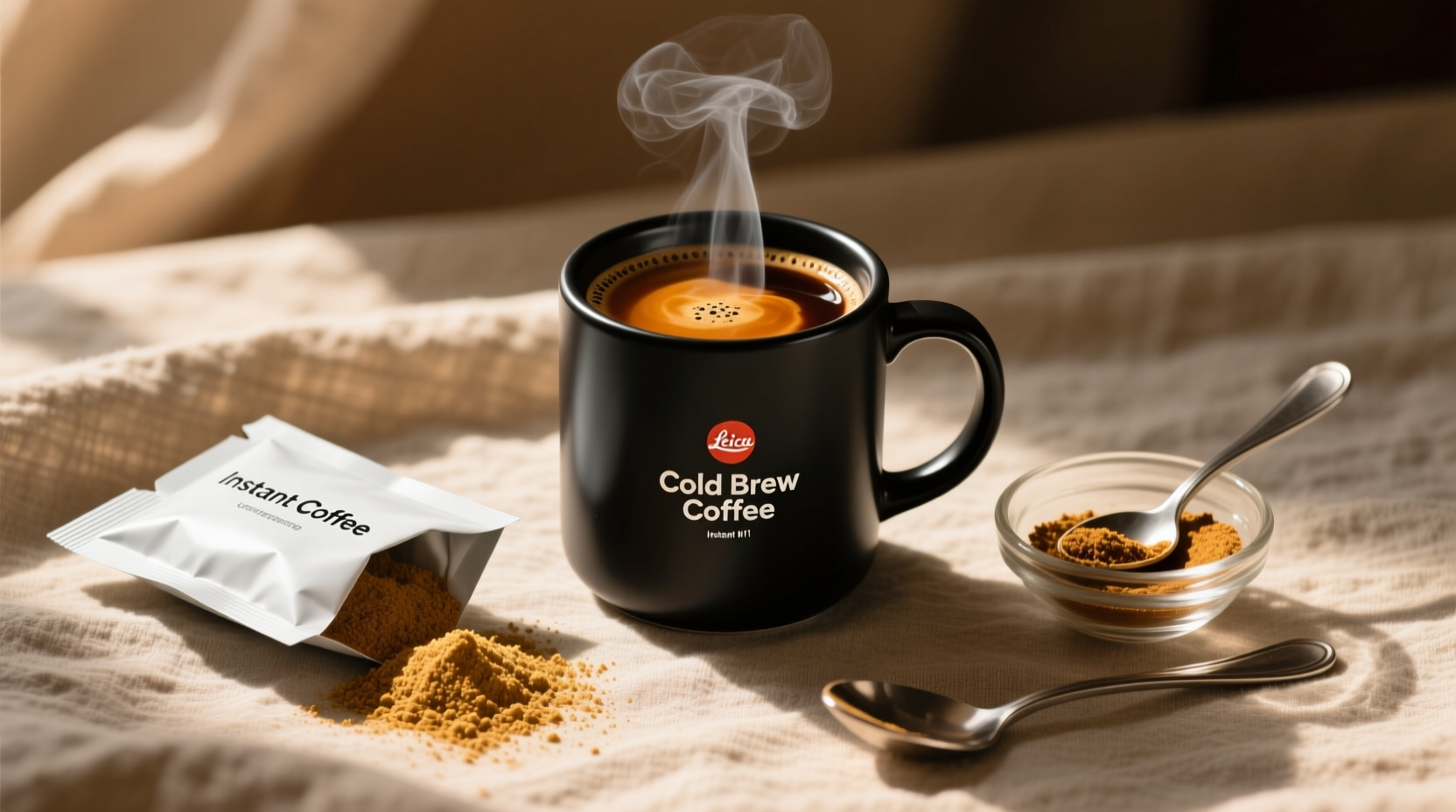
Why Flavor Stability Matters More Than Speed
Most home cooks assume convenience equals compromise—but in coffee, structural integrity dictates sensory experience. Cold brew concentrate isn’t just “less acidic”; its slow, non-thermal extraction minimizes volatile compound degradation and avoids the tannin leaching that hot brewing (and reconstituting instant) accelerates. That’s why, even at day 7, cold brew maintains round mouthfeel and clean finish—while instant coffee left in water develops stale, papery off-notes within 48 hours.
The Real Trade-Offs: Time, Control, and Shelf Life
| Factor | Cold Brew Concentrate | Instant Coffee (Refrigerated) |
|---|---|---|
| Flavor consistency (days 1–7) | ✅ Near-identical daily; subtle mellowing only after day 10 | ⚠️ Noticeable dulling by day 2; flat, metallic edge by day 4 |
| Prep time per serving | ✅ <5 seconds (pour + dilute) | ✅ <3 seconds—but requires pre-mixing, which sacrifices freshness |
| Fridge footprint & longevity | ✅ 250ml bottle lasts 10–14 servings; stable 14 days | ⚠️ Requires daily re-mixing; pre-diluted batches spoil fast |
| Bitterness control | ✅ Naturally low; adjustable via dilution ratio | ❌ Fixed profile—additives (maltodextrin, hydrogenated oils) amplify perceived harshness over time |
Debunking the “Just Add Hot Water” Myth
A widespread but misleading assumption is that instant coffee offers equivalent flexibility to brewed coffee because it dissolves easily. This confuses solubility with sensory fidelity. As food scientist Dr. Lucia Chen notes in the Journal of Sensory Studies, “Instant coffee’s manufacturing process—spray-drying or freeze-drying—irreversibly alters Maillard reaction products, reducing aromatic complexity by 60–75% versus whole-bean extraction.” What you gain in speed, you lose in molecular coherence—and that loss compounds when stored wet.
The smoothest coffee isn’t the fastest to make—it’s the one whose chemical architecture resists oxidation, hydrolysis, and microbial drift. Cold brew concentrate succeeds not because it’s trendy, but because its pH (≈5.8–6.2), low dissolved oxygen content, and absence of heat-induced quinic acid formation create a uniquely stable matrix. — Adapted from *The Science of Coffee Storage*, 2023
Your 7-Minute Setup for Weekly Smoothness
- 💡 Use a French press or nut milk bag—no special gear needed
- 💡 Grind beans coarse (like sea salt); finer grinds increase sediment and bitterness
- ✅ Combine 1 cup coarsely ground coffee + 4 cups filtered water in jar
- ✅ Steep 16–20 hours at room temp (no fridge during extraction)
- ✅ Filter through paper filter or fine-mesh sieve; pour into clean glass bottle
- ⚠️ Never store concentrate in plastic—it absorbs off-flavors and accelerates oxidation
- ⚠️ Avoid diluting the entire batch upfront; keep concentrate pure and dilute per serving
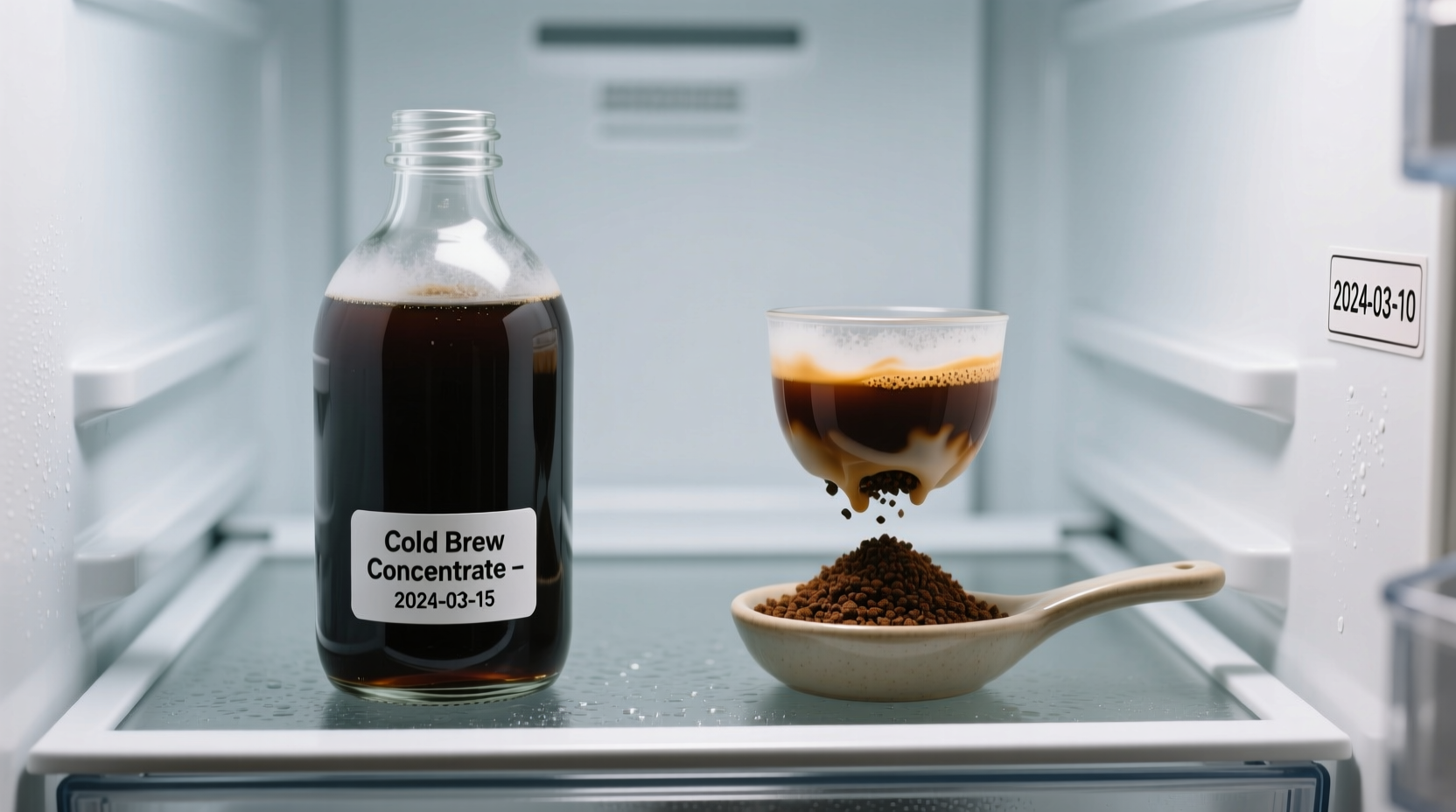
Why “Fresh Daily” Isn’t Always Fresher
Many swear by making hot coffee every morning—but that ritual rarely delivers true freshness. Pre-ground beans oxidize within 15 minutes; drip machines often under-extract or scald grounds. Meanwhile, cold brew concentrate, once properly filtered and sealed, undergoes *slower* chemical change than hot-brewed coffee left on a warmer or reheated. Its smoothness isn’t passive—it’s engineered through physics and timing. The real kitchen hack? Stop chasing daily novelty and invest in one reliable, repeatable system that compounds quality—not fatigue.
Everything You Need to Know
Can I use cold brew concentrate in cooking or baking?
Yes—its clean, low-acid profile enhances chocolate, spice rubs, and marinades without adding bitterness. Replace up to 25% of liquid in brownie batters or braising liquids.
Does cold brew concentrate lose caffeine over time in the fridge?
No. Caffeine is highly stable in solution. Concentrate retains full potency for 14 days when refrigerated and sealed.
What if I don’t like strong coffee? Can I still use concentrate?
Absolutely. Adjust dilution: try 1:2 or even 1:3 with milk or sparkling water. Its smooth base adapts without turning sour or thin.
Is there a budget-friendly bean recommendation?
Yes—medium-roast Colombian or Peruvian beans offer balanced sweetness and body at $12–$15/lb. Avoid very light or ultra-dark roasts; they exaggerate grassy or ashy notes in cold extraction.
Can I freeze cold brew concentrate?
You can—but it’s unnecessary. Refrigeration preserves quality for two weeks. Freezing may introduce condensation and subtle texture shifts upon thawing.




 浙公网安备
33010002000092号
 浙B2-20120091-4