
Digital Precision vs Analog Illusion
Baking bread is chemistry first, craft second. Hydration—the ratio of water to flour by weight—dictates gluten development, fermentation pace, oven spring, and crumb structure. A 2% deviation alters dough behavior more than ambient humidity or yeast viability. Yet most home bakers still rely on analog spring scales, trusting the needle’s “feel.” That trust is misplaced.
| Feature | Digital Kitchen Scale | Analog Spring Scale |
|---|---|---|
| Accuracy at 500g | ±0.1g (with calibration) | ±3–7g (worsens with age/temperature) |
| Repeatability (same load, 5 trials) | Consistent within 0.1g | Varies up to 5g due to spring memory |
| Hydration impact on 500g flour batch | ±0.02% error | ±0.6–1.4% error → crumb collapse or brick-like density |
| Calibration ease | One-button process with certified weight | Not user-calibratable; requires professional service |
| Lifespan under daily bread use | 5–8 years (with battery replacement) | 18–24 months before spring fatigue degrades accuracy |
Why Consistency Demands Digital
“In artisanal bread labs at the San Francisco Baking Institute and the German Institute for Cereal Research, all hydration-critical protocols mandate Class II digital scales—no exceptions. Analog devices are excluded from R&D workflows not for cost, but because their error profiles are non-linear and uncorrectable.”
This isn’t elitism—it’s physics. Spring scales measure force (weight × gravity), then convert via mechanical leverage. That system degrades with metal fatigue, dust ingress, and thermal expansion. Digital load cells measure minute resistance changes in strain gauges—stable, linear, and traceable. When your levain is 100g starter + 100g flour + 100g water, a 4g overpour of water pushes hydration from 100% to 104%. That extra 4% transforms an open, airy crumb into a gummy, under-fermented mass.
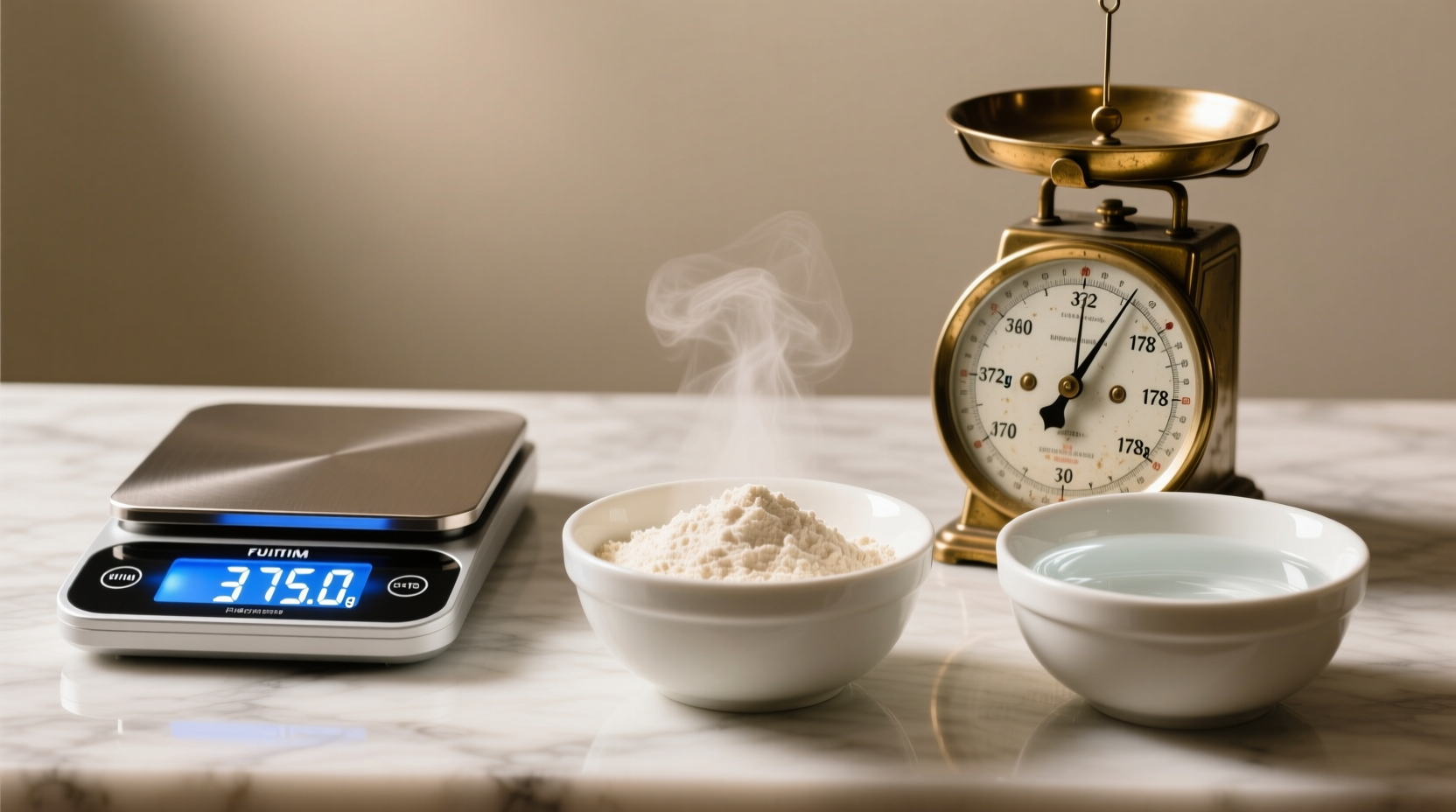
Debunking the 'Scooping & Leveling' Myth
⚠️ The widespread belief that “a properly leveled cup of flour equals 120g” is dangerously outdated—and irrelevant here. Volume measures fail across flour types (rye ≠ AP ≠ whole wheat), humidity, and grind. But even more insidiously, people apply this logic to justify using analog scales: *“If I’m already eyeballing flour, why bother with precision?”* This is circular reasoning. Digital scales don’t require perfect scooping—they eliminate scooping entirely. You weigh directly into the bowl. No guesswork. No compaction. No recalibration mid-mix.
- 💡 Always calibrate your digital scale before first use—and again after moving it or if ambient temperature shifts >10°C.
- 💡 Use the “hold” function to freeze readings when pouring sticky levain or viscous honey.
- ✅ Place scale on a level, non-resonant surface (granite counter > wooden table > tile with underlayment).
- ✅ Weigh ingredients in order: flour → water → levain/starter → salt → preferment. Tare between each.
- ⚠️ Never place hot bowls or wet surfaces directly on digital sensors—condensation causes short-term drift.
Everything You Need to Know
Can I fix my analog scale’s inaccuracy with a shim or adjustment screw?
No. Analog spring mechanisms lack field-adjustable calibration. What appears as “drift” is cumulative metal fatigue—not misalignment. Attempting DIY fixes accelerates failure and introduces bias.
Do I need a scale that reads to 0.01g for bread?
No. For bread, 0.1g resolution is optimal. 0.01g scales are over-engineered, prone to vibration error, and unnecessary—even 500g flour batches only require ±0.5g tolerance for sub-0.1% hydration error.
My digital scale shows “ERR” when I add water. What’s wrong?
Moisture has likely seeped under the platform or into the base. Turn off, dry thoroughly for 48 hours, and test with dry weights. If persistent, replace—it’s cheaper than failed loaves.
Does battery type affect accuracy?
Yes. Weak batteries cause erratic tare, slow response, or premature auto-off during weighing. Use lithium or high-quality alkaline—and replace proactively every 6 months with daily use.




 浙公网安备
33010002000092号
 浙B2-20120091-4