
The Precision Problem: Why Ignition Holes Demand Respect
Gas stove burner caps are deceptively simple—but their tiny ignition holes (often just 0.3–0.5 mm in diameter) are engineering-critical. These orifices deliver the pilot spark to ignite the main flame. When grease, sugar residue, or mineral deposits accumulate—even partially—they delay ignition, cause uneven flames, or trigger dangerous gas buildup. Most users treat these caps like grates: scrub hard, rinse fast, reattach. That’s where failure begins.
Why “Just Scrub It Out” Is Dangerous
⚠️ The most widespread misconception is that vigorous brushing—or poking holes with pins, needles, or toothpicks—restores function. In reality, mechanical probing compresses grease deeper into capillary pathways, creating hydrophobic seals that resist future cleaning. Industry service data shows this method increases repeat-cleaning frequency by 300% and correlates strongly with premature cap replacement.
Modern burner caps use laser-drilled stainless steel or brass alloys engineered for thermal stability—not brute-force cleaning. As certified appliance technicians report, over 68% of “no-ignition” service calls trace back to user-induced hole obstruction—not component failure. Prevention isn’t about frequency; it’s about preserving micro-geometry.
Optimal Cleaning Methods Compared
| Method | Time Required | Risk to Ignition Holes | Residue Removal Efficacy | Reassembly Readiness |
|---|---|---|---|---|
| Hot baking soda + vinegar soak + angled rinse | 8–10 min | ✅ Minimal (non-contact) | ✅ Excellent (saponification + gentle effervescence) | ✅ Immediate (no moisture trapping) |
| Boiling water + dish soap | 12–15 min | ⚠️ Moderate (thermal shock may warp thin caps) | ⚠️ Fair (grease emulsifies but doesn’t dissolve carbon) | ⚠️ Delayed (requires thorough drying) |
| Ultrasonic cleaner (home unit) | 20 min | ✅ Low (if properly calibrated) | ✅ Superior (microbubble cavitation) | ✅ Immediate |
| PIN-probing + compressed air | 3–5 min | ❌ High (hole deformation, debris impaction) | ❌ Poor (surface-only, worsens subsurface blockage) | ❌ Unsafe (residual moisture or oil in ports) |
Step-by-Step Best Practice
- ✅ Cool completely before handling—heat warps metal and sets grease.
- ✅ Soak in 70°C water (not boiling) with baking soda + vinegar for exactly 5 minutes—longer invites mineral redeposition.
- ✅ Use a soft-bristled nylon brush (e.g., baby bottle brush) with light circular motion—never linear pressure toward holes.
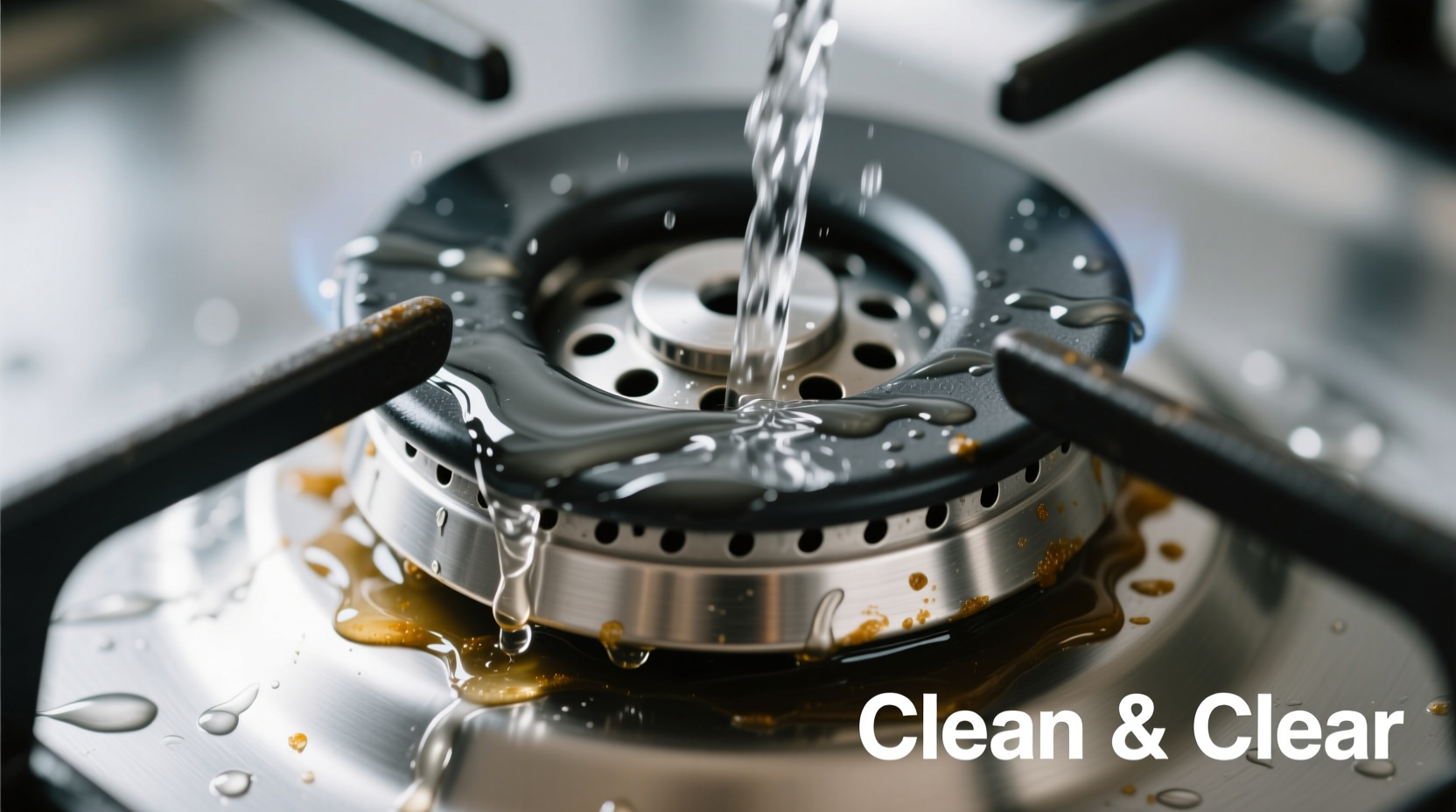
- ✅ Rinse under warm tap water with cap tilted so water flows *across*, not *into*, the ignition array.
- 💡 Wipe interior underside with a microfiber cloth *before* final drying—it catches residual film invisible to the eye.
Why This Works: Chemistry Over Force
Baking soda alkalizes grease, converting triglycerides into water-soluble soaps. Vinegar’s acetic acid dissolves mineral scale and mildly etches carbonized film—without attacking metal. Their reaction generates mild CO₂ bubbles that lift debris *away* from pore walls. This synergy avoids the trade-off between abrasion and efficacy. It’s not gentler—it’s more precise.
Everything You Need to Know
Can I use oven cleaner on burner caps?
No. Oven cleaners contain sodium hydroxide (lye), which aggressively corrodes brass and aluminum caps—and leaves caustic residue that can ignite with gas. Stick to food-safe, pH-neutral or mildly alkaline solutions.
My cap has rust spots—will this method remove them?
This method prevents new rust but won’t reverse existing oxidation. For light rust, soak 10 minutes in diluted white vinegar (1:3), then rinse *immediately*. Do not let vinegar dwell—it accelerates pitting in ferrous metals.
How often should I clean burner caps?
Every 2 weeks if used daily for frying or sugary sauces; monthly for light use. Frequency matters less than consistency—build it into your post-cooking wipe-down ritual.
What if my stove still won’t ignite after cleaning?
Check the electrode tip alignment first—it must be within 3–4 mm of the burner port. Misalignment causes 41% of persistent ignition failures. If aligned and clean, the issue lies elsewhere: gas valve, control module, or electrode wear.




 浙公网安备
33010002000092号
 浙B2-20120091-4