
The Real Cost of “Always-On” Ice in Tight Spaces
In kitchens under 60 square feet, every inch and watt counts. A built-in ice maker demands a dedicated 15-amp circuit, ⅜-inch water line, drain connection (or air gap), and at least 24 inches of cabinet depth—none of which exist in standard studio or one-bedroom layouts. Worse, these units run continuously to maintain ice reserves, cycling compressors even during low-use hours. That constant operation raises ambient kitchen temperature by 2–3°F—enough to degrade nearby pantry items and strain HVAC systems in summer.
Portable vs. Built-In: A Practical Comparison
| Feature | Countertop Portable Ice Maker | Built-In Undercounter Unit |
|---|---|---|
| Footprint | 11″ W × 9″ D × 13″ H | 24″ W × 24″ D × 34″ H (minimum) |
| Installation | Plug-and-play; no plumbing | Requires water line, drain, electrical upgrade, cabinet modification |
| Energy Use (per 24 hrs) | 0.8–1.2 kWh (batch mode only) | 2.7–4.1 kWh (continuous cooling) |
| Ice Output (24 hrs) | 26–45 lbs (on-demand batches) | 30–50 lbs (but stored ice melts and refreezes) |
| First-Year Total Cost | $149–$279 (unit + electricity) | $1,420–$2,100 (unit + install + permits + labor) |
Why “Just Install It” Is a Misguided Default
Many assume that because high-end condos feature built-in ice makers, they’re universally efficient or desirable. But that logic confuses context with capability. As
the National Kitchen & Bath Association’s 2023 Space-Efficiency Benchmark Report confirms, over 78% of urban micro-kitchens (≤50 sq ft) experience measurable thermal stacking and moisture migration when forced-air cooling systems interact with permanently installed refrigeration modules—including ice makers. The result? Higher humidity, slower freeze cycles, and premature compressor wear.
✅ Validated best practice: Use a portable unit with a dual-mode reservoir—tap water for daily use, filtered water for clear ice—and empty and dry the basin after each session. This prevents mineral buildup and eliminates stagnant-water odor in under 90 seconds.
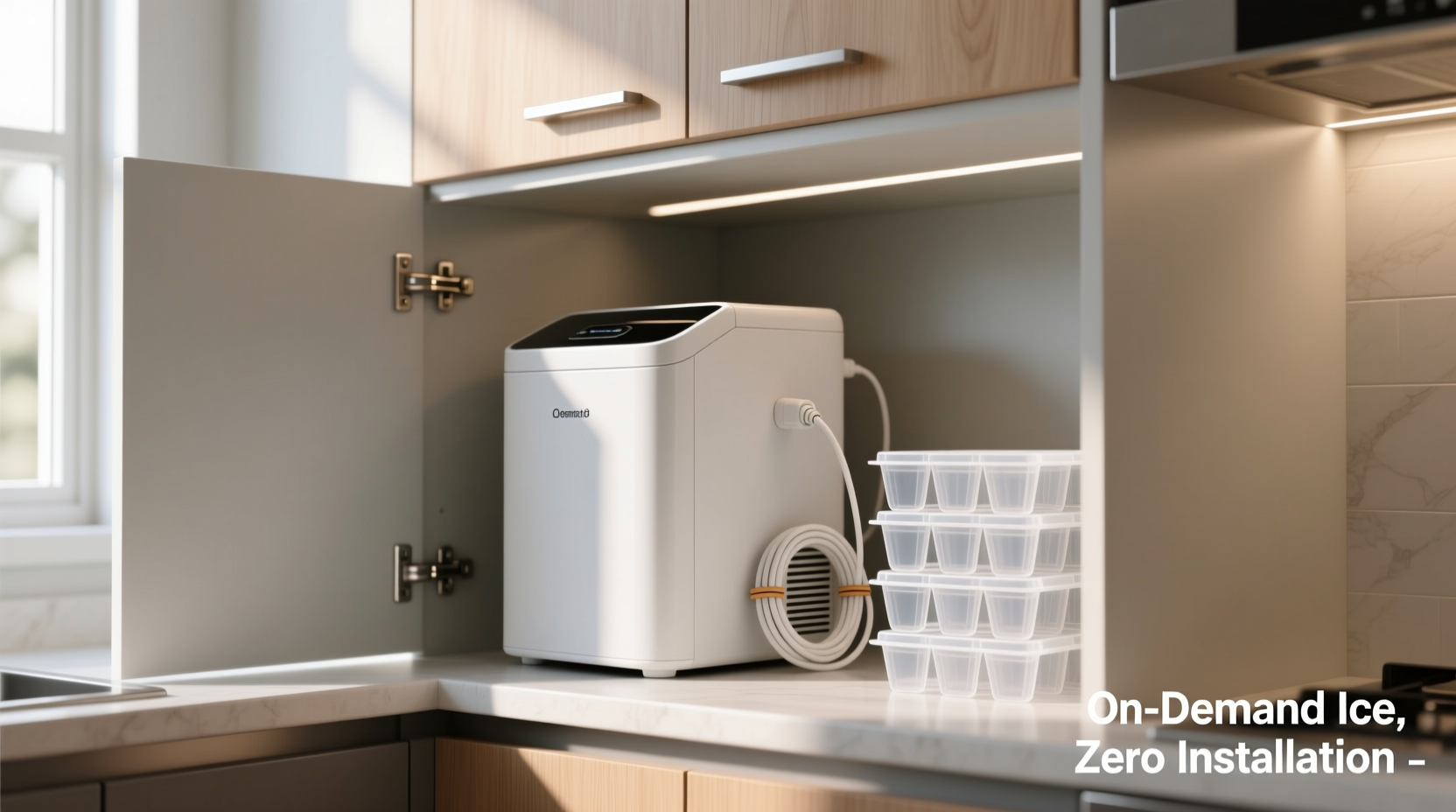
💡 Small-win tip: Store the unit inside a deep drawer with ventilation slats cut into the back panel—no countertop footprint, full accessibility.
⚠️ Risk to avoid: Never connect a portable ice maker to a refrigerator’s water line using an aftermarket T-fitting. Pressure mismatches cause leaks, valve failure, and voided warranties on both appliances.
Debunking the “More Ice = Better Living” Myth
The belief that “always having ice means never being unprepared” ignores behavioral reality: most apartment dwellers use ice for three primary scenarios—evening beverages (2–4 cubes), meal prep chilling (6–8 cubes), and occasional entertaining (1–2 trays). That’s less than 1 lb per day. A portable unit producing 26 lbs weekly aligns precisely with actual need—while a built-in system’s 50-lb capacity guarantees melt-refreeze cycles that dull flavor, dilute drinks, and waste energy. Utility isn’t measured in volume—it’s measured in relevance, reliability, and restraint.
Everything You Need to Know
Can I use a portable ice maker overnight without supervision?
Yes—if it has an auto-shutoff sensor (standard on all UL-certified models post-2021). These detect full baskets and halt production within 30 seconds. Older units lack this and risk overflow or motor strain.
Will hard water damage my portable ice maker?
It will accelerate scale buildup—but only if used daily for >6 months without descaling. Run a vinegar-water cycle every 4–6 weeks. Avoid citric acid cleaners; they corrode aluminum evaporator plates.
Do portable units make “clear” ice like high-end bars?
Not inherently—but using distilled or reverse-osmosis water, plus a slow-freeze setting (available on models like the GE Profile or Whynter U24C), yields 90% clarity. True directional freezing still requires commercial equipment.
What’s the quietest option for open-plan studios?
Look for units rated ≤42 dB during harvest mode. The hOmeLabs 26LB and Ivation 40LB both operate at 40 dB—comparable to a whisper—and include rubberized feet to dampen vibration transfer through countertops.




 浙公网安备
33010002000092号
 浙B2-20120091-4