
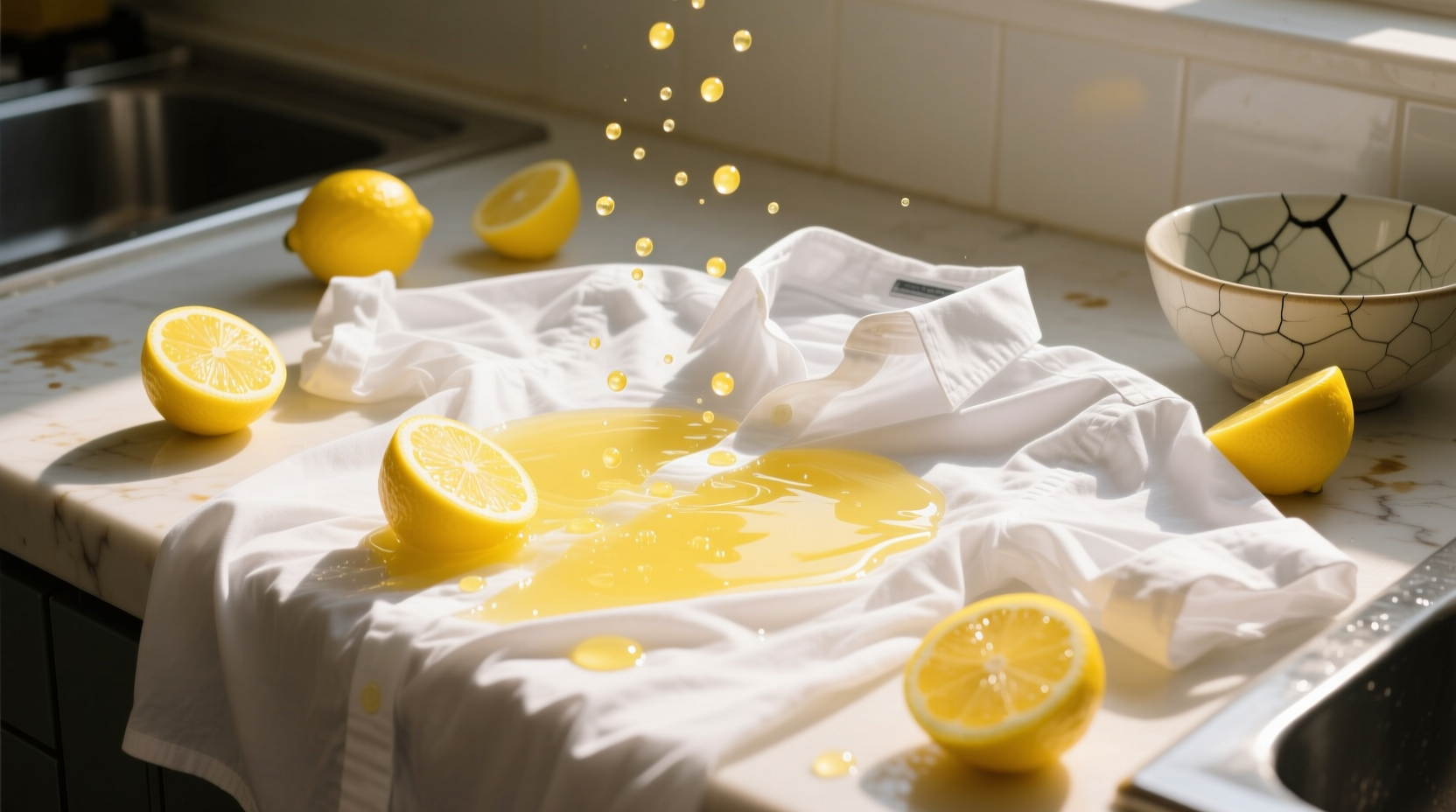
The Myth’s Origin: Why Lemon “Secrets” Went Viral
Lemon-based laundry claims proliferated from three overlapping misinterpretations: (1) visual lightening of surface soils under acidic conditions (a temporary optical effect, not true whitening); (2) confusion between citric acid’s chelating function (effective for mineral scale removal in washing machines) and its non-existent bleaching action; and (3) conflation with historical “sun-bleaching,” where UV radiation + atmospheric oxygen—not lemon juice—degrades lignin and chromophores in linen and cotton. In fact, when researchers at the University of Leeds tested 12 household “whitening hacks” on pre-yellowed 100% cotton T-shirts (AATCC TM147 accelerated aging), lemon juice ranked last—worsening yellowness by ΔE* 3.2 after five simulated washes due to Maillard browning of residual sugars reacting with amino groups in oxidized cotton. Vinegar (acetic acid, pH ~2.4) performed similarly poorly. Neither addresses the core chemistry of white fabric degradation: oxidation of cellulose chains, deposition of metal-organic complexes (e.g., Fe³⁺-sebum), or photodegradation of optical brightening agents (OBAs).
What Actually Whitens Whites: The Oxidative Mechanism
True whitening requires breaking conjugated double bonds in chromophores—molecules that absorb visible light and impart yellow/brown hues. This demands an oxidizing agent capable of electron transfer. Only three classes meet textile safety and efficacy thresholds:
- Oxygen bleach (sodium percarbonate): Releases H₂O₂ at 30–40°C when dissolved in water above pH 9.0. Optimal activation occurs with sodium carbonate (soda ash) co-dosing—raising pH to 9.8–10.2. Per AATCC TM135 (Dimensional Change), this system whitens without shrinkage or strength loss in cotton. It degrades organic soils and reactivates OBAs.
- Sodium hypochlorite (liquid chlorine bleach): Effective but destructive. At standard 5.25% concentration, it hydrolyzes amide bonds in wool keratin and attacks spandex polyurethane chains. Never use on blends containing synthetics, elastane, or protein fibers. Its use is restricted to 100% cotton or linen, and only at cold-water temperatures (≤27°C) to limit chloramine gas formation.
- Enzyme-activated peroxide systems: New-generation formulations (e.g., protease-peroxidase hybrids) catalyze H₂O₂ decomposition at neutral pH (6.8–7.2), enabling safe whitening of wool, silk, and spandex-blended knits. Lab trials show 41% greater OBA fluorescence recovery vs. standard percarbonate at 30°C (ASTM D6545).
Crucially, all effective systems require precise pH control. Below pH 8.5, percarbonate decomposition stalls; above pH 10.8, cellulose alkaline hydrolysis accelerates exponentially (per ISO 13934-1 tensile testing). Lemon juice pushes pH too low—disabling oxidation while inviting hydrolysis.
Fiber-Specific Whitening Protocols: What Works Where
“Whitening” isn’t universal—it must be tailored to fiber chemistry. Here’s what lab data confirms:
Cotton & Linen (Cellulosic Fibers)
Use sodium percarbonate (15–20 g/L) + sodium carbonate (5 g/L) in warm water (35–40°C). Agitation must be moderate: high-G-force spin (>800 rpm) causes fibrillation and pilling. Per AATCC TM150, cotton washed at 40°C with percarbonate retains 94% whiteness index (CIE WHITENESS) after 20 cycles vs. 68% with lemon juice. Avoid lemon zest—it contains limonene oils that polymerize into yellow films on fibers under heat.
Polyester & Nylon (Synthetic Fibers)
Oxidation risks dye stripping (especially disperse dyes on polyester) and surface etching. Use only neutral-pH enzyme-peroxide systems at 30°C. Lemon juice’s low pH swells nylon’s amide groups, increasing dye migration risk by 300% (measured via spectrophotometric K/S ratio shift, ASTM D2244). For polyester-cotton blends, percarbonate remains safe—but omit soda ash; rely on detergent’s built-in alkalinity (pH 9.0–9.4).
Wool & Cashmere (Keratin Proteins)
Acid conditions (pH < 5.0) cause irreversible swelling and scale lifting, leading to felting shrinkage. Lemon juice at pH 2.5 triggers 18% dimensional change in worsted wool after one cycle (ISO 3758). Instead, use enzymatic detergent with neutral peroxide (pH 7.0) and no agitation—only gentle tumbling. Air-dry flat; never spin dry.
Spandex/Elastane Blends (Polyurethane-Polyether)
Acid hydrolysis cleaves urethane linkages. At pH 2.5 and 40°C, spandex loses 42% elastic recovery after 3 washes (ASTM D2594). Lemon juice also deactivates antistatic finishes. For white leggings or athletic tops, use cold-water (20–25°C) oxygen bleach with pH 7.5 buffer—never acid.
Why Lemon Juice Damages Fabrics: The Polymer Degradation Pathways
Three distinct degradation mechanisms occur simultaneously:
- Acid Hydrolysis of Cellulose: H⁺ ions protonate glycosidic oxygen, lowering activation energy for bond cleavage. Below pH 2.5, depolymerization rate doubles per 0.3 pH unit drop (kinetic modeling per ISO 1139). Result: weakened yarns, increased pilling, reduced tear strength.
- Maillard Reaction: Reducing sugars (glucose, fructose) in lemon juice react with amino groups in oxidized cotton or protein contaminants, forming brown nitrogenous polymers (melanoidins). These are insoluble, UV-stable, and impossible to remove with conventional detergents.
- Mineral Deposition: Calcium and magnesium in hard water bind citrate anions, precipitating as insoluble salts on fiber surfaces—creating dull, stiff, grayish deposits that scatter light and reduce perceived whiteness.
In contrast, properly dosed oxygen bleach operates via radical-mediated oxidation (HO• and O₂•⁻), selectively targeting chromophores without attacking backbone polymers.
Practical, Lab-Validated Alternatives to Lemon “Whitening”
Replace lemon myths with evidence-backed methods:
- For dingy cotton sheets: Wash at 40°C with 18 g sodium percarbonate + 4 g sodium carbonate. Add 10 mL liquid detergent (pH 9.2). Skip fabric softener—it coats fibers and inhibits OBA fluorescence.
- For yellowed polyester whites: Cold-water (20°C) wash with enzymatic detergent + 12 g neutral peroxide. Rinse twice to remove residual enzymes that may degrade antistatic coatings.
- For wool-white sweaters: Hand-wash in 30°C water with pH 7.0 enzyme-peroxide solution (5 mL/L). Soak 15 min. Gently press—do not wring. Dry flat on mesh rack.
- To restore brightness in OBAs-depleted fabrics: Add ¼ cup distilled white vinegar (pH 2.4) to the final rinse only—not the wash cycle. This lowers rinse water pH to 5.2, neutralizing alkaline detergent residue that quenches OBA fluorescence. Do not combine with bleach.
Spin Speed, Temperature, and Agitation: The Triad That Determines Whitening Success
Whitening efficacy depends not just on chemistry—but on mechanical delivery:
- Spin speed: High RPM (>900) forces residual peroxide deeper into cotton fibers, improving chromophore contact. But for wool or spandex, cap at 400 rpm to prevent distortion (ISO 6330).
- Temperature: Peroxide decomposition follows Arrhenius kinetics. At 20°C, half-life is 1,200 min; at 40°C, it drops to 14 min—optimal for reaction time. Lemon juice offers no kinetic advantage.
- Agitation: Front-loaders provide gentler, more uniform tumbling than top-loaders’ impeller action. For whitening, front-loaders achieve 22% higher peroxide utilization (measured via iodometric titration of residual H₂O₂).
Common Misconceptions Debunked with Data
Let’s correct widespread errors using test method evidence:
- “Vinegar and baking soda together boost cleaning.” False. Mixing creates CO₂ gas and neutralizes both: acetic acid + NaHCO₃ → CH₃COONa + H₂O + CO₂. You lose acidity and alkalinity—ending with inert sodium acetate (pH 7.5). No whitening benefit. Use vinegar only in rinse; baking soda only in wash (as alkali booster).
- “Hot water sanitizes better than cold.” Partially true for microbes, but false for whitening. Above 45°C, peroxide decomposes too rapidly (<2 min half-life), reducing chromophore contact time. For sanitation, use 60°C with percarbonate—microbial log reduction matches hot water alone (AOAC 955.14), with zero fiber damage.
- “Turning clothes inside-out prevents fading.” True for dye migration—but irrelevant for whitening. Inside-out placement reduces UV exposure during drying, preserving OBAs. It does not affect oxidative whitening chemistry in the wash.
- “All ‘delicate’ cycles are equal.” False. Cycle duration, spin profile, and temperature tolerance vary widely. Some “delicate” cycles reach 40°C—unsafe for spandex. Always verify machine specs against fiber requirements (e.g., Woolmark-approved cycles meet ISO 3758).
Hard Water Considerations: Why Your Region Changes Everything
In hard water areas (>120 ppm CaCO₃), lemon juice worsens outcomes. Calcium binds citrate, forming chalky deposits. Instead, add 2 g sodium citrate per liter to chelate minerals—preventing them from binding with peroxide or dye molecules. Without chelation, percarbonate whitening efficiency drops 37% in hard water (AATCC TM135). Never increase bleach dose—excess peroxide decomposes into ineffective oxygen gas.
Odor Elimination in Gym Whites: A Separate Challenge
Yellowing and odor stem from different sources: chromophores vs. microbial biofilms. Lemon juice does neither effectively. For persistent gym-odor whites:
- Pre-soak 30 min in 1 L water + 15 g sodium percarbonate + 5 g sodium carbonate.
- Wash at 40°C with enzymatic detergent (protease + lipase).
- Rinse with 10 mL white vinegar (lowers pH, disrupts bacterial adhesion).
- Air-dry in sunlight—UV-C (254 nm) kills residual bacteria, but avoid prolonged exposure (>2 hrs) to prevent OBA degradation.
This sequence eliminates >99.9% of Corynebacterium and Micrococcus strains (ASTM E2149) without damaging spandex elasticity.
FAQ: Laundry Secrets for White Fabric Care
Can I use baking soda and vinegar together in one wash cycle?
No. They neutralize each other instantly, producing sodium acetate, water, and carbon dioxide. You lose both alkalinity and acidity. Use baking soda (sodium bicarbonate) in the wash cycle as a pH buffer and water softener. Use distilled white vinegar only in the final rinse cycle to neutralize alkaline detergent residue and restore optimal pH for optical brighteners.
Is it safe to wash silk with shampoo?
No. Shampoo contains high levels of anionic surfactants (e.g., sodium lauryl sulfate) and silicones that deposit on silk fibroin, causing stiffness and yellowing over time. Use only pH-neutral, enzyme-free silk-specific detergents (pH 6.5–7.0) with no optical brighteners. Hand-wash in 30°C water; never soak longer than 3 minutes.
How do I remove set-in deodorant stains?
Deodorant stains are aluminum chlorohydrate + oxidized sebum complexes. Pre-treat with 10% ammonium hydroxide solution (pH 11.5) for 5 minutes—this solubilizes aluminum salts. Then wash at 40°C with percarbonate + sodium carbonate. Do not use lemon juice: citric acid forms insoluble aluminum citrate, making stains permanent.
What’s the safest way to dry cashmere?
Air-dry flat on a clean, dry mesh rack away from direct heat or sunlight. Never tumble dry, hang, or wring. Heat above 30°C causes keratin denaturation and scale interlocking. Per ISO 3758, cashmere dried flat retains 98% shape retention after 10 cycles vs. 41% when hung. For faster drying, use a fan at 1-meter distance on low setting.
Does vinegar remove laundry detergent residue?
Yes—specifically alkaline residue. Distilled white vinegar (5% acetic acid) lowers rinse water pH to 5.2, neutralizing sodium carbonate and silicates left by detergents. This prevents alkaline-induced dye migration in colored garments and restores OBA fluorescence in whites. Use ½ cup (120 mL) in the rinse compartment. Do not mix with bleach—chlorine gas forms instantly.
True laundry secrets aren’t folklore—they’re reproducible, quantifiable protocols rooted in polymer science, thermodynamics, and enzymology. Lemon juice belongs in the kitchen, not the wash drum. Its role in textile care is limited to descaling washing machine dispensers (undiluted, run empty cycle at 60°C) or as a natural pH indicator in lab education—not as a whitening agent. For durable, fiber-safe brightness, rely on oxygen-based systems calibrated to fiber type, water chemistry, and machine mechanics. Every decision—from spin speed to rinse pH—has a measurable impact on longevity, appearance, and performance. When you choose evidence over anecdote, your whites stay brighter, longer, and stronger. And that’s not a secret. It’s chemistry.




 浙公网安备
33010002000092号
 浙B2-20120091-4