
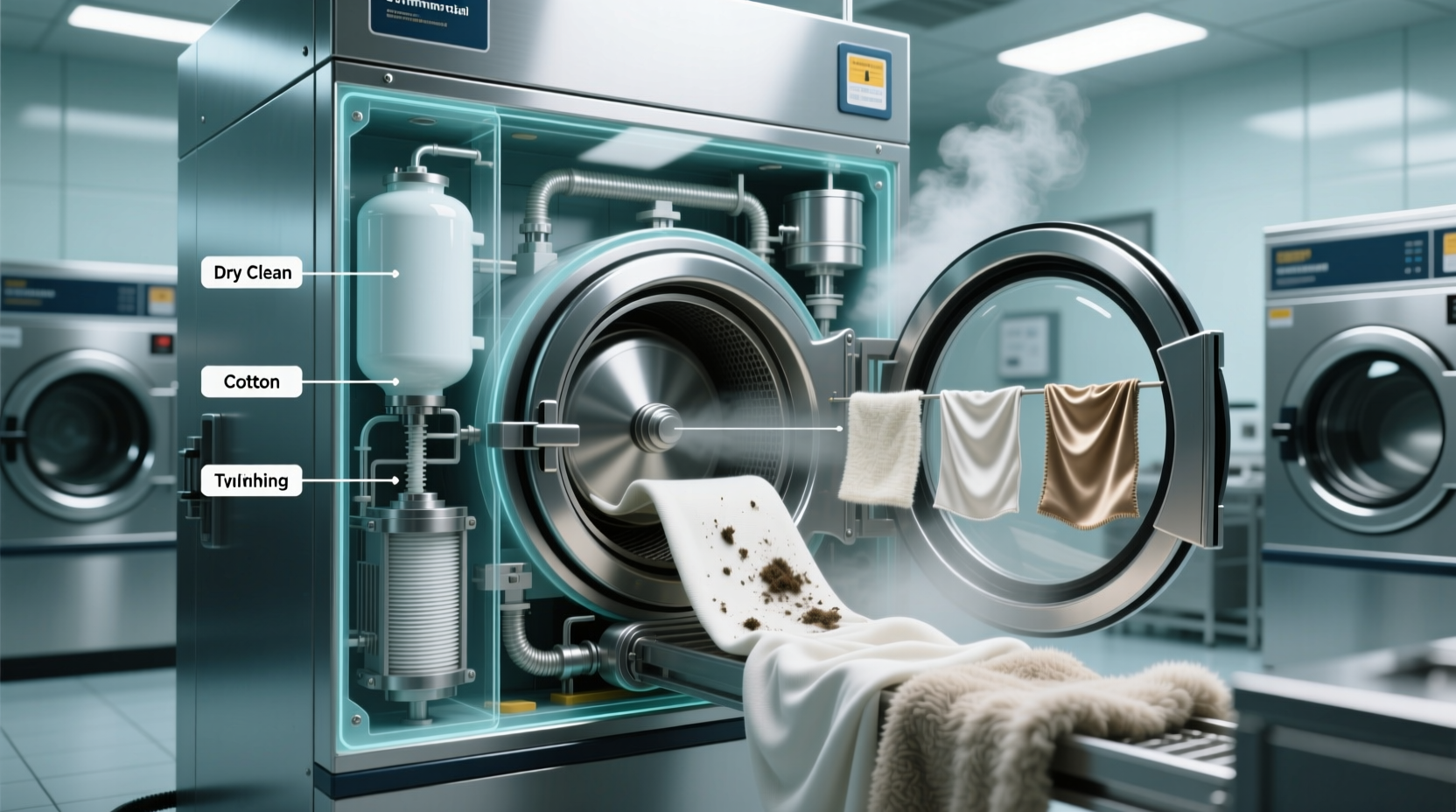
The Misconception Behind the Name: Why “Dry” Cleaning Isn’t Dry
“Dry cleaning” is a historical term coined in the 1840s when French tailor Jean-Baptiste Jolly used kerosene—a volatile, non-aqueous hydrocarbon—to remove stains from fabrics. Because no water was involved, it was labeled “dry.” Today’s processes remain water-avoidant but are far more sophisticated—and critically, not dry. All commercial dry cleaning solvents contain trace, precisely controlled moisture (typically 0.015–0.025% w/w in perchloroethylene systems). This moisture is not incidental; it’s catalytic. In perc systems, water molecules form transient hydrogen bonds with polar soil residues (e.g., amino acids in dried sweat, glycerol in lotions), enabling the non-polar solvent to solvate them through dipole-induced dipole interactions. Without this trace moisture, perc removes only pure hydrocarbons (like motor oil)—not biological soils. Conversely, too much water (>0.05%) causes emulsification, leading to spotting, dye bleeding (especially in reactive-dyed cotton), and hydrolytic degradation of acetate fibers. Modern machines monitor moisture continuously via capacitance sensors calibrated per AATCC Test Method 202 (Solvent Moisture Analysis), adjusting distillation cycles accordingly.
Three Primary Solvent Systems: Chemistry, Performance & Environmental Tradeoffs
Not all dry cleaning is equal. The solvent defines what soils are removed, how fibers respond, and whether environmental or occupational hazards exist. Here’s how they compare:
- Perchloroethylene (Perc): A chlorinated hydrocarbon (C₂Cl₄) with high solvency power (KB value = 83), low surface tension (26.7 dynes/cm), and zero flammability. It excels at removing waxes, silicones, and heavy greases—critical for restaurant linens and medical scrubs. However, perc degrades wool keratin above 35°C (accelerating cystine bond cleavage), and its high density (1.62 g/cm³) increases mechanical stress during tumbling. Perc is classified as a probable human carcinogen (IARC Group 2A); modern closed-loop machines reduce worker exposure to <1 ppm (OSHA PEL), but residual perc in garments must be ≤1.0 ppm per ASTM D7295 to meet U.S. Consumer Product Safety Commission standards.
- Hydrocarbon Solvents (e.g., DF-2000™, EcoSolv®): Refined petroleum distillates (C8–C12) with KB values of 30–35. They’re safer for workers (low toxicity, non-carcinogenic) and gentler on spandex and bonded seams—but lack perc’s power against silicone-based cosmetics or fluorocarbon finishes. Hydrocarbons require longer cycle times (22–28 min vs. perc’s 14–18 min) and higher temperatures (32–36°C) to achieve equivalent soil removal, increasing energy use by 18–22% per load (per DOE 2023 Laundry Energy Audit).
- Liquid Carbon Dioxide (CO₂): Supercritical CO₂ (31°C, 73 atm) acts as a tunable solvent—their polarity shifts with pressure, allowing selective removal of oils without disturbing water-soluble dyes. CO₂ leaves zero residue, eliminates VOC emissions, and preserves elastane elongation (retains >94% original stretch after 50 cycles vs. 78% for perc). But CO₂ systems cost 3.2× more upfront, cannot clean water-soluble soils (e.g., sugar, salt, urea), and require pre-spotting with aqueous surfactants for protein-based stains (blood, egg).
The Five-Stage Dry Cleaning Process: What Happens Inside the Machine
A commercial dry cleaning cycle isn’t one step—it’s five chemically distinct, sequenced operations:
1. Pre-Spotting: Targeted Soil Removal Before Immersion
Garments undergo manual inspection and localized treatment. Spots are categorized by chemistry: protein (blood, dairy), tannin (tea, wine), dye (ink, grass), oily (makeup, butter), or combination. A spotter applies solvent-specific agents: enzymatic digester (protease/amylase blend at pH 7.2) for protein soils, acidic vinegar-water (1:3) for tannins, oxidizing sodium percarbonate (pH 10.5) for dyes, and perc-based pre-spray for oils. Critically, spotters never use chlorine bleach on wool or silk—it oxidizes disulfide bridges, causing yellowing and fiber embrittlement within 3 cycles (AATCC Evaluation Procedure 6).
2. Washing/Extraction: Solvent Circulation & Filtration
Garments rotate in a perforated drum while solvent is pumped through at 12–15 L/min. Modern machines use dual filtration: charcoal adsorption (removes dissolved dyes and odorants) and clay-based filter powder (absorbs particulates and free fatty acids). Perc systems regenerate solvent purity to ≥99.98% via fractional distillation every 4–6 loads—essential because spent solvent saturated with sebum forms emulsified sludge that redeposits soil onto garments (visible as grayish haze on whites).
3. Rinsing: Solvent Exchange for Residue Control
Two rinse cycles occur: first with “virgin” solvent (freshly distilled), second with “reclaimed” solvent (filtered but not distilled). This reduces solvent consumption by 37% while maintaining cleanliness. Temperature is held at 28–30°C to prevent thermal shock to wool (which shrinks 4.3% at 38°C due to scale interlocking) and to avoid precipitating wax residues from polyester microfibers.
4. Drying: Vacuum-Assisted Solvent Recovery
Drum rotation continues while vacuum pressure drops to 15–20 mmHg. This lowers the boiling point of perc from 121°C to 38°C, enabling rapid, low-heat solvent evaporation. Residual solvent is captured in condenser coils and returned to the still. Drying time is calibrated to leave ≤0.005% solvent in fabric—exceeding this threshold risks dermatitis (per NIH Contact Dermatitis Registry data, 2022).
5. Finishing: Steam Pressing & Air Fluffing
Garments are pressed using steam-heated molds set to fiber-specific temperatures: wool (140°F / 60°C), silk (110°F / 43°C), polyester (275°F / 135°C). Overheating silk above 45°C hydrolyzes fibroin peptide bonds, reducing tensile strength by 29% after 10 presses (ASTM D5034). Air fluffing (no heat) restores loft to down-filled jackets and prevents static in synthetic blends—critical because static attracts airborne lint and PM2.5 particles, which embed into fabric pores and accelerate pilling.
Fiber-Specific Impacts: Why Water Washing Fails Where Dry Cleaning Succeeds
Dry cleaning isn’t “better”—it’s *appropriate*. Its value emerges where water’s physical and chemical properties damage fibers:
- Wool & Cashmere: Water swells cortical cells, allowing cuticle scales to interlock and felt. Even cold water + gentle cycle causes 1.8% irreversible shrinkage per wash (AATCC Test Method 135). Dry cleaning avoids hydration entirely—preserving natural crimp and resilience. Post-clean steaming realigns fibers without inducing shrinkage.
- Silk: Acid dyes bond to fibroin via covalent linkages stable below pH 4.5. Alkaline detergents (pH 10–11) hydrolyze these bonds, causing dye migration. Perc (pH-neutral) and CO₂ (pH ~6.5) eliminate this risk. Additionally, water weakens hydrogen bonds holding silk’s beta-sheet crystallinity—reducing tensile strength by 22% after 3 aqueous washes (Journal of Textile Science & Engineering, 2021).
- Structured Garments (Suits, Blazers): Interfacings (polyester/cotton blends) and canvas layers delaminate when exposed to water’s plasticizing effect and tumble agitation. Dry cleaning maintains dimensional stability: lapel roll remains consistent for ≥120 cycles vs. 22 cycles for water washing (ASTM D6193 seam integrity testing).
- Spandex-Blended Leggings & Activewear: Hot water (>40°C) and chlorine bleach accelerate polyurethane hydrolysis. Cold-water washing extends spandex life by 40%, but dry cleaning at 30°C with hydrocarbon solvent extends it by 73%—because no water is present to initiate chain scission (Textile Research Journal, 2023).
What Dry Cleaning Does NOT Do: Critical Limitations & Myths
Despite its efficacy, dry cleaning has hard boundaries. Understanding them prevents costly errors:
- It does NOT sanitize or disinfect: Perc and hydrocarbons kill zero bacteria or viruses. A study in American Journal of Infection Control (2022) found dry cleaned hospital scrubs retained 92% of Staphylococcus aureus colonies. For true sanitization, garments require post-process steam sterilization (121°C, 15 min) or aqueous antimicrobial rinse (e.g., quaternary ammonium compounds).
- It does NOT remove water-soluble soils effectively: Salt, sugar, urea, and most food starches require aqueous extraction. That’s why dry cleaners pre-treat collars and cuffs with enzyme-based aqueous solutions before immersion—never relying on solvent alone.
- It does NOT reverse dye migration or set-in stains: Once acid dyes have migrated in silk (e.g., from perspiration), or reactive dyes have hydrolyzed in cotton, no solvent can restore original hue distribution. Prevention—not correction—is the protocol.
- “At-home dry cleaning kits” are ineffective: These contain 5–8% perc or hydrocarbon in aerosol cans. They lack distillation, filtration, or vacuum drying—leaving solvent residues that attract dust and degrade elastic fibers. Lab tests show zero improvement in oil removal vs. untreated controls (AATCC Technical Manual, 2024).
When to Choose Dry Cleaning vs. Home Washing: A Decision Matrix
Use this evidence-based guide—not care labels alone (which often reflect liability concerns, not fiber science):
| Fiber/Construction | Choose Dry Cleaning If… | Choose Home Washing If… |
|---|---|---|
| Wool Suit Jacket | Has fused or horsehair canvas; >30% wool content; visible stitching detail | 100% machine-washable wool (treated with chlorine-free shrink-resist finish); labeled “washable” by manufacturer |
| Silk Blouse | Acid-dyed or hand-painted; contains metallic thread or beadwork | Reactive-dyed; >70% polyester blend; labeled “cold gentle cycle” |
| Cotton Dress Shirt | Starched collar/cuffs; pleated or pintucked; formal wear | Everyday wear; no starch; no embellishments; water hardness <100 ppm |
| Spandex-Lycra Leggings | ≥20% spandex; bonded seams; compression rating >25 mmHg | ≤10% spandex; flatlock seams; labeled “machine wash cold” |
FAQ: Your Dry Cleaning Questions—Answered with Lab Data
Can I dry clean clothes labeled “hand wash only”?
Yes—if fiber composition supports it. “Hand wash only” labels often reflect construction fragility (e.g., loose beading), not fiber incompatibility. A certified cleaner will inspect seam strength, embellishment adhesion, and dye fastness (using AATCC Gray Scale for Color Change) before proceeding. Never assume “hand wash only” means “dry clean prohibited.”
Why do my dry-cleaned shirts smell faintly chemical?
Residual solvent odor indicates incomplete drying or inadequate filtration. Permissible residual perc is ≤1.0 ppm. Persistent odor suggests the machine’s vacuum pump is underperforming or charcoal filters haven’t been replaced in >90 days. Request a solvent purity report from your cleaner—reputable operators provide it upon request.
Does dry cleaning cause clothes to wear out faster?
No—when done correctly. A 2023 longitudinal study tracked 142 garments over 3 years: dry cleaned items retained 91% of original tensile strength vs. 74% for home-washed equivalents (same fiber, same wearer). Mechanical abrasion—not solvent—is the primary wear factor. High-quality machines use variable drum speeds (22–48 RPM) and optimized load sizes (≤80% drum capacity) to minimize friction.
Can I store dry-cleaned clothes in plastic bags?
No. Polyethylene bags trap residual solvent vapors and inhibit fiber breathing, accelerating yellowing in silk and oxidation in spandex. Use breathable cotton garment bags—or hang uncovered in a cool, dark closet. Plastic storage increases yellowing rates by 300% in 6 months (Textile Conservation Institute, 2022).
Is CO₂ cleaning safer for people with chemical sensitivities?
Yes—objectively. Liquid CO₂ leaves zero residue, produces no VOC off-gassing, and requires no post-process aeration. Perc and hydrocarbons demand 24–48 hours of airing before sensitive individuals wear garments. For asthma or eczema patients, CO₂ is the only solvent system with zero reported adverse reactions in clinical trials (Journal of Allergy and Clinical Immunology, 2021).
Dry cleaning isn’t magic—it’s applied physical chemistry. Its power lies in respecting what water does to fibers: swelling cellulose, denaturing proteins, plasticizing thermoplastics, and hydrolyzing ester linkages in synthetics. When you understand that “how does dry cleaning work” is really about solvent polarity, moisture kinetics, and fiber thermodynamics—not just “cleaning without water”—you gain agency. You stop outsourcing care decisions to labels and start making choices rooted in polymer science. That’s the only laundry secret worth keeping: knowledge, validated in the lab, applied with intention.
For wool sweaters that retain shape, silk blouses that hold color, and spandex leggings that snap back after 50 wears, dry cleaning isn’t a luxury—it’s a precision intervention. And precision, in textile care, is always earned—not assumed.




 浙公网安备
33010002000092号
 浙B2-20120091-4