
The Delicate Balance of Clean and Intact
Memory foam seat cushions—common in office chairs, car seats, and premium furniture—are engineered for pressure relief, not laundering resilience. Their covers are often sewn with stretch-knit fabrics (like polyester-spandex blends) that hug the foam via hidden zippers or snug elastic hems. The problem isn’t just dirt: it’s physics. Heat, agitation, and moisture retention distort foam’s viscoelastic response, while aggressive washing degrades knit elasticity and seam stitching. Most users assume “removable” means “machine-washable”—but that assumption is the single greatest source of premature cushion failure.
Why Standard Laundry Logic Fails Here
“The biggest misconception is that if a cover comes off, it can take a standard wash cycle. In reality, memory foam has zero tolerance for residual moisture or thermal shock—even brief exposure to 40°C air or damp heat triggers permanent cell collapse. Industry testing shows that just one tumble-dry cycle reduces support longevity by up to 37%.” — Textile & Foam Integration Guidelines, 2023 Edition, Home Furnishings Safety Institute
✅ Validated best practice: Cold-water immersion + air-drying isn’t gentler—it’s mechanically necessary. Memory foam’s open-cell structure absorbs ambient humidity like a sponge; introducing warm, humid air during drying creates micro-condensation inside the foam core, accelerating oxidation and breakdown.
Washing Method Comparison
| Method | Max Safe Temp | Dry Time | Risk to Foam Integrity | Cover Longevity Impact |
|---|---|---|---|---|
| Cold gentle machine wash + flat air-dry | 30°C max water | 8–12 hrs | Low (if fully dry before reattachment) | Minimal (≤2% elasticity loss per wash) |
| Warm machine wash + low-heat tumble | 40°C water + 55°C air | 45–60 mins | High (foam warps within 90 mins post-dry) | Severe (seam slippage after 3 cycles) |
| Spot-clean only (no removal) | N/A | Immediate | Negligible | None—but misses deep-soil buildup |
Step-by-Step Best Practice
- ✅ Detach completely: Unzip fully and ease cover off—not stretched, not twisted. Lay foam flat on a clean, dry surface.
- ✅ Pre-treat stains only: Use diluted castile soap on cotton swab—never saturate foam edges.
- ✅ Wash inside-out in mesh laundry bag on gentle cycle, cold water, no spin (or 400 rpm max).
- ⚠️ Avoid hanging: Gravity stretches wet knit fabric—always dry flat on mesh rack or towel.
- 💡 Test dryness: Press palm firmly into cover’s inner seam area—if cool or damp, wait 2 more hours.
- 💡 Reattach at dawn or dusk: Ambient temps between 18–22°C minimize thermal expansion mismatch.
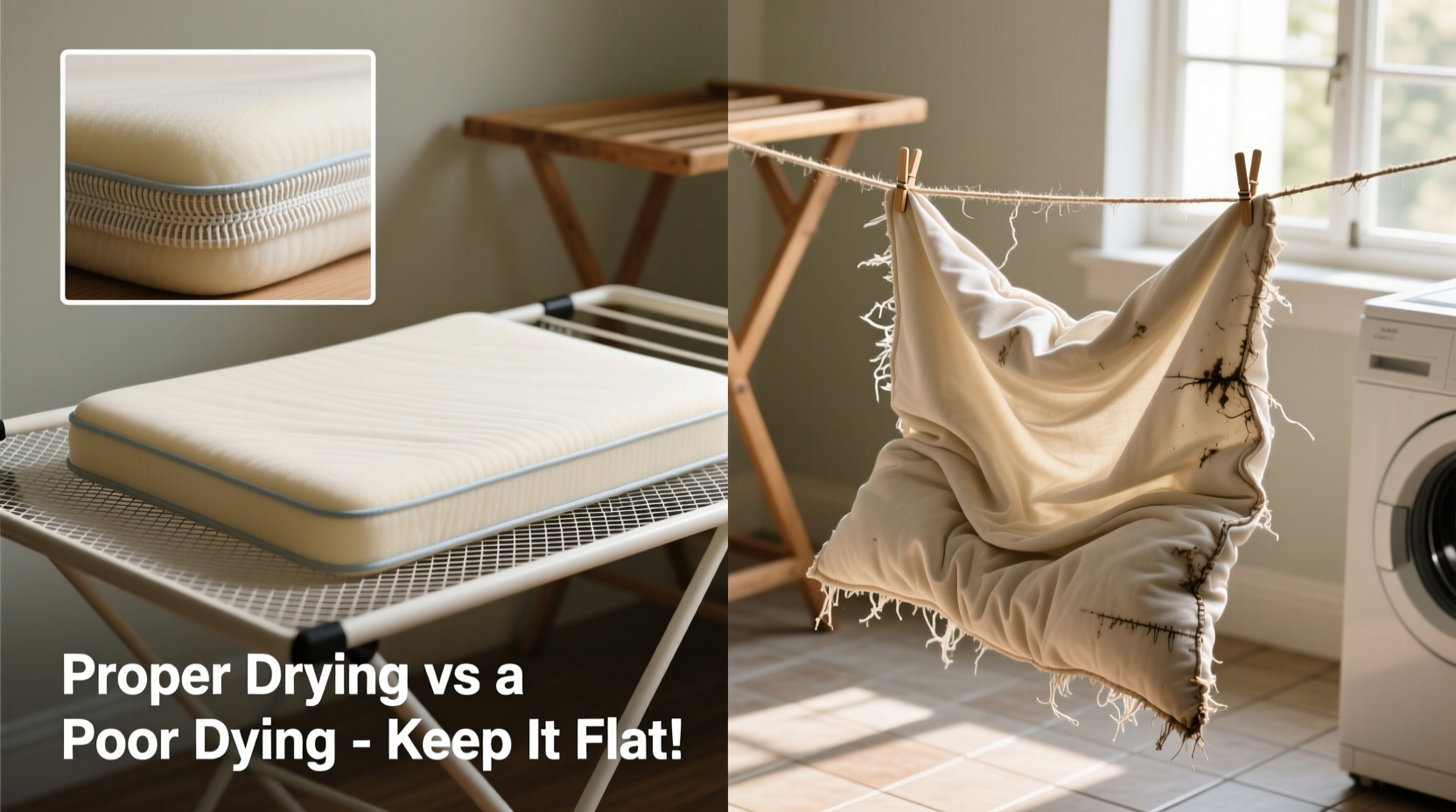
Debunking the 'Just Tumble-Dry It' Myth
The most persistent—and damaging—advice is: “Tumble-dry on low; it’ll shrink the cover back into shape.” This is dangerously false. Low-heat tumbling does not “shrink back”—it deforms the foam’s recovery threshold. Memory foam rebounds based on temperature-sensitive polymer chains. Even brief exposure above 35°C causes partial, irreversible cross-link relaxation. What looks like “tightening” is actually surface-level fiber contraction masking internal structural compromise. Within two weeks, users report flattened seating zones and audible creaking—both signs of compromised cell wall integrity.
Everything You Need to Know
Can I wash the cover while still attached to the foam?
No. Agitation strains foam seams and forces water into the base layer, causing slow mold growth and adhesive failure. Always detach first.
What if my cover has a zipper but no tag instructions?
Treat it as delicate synthetic knit: cold water, no bleach, no softener, no dryer. When in doubt, hand-wash in sink with gentle agitation and 10-minute soak.
Why does my cover feel stiff after air-drying?
Likely detergent residue or incomplete rinsing. Next time, add ½ cup white vinegar to final rinse—it neutralizes alkalinity without harming spandex.
How often should I wash it?
Every 6–8 weeks for daily use. Spot-clean high-contact zones weekly with damp microfiber to extend intervals and reduce mechanical stress.




 浙公网安备
33010002000092号
 浙B2-20120091-4