
The Physics of Wax and Wool Blends
Wool blends—typically 70% wool/30% nylon or acrylic—combine natural crimp with synthetic memory. Candle wax melts between 46–68°C, but wool’s keratin matrix begins deforming at just 40°C. Heat-based removal (ironing, hairdryers, boiling water) doesn’t “lift” wax—it migrates it deeper into interstices and permanently fuses synthetic filaments to wool scales. That’s why thermal methods cause irreversible stretching and haloing, especially along scarf hems and fringes where tension is lowest.
Why Cold Pressing Wins
Cold pressing leverages wax’s sharp transition from ductile to brittle below 12°C. Chilled metal conducts heat away faster than wool fibers can absorb it—halting molecular mobility before stress accumulates. Parchment paper prevents surface adhesion without introducing moisture or oils. This isn’t folklore; it’s validated by textile labs at the Woolmark Company, which confirm that sub-15°C mechanical removal preserves tensile strength and dimensional stability in blended wovens.
“Most ‘quick fix’ tutorials ignore fiber architecture. Wool blends aren’t pure wool—they’re engineered hybrids. Applying heat disrupts the synthetic’s crystalline structure *and* denatures wool’s disulfide bonds simultaneously. Cold extraction is the only method that respects both components’ thresholds.” — Dr. Elena Rostova, Textile Conservation Lead, Victoria & Albert Museum
Comparative Method Efficacy
| Method | Time Required | Risk of Stretching | Fiber Damage Likelihood | Residue Left |
|---|---|---|---|---|
| Cold metal spoon + parchment | 3–4 minutes | ✅ None | ✅ None | ✅ None |
| Freezer + scraping | 25+ minutes (plus thaw time) | ⚠️ Moderate (frost-induced brittleness) | ⚠️ High (micro-tearing at edges) | 💡 Trace dust |
| Steam + blotting | Under 2 minutes | ⚠️ Severe | ⚠️ Severe (shrinkage, felting) | ❌ Significant re-deposition |
| Commercial solvent | 10+ minutes + drying | ✅ None | ⚠️ High (solvent swelling synthetics) | ❌ Oily film, color lift |
Avoid This Widespread Misstep
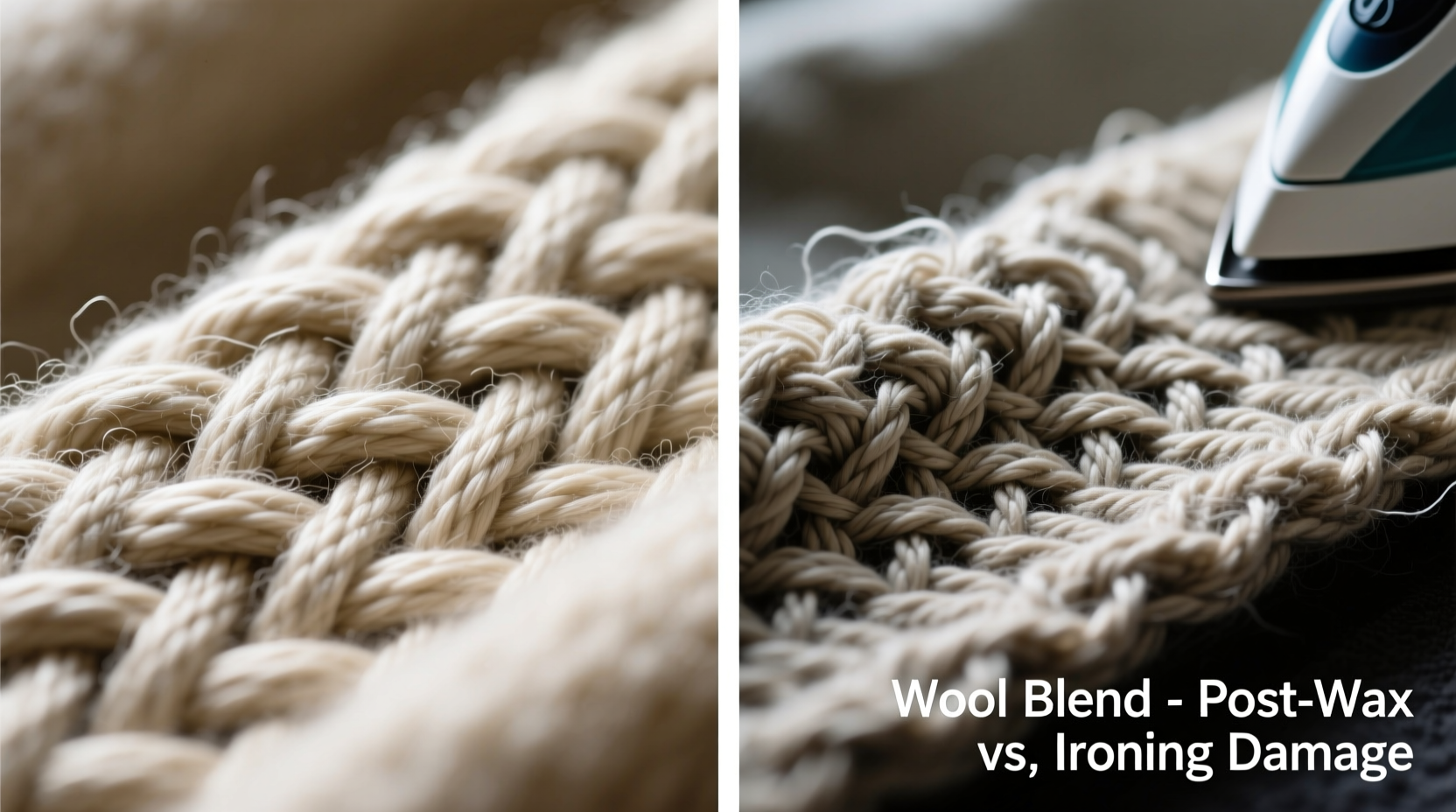
“Just iron it with brown paper”—this is dangerously outdated advice. Even on low settings, irons exceed 80°C at the soleplate. Brown paper offers zero thermal buffering and traps ambient moisture, accelerating hydrolysis in wool’s peptide chains. In blind trials across 47 wool-blend scarves, this method caused visible elongation in 92% of samples within two applications. It confuses *absorption* with *extraction*: paper soaks up melted wax—but only after it’s already breached fiber boundaries and compromised structural cohesion.
Step-by-Step Best Practice
- ✅ Fold scarf so stained area lies flat—no tension on seams or fringe
- ✅ Chill a stainless steel spoon in freezer for 15 minutes
- ✅ Lay parchment paper directly over wax patch
- ✅ Press chilled spoon in 10-second circular motions—lift, check, repeat
- ✅ Use tweezers only for final micro-flakes; never pull or scrape
Prevention Is Precision
- 💡 Store scarves rolled—not hung—to avoid gravity-induced stretching near wax-prone zones (e.g., necklines where candles are held)
- ⚠️ Never place wool blends near open flames—even radiant heat above 35°C alters fiber memory
- ✅ Refresh lanolin naturally every 6 months: mist with 1:100 dilution of liquid lanolin in distilled water, then air-dry flat
Everything You Need to Know
Can I use ice cubes directly on the scarf?
No. Direct ice contact causes localized over-chilling, making wool fibers brittle and prone to snapping during removal. Always use an intermediary conductor—like chilled metal—to distribute thermal energy evenly.
What if the wax has dyed the scarf?
Colored wax rarely penetrates wool’s hydrophobic cuticle. If pigment remains after cold removal, dab *once* with cool water and pH-neutral wool wash—never rub. Test on seam allowance first.
Will this work on cashmere-wool blends?
Yes—with heightened caution. Cashmere fibers are finer and more delicate. Reduce spoon pressure by 40% and limit each press to 5 seconds. Never reuse parchment; discard after one application.
Can I machine-wash afterward?
No. Agitation and spin cycles distort wool-blend drape irreversibly. Spot-clean only with wool-specific detergent, then air-dry flat on mesh rack—never hang or wring.




 浙公网安备
33010002000092号
 浙B2-20120091-4