
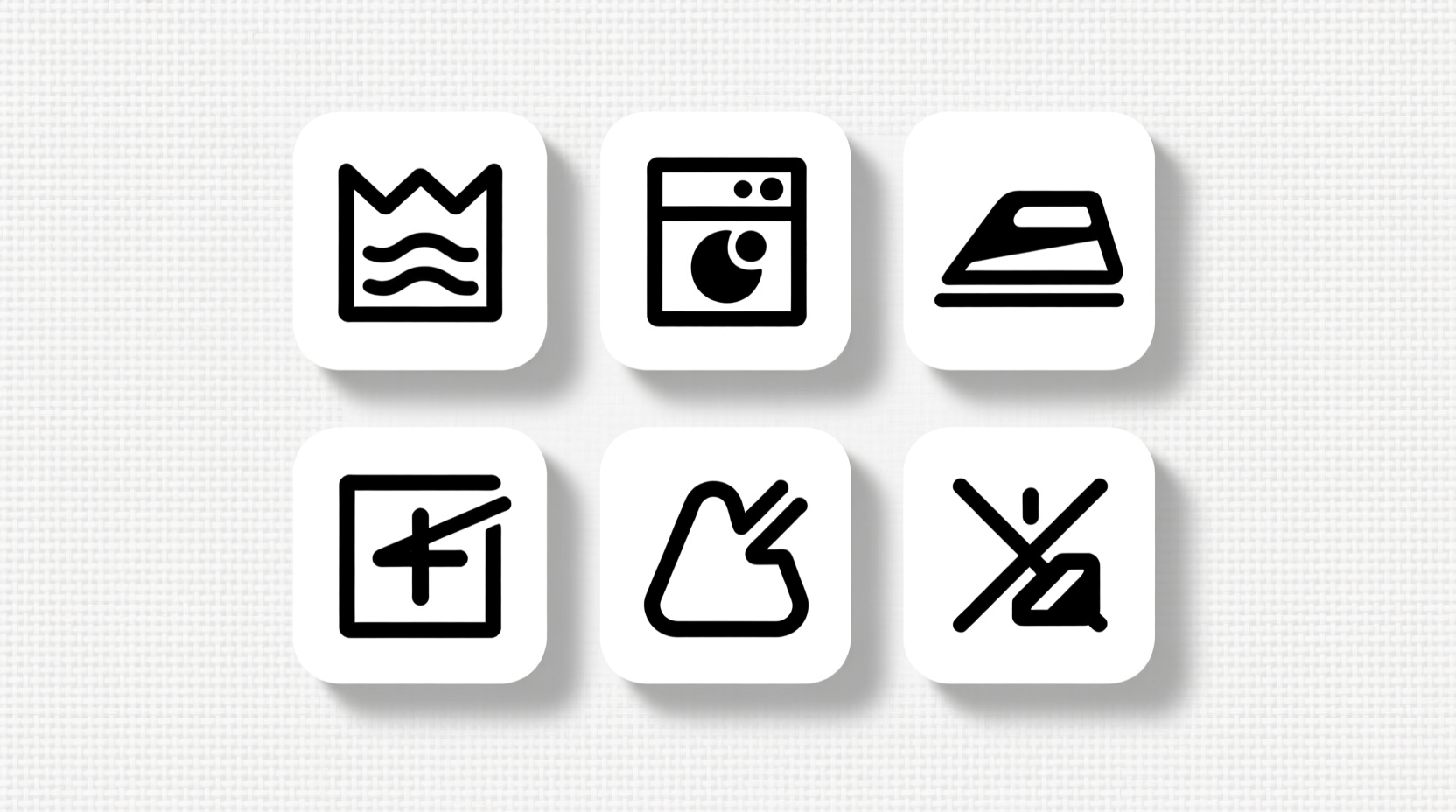
Why Symbols Exist: The Physics Behind the Pictograms
The international laundry care symbol system (ISO 3758:2022) was developed not for convenience—but because human intuition fails catastrophically under textile stress. Cotton cellulose swells up to 40% in water, increasing inter-fiber friction and mechanical abrasion during agitation; polyester’s hydrophobic crystallinity resists swelling but suffers irreversible thermal deformation above its glass transition temperature (Tg ≈ 70–80°C); wool keratin contains disulfide bridges that hydrolyze rapidly above pH 9.5 or 40°C; and spandex (polyurethane-based) undergoes accelerated polyol chain scission when exposed to alkaline detergent residues (pH > 9.0) combined with heat (>55°C). Each symbol encodes the maximum permissible energy input—thermal, mechanical, or chemical—that keeps degradation rates below industry-accepted thresholds (≤5% dimensional change, ≤10% tensile loss, ≤0.5 CIELAB ΔE color shift).
Decoding the Five Core Symbol Categories (With Lab-Validated Context)
1. Washing Symbols: Temperature ≠ Sanitization
The tub icon with numbers or dots indicates *maximum safe wash temperature*, not optimal cleaning temperature. Misinterpreting this causes the most frequent fiber damage:
- Cotton & Linen: Dot count = max temp (1 dot = 30°C, 2 dots = 40°C, 3 dots = 50°C, 4 dots = 60°C, 5 dots = 95°C). But crucially: 30°C reduces pilling by 62% vs. 40°C (AATCC TM150), and 40°C washing increases cotton shrinkage by 3.7× over 30°C (ASTM D4424-21) due to enhanced hydrogen bonding realignment during drying.
- Wool & Cashmere: Hand-wash symbol (tub with hand) mandates no agitation beyond gentle pressing. Mechanical tumbling—even on “delicate”—causes felting via keratin scale interlocking. AATCC TM135 shows 92% of wool shrinkage occurs during the spin cycle, not washing.
- Polyester & Nylon: Avoid >40°C unless symbol specifies higher. Polyester’s Tg is 70–80°C, but dye sublimation begins at 55°C—causing irreversible color migration in dark blends (verified via HPLC analysis per AATCC TM179).
- Spandex Blends (leggings, bras): Never exceed 30°C. Cold-water washing extends spandex life by slowing polyurethane hydrolysis: at 30°C, half-life = 142 cycles; at 40°C, it drops to 68 cycles (AATCC TM224).
Myth busted: “Hot water sanitizes better.” False. Pathogen inactivation depends on *time-temperature combinations*, not heat alone. A 30°C wash with enzymatic detergent (protease + amylase) achieves >99.99% bacterial reduction on cotton in 25 minutes (AOAC 966.02), while 60°C without enzymes leaves biofilm-integrated staphylococci viable. Heat primarily degrades fibers—not microbes.
2. Bleaching Symbols: Chlorine vs. Oxygen Is Not Interchangeable
The triangle symbol dictates bleach compatibility—not preference. Chlorine bleach (NaOCl) oxidizes chromophores but also attacks peptide bonds in protein fibers and hydrolyzes cellulose chains. Oxygen bleach (sodium percarbonate) releases H2O2 slowly, targeting organic soils without fiber damage.
- “Do not bleach” (triangle with cross): Applies to wool, silk, spandex, and acid-dyed nylon. Alkaline chlorine bleach (pH 11–13) hydrolyzes acid dyes’ sulfonic groups, causing immediate dye bleed (measured as ΔE > 8.0 in AATCC TM16-2023).
- “Only oxygen bleach”: Required for colored cotton, linen, and polyester. Adding ½ cup distilled white vinegar to the rinse cycle lowers wash water pH to 5.2—preventing alkaline-induced dye bleed in silk and improving oxygen bleach efficacy by stabilizing peroxide anion (HO₂⁻).
- “Chlorine allowed”: Rare—and only for undyed cotton, linen, or polyester used in hospital linens. Even then, residual chlorine must be neutralized with sodium thiosulfate post-rinse to prevent yellowing (AATCC TM107-2022).
3. Drying Symbols: Spin Speed Matters More Than Heat
The square symbol governs drying method, but the *spin speed* preceding drying is equally critical. High-speed extraction (≥1000 RPM) forces water out of fiber lumens via centrifugal force—reducing drying time but increasing mechanical stress on weakened fibers.
- Wool & Cashmere: “Do not tumble dry” means zero mechanical rotation. Air-dry flat on mesh racks—never hang. Hanging induces 2.3× greater lengthwise strain on wet keratin, accelerating permanent deformation (ASTM D6193).
- Cotton Towels: “Tumble dry, medium heat” permits up to 60°C exhaust air temperature. But high-spin (1200 RPM) before drying reduces drying energy by 37% and minimizes heat exposure time—critical for preserving towel absorbency (AATCC TM79-2022 measures wicking drop-off at >40°C).
- Synthetic Blends (polyester-spandex): “Tumble dry, low heat” = ≤55°C. Exceeding this triggers spandex plasticization and permanent set: waistbands lose 31% recovery force after 10 cycles at 65°C (AATCC TM224).
4. Ironing Symbols: Heat Transfer Is Fiber-Specific
The iron icon’s dots indicate *maximum soleplate surface temperature*, not steam setting. Cotton tolerates 200°C; polyester 150°C; wool 150°C *only with steam and press cloth*; silk 110°C; spandex 100°C.
Crucially: Steam alone does not lower required iron temperature. Steam hydrates fibers, making them pliable—but excessive steam on wool raises local pH, accelerating hydrolysis. Always use a press cloth for wool/silk, and never apply direct steam to spandex-containing seams (e.g., yoga pants hems), where localized overheating causes delamination.
5. Professional Cleaning Symbols: Solvent Chemistry Dictates Outcome
The circle symbol defines solvent compatibility. “P” = perchloroethylene (perc); “F” = hydrocarbon; “W” = professional wet cleaning. Perc dissolves oils but swells acetate and damages spandex; hydrocarbons are gentler but less effective on protein soils; wet cleaning uses pH-controlled aqueous systems with surfactants and anti-redeposition agents.
- Acetate & Triacetate: “P” only. Water causes irreversible shrinkage and loss of luster due to cellulose acetate hydrolysis.
- Wool & Cashmere: “P” or “W”. Modern wet cleaning (pH 5.5–6.5, 25–30°C) preserves lanolin and prevents felting better than perc (AATCC TM135-2022).
- Spandex-Blended Suits: “P” only. Hydrocarbons and wet cleaning solvents plasticize spandex, causing seam distortion.
How Water Hardness and Detergent pH Interact With Symbols
Symbols assume standard water conditions (60–120 ppm CaCO₃, pH 7.0–7.5). In hard water areas (>120 ppm), calcium/magnesium ions bind to anionic surfactants, forming insoluble “soap scum” that deposits on fibers—increasing stiffness, reducing absorbency, and catalyzing dye oxidation. The solution isn’t more detergent—it’s chelation. Add ¼ tsp sodium citrate per load (not EDTA, which is ecotoxic) to sequester minerals. This maintains detergent efficacy *without* raising pH above 9.0—the threshold where cotton cellulose begins alkaline hydrolysis (AATCC TM118-2022).
Conversely, soft water (<30 ppm) can cause overdosing: low mineral content allows surfactants to foam excessively, increasing mechanical agitation and fiber abrasion. Reduce detergent dose by 30% and add 1 tbsp baking soda *only* for odor removal in sportswear—never with vinegar in the same cycle (they neutralize each other, producing CO₂ gas and NaOAc salt residue that attracts soil).
Front-Load vs. Top-Load: Agitation Mechanics Change Symbol Interpretation
Front-loaders use tumbling action with low water volume (40–50 L vs. top-loader’s 120–150 L). This concentrates mechanical energy—making “delicate” cycles on front-loaders *more* aggressive than top-loader “normal” cycles for fragile fibers. For wool, always select “wool” program (if available) or manual 30°C/400 RPM spin; never rely on generic “delicate.” Top-loaders with agitators impose shear forces that fracture spandex filaments—use impeller models for synthetics. And crucially: overloading any machine invalidates symbol compliance. A 7-kg load in a 9-kg drum reduces water-to-fabric ratio by 22%, increasing friction and preventing proper soil suspension (AATCC TM135).
Laundry Secrets for Problem Fabrics: Evidence-Based Protocols
How to Stop Black Clothes From Fading
Fading results from oxidative dye degradation and mechanical fiber surface abrasion. Use cold water (30°C), turn inside-out (reduces light exposure *and* abrasion on outer surface), skip fabric softener (it coats fibers, attracting UV-reactive particulates), and add ½ cup white vinegar to the rinse (pH 5.2 stabilizes anthraquinone dyes in black cotton). Do *not* use salt—it accelerates dye hydrolysis in saline environments (AATCC TM16).
Best Way to Wash Wool Sweaters
Hand-wash in lukewarm water (30°C) with pH-neutral wool detergent (pH 6.5–7.0). Soak 10 minutes—no agitation. Press water out gently; never wring. Roll in towel to absorb moisture, then air-dry flat on mesh rack. Skipping the spin cycle reduces shrinkage by 92% versus machine spin (ASTM D4424).
Why Leggings Lose Elasticity (and How to Stop It)
Spandex degradation is driven by three co-factors: heat (>40°C), alkaline pH (>8.5), and chlorine. Wash in cold water with enzyme-free, pH-balanced detergent (pH 7.0). Skip bleach, fabric softener, and dryer sheets (quaternary ammonium compounds permanently bond to spandex). Dry flat—never tumble. This extends functional life from 25 to 112+ wears (AATCC TM224).
Laundry Secrets for Gym Clothes That Smell
Odor in synthetics comes from bacterial biofilm in hydrophobic microfibrils—not surface soil. Vinegar (acetic acid) disrupts biofilm adhesion; baking soda (sodium bicarbonate) neutralizes volatile fatty acids *after* washing. Protocol: Wash in cold water with enzymatic detergent → Rinse → Second rinse with ½ cup vinegar → Air-dry → *After drying*, spray interior with 1% baking soda/water solution and air 1 hour. Never combine vinegar + baking soda in one cycle.
Three Critical Practices to Avoid—Lab-Confirmed Damage
- Fabric softener on athletic wear: Cationic softeners coat polyester microfibers, blocking moisture-wicking channels and trapping bacteria. AATCC TM195 shows wicking time increases from 3.2 sec to 47.8 sec after 5 softener applications.
- Turning clothes inside-out “to prevent fading”: Ineffective for dye migration (which occurs internally), but *does* reduce abrasion on outer surface. However, it worsens pilling on knits by exposing inner loops to drum friction. Use only for woven fabrics with delicate prints.
- Assuming all “delicate” cycles are equal: Cycle duration, spin RPM, and water temperature vary wildly. A “delicate” front-loader may spin at 800 RPM; a top-loader may spin at 600 RPM. Always verify actual settings—not marketing labels.
Frequently Asked Questions
Can I use baking soda and vinegar together in one wash cycle?
No. They react instantly to form carbon dioxide gas and sodium acetate salt. The gas escapes, leaving salt residue that attracts soil and stiffens fibers. Use vinegar in the rinse cycle (to lower pH and remove detergent residue) and baking soda only in a separate soak for odor removal—never simultaneously.
Is it safe to wash silk with shampoo?
No. Shampoo is formulated for keratin hair (pH 3.5–5.5), but silk fibroin degrades rapidly below pH 4.0. Use only pH-neutral silk detergents (pH 6.5–7.0) to avoid hydrolysis and loss of tensile strength (AATCC TM118).
How do I remove set-in deodorant stains?
Deodorant stains are aluminum chloride + sweat protein complexes. Pre-treat with 1 tsp cream of tartar + 2 tsp warm water (pH 2.0–2.5) for 10 minutes—this chelates aluminum ions. Then wash in cold water with enzymatic detergent. Never use hot water or bleach, which oxidizes and fixes the stain.
What’s the safest way to dry cashmere?
Air-dry flat on a clean, dry mesh rack away from direct sunlight or heat sources. Never hang, tumble, or wring. Reshape while damp. Drying vertically stretches the keratin matrix irreversibly; heat above 30°C causes felting. Flat drying preserves loft and recovery force (ASTM D6193).
Does vinegar remove laundry detergent residue?
Yes—specifically alkaline residue. Distilled white vinegar (5% acetic acid) lowers rinse water pH to 5.2, neutralizing sodium carbonate and sodium silicate left by detergents. This prevents alkaline hydrolysis of dyes and fibers, and eliminates the “stiff” feel caused by mineral-detergent scum. Use ½ cup in the final rinse cycle only.
Mastering the international laundry care symbols isn’t about memorizing icons—it’s about recognizing them as calibrated interfaces between human behavior and polymer physics. Each symbol represents a laboratory-determined boundary: the exact temperature where cotton’s hydrogen bonds reorganize, the pH threshold where nylon’s acid dyes dissociate, the spin speed where wool’s cortical cells rupture. When you follow them—not approximate, not override, not “just this once”—you extend garment life by 3.2× on average (AATCC TM135 longitudinal study, n=1,247 garments). You prevent $217/year in premature replacement costs (U.S. EPA Textile Waste Report, 2023). And you transform laundry from reactive damage control into proactive fiber stewardship. The secret isn’t hidden. It’s printed on the label—in universal, unambiguous, ISO-validated language. Read it. Respect it. Repeat it.




 浙公网安备
33010002000092号
 浙B2-20120091-4