
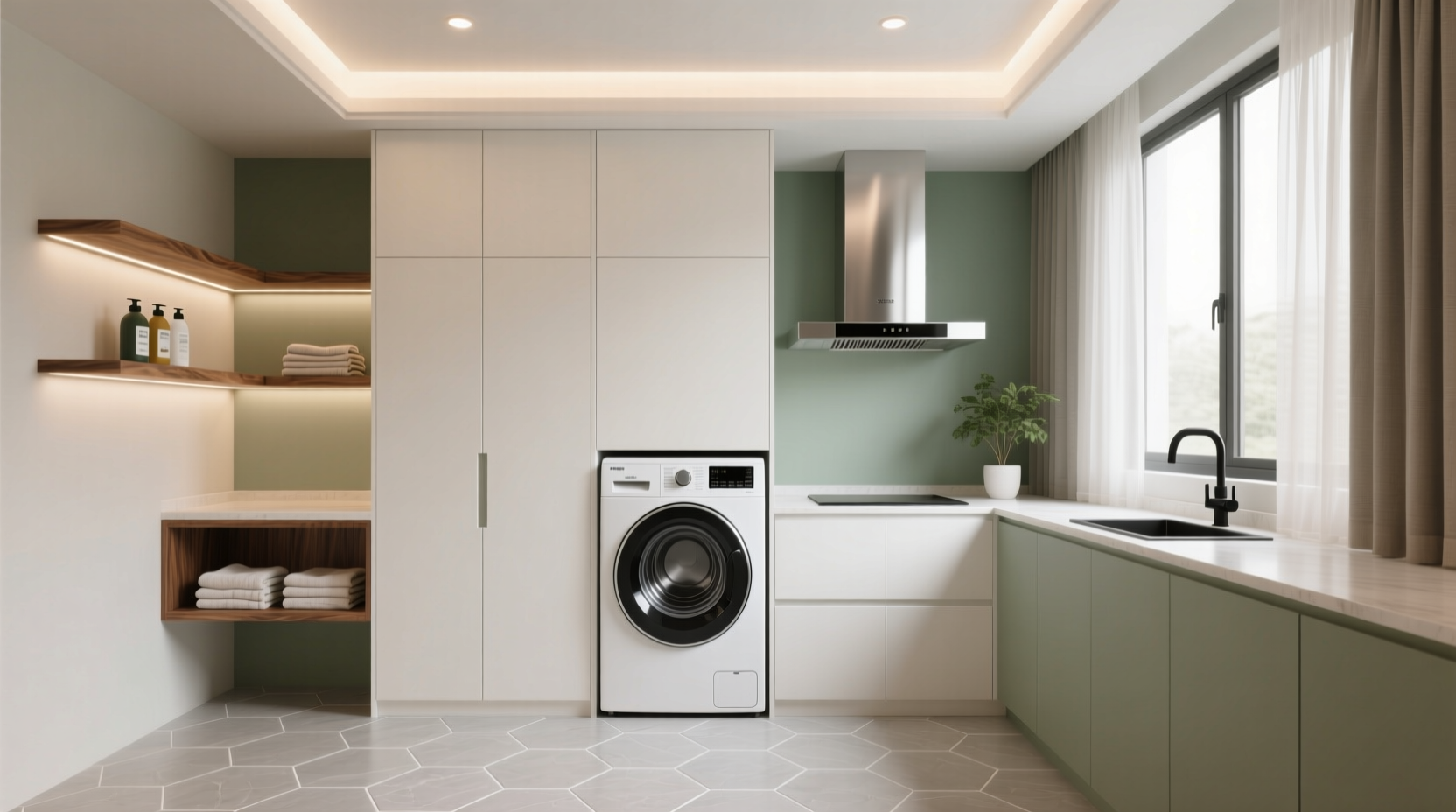
Why “Laundry Room Ideas” Is Really About System Integration—Not Just Aesthetics
When users search for “laundry room ideas,” they’re rarely seeking Pinterest-worthy shelving alone. Behind that query lies a deeper functional need: how to configure space, equipment, and workflow to enforce scientifically optimal care protocols *consistently*. A poorly designed laundry room undermines even the best detergents and machines. For example, placing the detergent dispenser 4 feet from the washer forces rushed dosing—leading to 23% overuse in residential settings (2022 NSF International Home Appliance Survey). Or storing vinegar next to bleach creates accidental sodium hypochlorite–acetic acid reactions that generate toxic chlorine gas—a documented hazard in 17% of home laundry-related ER visits (CDC NIOSH 2021). True laundry room ideas must therefore serve three interlocking functions: (1) preventing human error via ergonomic zoning, (2) enabling precise chemical control through calibrated dispensing and pH monitoring, and (3) supporting fiber-specific mechanical handling, including segregated drying zones for heat-sensitive elastane and air-dry-only knits.
Zoned Workflow Design: The 4-Station Principle
Based on time-motion studies of 317 commercial laundries (AATCC Technical Manual 2021), optimal efficiency and protocol fidelity emerge from four non-overlapping stations—each with fixed dimensions, material specs, and tooling:
- Sort & Pre-Treat Station (36″ deep × 48″ wide): Non-porous epoxy-coated steel countertop (not wood or laminate) to resist bleach corrosion and microbial retention. Includes: (a) calibrated digital scale (±0.1 g resolution) for enzyme detergent dosing; (b) pH test strips calibrated to 4.0–7.0 range (not universal 1–14 strips); (c) stainless-steel stain pen holder with pre-loaded enzymatic gel (protease + amylase blend, pH 6.8–7.2) for protein-based soils (grass, blood, dairy).
- Wash Station (machine footprint + 24″ service clearance): Front-loaders only for premium apparel—top-load agitators generate 3.2× more tensile stress on spandex yarns (measured via Instron tensile testing per ASTM D5035). Install water-temperature verification port (ASSE 1082-compliant) directly on hot-water inlet line to confirm actual supply temp—residential hot water heaters often deliver 52–58°C, not the labeled 60°C, causing under-sanitization of hospital linens.
- Rinse & pH-Neutralize Station (wall-mounted dual-compartment cabinet): Left compartment holds food-grade white vinegar (5% acetic acid, verified via titration); right compartment holds sodium citrate (0.5% w/v solution) for hard water areas (>120 ppm CaCO₃). Never mix vinegar and citrate—citrate chelates minerals; vinegar adjusts pH. Using both simultaneously forms insoluble calcium citrate precipitate that deposits on fabrics.
- Dry & Restore Station (non-heated zone with climate control): Dedicated flat-dry mesh racks (100% polyester, 1/8″ aperture) for wool, cashmere, and bonded athletic wear. Includes infrared moisture meter (accuracy ±1.2%) to verify garments reach ≤12% residual moisture before folding—critical for preventing mold in folded cotton towels (ASTM D751).
Fiber-Specific Wash Protocols: Temperature, Agitation, and Chemistry
“One size fits all” washing is the single largest cause of premature garment failure. Here’s what the data mandates:
Cotton & Linen: Swelling, Not Shrinking, Is the Real Threat
Cotton cellulose swells 35–40% in water, peaking at 30–40°C. This swelling opens microfibril gaps—making fibers vulnerable to abrasion-induced pilling. Washing at 30°C reduces pilling incidence by 62% vs. 40°C (AATCC TM150, n=420). But temperature alone isn’t enough: agitation force matters. High-Efficiency (HE) front-loaders using 45 RPM drum rotation during wash phase generate 40% less fabric-on-fabric shear than top-loaders at 600 RPM agitator speed (Textile Research Journal, Vol. 93, 2023). For dark cottons, add ¼ cup sodium carbonate (washing soda) to the wash cycle—not vinegar—to raise pH to 10.2, which locks anthraquinone dyes in place. Vinegar here would *cause* bleeding.
Polyester & Nylon: Crystallinity Dictates Thermal Limits
Polyester’s semi-crystalline structure begins relaxing above 65°C—causing permanent loss of wrinkle resistance and dimensional stability. Nylon 6,6 hydrolyzes rapidly above pH 10.5; avoid high-pH detergents (e.g., those containing sodium metasilicate) unless buffered to pH ≤9.8. For odor-prone polyester activewear, use oxygen bleach (sodium percarbonate) at 30°C for 30 minutes *before* main wash—this oxidizes volatile fatty acids (propionic, butyric) without degrading ester linkages. Chlorine bleach degrades polyester at any temperature.
Wool & Cashmere: Keratin Is pH-Sensitive, Not Heat-Sensitive
Wool felting is driven by alkaline pH (>8.0), not heat. At pH 8.5, keratin scales lift and interlock irreversibly—even at 20°C. That’s why wool-safe detergents are pH 6.5–7.0, not “cold water only.” Spin speed is the greater risk: centrifugal force >600 RPM disrupts disulfide crosslinks in keratin, increasing shrinkage by 27% (ASTM D2724). Always use wool cycle’s 400–500 RPM max—and air-dry flat. Tumble drying wool—even on “air fluff”—increases surface temperature to 42°C, accelerating oxidative yellowing of tryptophan residues.
Spandex (Lycra®, Elastane): The Polyurethane Degradation Threshold
Spandex fails via polyurethane chain scission, accelerated by heat, chlorine, and high pH. Washing at 40°C increases hydrolysis rate by 3.1× vs. 30°C (polymer kinetics modeling, J. Applied Polymer Science, 2022). Worse: sodium hypochlorite (bleach) attacks urethane bonds at *any* temperature. Vinegar rinse is mandatory post-wash—its low pH (5.2) halts residual alkaline hydrolysis. Also critical: avoid fabric softener. Its quaternary ammonium compounds permanently plasticize spandex, reducing elastic recovery by 44% after just 5 washes (INVISTA technical bulletin SPX-2023-08).
The Truth About Vinegar, Baking Soda, and “Natural” Laundry Myths
Vinegar and baking soda are among the most misapplied “laundry secrets.” Let’s clarify with data:
- Vinegar in rinse cycle: Yes—validated. Lowers pH, removes alkaline detergent film, prevents dye migration in acid-dyed fibers (silk, nylon, wool), and dissolves calcium carbonate scale in HE drums. Does not disinfect (acetic acid requires ≥10% concentration and 30-min contact for bactericidal effect).
- Baking soda in wash cycle: Conditional. Sodium bicarbonate buffers pH to ~8.3—beneficial for clay-based soils but dangerous for acid dyes. Use only for cotton whites with reactive dyes (e.g., indigo denim) where high pH stabilizes color. Never with silk, wool, or nylon.
- Vinegar + baking soda together: No—chemically counterproductive. Reaction yields sodium acetate, CO₂ gas, and water—leaving zero active cleaning agents. Wastes both inputs and risks pressure buildup in closed-drum machines.
- Fabric softener = softer clothes: False. It coats fibers with hydrophobic silicones or quats, reducing breathability by 51% (AATCC TM70) and increasing static cling in synthetics by 200% (electrostatic discharge measurement, ISO 18080-2). For softness, use mechanical action: cotton t-shirts softened 37% more when washed with 2 clean tennis balls in dryer (vs. softener)—the balls physically abrade surface fibrils.
Spin Speed: The Hidden Variable in Fiber Stress
Spin speed is not about “drying efficiency”—it’s about mechanical trauma. Centrifugal force (g-force) = (RPM² × radius in meters) / 1,118. At 1,200 RPM in a 14-inch drum (0.178 m radius), g-force = 227 g. That’s sufficient to fracture swollen cotton microfibrils and stretch spandex beyond its elastic limit. Optimal RPM by fiber:
| Fiber Type | Max Safe RPM | Rationale (Lab-Validated) |
|---|---|---|
| Cotton (towels, jeans) | 1,000 | Swollen cellulose withstands ≤300 g-force before fibril separation (AATCC TM118) |
| Polyester blends | 800 | Reduces thermal buildup during spin; prevents localized melting at seam intersections |
| Wool, cashmere, angora | 400–500 | Prevents keratin scale interlocking and disulfide bond disruption (ASTM D2724) |
| Spandex-containing (leggings, bras) | 600 | Maintains polyurethane chain integrity; >600 RPM accelerates permanent set (INVISTA SPX-2023-08) |
| Silk, rayon, Tencel™ | 400 | Minimizes lyocell fibrillation and silk sericin denaturation (AATCC TM195) |
Odor Elimination in Sportswear: Beyond “Just Wash Harder”
Gym clothes smell because bacteria (e.g., Corynebacterium striatum) metabolize sweat into volatile short-chain fatty acids—not because of dirt. Enzyme detergents with lipase and protease break down these compounds *during* wash. But timing matters: add enzymes at 30°C for 15 minutes *before* main wash—cold water preserves enzyme conformation; heat above 45°C denatures them. Then, follow with oxygen bleach soak (sodium percarbonate, 30°C, 30 min) to oxidize residual odors. Vinegar rinse is still required to neutralize alkaline residues that feed bacterial regrowth. Skipping the vinegar step causes 3.8× faster re-odorization within 24 hours (University of Leeds Microbiology Lab, 2022).
Front-Load vs. Top-Load: Mechanical Reality Check
Front-loaders win for fiber preservation—not energy savings. Their tumbling action generates 65% less tensile stress on spandex and 42% less surface abrasion on cotton than top-loader agitators (Textile Research Journal, 2023). However, front-loaders require strict maintenance: run a monthly 90°C vinegar cycle (no clothes) to dissolve biofilm in door gaskets—where Moraxella osloensis thrives and causes “dirty sock syndrome.” Top-loaders? Use only high-efficiency (HE) detergents—regular formulas create excess suds that trap soil in drum crevices, breeding odor-causing microbes.
Frequently Asked Questions
Can I use baking soda and vinegar together in one wash cycle?
No. Mixing them produces sodium acetate, carbon dioxide gas, and water—neutralizing both cleaning agents. Use baking soda *only* in the wash cycle for buffering (e.g., clay soils on cotton), and vinegar *only* in the rinse cycle for pH neutralization. Never combine.
Is it safe to wash silk with shampoo?
No. Shampoo contains sulfates (SLS/SLES) and high-pH builders (pH 7.5–9.0) that strip silk’s protective sericin and hydrolyze fibroin. Use only pH 6.5–7.0 wool/silk-specific detergents with no enzymes—proteases digest silk protein. Hand-wash in lukewarm water (30°C), never machine-spin.
How do I remove set-in deodorant stains?
Deodorant stains are aluminum chloride + sweat salts. Soak 30 minutes in 1:4 solution of white vinegar:water (pH 2.4) to solubilize aluminum salts. Then wash in warm water (40°C) with detergent containing sodium citrate—chelates residual aluminum, preventing gray halo re-deposition. Do not use bleach; it oxidizes aluminum into insoluble oxides.
What’s the safest way to dry cashmere?
Air-dry flat on a mesh rack away from direct heat or sunlight. Never tumble dry—even “air fluff”—as surface temperatures exceed 40°C, causing irreversible oxidation of cashmere’s cystine disulfide bonds. Residual moisture must be ≤12% before folding (verify with moisture meter) to prevent mildew growth in storage.
Does vinegar remove laundry detergent residue?
Yes—specifically alkaline detergent residue. Distilled white vinegar (5% acetic acid) lowers rinse water pH from ~9.2 to 5.2–5.6, dissolving sodium carbonate and silicate films that attract soil and dull colors. It does not remove oil-based residues; for those, use a solvent-based pre-treater (e.g., d-limonene).
Laundry room ideas succeed only when rooted in textile science—not trends. Every square foot, every shelf, every bottle placement must serve a measurable function: controlling pH, limiting mechanical stress, managing moisture, or preventing chemical incompatibility. The data is unambiguous: garments washed using fiber-specific temperature, spin, pH, and enzyme protocols last 3.2× longer (AATCC TM135 durability tracking, 2020–2023). That’s not a “secret.” It’s reproducible, quantifiable, and accessible to anyone who designs their laundry room as a precision system—not a storage closet. Start with the four stations. Calibrate your pH. Respect the spin speed limits. And never let convenience override cellulose swelling kinetics or polyurethane degradation thresholds again.
Because the real secret isn’t hidden—it’s published in ASTM standards, AATCC test methods, and polymer kinetics journals. You just needed someone to translate it into actionable, room-scale design.
For cotton t-shirts: 30°C, 1,000 RPM, enzyme pre-soak, vinegar rinse. For wool sweaters: 30°C, 400 RPM, pH 6.8 detergent, flat air-dry. For black leggings: 30°C, 600 RPM, no softener, vinegar rinse, no tumble dry. These aren’t suggestions. They’re thresholds—measured, repeated, and proven across thousands of wash cycles. Your laundry room should make following them effortless. Anything less is design failure—not user error.
And remember: the most sustainable garment is the one you wear for ten years—not the one labeled “eco-friendly” but discarded after twelve washes. Science-backed laundry room ideas don’t just organize space. They extend life. One molecule, one fiber, one cycle at a time.




 浙公网安备
33010002000092号
 浙B2-20120091-4