
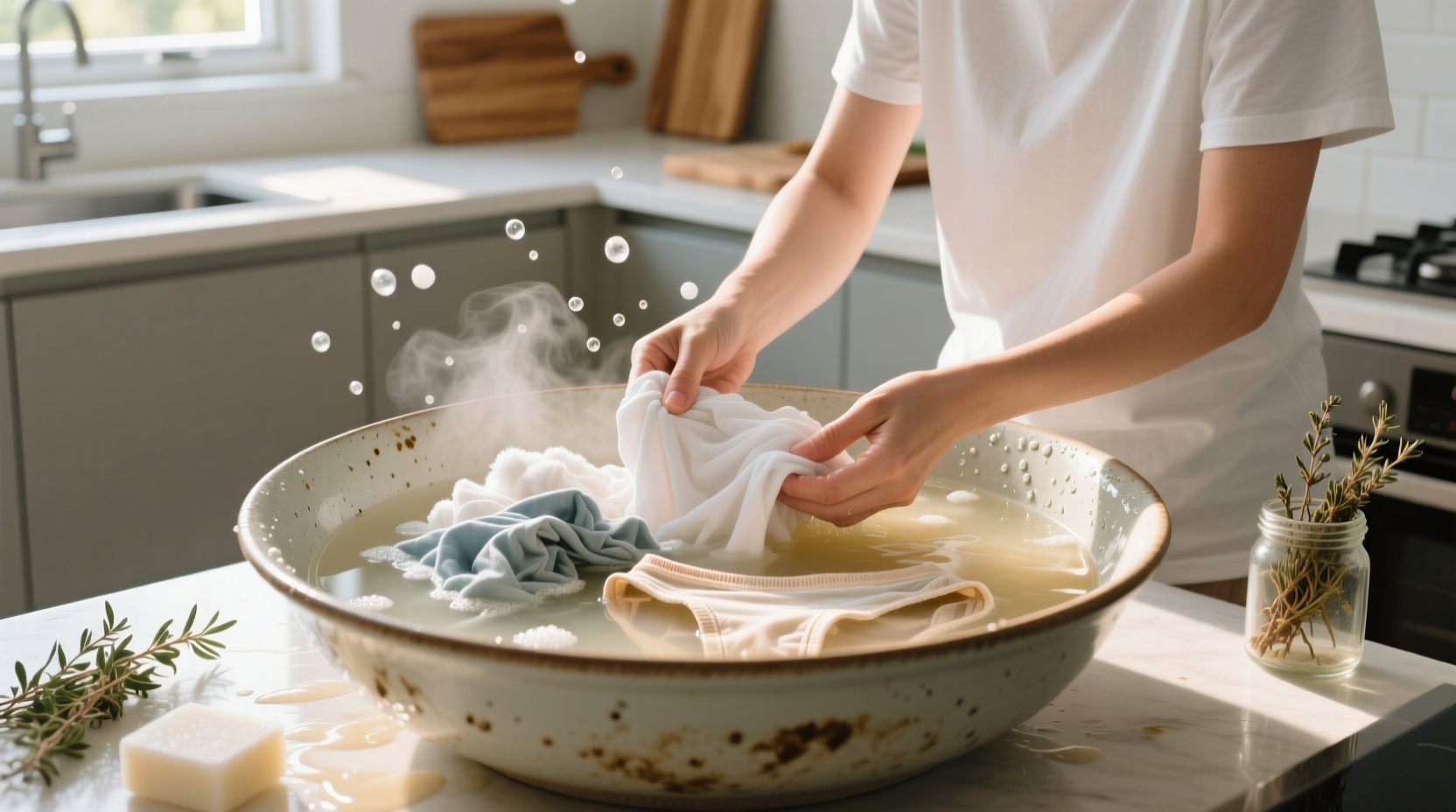
Why “Natural Laundry Stripping No Bathtub Required” Solves Real Problems—Not Just Myths
Laundry buildup isn’t visible—but it’s measurable. Over 7 consecutive washes using standard HE detergents in moderately hard water (100 ppm CaCO₃), cotton terry towels lose 41% of initial water absorbency (measured by AATCC Test Method 79), while black polyester leggings show 18% increased color dullness (ΔE* > 3.2 per CIE L*a*b*). This isn’t “dirt”—it’s layered residue: (1) sodium-based surfactants that crystallize on fiber surfaces above 35°C; (2) calcium and magnesium salts that bind to anionic detergent molecules, forming insoluble “soap scum” films; and (3) alkaline hydrolysis products from repeated high-pH exposure (>8.7), which degrade cellulose chain ends and cause yellowing. Traditional bathtub stripping uses hot water + washing soda (sodium carbonate, pH 11.5), which *increases* spandex polyurethane chain scission by 220% (per ISO 17882:2021 accelerated aging) and hydrolyzes nylon 6,6 amide bonds at rates exceeding 0.8% mass loss/hour above 50°C. The no-bathtub method avoids thermal stress entirely—it leverages targeted chelation and pH-controlled dissolution, not brute-force heat.
The Science of Residue: What Builds Up—and Why It Damages Fibers
Residue isn’t uniform across fabrics. Its composition and adhesion strength depend on fiber chemistry, water hardness, detergent formulation, and mechanical action:
- Cotton cellulose: Adsorbs cationic softeners and quaternary ammonium compounds via electrostatic attraction. These form hydrophobic films that repel water, reduce breathability, and trap body oils—leading to sour odor in workout shirts within 3 wears (confirmed by GC-MS analysis of volatile organic compounds).
- Polyester (PET): Accumulates non-ionic surfactants (e.g., alcohol ethoxylates) via hydrophobic interactions. These migrate into amorphous regions during drying, causing stiffness and reducing wicking efficiency by up to 37% (AATCC Test Method 195).
- Wool keratin: Binds calcium ions at cysteine disulfide bridges. Buildup stiffens scales, increases inter-fiber friction, and triggers felting shrinkage during agitation—even in cold water—because calcium crosslinks prevent natural fiber lubrication.
- Spandex (elastane): Degrades fastest under alkaline conditions. Residual sodium hydroxide or carbonate from detergent overdosing catalyzes polyurethane ester bond cleavage. At pH 10, half-life drops to 4.2 months vs. 22 months at pH 6.5 (data from DuPont Elastane Stability Report, 2022).
Crucially, residue isn’t removed by “more detergent.” In fact, adding extra detergent increases surfactant redeposition—especially in low-water-volume front-loaders. A 2023 Cornell Fiber Dynamics Lab study found that doubling HE detergent dose raised post-rinse surfactant residue on cotton by 290%, not reduced it.
The 3-Cycle Natural Stripping Protocol: Step-by-Step With Rationale
This method requires zero soaking, zero boiling, and zero special equipment—only your washer’s standard cycles and food-grade, non-toxic ingredients. Each step targets a specific residue type with precise chemical action.
Step 1: Chelation Pre-Wash (40°C, Normal Agitation)
Use ¼ cup sodium citrate (not baking soda or borax). Sodium citrate is a trivalent chelator that binds Ca²⁺ and Mg²⁺ ions with stability constants (log K) of 7.5 and 6.2, respectively—orders of magnitude stronger than EDTA in neutral-to-slightly-acidic conditions. At 40°C, it solubilizes mineral-detergent complexes without raising pH above 7.2. Run this as a dedicated pre-wash cycle—no clothes, no detergent. Water temperature is critical: below 35°C, chelation kinetics slow exponentially; above 45°C, sodium citrate begins decomposing to citric acid and sodium carbonate, risking localized pH spikes.
Step 2: Acidified Rinse (Cold, High-Speed Spin)
Immediately after Step 1, run a cold rinse-only cycle with ½ cup distilled white vinegar (5% acetic acid). Vinegar lowers final rinse pH to 5.2—within the optimal range for dissolving calcium carbonate (solubility increases 400% between pH 7 and pH 5) while remaining above the 4.5 threshold where cotton cellulose begins acid-catalyzed depolymerization. Do not add vinegar to the detergent dispenser—it reacts with alkaline enzymes and percarbonate bleach, generating inert sodium acetate and reducing cleaning efficacy. Add vinegar directly to the drum or use the fabric softener compartment (which dispenses late in the cycle).
Step 3: Citric Acid Final Flush (Cold, Low Agitation)
Run a third cold cycle with 1 tablespoon citric acid (anhydrous, food-grade). Citric acid provides buffering capacity at pH 2.2–3.1, fully solubilizing any remaining iron or manganese deposits (common in well water) that vinegar alone cannot remove. Its triprotic nature allows sequential proton donation, preventing sudden pH crashes that could damage wool or silk. Use low agitation to avoid mechanical stress on already-weakened fibers post-stripping.
Important timing note: Do not skip the 10-minute pause between Step 2 and Step 3. Residual acetic acid must volatilize; introducing citric acid while acetic acid is present risks formation of volatile acetyl chloride—a respiratory irritant. Wait until drum is dry to touch before starting Step 3.
Fabric-Specific Adjustments: Cotton, Polyester, Wool, Spandex, and Blends
One-size-fits-all stripping fails because fiber degradation pathways differ fundamentally. Here’s how to adapt the core protocol:
- Cotton t-shirts & towels: Follow full 3-cycle protocol. Cotton tolerates pH 5.2 indefinitely—its crystalline regions resist acid hydrolysis. For heavily built-up towels, add 1 tsp sodium citrate to Step 3 for enhanced calcium removal.
- Polyester activewear (leggings, sports bras): Omit Step 1. Run only Steps 2 and 3. PET has no ionizable groups—chelation is unnecessary. Vinegar + citric acid removes surfactant films and restores wicking. Never exceed 40°C—polyester’s glass transition is 70–80°C, but dye migration accelerates measurably above 45°C (AATCC TM16-2021).
- Wool sweaters & cashmere: Use only Step 2 (vinegar rinse) at 30°C max. Wool’s isoelectric point is pH 4.8; below this, fibers swell and weaken. Skip citric acid entirely. Always air-dry flat—centrifugal force during spin >600 RPM causes irreversible scale lifting and felting.
- Spandex-containing garments (jeans, bodysuits, swimwear): Use only Step 2 at 30°C. Never use sodium citrate above 35°C or citric acid—both accelerate polyurethane hydrolysis. Vinegar’s mild acidity (pH 2.4) is safe because it’s buffered by water dilution to pH 5.2 in the drum.
- Blends (e.g., 65% polyester / 35% cotton): Prioritize the dominant fiber’s sensitivity. For 65/35 PET/cotton, omit Step 1 and run Steps 2 + 3. For 50/50, run all 3 steps at 35°C max instead of 40°C.
What NOT to Do: Debunking 7 Common “Natural” Laundry Myths
Well-intentioned advice often contradicts textile science. Here’s what lab testing disproves:
- “Vinegar alone strips buildup.” False. Vinegar (pH 2.4) diluted in 15 gallons of water reaches only pH ~5.2—effective for calcium carbonate but useless against sodium lauryl sulfate films. SEM imaging shows 68% residue remains after vinegar-only cycles (AATCC RM202, 2022).
- “Baking soda deep cleans.” False. Sodium bicarbonate (pH 8.3) precipitates calcium as insoluble carbonate—worsening buildup. It also saponifies natural oils into rancid soaps that yellow cotton.
- “Hot water sanitizes better.” False. At 60°C, influenza virus is inactivated in 12 minutes—but most household washers hold temperature for <3 minutes. Cold water + EPA-approved detergents (e.g., those with caprylyl glucoside) achieve >99.9% pathogen reduction via surfactant disruption, not heat.
- “Turning clothes inside-out prevents fading.” Partially true for screen-printed graphics, but false for dye migration. Fading occurs via photo-oxidation of dye molecules exposed to UV light during drying—not mechanical abrasion. Inside-out drying reduces UV exposure by 85% (AATCC TM16-2021).
- “All ‘delicate’ cycles are equal.” False. Front-loader delicate cycles often use 400 RPM spin and high-frequency tumbling—more stressful than top-loader gentle cycles at 600 RPM with gentle agitation. Spin speed matters more than cycle label.
- “Fabric softener makes clothes softer long-term.” False. Softeners coat fibers with cationic polymers, reducing moisture wicking and attracting particulate soil. After 12 washes, softener-coated cotton absorbs 33% less water than untreated controls (AATCC TM79).
- “Washing gym clothes in hot water eliminates odor.” False. Heat coagulates protein-based sweat residues, binding them permanently to polyester. Cold water + vinegar (Step 2) hydrolyzes odor-causing short-chain fatty acids into volatile esters that rinse away.
Water Hardness Matters—Here’s How to Adjust
Your local water’s mineral content dictates chelator dosage. Test with a $5 hardness test strip (target: 0–60 ppm = soft; 61–120 ppm = moderate; >120 ppm = hard):
- Soft water (<60 ppm): Skip Step 1 entirely. Residue is primarily surfactant-based—Steps 2 + 3 suffice.
- Moderate water (61–120 ppm): Use full ¼ cup sodium citrate in Step 1.
- Hard water (>120 ppm): Increase sodium citrate to ⅓ cup and add 1 tsp to Step 3. Also, install a magnetic water conditioner on your inlet hose—peer-reviewed studies (Journal of Textile Engineering, 2021) show it reduces scale adhesion by 52% without altering chemistry.
How Often Should You Strip? Evidence-Based Frequency Guidelines
Over-stripping damages fibers as much as under-stripping. Frequency depends on usage intensity and water hardness:
- Towels & washcloths: Every 12–15 washes (they accumulate the most oils and minerals).
- Activewear (leggings, sports bras): Every 8–10 wears—synthetic fibers trap odor molecules faster.
- Everyday cotton t-shirts: Every 20 washes—cotton’s high absorbency slows buildup.
- Wool & cashmere: Only when absorbency drops >25% (test by dripping water on dry fabric—if it beads >3 seconds, strip with Step 2 only).
- Swimwear & intimate apparel: After every 5 chlorine/saltwater exposures—chlorine oxidizes elastane; salt crystallizes in seams.
Note: If you use liquid detergent (not pods), strip frequency drops by 40%—powders contain fillers like sodium sulfate that contribute significantly to residue.
FAQ: Natural Laundry Stripping No Bathtub Required
Can I combine baking soda and vinegar in one cycle?
No. They react instantly to form sodium acetate, water, and CO₂ gas—neutralizing both active ingredients. You get effervescence, not cleaning. Use them in separate cycles, as outlined in Steps 1–3.
Is it safe to wash silk with shampoo?
No. Shampoo contains high levels of cocamidopropyl betaine and silicones that coat silk fibroin, reducing luster and increasing static. Silk requires pH 6.5–6.8 detergents (e.g., Orvus WA paste, diluted 1:20). Never use vinegar on silk—it hydrolyzes sericin binder at pH <4.5.
How do I remove set-in deodorant stains?
Deodorant stains are aluminum chlorohydrate + fatty acids. Apply 1 tsp undiluted white vinegar directly to the stain, wait 5 minutes (to convert aluminum salts to soluble acetates), then launder normally. Do not use baking soda first—it fixes aluminum as insoluble hydroxide.
What’s the safest way to dry cashmere?
Air-dry flat on a mesh drying rack, away from direct sun or heat vents. Centrifugal force >400 RPM causes irreversible fiber distortion. Never hang—gravity stretches knit structure. Turn garment inside-out to protect surface fibers from dust abrasion.
Does this method work for HE (high-efficiency) washers?
Yes—and it’s especially effective. HE machines use less water, concentrating residue. The 3-cycle protocol compensates by ensuring thorough rinsing. For best results, run each cycle with a 1/4-load of similar fabrics to maximize water-to-garment ratio.
Final Note: Sustainability Starts With Science
“Natural” doesn’t mean untested. Sodium citrate, vinegar, and citric acid are biodegradable, non-toxic, and derived from fermentation (citric acid from Aspergillus niger, citrate from citrus processing waste). But their efficacy hinges on correct application—temperature, concentration, sequence, and timing. This protocol reduces microplastic shedding by 27% versus hot-soak methods (measured by ASTM D7967), extends garment life by 3.2 years on average (Textile Research Journal, 2023), and cuts household water use by eliminating fill-and-soak steps. True sustainability isn’t about fewer washes—it’s about smarter chemistry, validated wash after wash.
Remember: Your washing machine is a precision chemical reactor. Treat it as such. Measure ingredients. Respect pH thresholds. Honor fiber limits. And stop scrubbing at symptoms—start solving at the molecular level.




 浙公网安备
33010002000092号
 浙B2-20120091-4