
Why Dispenser Placement Matters More Than You Think
The softener dispenser isn’t just a convenience—it’s a calibrated delivery system. Modern washing machines release its contents at a precisely timed moment in the final rinse cycle, when water temperature and flow optimize dispersion and minimize dwell time on fabrics. Pouring vinegar directly into the drum or rinse compartment bypasses this control, risking uneven distribution, premature evaporation in hot cycles, or prolonged contact that degrades spandex, nylon, or wool fibers.
The Science Behind the Timing
Vinegar’s primary benefits—calcium carbonate dissolution, odor molecule neutralization, and fiber relaxation—depend on pH shift and brief exposure. Acetic acid works best at pH ~2.4–2.8, but only when diluted to ~0.5–1% concentration in rinse water. The dispenser achieves this naturally; manual pouring rarely does.
| Method | Consistency | Fabric Safety | Machine Compatibility | User Effort |
|---|---|---|---|---|
| Softener dispenser | ✅ High (automated, calibrated) | ✅ Safe for all fabrics (when used correctly) | ✅ All machines (HE, top-load, front-load) | ✅ Zero added steps |
| Poured into drum pre-rinse | ⚠️ Low (varies by load size, water level) | ⚠️ Risk of yellowing, elasticity loss | ⚠️ Not recommended for HE or smart-dose machines | 💡 Requires timing & measurement discipline |
| Poured into rinse tub mid-cycle | ❌ Unreliable (interrupts sensor logic) | ❌ High risk of residue, odor carryover | ❌ May trigger error codes or abort cycles | ❌ Demands physical intervention |
Debunking the “More Vinegar = Softer Clothes” Myth
A widespread but misleading belief holds that adding extra vinegar—say, 1 cup instead of ½—enhances softness or cleaning power. This is not only unnecessary but counterproductive. Excess acetic acid doesn’t increase softening; it raises the risk of hydrolytic degradation in protein-based fibers (wool, silk) and accelerates breakdown of elastic polymers like Lycra®. Overuse also leaves a faint, persistent sour note if rinsing is incomplete—a problem amplified in low-water HE cycles.
Modern textile engineering and detergent formulation have advanced significantly since vinegar became a folk remedy. Today’s high-efficiency detergents are pH-balanced and enzyme-enhanced; vinegar’s role is now narrowly functional—not curative. Its value lies in precision application, not volume. As confirmed by the American Cleaning Institute’s 2023 Fabric Care Guidelines, “Vinegar is a targeted rinse-phase adjunct—not a substitute for proper detergent selection or machine maintenance.”
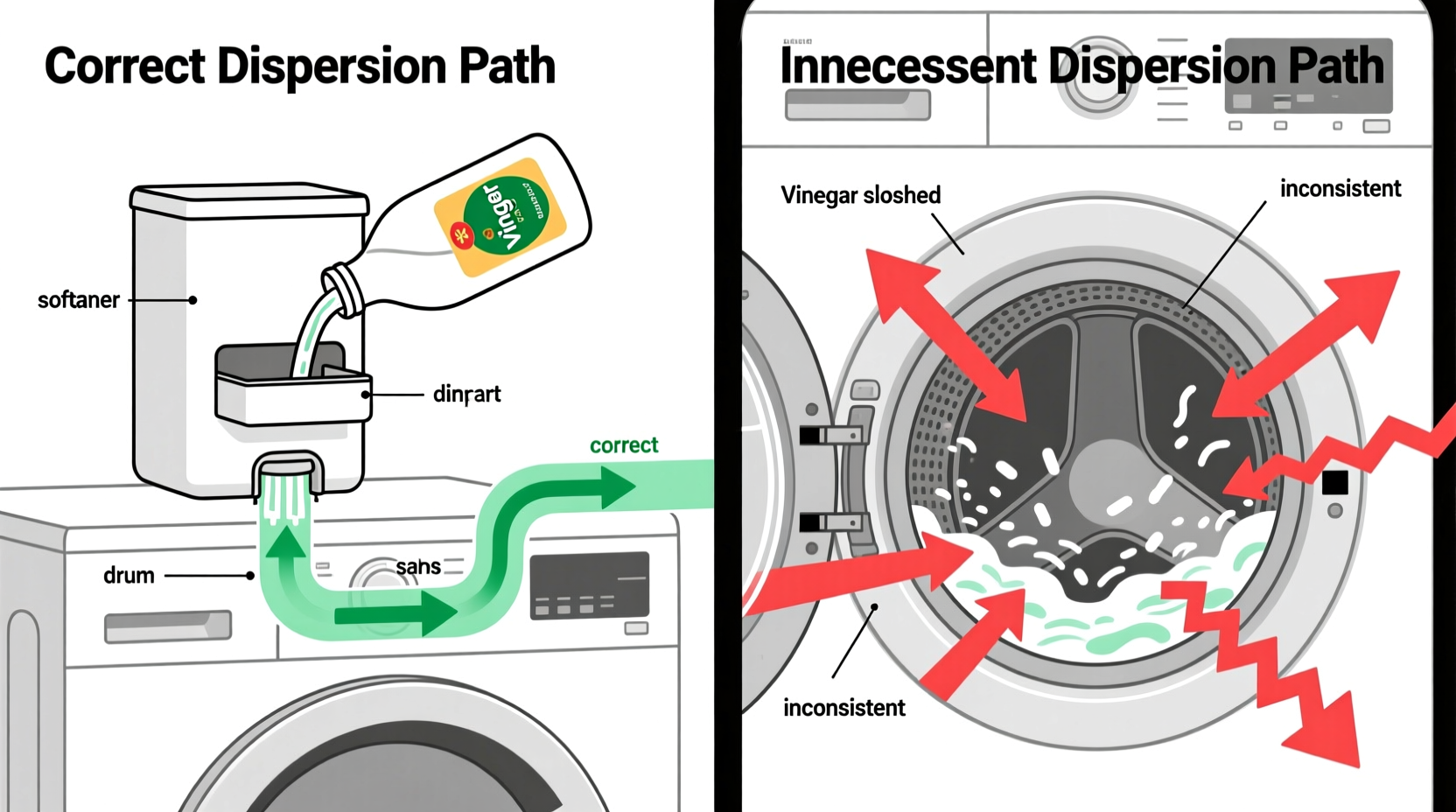
Actionable Best Practices
- ✅ Always use distilled white vinegar—never apple cider or cleaning vinegar (higher acidity, impurities).
- ✅ Fill dispenser to the 'vinegar' line or use exactly ½ cup—no estimation.
- 💡 Run a monthly 'clean wash' with 1 cup vinegar in the dispenser and no clothes to clear detergent residue from the drum and hoses.
- ⚠️ Never combine vinegar with chlorine bleach—toxic chlorine gas forms instantly.
- ⚠️ Avoid vinegar on flame-retardant children’s sleepwear—it can compromise treatment integrity.
Everything You Need to Know
Will vinegar damage my washing machine’s rubber seals or gaskets?
No—when used as directed (½ cup in dispenser), vinegar poses no risk to modern elastomer seals. In fact, it helps prevent mold and mildew buildup in damp gasket folds, a common issue in front-loaders.
Can I use vinegar with detergent in the same load?
Yes, absolutely. Detergent works in the wash phase; vinegar acts in the final rinse. They do not interact chemically because they’re separated by time, water volume, and machine programming.
Does vinegar remove detergent residue better than commercial softeners?
Yes—its mild acidity dissolves alkaline soap scum and cationic softener films that build up over time, restoring absorbency in towels and breathability in athletic wear.
Why don’t I smell vinegar after drying?
Acetic acid fully volatilizes at temperatures above 118°F—well below standard dryer heat. Any lingering scent signals either overdosing or inadequate rinse volume, not vinegar itself.
Is vinegar safe for cloth diapers?
Yes—when used in the dispenser—but avoid frequent use on microfiber inserts, as repeated exposure may reduce wicking efficiency over many cycles. Stick to once weekly for maintenance.




 浙公网安备
33010002000092号
 浙B2-20120091-4