
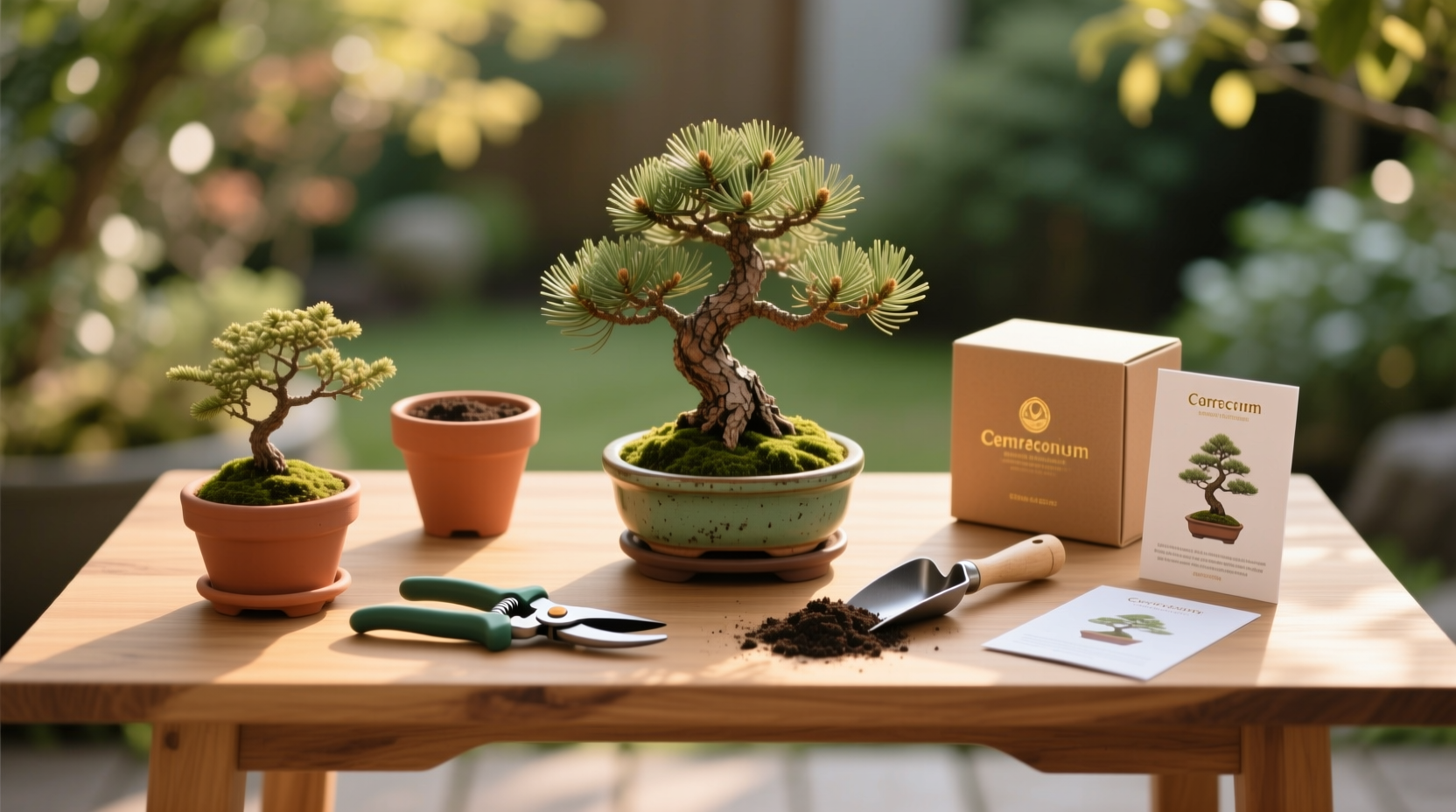
Why “Beginner-Friendly” Bonsai Kits Often Set You Up for Failure
It’s understandable why bonsai kits appeal: compact packaging, labeled “complete,” priced under $40, and prominently displayed beside succulent arrangements and terrariums. But horticulturally speaking, many kits violate three foundational principles of bonsai cultivation—species suitability, substrate integrity, and developmental timing.
First, species mismatch is rampant. Kits frequently include Ficus benjamina, Chinese elm (Ulmus parvifolia), or juniper cultivars—plants that *can* become bonsai—but often ship them as untrained nursery stock grown in dense, moisture-retentive potting mix. These specimens lack taper, branch structure, or nebari (surface root flare). Worse, some kits include tropical species like schefflera or dracaena marketed as “bonsai” despite having no historical or structural capacity for true bonsai development. These plants grow upright, produce large internodes, and resist ramification—making them unsuitable for the scale, proportion, and refinement expected in bonsai art.
Second, the “soil” included is rarely functional. Over 80% of mass-market kits ship with compressed peat pellets, coconut coir bricks, or generic “bonsai mix” containing >60% organic matter. These materials break down rapidly, compact over time, and suffocate fine roots—especially when watered as instructed (“keep moist”). True bonsai substrate must drain freely while retaining just enough moisture to support microbial life and nutrient exchange. That means mineral-based components: akadama (fired Japanese clay), pumice, lava rock, or horticultural grit—ideally in ratios adjusted for species and climate.
Third, timing expectations are dangerously unrealistic. Kit instructions often say “prune every 2–3 weeks” or “wire anytime.” In reality, pruning frequency depends on species vigor, season, and energy reserves. Wiring too early—or with soft aluminum wire on brittle branches—causes scarring or breakage. Root pruning before the tree establishes stable growth can trigger dieback. Most kits omit these critical thresholds entirely.
What a High-Value Bonsai Kit *Should* Contain (and Why Each Element Matters)
A genuinely useful bonsai kit isn’t defined by quantity, but by horticultural intentionality. Below is a breakdown of essential components—and what to verify before purchase:
- Species with proven bonsai adaptability: Look for pre-bonsai material of Juniperus chinensis ‘Shimpaku’, Carmona microphylla (Fukien tea), or Zelkova serrata—not generic “miniature tree” labels. These species tolerate root confinement, back-bud readily, and respond predictably to pruning and wiring.
- Mineral-based substrate—not peat or coir: Acceptable options include akadama (50%), pumice (25%), and lava rock (25%) for conifers; or akadama (40%), pumice (30%), and decomposed granite (30%) for broadleaf evergreens. Avoid any kit listing “peat moss,” “forest humus,” or “organic blend” as primary ingredients.
- Functional tools—not decorative novelties: A sharp concave cutter (not scissors), knob cutter for branch removal, and a fine-grade root rake are non-negotiable. Plastic-handled “bonsai shears” sold in kits often dull after one use and lack the precision needed for clean cambium cuts.
- Pot with drainage—non-porous and shallow: True bonsai pots have multiple drainage holes, unglazed sides (for breathability), and proportional depth (1/3 the height of the trunk). Avoid glazed ceramic pots with single central holes—they trap water and restrict oxygen exchange.
- Clear, species-specific care guide—not generic bullet points: It should specify seasonal watering windows (e.g., “water only when top 1 cm of akadama feels dry to touch, typically every 2–4 days in summer”), light requirements (“east-facing window with 4+ hours direct sun, not south-facing in desert climates”), and precise repotting cues (“repot when white root tips appear at drainage holes in early spring”)
Step-by-Step: Turning a Bonsai Kit into a Living, Thriving Tree
Receiving a kit is just step zero. Real cultivation begins the day you unpack it. Follow this sequence—not chronologically, but according to plant physiology:
Step 1: Immediate Assessment & First Repot (Within 48 Hours)
Remove the plant from its shipping container. Gently tease away the nursery soil—do not wash roots bare unless absolutely necessary. Inspect for circling roots, rot, or pests. Trim any blackened, mushy, or tightly wound roots with sterilized concave cutters. Repot into appropriate mineral substrate in a properly sized bonsai pot. Water thoroughly until runoff is clear. Place in bright, indirect light for 7–10 days to reduce transplant shock.
Step 2: Light Mapping—Not Guesswork
Use a free smartphone app like “Lux Light Meter” to measure foot-candles at your intended location. Junipers require ≥2,500 fc; ficus and carmona need ≥1,800 fc; zelkova tolerates 1,200–1,500 fc. If readings fall short, add a full-spectrum LED grow light (3000K–4000K, 50–70 µmol/m²/s PPFD at canopy) for 10–12 hours daily. Never rely on “bright window” descriptions—seasonal angle changes reduce winter light by up to 60%.
Step 3: Watering Based on Substrate Physics, Not Calendar
Stick your finger 2 cm deep—not the surface. Or use a moisture meter calibrated for mineral soils (standard meters read falsely high in akadama). Water only when the substrate feels *just barely damp*, not dry-crumbly nor cool-wet. For most indoor setups in moderate climates, this means: every 2–3 days in summer, every 5–7 days in winter. Always water slowly until excess drains freely—never let the pot sit in standing water.
Step 4: Pruning & Wiring: Timing Rules You Can’t Skip
Pruning: Wait until the tree produces two to three sets of new leaves post-repot. Then prune only the longest 20–30% of shoots—never remove more than one-third of total foliage at once. Use scissors only for soft new growth; use concave cutters for woody stems. Seal cuts >3 mm with wound paste.
Wiring: Wire only during active growth (spring–early summer for temperate species; year-round for tropicals in stable temps). Use aluminum wire (2–2.5 mm for trunks; 1–1.5 mm for branches). Wrap at a 45° angle—tight enough to hold, loose enough to allow swelling. Check weekly; remove before wire bites in (typically 4–8 weeks).
Top 5 Costly Mistakes Beginners Make With Bonsai Kits (and How to Avoid Them)
Mistakes aren’t failures—they’re data points. But repeating these five undermines viability faster than any pest or disease:
- Mistake #1: Keeping the original plastic nursery pot
Plastic retains heat, blocks gas exchange, and encourages root circling. Repot within 48 hours—even if the tree looks healthy. Delaying past 72 hours risks anaerobic conditions in the dense soil. - Mistake #2: Following “water when top feels dry” advice literally
This rule assumes peat-based soil. In mineral substrates, the surface dries in hours—even when lower layers remain moist. Rely on weight (a hydrated pot feels distinctly heavier) or a chopstick test (insert 3 cm deep; withdraw—if damp, wait). - Mistake #3: Pruning roots or canopy during dormancy
Deciduous species like zelkova or maple store energy in roots during winter. Pruning then depletes reserves needed for spring bud break. Only prune roots in early spring, just as buds swell—not when they’re still dormant. - Mistake #4: Using tap water without treatment
Chlorine and fluoride accumulate in mineral substrates and damage fine roots. Let tap water sit uncovered for 24 hours, or use rainwater or distilled water. Test pH monthly—ideal range is 5.5–6.5. - Mistake #5: Assuming “indoor bonsai” means low-light tolerance
There is no such thing as a true low-light bonsai. “Indoor” refers only to climate control—not light reduction. Even carmona requires >1,800 fc. If natural light is insufficient, supplemental lighting is mandatory—not optional.
Climate-Specific Adjustments: Matching Your Region to Species Choice
Your USDA Hardiness Zone (or equivalent, e.g., RHS Hardiness Rating in the UK) determines which species can thrive outdoors year-round—and which must remain indoors or in protected environments. Ignoring this leads to repeated loss:
| Climate Zone | Suitable Outdoor Species | Indoor-Only Alternatives | Critical Adjustment |
|---|---|---|---|
| Zones 4–6 (cold winters, <−20°F) | Juniperus communis, Picea glauca ‘Conica’ | Carmona, Ficus retusa | Outdoor species need winter chilling (6–8 weeks <40°F); protect pots from freeze-thaw cycles with mulch or insulated benches. |
| Zones 7–9 (mild winters, 0–30°F) | Zelkova serrata, Trident maple (Acer buergerianum) | Ficus benjamina, Serissa foetida | Monitor late frosts—new spring growth is highly susceptible. Delay pruning until after last frost date. |
| Zones 10–11 (frost-free, >30°F) | Olive (Olea europaea), Bougainvillea | All tropical species | Increase air circulation—stagnant humidity invites fungal leaf spot. Use fans on low setting during midday. |
When to Ditch the Kit—and Invest in Real Bonsai Infrastructure
A kit serves its purpose for roughly 9–12 months—provided you’ve followed sound horticultural practice. After that, progression demands infrastructure upgrades:
- Substrate upgrade: Replace initial mix with custom-blended akadama/pumice ratio based on observed drying rate and root health. Add mycorrhizal inoculant at repotting to restore beneficial fungi lost in sterile mixes.
- Tool upgrade: Replace plastic-handled cutters with stainless steel, ergonomic models (e.g., Masakuni or Kikuichi). Precision matters—blunt tools crush tissue, inviting infection.
- Light upgrade: Switch from basic LED strips to horticultural fixtures with adjustable spectrum and dimming (e.g., Mars Hydro TSW 2000). Monitor PPFD regularly—output degrades 20–30% per year.
- Education upgrade: Move beyond kit pamphlets to authoritative texts: *The Complete Book of Bonsai* (Harry Tomlinson), *Bonsai Basics* (Colin Lewis), or the International Bonsai Arboretum’s free seasonal webinars.
Frequently Asked Questions
Q: Can I use regular potting soil instead of bonsai mix?
No. Regular potting soil retains too much water, breaks down into sludge, and collapses pore space—suffocating roots within 4–8 weeks. Mineral substrates mimic natural rocky outcrops where bonsai species evolved. If akadama is unavailable, substitute equal parts horticultural grit, pumice, and screened Turface MVP.
Q: My kit included a “bonsai fertilizer”—is it adequate?
Most kit fertilizers are balanced (e.g., 10-10-10) and synthetic. While usable short-term, they lack trace elements critical for bark development and ramification. Switch after 3 months to an organic slow-release like Biogold or a liquid kelp-fish emulsion (e.g., Grow More 10-10-10 + Sea Green). Apply only during active growth—never in dormancy or extreme heat.
Q: How do I know if my bonsai is getting enough light indoors?
Observe growth patterns: elongated internodes, pale leaves, weak branching, or leaf drop signal insufficiency. Use a PAR meter or Lux app. If readings stay below 1,200 fc for >3 hours daily, supplement immediately. No bonsai species thrives long-term under standard room lighting.
Q: Can I keep a juniper indoors year-round?
No—junipers are outdoor species requiring winter dormancy and high light intensity. Indoor placement leads to needle drop, spider mite infestation, and eventual death. Keep them on a balcony, patio, or unheated garage with light exposure. Only tropical species (carmona, ficus, serissa) are viable indoors.
Q: Is it okay to buy a bonsai kit online versus from a local nursery?
Online kits offer convenience but carry higher risk: shipping stress, delayed arrival, and no opportunity to inspect root health or trunk taper pre-purchase. Local nurseries let you assess vigor, check for pests, and ask staff about regional suitability. If buying online, choose vendors who ship bare-root or semi-bare-root with moisture wraps—and confirm species identity via botanical name, not common name.
Bonsai is not about miniaturization for novelty’s sake—it’s about cultivating resilience, observing subtle physiological cues, and participating in a living dialogue between human intention and plant response. A kit can spark that relationship, but it cannot sustain it. The moment you repot your first tree into proper substrate, prune with anatomical awareness, and adjust care based on seasonal shifts—not package instructions—you’ve moved beyond the kit and into authentic bonsai practice. That transition doesn’t happen on a timeline. It happens when observation replaces assumption, when substrate physics informs watering, and when respect for species-specific needs overrides the desire for instant results. That’s where lifelong cultivation begins.
Remember: Every thriving bonsai you see in galleries or exhibitions started not with a kit—but with someone who chose patience over packaging, precision over promise, and plant science over slogans. Your first tree won’t look like a masterwork in six months. But if you honor its biology, it will still be alive—and teaching you—five years from now.




 浙公网安备
33010002000092号
 浙B2-20120091-4