
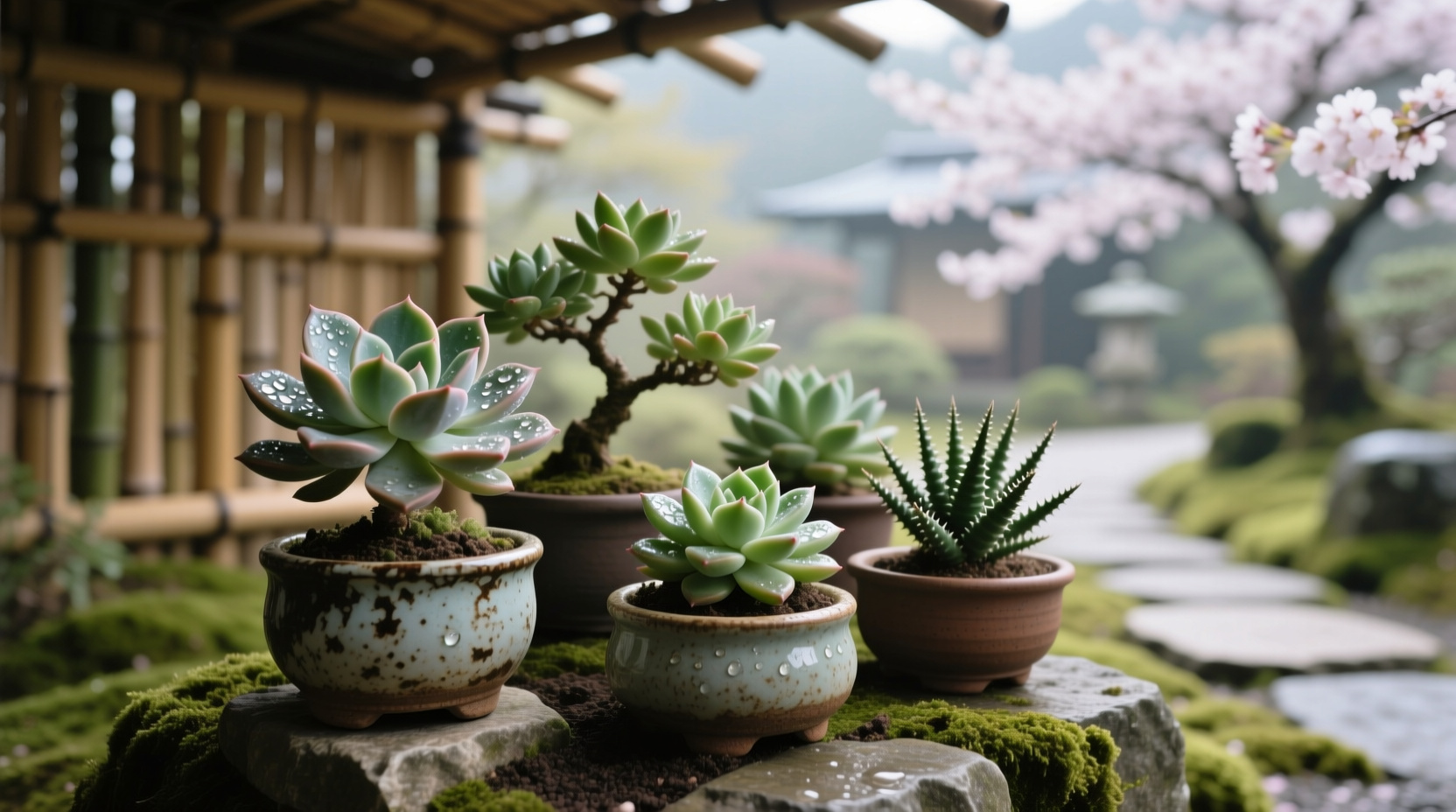
Why “Bonsai Succulent Plants” Is a Misleading Term—And Why It Still Matters
The phrase “bonsai succulent plants” circulates widely online, often attached to marketing photos of tiny jade plants in shallow ceramic pots. Yet botanically, it’s inaccurate—and that inaccuracy causes real harm. True bonsai (from the Japanese bon = tray, sai = planting) refers to the disciplined cultivation of perennial, woody-stemmed trees or shrubs trained for decades into miniature representations of mature forest specimens. These plants must possess: (1) secondary growth (true wood formation), (2) ability to back-bud reliably after pruning, (3) fine branching capacity, and (4) tolerance for root confinement and repeated repotting.
Most succulents—by definition—store water in leaves, stems, or roots and evolved in arid environments. Their growth patterns differ fundamentally: many lack true cambial wood (e.g., Echeveria, Sedum), produce new growth from meristematic tissue at leaf axils rather than dormant buds, and respond poorly to aggressive root pruning or constant wiring. Forcing a Sempervivum into a bonsai pot without drainage adaptation invites crown rot within weeks.
That said, the *intent* behind the term is valid and valuable: gardeners worldwide seek compact, sculptural, low-maintenance container plants with strong visual presence. And several succulents *do* lend themselves beautifully to intentional shaping, aging, and display—when approached with physiological respect. The key is shifting focus from “making a succulent into a bonsai” to “cultivating a succulent with bonsai-inspired discipline.”
Top 7 Species That Excel in Bonsai-Style Cultivation
Not all succulents are equal candidates. Below are species proven over decades of hands-on balcony, greenhouse, and indoor trials to respond well to miniature training—provided core cultural needs are met first.
- Crassula ovata (Jade Plant): The gold standard. Develops thick, woody trunks with age; branches readily; tolerates heavy pruning and light wiring (use padded aluminum wire only on young, green stems); thrives in shallow pots with excellent drainage. Mature specimens over 10 years old show pronounced bark texture and taper.
- Portulacaria afra (Elephant Bush): Faster-growing than jade but equally responsive. Stems lignify quickly; leaves reduce in size under consistent sun and mild stress; excellent for informal upright or cascade styles. Avoid overwatering—it drops leaves before showing visible rot.
- Adenium obesum (Desert Rose): A true caudiciform—its swollen basal caudex stores water and becomes dramatically sculptural. Requires warm temperatures year-round (>55°F/13°C minimum), full sun, and strict dry-wet cycles. Prune hard in spring to encourage branching; never wire the caudex.
- Euphorbia tirucalli ‘Sticks on Fire’: Grows upright with pencil-thin, orange-red stems. Responds to tip pruning by producing dense lateral shoots. Use extreme caution—sap is toxic and irritant. Best for tall, linear compositions.
- Senecio serpens (Blue Chalksticks): Low-growing, trailing; ideal for literati or windswept styles in wide, shallow containers. Pinch tips regularly to maintain density; tolerates drought and reflected heat.
- Pachyphytum oviferum (Moonstones): Rosette-forming with plump, powdery blue leaves. Not wired—but stunning in shallow pots where its sprawling habit creates natural asymmetry. Repot every 2–3 years to refresh soil; avoid burying the stem.
- Caralluma europaea: A lesser-known but exceptional candidate. Forms compact, segmented stems with star-shaped flowers. Thrives on neglect—water only when soil is bone-dry for 5+ days. Ideal for rock gardens or crevice-style plantings.
Species to avoid entirely: Sempervivum (rosettes collapse when stressed), Lithops (no stem structure), Kalanchoe blossfeldiana (leggy, weak stems), and most Graptopetalum (prone to stem flop and rot under confinement).
Soil, Pots, and Drainage: Non-Negotiable Foundations
Bonsai-style succulents fail most often due to poor substrate—not insufficient sunlight or incorrect pruning. Standard “cactus mix” sold commercially is frequently too peaty or contains moisture-retentive polymers. Your mix must drain *within seconds*, yet retain enough trace minerals and microbial life to support slow growth.
A field-tested formula (by volume):
- 40% coarse pumice (¼”–⅜” grade—not perlite, which degrades and floats)
- 30% baked clay granules (Turface MVP or Akadama—soaked 24 hrs before use)
- 20% screened decomposed granite (¼” max particle size)
- 10% high-quality compost (well-aged, low-salt, screened to ⅛”)
Pots must have *at least three* large drainage holes—not one small one. Glazed ceramic is acceptable if unglazed on the base; avoid plastic unless drilled extensively. Depth matters: Jade and Elephant Bush need pots at least 4–6 inches deep to anchor developing trunks; Desert Rose requires depth equal to caudex height plus 2 inches for root expansion. Never use “bonsai pots” with no drainage—this is the single most common cause of sudden death.
Watering: The #1 Killer—and How to Master It
Overwatering kills more bonsai-style succulents than pests, frost, or neglect combined. But “less water” isn’t the answer—it’s timing, temperature, and soil response.
Use the “weight test”: Lift the pot daily in active growth season (spring–early fall). When it feels *lighter than your hand*—not just “dry on top”—it’s time to water. In winter, lift weekly; many species require zero water for 6–8 weeks if kept cool (50–55°F/10–13°C) and bright.
Never water on a schedule. Instead, monitor these four concurrent signals:
- Soil surface: Cracked, dusty, and pulling away from pot edges
- Soil color: Light tan turning pale gray—not just brown
- Root zone temperature: Cool to touch indicates evaporation is complete
- Plant firmness: Gently squeeze a lower stem—slight give is normal; mushiness means rot has begun
When watering, drench thoroughly until water exits all holes—then empty the saucer immediately. Do not mist foliage; it encourages fungal spores and offers zero hydration benefit.
Pruning, Shaping, and Wiring: Technique Over Tradition
Pruning serves two purposes: health maintenance and aesthetic refinement. Remove dead, crossing, or inward-growing stems first—always with sterilized bypass pruners (rubbed with 70% isopropyl alcohol). For shape, prune *just above a node facing the direction you want new growth*. Jade produces 2–3 new shoots per cut; Elephant Bush may produce up to 5.
Wiring is optional—and risky. Only apply to *green, flexible stems less than ¼” thick*. Use 1–2 mm anodized aluminum wire (never copper—it corrodes and burns tissue). Wrap loosely—never tighter than a gentle hug—and check weekly. Remove within 4–6 weeks, even if shape isn’t perfect; prolonged pressure causes scarring and girdling. Never wire near the caudex (Adenium) or rosette center (Echeveria).
For trunk thickening, allow one dominant leader to grow unpruned for 12–18 months—then cut back hard. Repeat annually. Sun exposure accelerates lignification: place outdoors in full sun for 6+ hours daily during warm months (acclimate gradually over 10 days).
Fertilizing: Less Is Legibly More
Succulents evolved in nutrient-poor soils. Excess nitrogen causes weak, spongy growth; excess phosphorus binds micronutrients. Feed only during active growth (mid-spring to early autumn), and only when plants show clear vigor—new leaf flush, stem elongation, or flower bud formation.
Use a fertilizer with an NPK ratio of 3-1-2 or 2-1-2, low in urea and chloride. Apply at ¼ strength, every 4–6 weeks. Organic options include diluted fish emulsion (1:10) or compost tea—strain thoroughly to prevent clogging pores. Never fertilize dormant, stressed, or recently repotted plants. Skip entirely in winter—even for indoor specimens under grow lights.
Repotting: Timing, Technique, and Root Respect
Repot every 2–3 years for juveniles; every 3–5 years for mature specimens. Best timing: early spring, just as new growth emerges (watch for tiny pink or red tips on stems). Avoid repotting in summer heat or winter chill.
Steps:
- Withhold water for 7–10 days pre-repot to dry roots slightly
- Gently remove plant; shake off loose soil—do not aggressively wash or comb roots
- Inspect for rot (black, mushy, foul-smelling sections)—cut away with sterile knife until clean, white tissue appears
- Trim only circling or broken roots—preserve fine feeder roots
- Place in new pot with fresh mix; tamp lightly—do not compact
- Wait 5–7 days before first watering; keep in bright, indirect light
Never increase pot size by more than 1 inch in diameter. A 6-inch Jade thrives in a 7-inch pot—not a 10-inch one. Oversized containers hold excess moisture far longer than roots can utilize.
Light, Temperature, and Seasonal Rhythms
Full sun is non-negotiable for trunk development and compact growth. Indoors, south-facing windows provide ~200–400 µmol/m²/s PAR—barely adequate. Supplement with full-spectrum LED grow lights (300–500 µmol/m²/s at canopy) for 10–12 hours daily March–October. Rotate pots weekly for even exposure.
Temperature drives dormancy cues. Jade and Elephant Bush enter semi-dormancy below 55°F (13°C); Desert Rose shuts down below 60°F (16°C). Use this intentionally: move to a cooler (but frost-free) location October–February, reduce water to near-zero, and cease fertilizing. This rest period strengthens cell walls and sets flower buds for spring.
Humidity is irrelevant—these plants thrive at 20–40% RH. Misting or humidifiers promote rot and attract fungus gnats.
Common Mistakes That Sabotage Success
Even experienced gardeners repeat these errors—often because advice conflates true bonsai with succulent care:
- Mistake #1: Using bonsai soil for succulents — Traditional akadama-heavy mixes retain too much moisture for succulents. They break down into mud when overwatered, suffocating roots.
- Mistake #2: Pruning during dormancy — Cutting in late fall or winter invites infection and delays spring recovery. Always prune in active growth windows.
- Mistake #3: Ignoring seasonal light shifts — Moving a sun-hardened plant indoors in autumn without acclimation causes etiolation (stretching) and leaf drop. Transition over 14 days.
- Mistake #4: Treating all “small pots” as bonsai pots — A decorative ceramic dish with one hole is a death trap. Drainage trumps aesthetics—every time.
- Mistake #5: Assuming “drought-tolerant” means “neglect-tolerant” — These plants need precise hydration cycles, not abandonment. Chronic underwatering leads to stunted growth, leaf shriveling, and vulnerability to scale insects.
Troubleshooting: What Symptoms Really Mean
Diagnosis starts with root inspection—not leaf guessing.
| Symptom | Most Likely Cause | Action |
|---|---|---|
| Lower leaves yellowing + soft stem base | Chronic overwatering / poor drainage | Remove plant, cut away all rot, repot in dry mix, withhold water 10 days |
| Leaf drop without mushiness | Underwatering OR sudden temperature drop | Check root moisture; adjust watering; verify nighttime temps >50°F |
| Etiolation (long, thin stems, spaced leaves) | Insufficient light intensity or duration | Move to brighter location or add supplemental lighting; prune back hard |
| White crust on soil surface | Mineral salt buildup from tap water or fertilizer | Leach soil monthly with distilled water; switch to rainwater or filtered water |
| Black spots on leaves/stems | Fungal infection (often from overhead watering or humidity) | Remove affected parts; improve air circulation; stop misting; apply copper fungicide once |
FAQ: Practical Questions from Real Growers
Can I grow bonsai-style succulents on a north-facing balcony?
No—north-facing exposures provide insufficient light intensity (<100 µmol/m²/s) for trunk lignification or compact growth. You’ll get etiolated, weak plants prone to rot. Use full-spectrum LEDs (minimum 300 µmol/m²/s at canopy) for 12 hours daily, or relocate to east/west/south exposure.
How do I encourage a thick trunk on my jade plant?
Allow uninterrupted vertical growth for 12–18 months in full sun and warm temperatures (70–85°F/21–29°C). Then prune back by ⅓–½. Repeat annually. Trunk thickness correlates directly with total photosynthetic surface area over time—not pruning frequency.
Is tap water safe for bonsai succulents?
Only if your municipal water is low in sodium and bicarbonates (check your local water report). High alkalinity raises soil pH, locking up iron and manganese. Use rainwater, distilled water, or reverse-osmosis water for best results—especially for Desert Rose and Elephant Bush.
Do bonsai-style succulents attract pests indoors?
Yes—primarily mealybugs and scale, drawn to stressed or overwatered plants. Inspect stems weekly with a 10x loupe. Treat early infestations with 70% isopropyl alcohol on a cotton swab. Avoid systemic neonicotinoids—they harm pollinators and degrade slowly in soil.
Can I graft different succulent species together for artistic effect?
Technically possible between closely related genera (e.g., Crassula × Crassula), but success rates are low (<20%) and long-term union stability is poor. Grafting introduces disease vectors and rarely enhances aesthetic value. Focus instead on complementary potting—pairing a sculptural Jade with trailing Senecio in the same container.
Mastering bonsai-style succulent cultivation isn’t about forcing nature—it’s about observing, respecting, and partnering with each plant’s innate architecture and rhythm. It demands patience measured in seasons, not weeks; attention to micro-changes in stem texture, leaf spacing, and soil weight; and the humility to let go of rigid definitions. The reward? Living sculptures that deepen in character over years—a fusion of resilience, form, and quiet intention. Start with one healthy Crassula ovata, a properly drained pot, and a commitment to watch—not just water. Everything else follows.
Remember: There are no shortcuts in living art. But there is immense satisfaction in guiding growth—not commanding it.




 浙公网安备
33010002000092号
 浙B2-20120091-4