
Why Bonsai Are Not Just “Small Trees”—And Why That Matters
Bonsai are living organisms trained through horticultural discipline—not genetically dwarfed plants. Every species used in bonsai (from Ficus retusa to Juniperus chinensis) possesses full-size genetic potential. What makes them miniature is sustained root confinement, repeated canopy reduction, and controlled nutrient availability. This induces stress-adapted morphology: smaller leaves, shorter internodes, denser ramification, and lignified bark—but also heightened sensitivity to environmental shifts. A Japanese maple (Acer palmatum) grown as a landscape tree tolerates brief droughts; the same cultivar in a 6-inch pot may desiccate to death in under 18 hours on a 32°C balcony. Understanding this physiological amplification is foundational. Ignoring it leads directly to the #1 cause of bonsai mortality: misaligned care protocols borrowed from houseplants or garden shrubs.
Watering: The Most Misunderstood Core Practice
“Water when the top inch is dry” is dangerously inaccurate for bonsai. Soil surface dryness tells you nothing about moisture at root level—especially in shallow pots with fast-draining akadama or pumice mixes. Instead, use the weight-and-tilt method:
- Weigh your pot (with tree) every morning before sunrise. Note the baseline weight when fully saturated.
- After 24 hours, weigh again. A loss of 12–18% indicates optimal timing for thorough watering.
- For trees in full sun or above 28°C, recheck weight at noon. If loss exceeds 22%, water immediately—even if morning reading was acceptable.
This method works because mature bonsai roots occupy only 15–25% of pot volume, leaving minimal water-holding reserve. In contrast, overwatering symptoms—yellowing older leaves, blackened root tips, fungal odor—appear within 48 hours of poor drainage. Never use standard potting soil. Always use a custom mix: 50% fired clay (akadama), 25% pumice, 25% lava rock for conifers; 40% akadama, 30% pumice, 20% fine pine bark, 10% decomposed granite for deciduous species like Zelkova serrata or Carmona microphylla. These substrates hold moisture briefly at particle surfaces while allowing 98% air-filled porosity—critical for root respiration.
Light & Placement: Species-Specific Requirements You Can’t Ignore
Light intensity, duration, and spectral quality dictate photosynthetic output—and thus energy available for root repair, bud formation, and defense compound synthesis. Indoor bonsai (e.g., Ficus benjamina, Sageretia theezans) require >2,500 lux at leaf level for ≥10 hours daily. A south-facing window delivers ~10,000 lux at noon but drops to <500 lux after 3 PM—insufficient for sustained vigor. Supplement with full-spectrum LED grow lights (3,000–6,500K CCT, 100 µmol/m²/s PPFD at canopy) placed 12 inches above foliage for 12 hours. Outdoor bonsai need site-specific placement:
- Junipers and pines: Full sun year-round (≥6 hours direct UV). Shade causes weak, leggy growth and needle elongation.
- Maples and elms: Morning sun + afternoon dappled shade in summer (UV index >6); full sun in spring/fall.
- Tropicals (Carmona, Serissa): Filtered light only—direct midday sun scorches leaves and desiccates buds.
Never rotate bonsai weekly like houseplants. Sudden directional change disrupts phototropic auxin distribution, causing uneven ramification and weak secondary branching. Rotate only during spring repotting—and only 90° maximum.
Pruning: Timing, Technique, and Hormonal Response
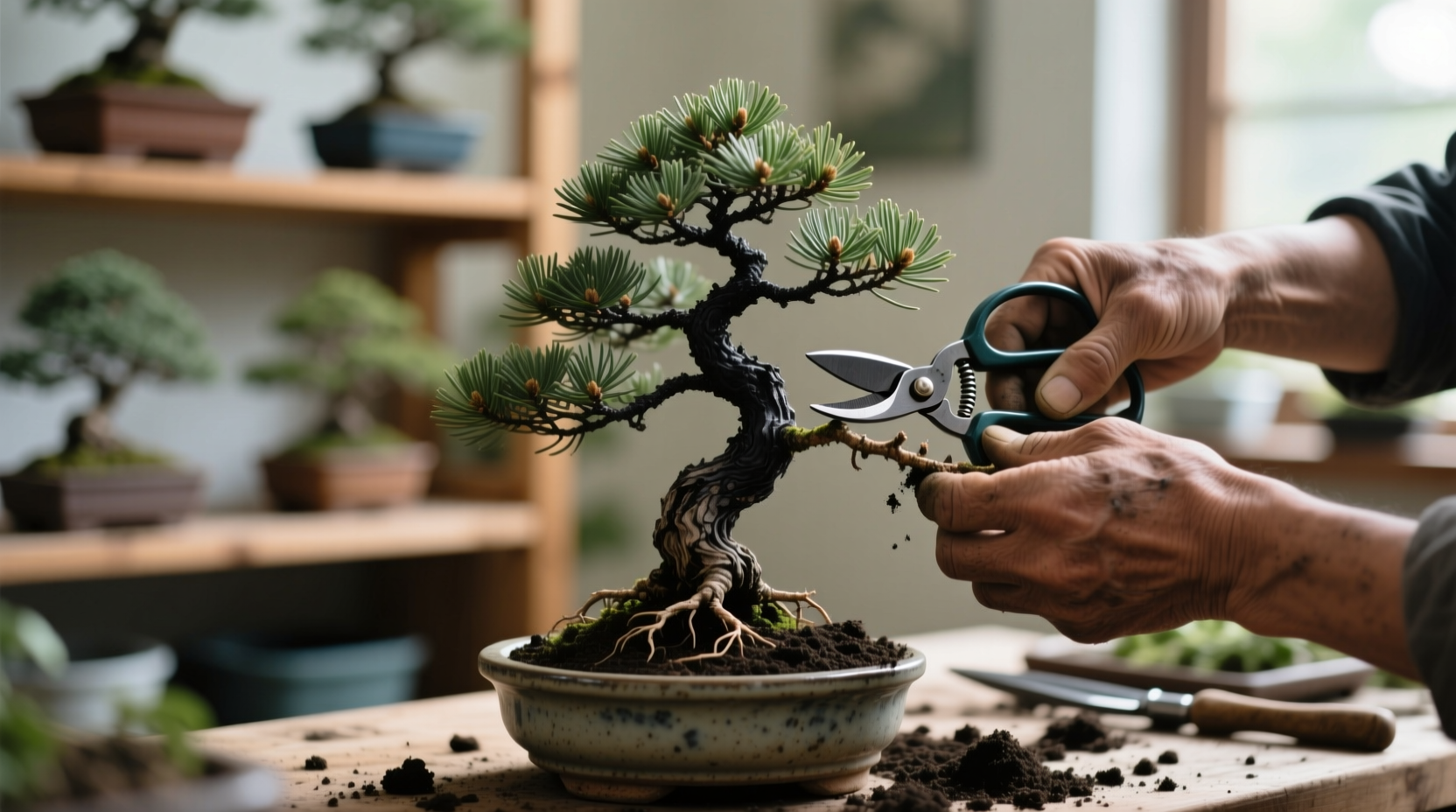
Pruning serves two distinct purposes: structural development and maintenance. Confusing them causes irreversible damage. Structural pruning—removing primary branches to define silhouette—must occur only during active growth phases when auxin and cytokinin levels peak. For temperate deciduous species (maples, elms, zelkovas), prune in early spring (bud swell) or late summer (after first flush hardens). For conifers (junipers, pines), prune candles in late spring (for density) or remove entire branches in early fall (when sap flow slows but cambium remains active). Never prune dormant deciduous trees in winter—cambial tissue lacks energy reserves to seal wounds, inviting fungal entry.
Maintenance pruning—trimming new shoots to 1–2 nodes—occurs every 10–14 days during growing season. Use sharp, concave branch cutters sterilized in 70% isopropyl alcohol between trees. Leave no stubs: cut flush to branch collar, where meristematic tissue initiates callus. After pruning, apply wound sealant only to cuts >¼ inch diameter on Acer or Ulmus; never seal juniper or pine wounds—the resinous exudate is natural protection.
Fertilization: Feeding Without Forcing
Bonsai require consistent, low-concentration nutrition—not periodic “feeding sprees.” Their tiny root systems absorb nutrients rapidly but lack buffering capacity. High-N fertilizers applied in summer trigger soft, sappy growth vulnerable to aphids and wind breakage. Instead, follow a seasonal NPK rhythm:
- Early spring (bud swell): 12-6-6 (higher nitrogen for shoot expansion)
- Mid-spring to early summer: 6-6-6 (balanced for root and leaf maturation)
- Midsummer: 3-10-10 (phosphorus/potassium focus for lignification and stress resilience)
- Early fall: 0-10-10 (no nitrogen—encourages hardening before dormancy)
Apply liquid fertilizer weekly at ¼ strength—or use time-release granules (e.g., Biogold or Hanagokoro) buried ½ inch below soil surface, replenished every 6–8 weeks. Never fertilize within 10 days of repotting, pruning, or during heat stress (>35°C). Flush pots monthly with plain water to prevent salt accumulation—a leading cause of root tip necrosis.
Repotting: When, Why, and How It Saves Lives
Repotting isn’t optional maintenance—it’s essential physiology. Roots secrete organic acids that acidify substrate over time. Akadama breaks down into fine dust after 18–24 months, collapsing pore space and suffocating roots. Visual signs demand action: slow growth despite adequate light/fertilizer, water pooling on surface >5 minutes after watering, or white fungal hyphae visible at pot rim. Ideal timing aligns with root phenology—not calendar dates:
- Deciduous species: Repot at bud swell (first green tip visible), when root tips are white and actively dividing.
- Conifers: Repot in early spring (just before candle emergence) or early fall (late September–mid-October in USDA Zones 5–8).
- Tropicals: Repot in late spring (May–June), when soil temps consistently exceed 20°C.
Process: Remove tree gently, wash soil from roots with lukewarm water, inspect for circling or blackened roots. Trim no more than 30% of total root mass—focus on thick, downward-growing roots. Retain fine feeder roots near trunk base. Repot into clean pot with fresh mix, ensuring root flare sits ¼ inch below rim. Water thoroughly, then place in shaded, humid location for 10 days before gradual reintroduction to light.
Common Fatal Mistakes—and How to Reverse Them
Over 70% of beginner bonsai deaths stem from just four errors. Recognize these early—and act:
- Mistake #1: Using “bonsai soil” sold at big-box stores. These blends contain peat moss, compost, or vermiculite—water-retentive materials that suffocate roots in shallow pots. Solution: Mix your own or source from reputable bonsai suppliers (e.g., Superfly Bonsai, Bonsai Boy of NY).
- Mistake #2: Pruning during dormancy or extreme heat. Dormant pruning creates open wounds that won’t heal; summer pruning on stressed trees depletes carbohydrate reserves. Solution: Mark your species’ phenological calendar—track bud swell, candle emergence, and leaf drop annually.
- Mistake #3: Assuming indoor = low-light tolerant. True indoor bonsai (Ficus, Carmona) still require intense, consistent light. Solution: Measure light with a lux meter app (e.g., Light Meter Pro) before placing any tree indoors.
- Mistake #4: Skipping winter dormancy for deciduous species. Maples and elms require 8–12 weeks below 7°C to reset hormonal cycles. Solution: Place outdoors in unheated garage or against north wall with mulch-covered pot base—avoid freezing root ball solid.
Species-Specific Nuances You Must Know
One-size-fits-all bonsai care is a myth. Here’s what separates thriving specimens from struggling ones:
| Species | Water Sensitivity | Critical Light Need | Dormancy Requirement | Key Vulnerability |
|---|---|---|---|---|
| Juniperus procumbens | Low—tolerates brief dryness | Full sun year-round | None (evergreen) | Root rot from overwatering; spider mites in dry air |
| Acer palmatum (Japanese maple) | High—dries rapidly; needs humidity | Morning sun only in summer | Yes—8 weeks @ ≤7°C | Leaf scorch from wind/heat; verticillium wilt in heavy soil |
| Ficus retusa | Moderate—check weight daily in summer | Bright indirect + 2 hours direct AM sun | None (tropical) | Leaf drop from draft or light shift; scale insects on stems |
| Pinus thunbergii (Black pine) | Low—deep roots tolerate dryness | Full sun; needs wind exposure | None (evergreen) | Candle breakage from handling; poor ramification if decandling skipped |
Pest & Disease Management: Prevention Over Reaction
Healthy bonsai resist pests naturally. Stress—from improper watering, light, or nutrition—lowers terpenoid and tannin production, making trees palatable to insects. Monitor weekly: hold a white sheet of paper beneath branches and tap—aphids, spider mites, and scale crawlers will fall onto it. Treat only when counts exceed 5 per 10 cm²:
- Aphids/Spider mites: Spray with insecticidal soap (Safer Brand) + 1% horticultural oil, applied at dawn or dusk. Repeat every 5 days for 3 cycles.
- Scale insects: Scrape adult shells with soft toothbrush, then drench soil with systemic imidacloprid (Bonide Systemic Granules)—only in spring, never during flowering or high heat.
- Root rot: Unpot immediately. Trim all black, mushy roots. Soak remaining roots in 0.1% hydrogen peroxide for 5 minutes. Repot in sterile, gritty mix. Withhold water for 7 days.
Prevent fungal leaf spots (e.g., Phyllosticta on maples) by avoiding overhead watering and ensuring airflow—use small fans on balconies during humid periods.
Winter Survival: Protecting Roots, Not Just Trunks
Roots die at higher temperatures than above-ground parts. While a maple trunk survives –20°C, its roots perish at –5°C if exposed. Critical protection strategies:
- In-ground storage: Dig trench 12 inches deep, line with insulation board, place pots inside, cover with 6 inches of shredded hardwood mulch. Monitor soil temp with probe thermometer.
- Unheated garage: Stack pots on wooden pallets (not concrete floor), wrap pots in burlap, group together for thermal mass. Keep door cracked 1 inch for air exchange.
- Never: Bring deciduous bonsai indoors for winter—they’ll break dormancy prematurely and exhaust reserves.
Frequently Asked Questions
How often should I water my bonsai tree?
Frequency varies by species, pot size, climate, and season—not fixed intervals. Use the weight method: water when pot weight drops 12–18% from saturated weight. Small pots in full sun may need daily watering in summer; larger pots with conifers may go 3 days in spring.
Can I keep a bonsai tree indoors year-round?
Only true tropical species (Ficus, Carmona, Serissa) can thrive indoors—if given sufficient light (≥2,500 lux for 10+ hours). Temperate species (maple, elm, juniper) require outdoor seasonal cycles and will decline within 6–12 months indoors.
When is the best time to prune a juniper bonsai?
Structural pruning: early spring (before candle emergence) or early fall (September–early October). Maintenance pruning: pinch new growth year-round except during extreme heat (>35°C) or drought stress.
Why are my bonsai leaves turning yellow and dropping?
Primary causes: overwatering (check root health—black, slimy roots mean rot), underwatering (crispy brown edges), insufficient light (pale yellow, elongated internodes), or sudden environmental shift (draft, temperature drop, relocation). Test soil moisture and light levels before assuming nutrient deficiency.
Do bonsai trees need special fertilizer?
Yes—standard houseplant fertilizer is too strong and unbalanced. Use bonsai-specific formulations with low, consistent NPK ratios (e.g., 5-5-5 or 3-10-10) applied weekly at quarter-strength, adjusted seasonally for growth phase and species requirements.
Bonsai tree care merges botanical precision with patient observation. It demands respect for species-specific physiology—not adherence to folklore or aesthetic dogma. Every decision—from the angle of a pruning cut to the particle size of your substrate—alters cellular water potential, hormone gradients, and carbon allocation. Master the weight method before memorizing schedules. Learn your tree’s phenology before reaching for shears. Prioritize root health over instant canopy density. With this foundation, even a Ficus trained from nursery stock can live 40+ years in a 5-inch pot—its miniature form not a compromise, but a testament to symbiotic horticultural intelligence. Start today: weigh your tree at dawn, note the number, and return in 24 hours. That single data point is where lifelong bonsai mastery begins.




 浙公网安备
33010002000092号
 浙B2-20120091-4