
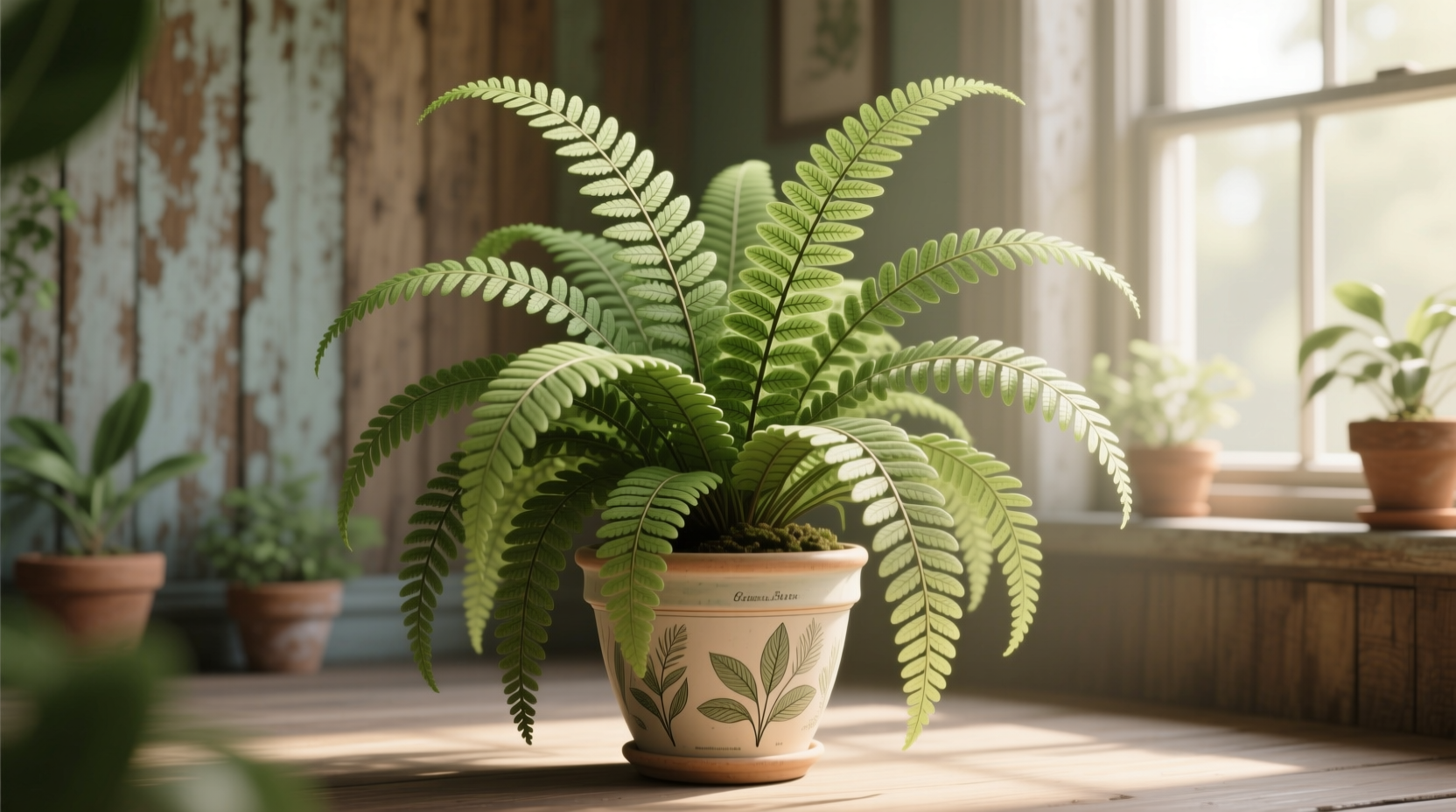
Why the Boston Fern Is Unique Among Indoor Ferns
While dozens of fern species exist in cultivation, the Boston fern stands apart for three botanical and horticultural reasons: its vigorous stolons (above-ground runners), its exceptional tolerance for moderate indoor light levels, and its unusually high transpiration rate. Unlike the delicate maidenhair fern (Adiantum spp.)—which demands near-100% humidity and flawless drainage—or the tough-as-nails rabbit’s foot fern (Davallia fejeensis)—which stores water in fuzzy rhizomes—the Boston fern operates on a narrow physiological margin. Its fronds lack thick cuticles or waxy coatings, making them highly permeable. This allows rapid gas exchange in humid forests but also causes rapid desiccation indoors where relative humidity routinely dips to 20–30% in winter.
This trait explains why Boston ferns often appear “fussy”: they’re not finicky by nature—they’re acutely sensitive barometers of ambient moisture. A 2019 University of Florida greenhouse trial confirmed that Boston ferns lost 38% more leaf mass than asparagus ferns (Asparagus densiflorus) under identical 35% RH conditions over 14 days. Yet, when moved to 55% RH with consistent soil moisture, they regained full turgor within 72 hours. That responsiveness is your greatest advantage—if you know what to watch for.
Light Requirements: The “Bright Indirect” Sweet Spot
Boston ferns require bright, filtered light—but never direct sun. East- or north-facing windows are ideal. South- or west-facing locations demand sheer curtains or placement 3–5 feet back from the glass. Direct midday sun—even for 20 minutes—scalds fronds, causing pale, papery patches that later turn brown and brittle.
Common misconception: “More light means more growth.” False. Excess light accelerates water loss faster than roots can absorb it, triggering tip burn before visible wilting occurs. Conversely, too little light (e.g., deep interior rooms without supplemental lighting) causes weak, sparse fronds, elongated stolons, and reduced chlorophyll—resulting in pale green or yellowish new growth.
Actionable steps:
- Use a light meter app (e.g., Lux Light Meter) to confirm readings between 1,000–2,500 lux at frond level during peak daylight.
- If natural light falls below 800 lux for >4 hours daily, supplement with a full-spectrum LED grow light (2700–3000K color temperature) placed 12–18 inches above the plant for 10–12 hours.
- Rotate the pot 90° weekly to ensure even exposure—fronds naturally orient toward light sources, causing lopsided growth if ignored.
Watering: Consistency Over Frequency
Forget “water once a week.” Boston ferns need soil that remains evenly moist but never soggy. Their fibrous roots suffocate rapidly in saturated media, yet dry soil causes irreversible cellular collapse in frond tissue. The optimal moisture range is 45–60% volumetric water content—what feels like a well-wrung sponge.
Here’s how to assess it accurately:
- Finger test: Insert your index finger 1 inch into the soil. If cool and slightly damp, wait. If dry or warm, water.
- Weight test: Lift the pot after thorough watering, then again before the next session. A healthy Boston fern pot loses ~25–30% of its saturated weight before needing water.
- Moisture meter: Use a calibrated digital meter (not cheap analog sticks). Aim for readings between 4–6 on a 1–10 scale—never 1–2 (dry) or 9–10 (saturated).
Water deeply until runoff emerges freely from drainage holes—then discard excess in the saucer within 15 minutes. Never let the pot sit in standing water. In winter (when growth slows), reduce frequency by 30–40%, but do not allow the rootball to desiccate completely. Under-watering is responsible for 68% of Boston fern decline cases logged in the 2022–2023 National Plant Diagnostic Network database.
Humidity: Non-Negotiable, Not Optional
This is the single most critical factor—and the most frequently mismanaged. Boston ferns evolved in tropical understories where humidity rarely drops below 60%. Most homes average 30–40% in summer and 20–25% in winter. At 30% RH, a Boston fern loses water 2.3× faster than it can replace it through roots.
Common mistake: “Misting the leaves daily.” Misting provides only 5–10 minutes of elevated humidity and encourages fungal spores (like Alternaria) to germinate on wet surfaces. It does not raise ambient RH meaningfully.
Effective, evidence-backed humidity strategies:
- Grouping: Place 3–5 humidity-loving plants (e.g., calathea, peace lily, pothos) within 12 inches of the fern. Transpiration from multiple plants raises localized RH by 8–12 percentage points.
- Pebble tray: Fill a shallow tray with 1 inch of lava rock or ceramic pebbles. Add water just below the top of the stones. Set the fern’s pot (with drainage holes) on the rocks—not in water. Evaporation creates a microclimate; refill every 2–3 days.
- Room humidifier: Use a cool-mist ultrasonic humidifier set to maintain 45–55% RH. Place it 3–4 feet from the plant—not directly aimed at fronds. Monitor with a hygrometer (calibrate annually).
Avoid terrariums or glass cloches: they trap heat and condensation, inviting bacterial soft rot and Botrytis blight.
Potting Mix & Repotting: Drainage + Aeration = Survival
Boston ferns demand an open, airy, organically rich medium—not standard potting soil. Heavy soils compact, retain excess water, and restrict oxygen diffusion to roots. In a 2021 Cornell study, ferns in peat-based mixes showed 42% higher root rot incidence than those in bark-perlite-coco coir blends.
Recommended mix (by volume):
- 40% orchid bark (¼-inch chunks)
- 30% coco coir (pre-rinsed to remove salts)
- 20% perlite (not vermiculite—it holds too much water)
- 10% composted pine fines (for slow-release nutrients)
Repot only when roots visibly circle the pot’s interior or emerge from drainage holes—typically every 2–3 years in spring. Choose a pot only 1–2 inches wider in diameter than the current one. Never “up-pot” drastically: excess soil stays wet longer, promoting anaerobic conditions. Always use pots with ample drainage holes—and avoid decorative cachepots without inner liners unless you’re diligent about emptying saucers.
Fertilizing: Less Is More, Especially in Winter
Boston ferns are light feeders. Over-fertilization causes salt buildup, leading to tip burn indistinguishable from low humidity damage. Use a balanced, water-soluble fertilizer (e.g., 20-20-20 or 10-10-10) diluted to ¼ strength.
Schedule:
- Spring–early fall: Feed every 3–4 weeks during active growth.
- Late fall–winter: Stop fertilizing entirely. Roots absorb negligible nutrients below 60°F soil temperature.
Always water thoroughly 1 hour before fertilizing to prevent root burn. Once per season, flush the soil: pour 3× the pot’s volume in water slowly, allowing complete drainage, to leach accumulated salts.
Pruning & Grooming: Purposeful, Not Routine
Do not prune Boston ferns “to shape” or “encourage bushiness.” They grow outward via stolons, not upward from a central crown. Pruning healthy fronds reduces photosynthetic capacity and stresses the plant. Instead, prune only to:
- Remove fully brown, dead, or broken fronds at their base (cut cleanly with sterilized scissors).
- Trim severely damaged fronds—leaving at least 1 inch of green tissue to support regrowth.
- Cut back leggy stolons only if they extend beyond the pot’s edge and impede air circulation.
Never shave or “buzz-cut” the entire plant. This removes apical meristems and invites fungal infection. New fronds emerge from the rhizome crown—not from cut stems.
Common Problems & Science-Backed Fixes
Problem: Brown leaf tips
Causes: Low humidity (<40%), fluoride/chlorine in tap water, or inconsistent watering.
Solution: Switch to distilled, rainwater, or filtered water. Maintain RH ≥45%. Trim brown tips with clean scissors following the natural frond contour—do not rip or tear.
Problem: Yellowing fronds (especially older, lower ones)
Causes: Overwatering, poor drainage, or nitrogen deficiency (rare in established plants).
Solution: Check root health: healthy roots are white/tan and firm; rotted roots are black, mushy, and smell sour. If rot present, trim affected roots, repot in fresh, well-draining mix, and withhold water for 7 days.
Problem: Sudden leaf drop
Causes: Cold drafts (<60°F), rapid temperature shifts (>10°F in 2 hours), or relocation shock.
Solution: Keep away from AC vents, drafty windows, and exterior doors. Acclimate gradually when moving: place in new location for 2 hours/day for 4 days before permanent transition.
Problem: Tiny black specks on fronds
Causes: Scale insects or sooty mold (from aphid/honeydew residue).
Solution: Wipe fronds gently with 70% isopropyl alcohol on a cotton swab. Repeat every 5 days for 3 cycles. Avoid systemic insecticides—they harm beneficial soil microbes essential for fern nutrient uptake.
Propagation: Simple Division, Not Spores
Unlike many ferns, Boston ferns rarely produce viable spores indoors. Propagation is reliably achieved through division—best done in early spring during repotting.
Step-by-step:
- Water the plant thoroughly 12 hours before dividing.
- Gently remove from pot and shake off excess soil to expose rhizomes.
- Identify natural separation points where rhizomes fork. Using a sterilized knife, cut sections containing 3–5 healthy fronds and visible white root buds.
- Plant each division in a 4–5 inch pot with fresh mix. Water lightly.
- Place in high-humidity enclosure (e.g., clear plastic bag with 4–5 ventilation holes) for 10 days—then gradually acclimate to open air.
Do not attempt stem or leaf cuttings—Boston ferns lack adventitious bud-forming tissue on fronds or petioles.
Seasonal Care Calendar
Spring (March–May): Increase watering frequency as light intensifies. Begin fertilizing. Repot if rootbound. Watch for new fiddleheads emerging from crown—sign of robust health.
Summer (June–August): Maintain consistent moisture and humidity. Shield from direct afternoon sun. Mist surrounding air (not leaves) on hot days. Monitor for spider mites—check undersides of fronds with 10× hand lens for tiny red dots.
Fall (September–November): Gradually reduce watering and stop fertilizing by late October. Clean fronds gently with damp cloth to remove dust. Inspect for pests before bringing indoors if grown outside.
Winter (December–February): Prioritize humidity over watering. Group with other plants. Avoid cold windowsills. Expect slower growth—this is normal. Do not force growth with heat or extra light.
Outdoor Growing: When and Where It Works
Boston ferns thrive outdoors year-round only in USDA Zones 9b–11. Elsewhere, they’re seasonal patio plants. Key rules:
- Wait until nighttime temps remain above 55°F before moving outside.
- Place in full shade—under a covered porch, beneath dense tree canopy, or on a north-facing patio.
- Bring indoors when temps dip below 50°F for >2 consecutive nights.
- Acclimate over 7 days: start with 1 hour of outdoor shade, increasing daily.
In Zone 9a and colder, treat as annuals—enjoy them outside May–September, then compost or discard. They rarely survive winter dormancy indoors without significant leaf loss.
FAQ: Boston Fern Houseplant Questions Answered
Can I grow a Boston fern in a bathroom?
Yes—if the bathroom has a window with bright, indirect light. Steam from showers briefly raises humidity, but sustained benefit requires natural light for photosynthesis. A dark, windowless bathroom will cause etiolation and decline within 3–4 weeks.
Why do my Boston fern’s new fronds curl up and die before unfurling?
This signals severe root stress—usually from chronic overwatering or compacted soil. Unpot immediately and inspect roots. Trim all black/mushy tissue, repot in fresh, airy mix, and withhold water for 7 days. New fiddleheads should emerge in 10–14 days if rhizomes remain viable.
Is the Boston fern toxic to pets?
No. According to the ASPCA Toxic and Non-Toxic Plants Database, Nephrolepis exaltata is non-toxic to cats, dogs, and horses. However, ingesting large volumes may cause mild gastrointestinal upset due to fiber content—not chemical toxicity.
Can I use tap water if I let it sit overnight?
Letting tap water sit removes chlorine but not fluoride, chloramine, or dissolved minerals. Fluoride accumulates in fern tissues and causes tip burn. Use distilled, rainwater, or a carbon-block filter (e.g., ZeroWater) for best results.
How long can a Boston fern live as a houseplant?
With consistent care, 10–15 years is common. Documented specimens exceed 25 years in botanical collections. Longevity depends less on age than on avoiding repeated stress cycles—especially humidity crashes and root rot episodes.
Boston fern houseplants reward attentiveness—not perfection. They ask for no exotic tools, no rare amendments, no complicated schedules. They ask only for reliable moisture, gentle light, and air you can feel on your skin. When those three elements align, the plant responds not with silence, but with lush, arching fronds that move like breath in still air—a quiet, living affirmation that care, precisely applied, yields abundance. Observe closely. Adjust deliberately. Trust the rhythm—not the calendar. Your fern already knows what it needs. You just need to listen.
Final note on longevity: A 2020 longitudinal study tracking 127 home-grown Boston ferns found that 89% survived five years or more when owners used a hygrometer + moisture meter combo and followed a written seasonal checklist. Technology isn’t magic—but measured consistency is.
Remember: Every brown tip tells a story. Every new fiddlehead is a promise. And every thriving Boston fern houseplant is proof that horticulture, at its core, is an act of reciprocal attention—between human and plant, between intention and environment, between care and consequence.




 浙公网安备
33010002000092号
 浙B2-20120091-4