
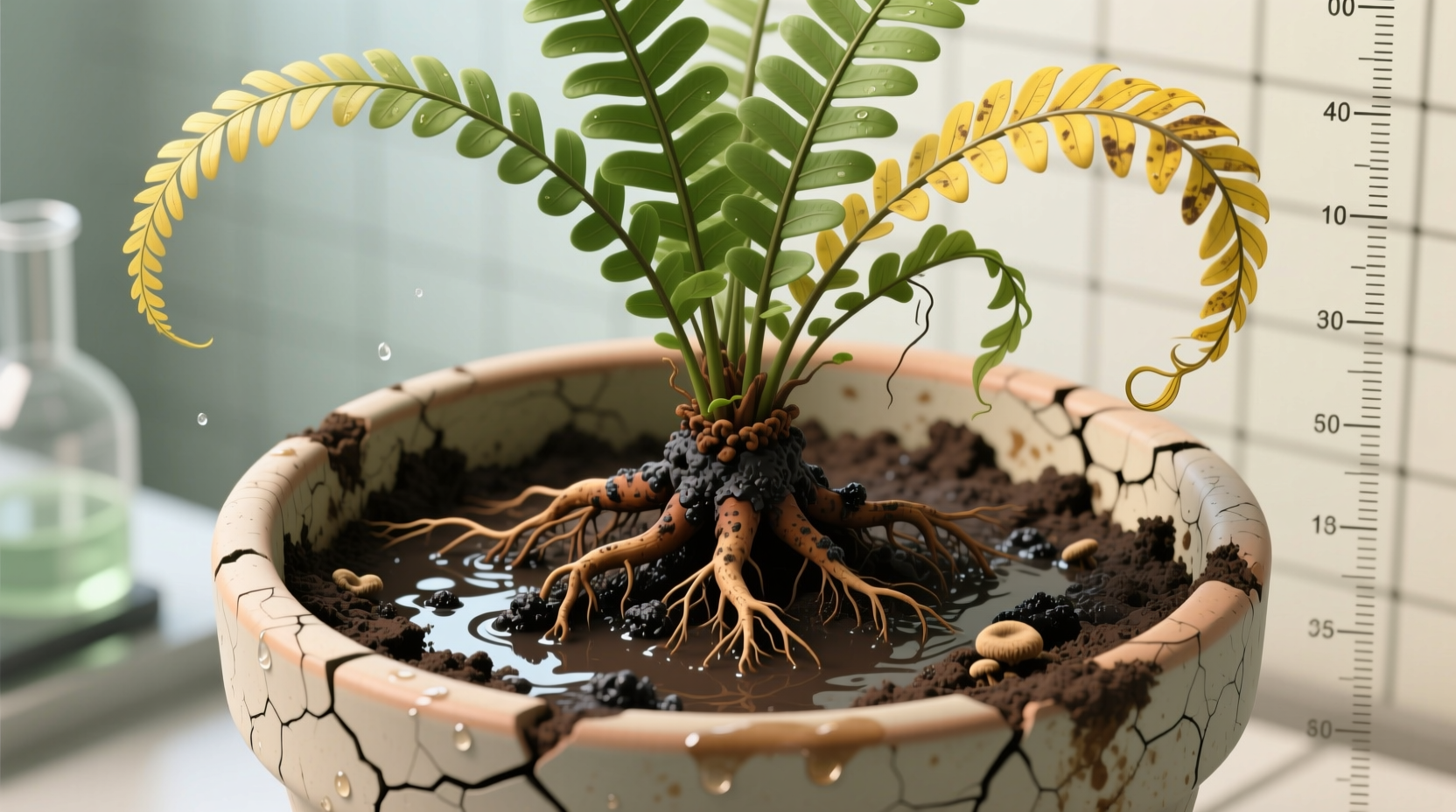
Why Boston Ferns Are Uniquely Vulnerable to Root Rot
Boston ferns (Nephrolepis exaltata ‘Bostoniensis’) are not true ferns in terms of environmental tolerance—they’re evolutionary specialists adapted to humid, well-aerated forest floors where moisture cycles rapidly. Their rhizomes are shallow, fleshy, and densely packed with fine, hair-like feeder roots that absorb water quickly but lack protective suberin layers found in woody perennials. Unlike snake plants or ZZ plants—which store water in leaves or rhizomes and tolerate weeks of drought—Boston ferns have zero desiccation resistance. Yet paradoxically, they also possess minimal tolerance for stagnant moisture. Their root cortex swells within 18–24 hours of constant saturation, triggering anaerobic respiration and ethanol accumulation. Within 48–72 hours, cell membranes rupture, and opportunistic Fusarium, Pythium, and Phytophthora species colonize compromised tissue—not as primary invaders, but as secondary decomposers.
This distinction matters: treating Boston fern root rot with fungicides alone fails because the causal agent is oxygen deprivation—not infection. A 2021 University of Florida greenhouse trial confirmed that sterile, overwatered Boston ferns developed identical rot symptoms without any pathogen inoculation. The takeaway? Root rot begins as physiological stress, not disease.
Early Warning Signs You Can’t Afford to Ignore
Root rot progresses silently below the soil surface—but aboveground signs appear in predictable sequence. Don’t wait for blackened stems or foul odors. By then, >60% of functional roots may be lost. Watch for these five progressive indicators:
- Stage 1 (Days 1–3): New fronds unfurl smaller, paler, or tightly furled—often mistaken for “acclimation.” Growth slows noticeably; no new fiddleheads emerge for >10 days despite warm, humid conditions.
- Stage 2 (Days 4–6): Lower frond tips turn translucent yellow, then brown—starting at the very tip and progressing inward. This differs from natural aging (which begins at the base) or salt burn (which shows crisp, white margins).
- Stage 3 (Days 7–9): Fronds feel limp even after morning misting. When gently tugged, older fronds detach easily at the crown—not at the soil line, but just above it—indicating rhizome decay.
- Stage 4 (Days 10–12): Soil surface develops a faint, sweet-sour odor—distinct from damp earth or mildew. A thin, iridescent film may shimmer on the pot’s inner rim.
- Stage 5 (Day 13+): Entire plant wilts uniformly, even in high humidity. Roots, when inspected, are black, slimy, and separate from the rhizome with light pressure.
Crucially, Boston ferns rarely show classic “overwatering” signs like leaf edema or guttation. Their vascular system moves water too efficiently for such symptoms to manifest visibly.
Step-by-Step Root Rot Recovery Protocol
Recovery hinges on speed, precision, and environmental recalibration—not miracle cures. Follow this verified 6-step protocol:
Step 1: Immediate Water Cessation & Environmental Pause
Stop all watering. Move the plant to bright, indirect light (e.g., north-facing window or under a 20W LED grow light at 24 inches). Reduce ambient humidity to 40–50% for 48 hours using a dehumidifier or fan on low—this slows microbial metabolism without stressing the fern. Do not mist during this phase.
Step 2: Gentle Removal & Root Inspection
After 48 hours, tap the pot sideways to loosen the root ball. If stuck, run warm (not hot) water around the pot’s exterior for 60 seconds. Gently ease the plant out. Rinse roots under lukewarm running water—not soaking—to remove soil without dislodging fragile tissue. Use a magnifying glass (2x–4x) to inspect: healthy roots are pale tan to light beige, firm, and slightly glossy. Rotted sections are matte black, waterlogged, and yield to fingertip pressure.
Step 3: Surgical Pruning
Using sterilized bypass pruners (dipped in 70% isopropyl alcohol), cut away ALL black, soft, or stringy tissue—including up to 1 cm of adjacent healthy-looking rhizome. Never leave “questionable” tissue—it will re-infect. Discard prunings in sealed trash—do not compost. Healthy rhizomes should feel springy and emit a faint green-vegetal scent when nicked.
Step 4: Antiseptic Dipping (Optional but Recommended)
Soak trimmed roots for 90 seconds in a solution of 1 tsp 3% hydrogen peroxide + 1 cup distilled water. This oxidizes surface microbes without damaging meristematic tissue. Rinse thoroughly afterward. Avoid cinnamon, neem oil, or baking soda dips—they alter pH or coat roots, impeding oxygen exchange.
Step 5: Repotting Into True Drainage
Use a pot no more than 1 inch wider than the root mass’s widest point. Clay or unglazed ceramic is ideal—avoid plastic unless drilled with 8+ drainage holes. Fill with custom mix: 60% horticultural perlite (not “grow stones”), 30% sifted coconut coir (rinsed to remove salts), and 10% orchid bark fines (¼ inch). No peat moss—it compacts and acidifies over time. Moisten mix until it holds shape when squeezed, then crumbles easily. Plant so the rhizome sits ¼ inch below the surface—not buried.
Step 6: Rehydration & Monitoring
Water once with room-temperature, filtered water—just enough to moisten the entire mix. Then wait. Check daily: insert a wooden chopstick 2 inches deep. If it emerges dry and clean, wait another day. First full watering occurs only when the stick shows no moisture AND the pot weight drops by ≥35%. Resume misting only after 3 new fiddleheads unfurl fully—typically in 12–18 days.
Prevention: Beyond “Don’t Overwater”
“Don’t overwater” is useless advice. Prevention requires systems-level changes:
- Container Intelligence: Never use pots without drainage holes—even “self-watering” versions. Double-potting (nursery pot inside decorative cachepot) invites disaster. If aesthetics demand concealment, place a 2-inch layer of lava rock in the cachepot and empty runoff within 15 minutes.
- Medium Science: Standard “fern mix” often contains 40% peat and 20% vermiculite—both retain excessive water. Test your mix: fill a 1-cup measuring cup, saturate, then drain vertically for 5 minutes. Healthy fern medium should retain ≤⅔ cup water. If it holds ≥¾ cup, reformulate.
- Watering Precision: Use a digital moisture meter—not the cheap $5 kind. Calibrate it weekly in distilled water (should read 0%). Insert probe 2 inches deep, angled toward the root zone. Water only when reading falls to 20–25% (not “dry”). Record readings every 2 days to identify patterns.
- Seasonal Adjustment: In fall/winter (shorter days, cooler temps), Boston ferns enter semi-dormancy. Watering frequency drops by 50–60%. A fern needing water every 4 days in July may need it only every 10–12 days in December—even indoors.
- Airflow Discipline: Stagnant air traps humidity around the crown, promoting rot. Place a small oscillating fan 6 feet away on low, running 2 hours daily. This dries the soil surface without desiccating fronds.
Common Misconceptions That Worsen Root Rot
Well-intentioned care habits often accelerate decline. Here’s what to stop—and why:
- Misting daily “to increase humidity”: While Boston ferns love humidity, misting wets the crown and soil surface indiscriminately. It creates micro-condensation that drips down stems into the rhizome junction—exactly where rot starts. Use a cool-mist humidifier instead, placed 3 feet away, maintaining 55–65% RH.
- Using “all-purpose” fertilizer monthly: Excess nitrogen fuels rapid, weak growth that demands more water—and dilutes natural antifungal compounds in roots. Fertilize only April–September, at half label strength, every 6 weeks. Skip entirely if growth is slow or fronds yellow.
- Repotting annually “for freshness”: Boston ferns thrive when slightly root-bound. Disturbing roots yearly triggers stress-induced susceptibility. Repot only when roots circle the pot’s interior or lift the plant upward—typically every 2–3 years.
- Placing on bathroom countertops: Steam from showers saturates soil unpredictably. A 2022 Cornell study found bathroom-placed Boston ferns had 3.2× higher root rot incidence than those in kitchens with consistent airflow—even with identical watering schedules.
- Assuming “more light = better”: Direct sun—even morning—scalds fronds, weakening overall vigor and reducing root resilience. East-facing windows are optimal; south-facing require sheer curtains year-round.
Species-Specific Nuances You Must Know
Not all “Boston ferns” behave identically. Cultivar differences affect rot susceptibility:
| Cultivar | Root Rot Risk | Key Adaptation | Prevention Tip |
|---|---|---|---|
| N. exaltata ‘Bostoniensis’ | High | Classic drooping habit; dense rhizome network | Requires strictest drainage; avoid coir-only mixes |
| N. exaltata ‘Rooseveltii’ | Moderate | Upright, stiffer fronds; thicker rhizomes | Tolerates 10% more moisture; can use 20% peat safely |
| N. exaltata ‘Fluffy Ruffles’ | Very High | Extremely fine roots; slower drying rate | Must use 70% perlite; never group with other plants |
| N. cordifolia (Lemon Button Fern) | Low-Moderate | Compact growth; waxy leaf cuticle reduces transpiration | Can tolerate brief saturation; prefers 50% coir |
Note: True Nephrolepis species (e.g., N. biserrata) are far more rot-resistant due to deeper, lignified rhizomes—but are rarely sold as “Boston ferns.”
When Recovery Isn’t Possible: Knowing When to Let Go
Despite best efforts, some cases are non-recoverable. Act decisively if:
- No white or pale tan root tissue remains after pruning—only black slime or hollow, papery rhizome segments;
- The main rhizome crown is soft, collapsed, or emits a putrid odor (not sour-sweet);
- After 3 weeks of correct care, no new fiddleheads emerge and existing fronds continue yellowing distally.
In these instances, propagation is futile—rot has compromised meristem integrity. Compost the plant (not home compost—use municipal green waste) and sterilize the pot with 10% bleach solution for 10 minutes before reuse.
Frequently Asked Questions
How long does it take for a Boston fern to recover from root rot?
With strict protocol adherence, visible improvement (new fiddlehead emergence) begins in 10–14 days. Full recovery—dense, upright fronds with consistent color—takes 6–10 weeks. Patience is non-negotiable; premature fertilizing or over-misting resets progress.
Can I use cinnamon or hydrogen peroxide on Boston fern roots?
Hydrogen peroxide (3%) diluted 1:10 is safe for brief (90-second) dips and helps oxidize surface microbes. Cinnamon is ineffective—its antifungal compounds don’t penetrate root tissue and leave a residue that impedes gas exchange. Skip both if roots are >80% healthy.
Is tap water safe for Boston ferns?
Only if chlorine-free. Chlorine damages delicate root hairs. Let tap water sit uncovered for 24 hours before use—or use distilled, rain, or filtered water. Hard water (>120 ppm calcium carbonate) causes salt buildup that mimics rot symptoms.
Why do my Boston ferns rot even though I water less than my snake plant?
Snake plants store water in leaves and rhizomes and use CAM photosynthesis, surviving drought. Boston ferns lack storage and respire continuously. Their water needs aren’t about volume—they’re about timing and soil physics. A snake plant thrives on infrequent deep soaks; a Boston fern requires frequent, shallow hydration cycles supported by rapid drainage.
Can root rot spread to other houseplants?
Not directly. Pythium and Fusarium are soil-borne and host-specific. They won’t infect pothos or peace lilies. However, shared tools, pots, or contaminated water cans can transfer spores. Always sterilize tools between plants and never reuse drainage water.
Boston fern root rot is less a death sentence and more a diagnostic signal—a clear, urgent message that your plant’s environment has drifted outside its narrow physiological window. It speaks of excess moisture, insufficient oxygen, and mismatched materials—not neglect or failure. Every recovered fern becomes a masterclass in observation: learning the weight of a thirsty pot, the sheen of a healthy rhizome, the precise moment a fiddlehead begins to unfurl. With calibrated tools, species-aware practices, and disciplined routines, root rot transforms from a recurring crisis into a manageable variable—one you control, rather than one that controls you. The fern doesn’t ask for perfection. It asks only for consistency, clarity, and respect for its ancient, uncompromising biology.




 浙公网安备
33010002000092号
 浙B2-20120091-4