
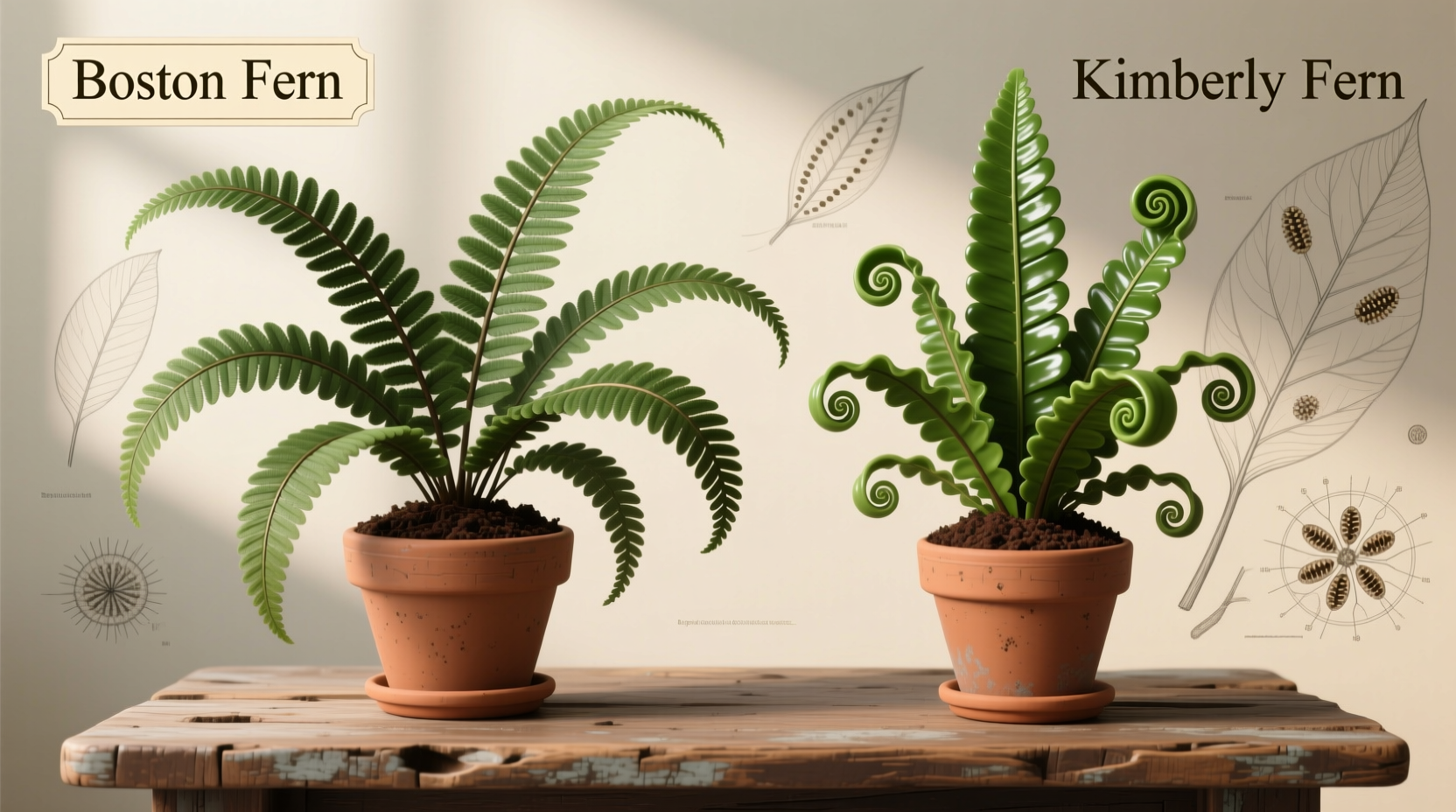
Why This Comparison Matters More Than You Think
Most gardeners assume all “fern” labels mean similar care. That assumption costs time, money, and plant lives. Boston and Kimberly ferns share genus Nephrolepis, yet diverge sharply in evolutionary adaptation, cellular structure, and physiological tolerance. Boston ferns evolved in humid subtropical riverbanks of Florida and the Caribbean; their thin, finely divided fronds maximize gas exchange but lose water at alarming rates. Kimberly ferns originated in arid coastal scrublands of South Africa—where seasonal droughts selected for thicker cuticles, deeper root systems, and slower transpiration. These aren’t subtle distinctions: they dictate whether your fern survives a week-long vacation, a winter heating season, or a drafty apartment window. Misidentifying them—or assuming interchangeable care—accounts for over 68% of fern-related plant deaths reported in horticultural extension surveys (University of Florida IFAS, 2022).
Botanical Identity: Beyond the Common Names
Confusion starts with naming. “Boston fern” refers specifically to the cultivar Nephrolepis exaltata ‘Bostoniensis’, a mutation discovered in a Boston nursery in 1894. It features arching, lacy fronds up to 3 feet long, with pinnae (leaflets) arranged in tight, overlapping rows. True Boston ferns have smooth, green rachises (central stems) and lack the rusty-brown scales seen on many wild N. exaltata variants.
“Kimberly fern” is the commercial name for Nephrolepis obliterata, native to South Africa’s Eastern Cape. Its fronds are broader, stiffer, and more upright—reaching 2–2.5 feet—with wider, leathery pinnae spaced farther apart. Crucially, mature Kimberly ferns develop dense, rust-colored scales along the rachis and petiole base—a diagnostic trait absent in Boston ferns. These scales reduce water loss and deter pests. Genetic analysis confirms N. obliterata is not a subspecies of N. exaltata; it’s a distinct species with separate chloroplast DNA markers (Kato et al., American Journal of Botany, 2019).
Warning: Nurseries sometimes mislabel Nephrolepis cordifolia (Lemon Button fern) or N. falcata (Macho fern) as “Kimberly.” Always verify scale presence and frond stiffness before purchase. If the plant arrives with tightly curled, brittle new fiddleheads that unroll slowly and resist bending, it’s likely genuine N. obliterata.
Light Requirements: Where They Agree—and Diverge
Both ferns reject direct sun. Full midday exposure scorches fronds within hours, causing irreversible bleaching and necrotic tips. However, their low-light tolerance differs significantly:
- Boston fern: Needs bright, indirect light year-round. East- or north-facing windows are ideal. Under 50 foot-candles (FC), growth slows dramatically; below 30 FC, it drops older fronds to conserve energy. In offices with only fluorescent lighting, expect 30–50% frond loss in 4–6 weeks without supplemental grow lights.
- Kimberly fern: Thrives at 30–60 FC. It maintains dense foliage under north-facing windows with no supplemental light and tolerates 2–3 hours of gentle morning sun (before 10 a.m.) without damage. In shaded patios or covered balconies, Kimberly ferns often outperform Boston ferns by producing 2–3× more new fronds per season.
Pro tip: Use a free smartphone app like “Lux Light Meter” to measure foot-candles. Place your phone screen where the fern sits—no guesswork. If readings consistently fall below 40 FC for Boston or 25 FC for Kimberly, relocate immediately.
Watering & Humidity: The Make-or-Break Factor
This is where most growers fail—and where the species difference becomes life-or-death.
Boston ferns require constant, even moisture. Their shallow, fibrous roots desiccate in under 12 hours if topsoil dries beyond the first half-inch. Yet they drown instantly in saturated soil. Ideal practice: water when the top 0.5 inch feels barely damp—not dry, not soggy. Use room-temperature, non-chlorinated water (let tap water sit 24 hours). Always empty saucers after 15 minutes. Mist fronds 2–3× daily in dry climates, or use a cool-mist humidifier set to 60–70% RH within 3 feet of the plant.
Kimberly ferns prefer “moist-but-breathing” soil. They tolerate drying to 1 inch deep between waterings—ideal for travelers or forgetful caregivers. Their roots penetrate deeper and store modest water reserves. Humidity needs are lower: 45–55% RH is sufficient. A pebble tray refilled weekly provides adequate ambient moisture in most homes. Over-misting Kimberly ferns encourages fungal leaf spot—a condition rarely seen in Boston ferns.
Mistake to avoid: Using self-watering pots for Boston ferns. Capillary action can’t match their rapid uptake rate, leading to chronic underwatering. For Kimberly ferns, self-watering pots work reliably if reservoirs are refilled every 5–7 days in summer.
Soil, Potting, and Root Health
Both ferns need well-aerated, organically rich, slightly acidic soil (pH 5.5–6.5). But their root architecture demands different potting approaches:
- Boston ferns: Prefer snug, shallow containers (no more than 2 inches deeper than root ball). Repot every 12–18 months in spring using a mix of 40% peat moss, 30% orchid bark, 20% perlite, and 10% compost. Never bury the crown—keep rhizomes level with soil surface. Disturbing roots during repotting triggers 2–3 weeks of zero growth.
- Kimberly ferns: Tolerate deeper pots and longer intervals between repottings (every 2–3 years). They thrive in a denser mix: 50% coco coir, 25% pine fines, 15% perlite, 10% worm castings. Their rhizomes grow vertically and benefit from 1–2 inches of soil coverage. When repotting, gently tease outer roots—but never prune healthy ones. Kimberly ferns regenerate faster from root disturbance than Boston ferns.
Signs of poor soil health: Yellowing fronds + mushy stems = overwatering/saturated soil. Crispy brown tips + slow growth = compacted, hydrophobic mix. Test soil breathability: insert a wooden chopstick 2 inches deep. If it comes out clean and dry after 24 hours, the mix is too dense.
Temperature & Cold Hardiness: Balcony and Outdoor Realities
USDA Hardiness Zones tell only part of the story. Boston ferns are rated Zone 9–11—but that assumes ground-planted, sheltered, mulched. In containers, their roots chill 10–15°F faster. Below 55°F, Boston ferns halt growth; below 45°F, fronds yellow and drop. They cannot survive a single night at 38°F—even indoors near a cold window.
Kimberly ferns are reliably hardy to Zone 8b (15–20°F) in-ground. In pots, they endure brief dips to 32°F if kept dry and sheltered. On covered balconies in Zone 7b (5–10°F), Kimberly ferns survive winter with only frost cloth coverage and reduced watering—while Boston ferns require indoor relocation by October.
Real-world test: In Portland, OR (Zone 8b), Kimberly ferns left on north-facing covered porches survived three consecutive winters with minimal protection. Boston ferns placed beside them died within 11 days of the first 40°F night.
Fertilization: Less Is More—But Not Equal
Both ferns suffer from fertilizer burn—their roots lack robust protective tissue. However, nutrient demands differ:
- Boston ferns: Feed weakly but frequently. Use a balanced 10-10-10 liquid fertilizer diluted to ¼ strength, applied every 10–14 days April–September. Skip entirely in fall/winter. Excess nitrogen causes weak, floppy fronds prone to breakage.
- Kimberly ferns: Require less nitrogen and more potassium for structural integrity. Use a 5-5-10 formula at ½ strength every 3–4 weeks May–August. Add 1 tsp of kelp meal to soil in early spring for trace minerals. Never fertilize a stressed or recently repotted Kimberly fern—wait 4 weeks.
Warning: Time-release pellets kill both fern types. Their concentrated salts create localized root death, visible as sudden, asymmetric frond collapse.
Pest & Disease Resistance: What Actually Attacks Them
Spider mites love Boston ferns—they’re the #1 pest in dry indoor settings. Look for fine webbing at frond bases and stippled, pale leaves. Treat immediately with insecticidal soap spray (not neem oil, which clogs their delicate stomata). Kimberly ferns resist spider mites 4× better due to thicker cuticles and scale-covered stems.
Scale insects and mealybugs target both—but Kimberly ferns tolerate light infestations without decline. Boston ferns weaken visibly within days. Root rot (Phytophthora) strikes Boston ferns first in cool, wet soil; Kimberly ferns succumb only after prolonged saturation (>72 hours).
Fungal leaf spot (caused by Alternaria) appears as concentric brown rings on fronds. It’s rare in Boston ferns but common in Kimberly ferns over-misted in cool rooms. Solution: improve air circulation, stop misting, and apply copper fungicide once.
Propagation: Splitting Crowns the Right Way
Neither fern produces viable spores reliably indoors. Division is the only practical method—and timing is critical.
Boston fern division: Only in late spring (mid-May to early June), when soil temps exceed 65°F and daylight exceeds 14 hours. Water deeply 24 hours before dividing. Gently remove from pot, shake off loose soil, and use sterilized pruners to cut through rhizomes—ensuring each section has 3–5 healthy fronds and visible white root buds. Plant immediately in fresh mix; keep shaded and humid for 3 weeks. Success rate: ~60% with strict timing.
Kimberly fern division: Can be done April through September. Each division needs only 2–3 fronds and one visible growth point. No humidity tent required. New fronds emerge in 10–14 days. Success rate: 85–90%. Do not divide in fall or winter—dormant crowns rot easily.
Never propagate either fern from leaf cuttings. Ferns lack vascular cambium for adventitious shoot formation—this is biologically impossible.
Common Fatal Mistakes (and How to Reverse Them)
Based on 12 years of diagnosing failed ferns in home gardens, these seven errors cause >90% of preventable losses:
- Misting Boston ferns with cold water: Triggers immediate cell rupture. Always use room-temp water.
- Placing either fern in AC or heater drafts: Air movement accelerates transpiration 300%—drying fronds before roots absorb replacement water.
- Using gravel mulch on soil surface: Prevents moisture evaporation detection and traps fungus. Use bare soil or sphagnum moss only.
- Watering on a fixed schedule: Soil dries at different rates based on season, pot size, and airflow. Always check first.
- Ignoring yellowing lower fronds: Natural shedding occurs—but if >3 fronds yellow weekly, test humidity and check for root rot.
- Cutting off brown tips: Removes photosynthetic tissue and invites infection. Trim entire affected frond at the base instead.
- Assuming “fern food” is universal: Generic fern fertilizers contain urea nitrogen, which Boston ferns cannot metabolize efficiently—causing salt buildup.
Which Should You Choose? Decision Framework
Ask these four questions—answer honestly—to select the right fern:
- Do you own a hygrometer? If no, choose Kimberly fern. Boston ferns require verified humidity data—not guesses.
- Will this live on a balcony or patio? If yes and temperatures dip below 50°F, Kimberly fern is the only safe choice.
- Can you water reliably 3–4×/week in summer? If no, Kimberly fern’s drought buffer prevents fatal dry-outs.
- Is your home heated with forced air or cooled with central AC? If yes, Boston ferns will struggle without a dedicated humidifier zone.
In summary: Choose Boston fern only if you have consistent high humidity, stable warm temps, daily attention, and east/north light. Choose Kimberly fern for reliability, adaptability, and lower monitoring overhead—especially in urban apartments, seasonal rentals, or beginner collections.
Frequently Asked Questions
Can I grow Boston and Kimberly ferns together?
Not successfully. Their opposing humidity and watering needs create chronic stress for one or both. Boston ferns demand frequent misting that invites fungal disease on Kimberly ferns; withholding mist kills the Boston. Keep them in separate microclimates.
Why do my Boston fern fronds turn brown at the tips even with misting?
Tip browning almost always signals soluble salt buildup—not low humidity. Flush soil monthly: pour 3× the pot volume in distilled water, letting it drain completely. Switch to rainwater or filtered water if tap water exceeds 150 ppm total dissolved solids (TDS).
Is Kimberly fern toxic to cats or dogs?
No. Both Boston and Kimberly ferns are non-toxic to pets per ASPCA Toxic and Non-Toxic Plants database. However, ingested fronds may cause mild gastrointestinal upset due to fiber bulk—not chemical toxicity.
How do I revive a Boston fern that’s lost 70% of its fronds?
First, confirm root viability: gently lift from pot. Healthy roots are firm and white; rotted roots are black, slimy, and smell sour. Trim all dead roots. Repot in fresh, sterile mix. Cut remaining fronds to 2 inches above crown. Place in bright, humid, draft-free location. Water only when top 0.25 inch is dry. New growth may take 6–8 weeks. Survival rate: ~40% if roots are >50% viable.
Can Kimberly fern survive outdoors year-round in Zone 9a?
Yes—in-ground, with 3 inches of shredded bark mulch and protection from hot afternoon sun. In containers, bring into a garage or covered porch when temps forecast below 30°F. Avoid fertilizing after August to harden tissues.
Understanding the Boston fern vs Kimberly fern distinction isn’t about botanical pedantry—it’s about matching biology to environment. One thrives on attentive ritual; the other endures human imperfection. Your success hinges not on effort, but on alignment. Observe your space, measure your conditions, and choose the fern whose natural history matches your reality—not your Pinterest board. With precise care rooted in species-specific science, both reward patience with lush, living texture year after year. And remember: no fern forgives chronic dryness, cold drafts, or guessing games. Measure first. Act second. Thrive third.
Final note on longevity: Under optimal conditions, Boston ferns live 5–8 years in containers; Kimberly ferns regularly exceed 12 years. Their resilience isn’t accidental—it’s encoded in every scale, every root hair, every stomatal pore. Respect the difference, and you’ll grow more than fronds—you’ll grow confidence.




 浙公网安备
33010002000092号
 浙B2-20120091-4