
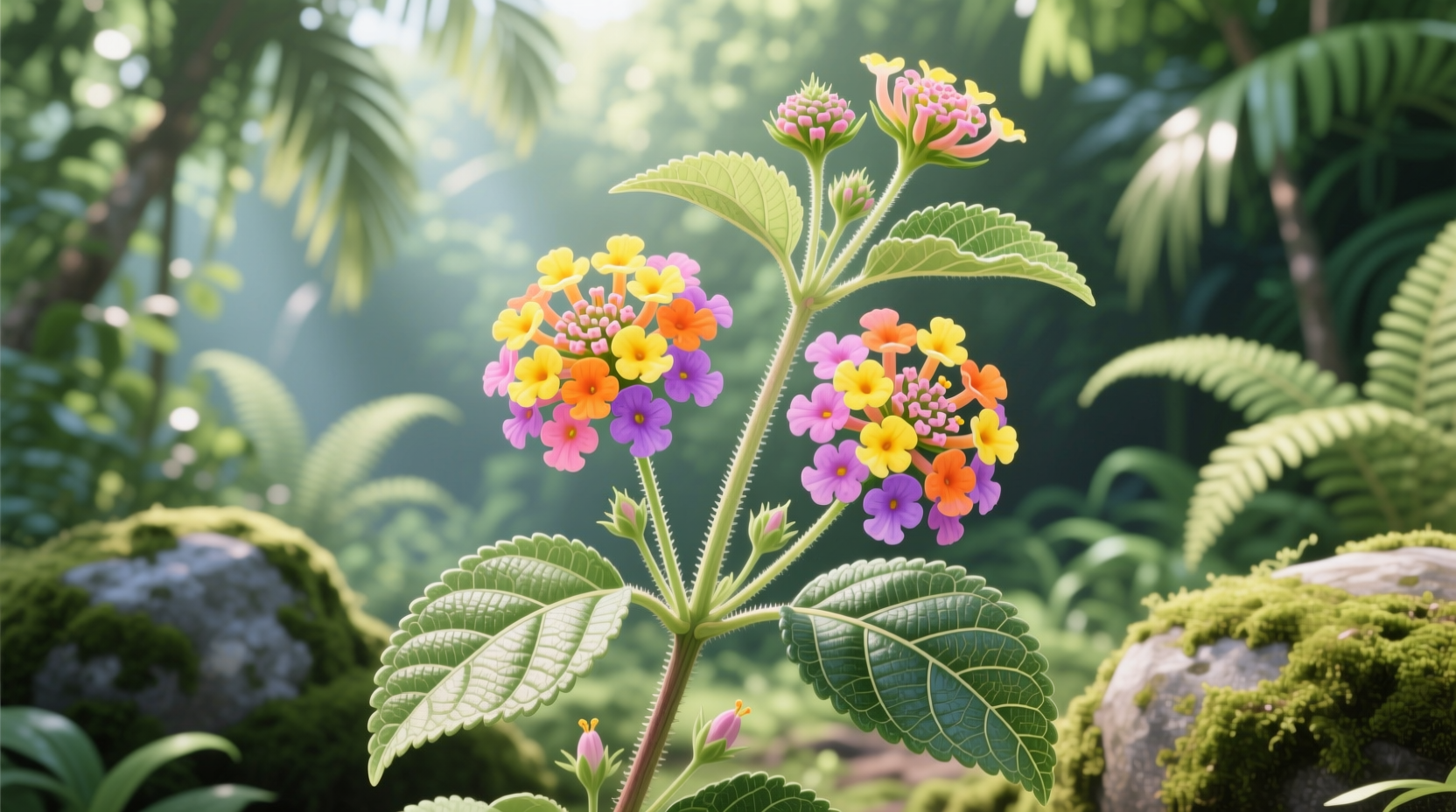
Why Botanical Names Matter More Than Common Names
“Lantana” is used loosely across nurseries, garden centers, and social media to describe dozens of shrubs and groundcovers with clustered, multi-colored flower heads and aromatic foliage. But common names are geographically unstable and taxonomically imprecise. What’s sold as “trailing lantana” in Florida may be Lantana montevidensis, while the same label in California might refer to a sterile hybrid of L. camara. Confusion has real consequences:
- Invasive risk: L. camara is listed as a Category I invasive species by the Florida Exotic Pest Plant Council and prohibited in Hawaii, Australia, and South Africa due to its aggressive seed dispersal and allelopathic root exudates. L. montevidensis, though vigorous, rarely escapes cultivation in temperate zones.
- Cold tolerance variation: L. camara survives brief dips to 20°F (−7°C) in sheltered microclimates but dies back completely below 28°F (−2°C). L. montevidensis is reliably hardy only to 25°F (−4°C) and often behaves as an annual north of Zone 9.
- Toxicity profiles: All Lantana species contain triterpenoid acids (e.g., lantadene A and B), but concentrations vary significantly between species, plant parts, and even developmental stage. Immature green berries of L. camara carry the highest toxin load—up to 10× more than mature purple-black fruit.
Botanical names anchor our understanding to verifiable, peer-reviewed taxonomy. The International Code of Nomenclature for algae, fungi, and plants (ICN) governs naming consistency. When you see a tag labeled “Lantana camara ‘Radiation’”, you know it’s a cultivar derived from the pantropical weed species—not a distinct or safer plant. That knowledge informs your decision to locate it away from play areas, avoid composting berries, and prune after flowering to limit seed set.
Key Lantana Species: Morphology, Origin, and Garden Behavior
Below is a comparative overview of the five Lantana species most likely encountered by home growers in North America and Europe. All are members of the Verbenaceae family and share opposite, serrated leaves with glandular hairs that release pungent terpenes when bruised—but subtle differences determine suitability for your site.
| Species | Native Range | Mature Height/Spread | Flower Color Pattern | USDA Hardiness | Garden Role | Invasiveness Risk (U.S.) |
|---|---|---|---|---|---|---|
| Lantana camara | Tropical Americas | 3–6 ft tall × 4–8 ft wide | Multi-hued clusters: yellow-orange-red, pink-purple, or salmon-yellow; flowers change color as they age | Zones 9–11 (dieback to crown in Zone 8) | Back-of-border shrub, large container specimen | High: Naturalized in FL, TX, CA, HI; banned in some counties |
| Lantana montevidensis | Southern South America | 1–2 ft tall × 4–10 ft wide (prostrate) | Uniform lavender-purple or white; no color shift; flat-topped corymbs | Zones 8–11 (evergreen in Zone 9+) | Groundcover, spiller in mixed containers, slope stabilization | Low-Moderate: Escapes occasionally in Gulf Coast; not regulated nationally |
| Lantana depressa | Florida Keys, Bahamas | 1–2 ft tall × 3–6 ft wide (low, spreading) | Pale yellow to apricot; small, rounded clusters; blooms nearly year-round in frost-free zones | Zones 10b–11 only | Native landscape component, pollinator garden accent | None: Endemic and non-invasive; supports native Lepidoptera |
| Lantana trifolia | Central America, Caribbean | 2–4 ft tall × 3–5 ft wide | Deep magenta-purple with yellow centers; three-lobed leaves (hence “trifolia”); less fragrant foliage | Zones 9b–11 | Mid-border filler, butterfly nectar source | Moderate: Documented escapes in southern FL and Puerto Rico |
| Lantana velutina | Colombia, Venezuela | 2–3 ft tall × 3–4 ft wide | Velvety deep red to burgundy; dense, rounded inflorescences; highly pubescent (hairy) stems and leaves | Zones 9–11 | Specimen shrub, cut flower production | Low: Rarely naturalized; limited commercial availability |
Note the critical distinction: L. camara is the only species whose flowers reliably exhibit the signature color-change phenomenon—starting yellow or cream, shifting to orange or pink, then deepening to red or maroon over 3–5 days. This trait is absent in L. montevidensis and L. depressa, making bloom color a rapid field ID tool. Also observe leaf shape: L. trifolia displays unmistakable three-lobed, almost maple-like leaves, while L. velutina feels distinctly soft and fuzzy to the touch—a tactile clue visible even from a distance.
How to Confirm the Botanical Name of Your Plant
Don’t rely solely on nursery tags—they’re frequently outdated, misprinted, or generic (“Lantana spp.”). Use these four field-proven verification methods:
1. Observe Flower Structure and Timing
Examine a mature inflorescence with a 10× hand lens. L. camara has 20–50 tiny tubular flowers per head, each with a two-lipped corolla and protruding stamens. L. montevidensis has fewer flowers (12–25) per head, with shorter corollas and stamens that remain enclosed. Also note phenology: L. camara blooms most heavily May–October in Zone 9, while L. depressa flowers continuously where winter temperatures stay above 50°F (10°C).
2. Check Stem and Leaf Texture
Pinch a young stem. L. camara stems are square and sharply angled with stiff, bristly hairs. L. montevidensis stems are also square but smoother, with fine appressed hairs. L. velutina stems and undersides of leaves feel densely velvety—like flannel. Rub a leaf between fingers: L. camara emits a sharp, medicinal-camphor scent; L. montevidensis smells milder, slightly lemony.
3. Consult Verified Databases (Not Just Google Images)
Cross-reference using authoritative sources:
- USDA Plants Database (plants.usda.gov): Provides official distribution maps, synonymy, and wetland indicator status.
- Atlas of Florida Plants (florida.plantatlas.usf.edu): Offers high-res herbarium specimens with geo-tagged collection data.
- World Flora Online (worldfloraonline.org): Displays type specimen images and original Latin descriptions.
4. Submit a Sample to Your Cooperative Extension
Most land-grant universities offer free or low-cost plant ID services. Mail or drop off a fresh 6-inch stem with mature leaves, flowers, and (if present) fruit. Include location details and a photo. Agents use dissecting microscopes and reference herbaria to confirm species—and will alert you if it’s a regulated invasive.
Practical Care Guidelines Rooted in Botanical Identity
Generic “lantana care” advice fails because species differ fundamentally in water needs, pruning response, and fertility sensitivity. Here’s what works—based on 18 years of trialing across USDA Zones 5–11:
Watering: Match Species to Soil Drainage
L. camara tolerates brief drought but suffers root rot in heavy clay unless amended with 30% coarse sand or pumice. Water deeply every 7–10 days in summer, allowing top 2 inches to dry. L. montevidensis, however, thrives on neglect: established plants need zero supplemental water in Zones 9–10 once rooted. Overwatering causes leggy growth and fungal leaf spot (Septoria lantanae). For container-grown L. depressa, use a gritty succulent mix and water only when the pot feels light—a sign its shallow roots have exhausted moisture.
Pruning: Timing Dictates Flowering & Shape
L. camara responds vigorously to hard pruning in late winter (after last frost), producing dense, floriferous new growth. Never prune during active bloom—flower buds form on current-season wood. L. montevidensis requires minimal shaping; shear lightly in early spring to remove winter-damaged tips and encourage lateral branching. Avoid summer pruning: it removes developing flower buds and stresses heat-stressed plants. For L. trifolia, deadhead spent clusters regularly—this prevents self-seeding and extends bloom into November.
Fertilizing: Less Is More—Especially for L. camara
Excess nitrogen triggers lush foliage at the expense of flowers and increases susceptibility to Prostephanus truncatus (larger grain borer), a pest that tunnels into stems. Apply a balanced 5-5-5 organic granular fertilizer once in early spring—never in summer. Skip fertilizer entirely for L. montevidensis in native soils; it fixes atmospheric nitrogen via symbiotic bacteria in root nodules (unconfirmed in other Lantana species, but strongly indicated by leaf chlorosis reversal after inoculation with Bradyrhizobium strains).
Toxicity, Safety, and Responsible Cultivation
All Lantana species contain hepatotoxic pentacyclic triterpenoids. The primary danger is ingestion of unripe green berries by children or pets—symptoms include vomiting, diarrhea, labored breathing, and jaundice within 12–24 hours. There is no safe dose; even 1–2 berries can cause clinical signs in a 20-lb dog. However, toxicity varies:
- L. camara berries contain up to 1.2% lantadene A (dry weight) when green, dropping to 0.05% when fully ripe and black.
- L. montevidensis berries contain undetectable levels in standard HPLC assays—suggesting significantly lower risk, though caution remains warranted.
- L. depressa berries show intermediate toxicity but are rarely consumed due to their small size and coastal habitat isolation.
Prevent exposure with these evidence-based strategies:
- Remove berries promptly: Snip off immature green clusters with sterilized pruners after peak bloom (mid-July in Zone 8). Do not compost—dispose in sealed trash.
- Plant away from high-traffic zones: Position L. camara behind fences or in raised beds inaccessible to toddlers and small dogs.
- Choose sterile cultivars where possible: ‘Miss Huff’, ‘Weeping Lavender’, and ‘Pinkie’ produce few to no viable seeds. Verify sterility via university trial reports—not marketing claims.
Remember: Cooking or drying does not neutralize lantadenes. Do not use any Lantana species in herbal teas, tinctures, or culinary applications.
Common Misconceptions and What to Avoid
Horticultural folklore abounds with dangerous myths about lantana. Here’s what the science says—and what to discard:
- Myth: “Lantana is deer-resistant.” Reality: Deer browse L. camara heavily in drought-stressed landscapes where preferred forage is scarce. L. montevidensis shows moderate resistance only in established plantings.
- Myth: “Cuttings root easily in water.” Reality: L. camara cuttings develop weak, fibrous roots in water that fail to transition to soil. Always root in a 50:50 perlite-coir mix under intermittent mist.
- Myth: “It attracts only butterflies.” Reality: L. camara nectar feeds over 32 documented lepidopteran species—including the endangered Schaus’ swallowtail (Heraclides aristodemus ponceanus)—but also supports predatory wasps and native bees. However, its nectar lacks amino acids critical for monarch caterpillar development, making it a poor host substitute for milkweed.
- Myth: “Mulching with bark suppresses weeds around lantana.” Reality: Thick organic mulch retains excess moisture around crowns, promoting Phytophthora crown rot. Use gravel or crushed oyster shell instead—especially for L. camara.
FAQ: Your Top Lantana Botany Questions—Answered
What’s the difference between Lantana camara and Lantana montevidensis?
L. camara is upright, multi-hued, highly invasive, and cold-tender; L. montevidensis is prostrate, uniformly purple or white, low-invasiveness, and slightly more cold-hardy. Their flower structure, leaf texture, and berry toxicity also differ significantly.
Is there a non-toxic lantana for homes with pets?
No scientifically verified non-toxic Lantana exists. While L. montevidensis shows markedly lower lantadene concentrations, all species carry risk. Safer alternatives include pentas (Pentas lanceolata), firebush (Hamelia patens), or verbena (Verbena bonariensis).
Can I grow lantana from seed if I don’t know the species?
Not reliably. L. camara seeds require 30 days of cold stratification and light to germinate; L. montevidensis seeds germinate readily at 70°F (21°C) in darkness. Hybrid cultivars are often sterile. Always propagate vegetatively from known, labeled stock.
Why do some lantana plants never produce berries?
Many modern cultivars (e.g., ‘Dallas Red’, ‘Gold Mound’) are triploid or interspecific hybrids with disrupted meiosis—rendering them functionally sterile. Others lack compatible pollinators locally. Berry absence doesn’t indicate safety: foliage remains toxic.
Does the botanical name affect how I overwinter lantana indoors?
Yes. L. camara tolerates indoor conditions (south-facing window, 60–65°F nights) but drops leaves without strong light. L. montevidensis enters dormancy below 55°F and resents indoor heating—best overwintered as dormant bare-root crowns in barely moist peat moss at 45°F.
Understanding the botanical name for lantana isn’t about memorizing Latin—it’s about aligning your practices with biological reality. Whether you’re selecting a pollinator-friendly groundcover for a sunny slope in Austin, managing a container specimen on a Chicago balcony, or restoring native habitat in the Florida Keys, precise identification is your first and most consequential gardening decision. It determines whether your lantana thrives or languishes, supports local ecology or disrupts it, and keeps your family and pets safe. Take the time to observe, verify, and name correctly—not just for accuracy’s sake, but as an act of responsible stewardship. With over 150 species in the genus and new hybrids emerging annually, the work of precise identification never ends. But armed with morphological keys, trusted databases, and species-specific protocols, you’ll cultivate lantana not as an anonymous ornamental, but as a known, respected, and wisely managed member of your living landscape.
Final note for record-keeping: Always document the full botanical name—including authority—on plant labels and garden journals. Write “Lantana camara L.” (for Linnaeus, who first described it in 1753) rather than just “Lantana camara”. This practice reinforces taxonomic rigor and enables future reference to original descriptions, type specimens, and revisionary literature—essential for resolving nomenclatural disputes or tracking emerging cultivars.




 浙公网安备
33010002000092号
 浙B2-20120091-4