
Why Bougainvillea Is Worth the Effort
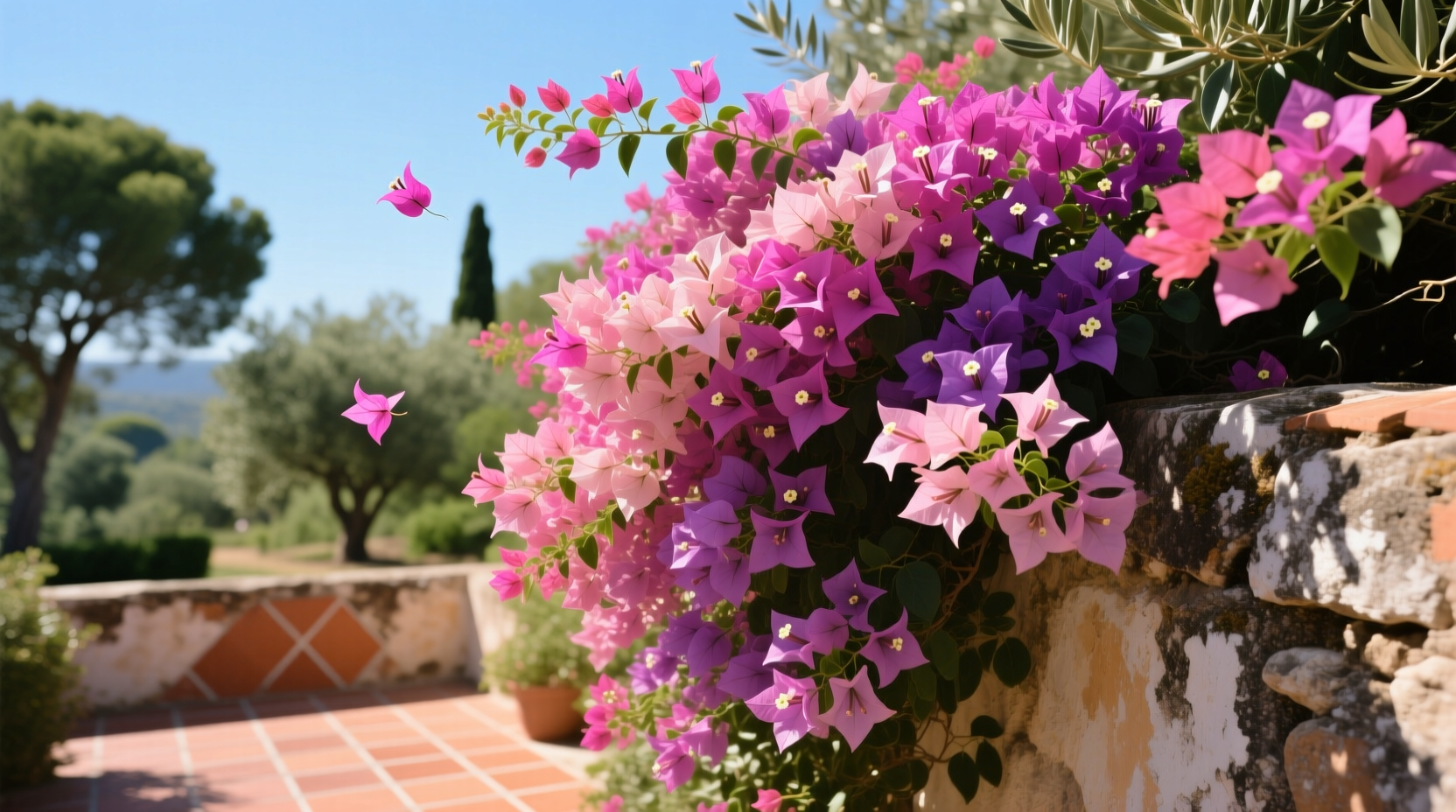
Bougainvillea (Bougainvillea spp.) isn’t just ornamental—it’s a botanical marvel. Native to coastal Brazil, this thorny, woody vine belongs to the Nyctaginaceae family and produces no true petals. What we call “flowers” are actually vivid, papery bracts—modified leaves—that surround tiny, cream-colored true flowers. These bracts come in over 300 cultivated varieties spanning magenta, crimson, tangerine, violet, white, and even bi-color combinations like ‘Barbara Karst’ (deep rose-red) and ‘Raspberry Ice’ (pink bracts with variegated foliage).
Gardeners across USDA Hardiness Zones 9–11 grow bougainvillea as a perennial shrub, climber, or container specimen. In cooler zones (4–8), it performs exceptionally well as a summer patio plant or overwintered indoors near a south-facing window. Its drought tolerance, salt resistance, and minimal pest pressure make it ideal for coastal balconies, Mediterranean-style courtyards, and xeriscaped gardens. With proper training, it covers arbors, spills from hanging baskets, or forms dense, sculptural hedges—offering up to 10 months of color per year in frost-free settings.
Choosing the Right Variety for Your Space
Selecting the right cultivar is the first strategic decision—not all bougainvilleas behave the same way. Growth habit, cold tolerance, bract color stability, and thorn density vary significantly:
- Vigorous climbers (e.g., ‘California Gold’, ‘Sundown’) reach 20–30 feet and require strong support; ideal for pergolas or blank walls. They bloom most profusely on mature wood but need annual structural pruning.
- Compact shrubs (e.g., ‘Rosenka’, ‘Helen Johnson’) stay under 5 feet, flower heavily on new growth, and respond well to frequent tip-pruning—perfect for containers, raised beds, or small urban patios.
- Variegated types (e.g., ‘Tina’, ‘Snowcap’) feature cream- or yellow-edged leaves and often produce softer bract tones. They demand more light than solid-green cultivars to prevent chlorosis and maintain color contrast.
- Thornless selections (e.g., ‘Bambino’ series) are safer for high-traffic areas and children’s gardens—but trade some vigor and longevity for ease of handling.
Always verify the cultivar’s documented hardiness rating—not just the species label. For example, Bougainvillea glabra tolerates brief dips to 25°F (−4°C) if dry and sheltered, while B. spectabilis suffers irreversible damage below 32°F (0°C). When purchasing, inspect roots through drainage holes: healthy specimens show firm, tan-to-light-brown roots—not mushy, blackened, or sour-smelling ones. Avoid plants with yellowing lower leaves or visible scale insects along stems—these signal chronic overwatering or systemic infestation.
Sunlight: The Non-Negotiable Requirement
Bougainvillea requires unfiltered, direct sunlight for at least 6 continuous hours daily—and 8+ hours dramatically increases bract production and intensity. This isn’t preference; it’s physiology. Bract formation is photoperiod-sensitive and triggered by high light intensity, not day length alone. In partial shade (e.g., under high-canopy trees or north-facing balconies), plants survive but produce sparse, pale bracts and leggy, weak growth. Indoors, even a bright east window delivers only ~30% of required irradiance—insufficient for flowering.
Practical solutions include:
- Moving potted bougainvillea outdoors for summer (acclimate gradually over 7 days to avoid sun scald).
- Using reflective surfaces—white gravel mulch, light-colored walls, or aluminum foil-lined trays—to bounce light onto lower branches.
- Pruning nearby trees or structures that cast afternoon shade during peak flowering windows (May–October in the Northern Hemisphere).
A common misconception is that “more sun equals more stress.” While extreme heat (>100°F/38°C) can cause temporary bract fading, bougainvillea evolved in equatorial sun and cools itself via rapid transpiration. Shade does not protect it—it suppresses flowering hormones and invites fungal issues like powdery mildew.
Soil & Drainage: Where Most Fail
Bougainvillea hates wet feet. Its fine, fibrous roots suffocate rapidly in saturated soil, leading to root rot caused by Phytophthora or Fusarium. Yet it also cannot tolerate pure sand or gravel that dries out too fast. The ideal medium balances porosity and moisture retention.
For in-ground planting:
- Amend native soil with equal parts coarse sand, aged compost, and perlite—never peat moss (it holds too much water and acidifies over time).
- Raise beds 6–8 inches above grade, especially in clay-heavy regions (e.g., Southeastern U.S. or Pacific Northwest valleys).
- Test drainage: dig a 12-inch-deep hole, fill with water, and time how long it takes to drain. If >4 hours, amend aggressively or choose containers.
For containers (the most reliable method for Zone 4–8 gardeners):
- Use a mix of 40% potting soil (soil-less, bark-based), 30% perlite, 20% pumice, and 10% horticultural charcoal.
- Select pots with drainage holes covering ≥25% of the base area—not just one small hole.
- Repot every 2–3 years in early spring, trimming circling roots and refreshing media. Never “up-pot” more than 2 inches in diameter at once—a 10-inch plant thrives in a 12-inch pot, not a 16-inch one.
Watering: Less Is More—But Timing Matters
The golden rule: water deeply only when the top 2–3 inches of soil are dry—and then soak until water runs freely from drainage holes. In hot, dry climates (e.g., Arizona, Southern California), this may mean every 4–7 days in summer. In humid subtropical zones (e.g., Florida), it may be every 10–14 days. Container-grown plants dry faster and need checking every 2–3 days in peak heat.
Signs you’re watering correctly:
- New growth emerges green and turgid—not wilted or yellow-tipped.
- Bracts remain vibrant for 3–5 weeks before naturally fading (not browning prematurely).
- No mold or algae forms on soil surface.
Signs of overwatering:
- Leaf drop—especially older interior leaves—while new tips remain green.
- Soft, blackened stems at the soil line.
- Stagnant, sour odor from pot or planting bed.
Under-watering shows as crisp, brittle leaf edges and premature bract drop—but recovery is rapid with one thorough soak. Never use self-watering pots or drip irrigation timers set on fixed schedules. Instead, use your finger, a moisture meter, or lift the pot to gauge weight loss (a dry 5-gallon pot weighs ~3 lbs less than a saturated one).
Fertilizing: Feed for Flowers, Not Foliage
Bougainvillea responds poorly to high-nitrogen fertilizers. Excess nitrogen promotes lush green growth at the expense of bracts—resulting in tall, leafy vines with few colors. Instead, use a balanced formula with an N-P-K ratio like 2-10-10, 5-10-10, or 6-30-30 applied every 4–6 weeks from March through September.
Organic options include:
- Well-aged chicken manure compost (low in soluble N, high in slow-release P/K).
- Bone meal + kelp meal blend (applied once in early spring).
- Fish emulsion diluted to half-strength, used only in early growth phase (March–April) to avoid late-season soft growth.
Stop all fertilization by mid-September—even in warm climates. Late feeding encourages tender new shoots vulnerable to early frosts and disrupts natural dormancy cues. Foliar sprays of seaweed extract (0.5 tsp/gal) every 3 weeks boost stress resilience without stimulating excess growth.
Pruning: Shape, Stimulate, and Sustain
Pruning drives flowering more than any other cultural practice. Bougainvillea blooms on new wood—specifically on lateral shoots that emerge after a terminal bud is removed. Prune twice yearly for maximum impact:
- Hard prune in late winter (Zone 9–11) or early spring (Zone 4–8): Cut back main stems by 1/3 to 2/3, removing dead, crossing, or inward-growing branches. This stimulates vigorous flushes of new growth—and subsequent bract clusters.
- Tip-prune lightly every 4–6 weeks during active growth: Pinch or snip the newest ½ inch of stem tips. This forces branching and creates more flowering sites per square foot.
Never prune in fall or winter. Cold-damaged wood should be left intact until spring—its presence insulates live tissue beneath. Use bypass pruners (not anvil type) sterilized with 70% isopropyl alcohol between plants to prevent disease spread. Always wear thick gloves—thorns penetrate standard gardening gloves.
Winter Care: Survival vs. Dormancy
In Zones 9–11, bougainvillea remains evergreen with minimal care—just reduce watering to once monthly and stop fertilizing. In colder zones, bring containers indoors before night temperatures dip below 45°F (7°C). Place in the sunniest available spot (south or west window), cut back watering to only when soil is bone-dry at 4 inches deep, and withhold fertilizer entirely.
Expect some leaf drop—it’s normal dormancy, not decline. Do not increase humidity or mist foliage; bougainvillea prefers dry air and misting invites botrytis. If space allows, store dormant plants in a cool (45–55°F), dark garage or basement—water only once every 6–8 weeks. Check for spider mites monthly (tap leaves over white paper; look for moving specks) and treat with insecticidal soap if found.
Pests & Diseases: Prevention Beats Cure
Bougainvillea is remarkably resilient—but three issues warrant vigilance:
- Aphids & mealybugs: Cluster on new growth and bract stems. Blast off with sharp spray of water, then apply neem oil (0.5% solution) weekly for 3 weeks. Avoid broad-spectrum insecticides—they kill beneficial lacewings and parasitic wasps that naturally control aphids.
- Spider mites: Thrive in hot, dry indoor conditions. Signs: fine stippling on upper leaf surfaces, fine webbing on undersides. Treat with miticide or horticultural oil—never soap-based sprays on hot days (leaf burn risk).
- Root rot: Irreversible once advanced. Prevent with strict drainage discipline and avoid mulching with organic matter directly against the crown.
Fungal leaf spots (e.g., Cercospora) appear as brown, circular lesions with yellow halos—caused by overhead watering or poor air circulation. Prevent by watering at soil level and spacing plants for airflow. Remove infected leaves immediately; do not compost.
Propagation: Reliable Methods That Work
Softwood cuttings taken in late spring or early summer root most reliably. Select 6-inch tip cuttings with 2–3 nodes, remove lower leaves, dip in 0.8% IBA rooting hormone, and insert into moist perlite-vermiculite mix. Cover with clear plastic dome, place in bright indirect light (no direct sun), and mist lightly every 2 days. Roots form in 3–4 weeks. Harden off gradually over 10 days before potting up.
Layering works well for established vines: bend a low-growing branch to soil, wound the underside, pin down with a U-shaped wire, cover with 2 inches of soil, and keep moist. Separate from parent after 10–12 weeks when roots are visible at the wound site.
Seed propagation is unreliable—most cultivars are hybrids and won’t come true. Seeds also require scarification and 30 days of cold stratification, with germination rates below 25%.
Common Misconceptions—Debunked
- “Bougainvillea needs constant water to bloom.” False. It blooms best under moderate drought stress—triggering survival response to reproduce. Consistent moisture = vegetative growth only.
- “It’s invasive everywhere.” Only B. spectabilis has invasive tendencies in tropical islands (e.g., Hawaii, Fiji). Most modern cultivars are sterile or low-seed-set and pose no ecological threat in mainland U.S. gardens.
- “Fertilize heavily to get more color.” Counterproductive. High nitrogen dilutes pigment concentration and delays bract maturation. Low-N, high-P/K supports pigment synthesis and cell wall strength in bracts.
- “Indoors, it needs humidifier support.” No—bougainvillea evolved in arid coastal zones. Indoor humidity above 50% encourages botrytis and root rot. Keep air moving with a small fan on low setting.
Troubleshooting Quick Reference
| Issue | Likely Cause | Immediate Action |
|---|---|---|
| No bracts for >3 months | Insufficient light, over-fertilization, or overwatering | Move to full sun; stop feeding; allow soil to dry fully before next watering |
| Yellowing lower leaves | Overwatering or poor drainage | Check root health; repot if rotted; reduce frequency; improve drainage |
| Leggy growth with sparse leaves | Too much shade or nitrogen | Relocate to full sun; switch to 2-10-10 fertilizer; prune hard |
| Black spots on bracts | Fungal infection from overhead watering or cool, wet nights | Water at soil level; improve airflow; remove affected bracts; apply copper fungicide |
| Stems turning black and soft | Root rot or phytophthora infection | Uproot immediately; discard rotted roots; repot in fresh, sterile, fast-draining mix |
Frequently Asked Questions
Can bougainvillea grow in pots on a north-facing balcony?
No—not successfully for flowering. North-facing exposures receive minimal direct sun. Even with reflective surfaces, light intensity remains too low to trigger bract formation. Choose shade-tolerant alternatives like begonias, ferns, or caladiums instead.
How often should I repot my potted bougainvillea?
Every 2–3 years in early spring, just before new growth begins. Repotting later risks damaging emerging buds. Always trim circling roots and refresh 100% of the growing medium—do not reuse old soil.
Why do my bougainvillea bracts fade so quickly?
Normal bract lifespan is 3–5 weeks. Premature browning suggests overwatering, cool temperatures below 60°F (15°C), or sudden shifts in light exposure (e.g., moving from outdoor sun to dim indoor light).
Is bougainvillea toxic to pets or children?
The sap can cause mild skin irritation or stomach upset if ingested in large quantities—but it is not classified as highly toxic by the ASPCA. Thorns pose greater physical risk than chemical toxicity. Supervise young children and pets around thorny cultivars.
Can I grow bougainvillea from grocery-store cuttings?
Unlikely. Supermarket bougainvillea stems are usually harvested from greenhouse stock treated with growth regulators and fungicides that inhibit rooting. Use certified nursery stock or take cuttings from known healthy, mature plants.
Bougainvillea rewards attentive, science-informed care—not brute-force inputs. Its flamboyant bracts are not random ornaments but precise physiological responses to light, moisture rhythm, nutrient balance, and mechanical stimulus. By aligning your practices with its evolutionary adaptations—rather than fighting them—you transform it from a temperamental curiosity into a dependable, long-lived centerpiece. Observe closely: the plant tells you what it needs through leaf texture, stem rigidity, bract hue, and growth direction. Adjust incrementally, document changes, and trust that consistency—not complexity—is the cornerstone of success. Whether cascading over a Santa Fe adobe wall or spilling from a Brooklyn fire escape planter, bougainvillea proves that resilience, beauty, and abundance can coexist—with the right understanding.




 浙公网安备
33010002000092号
 浙B2-20120091-4