
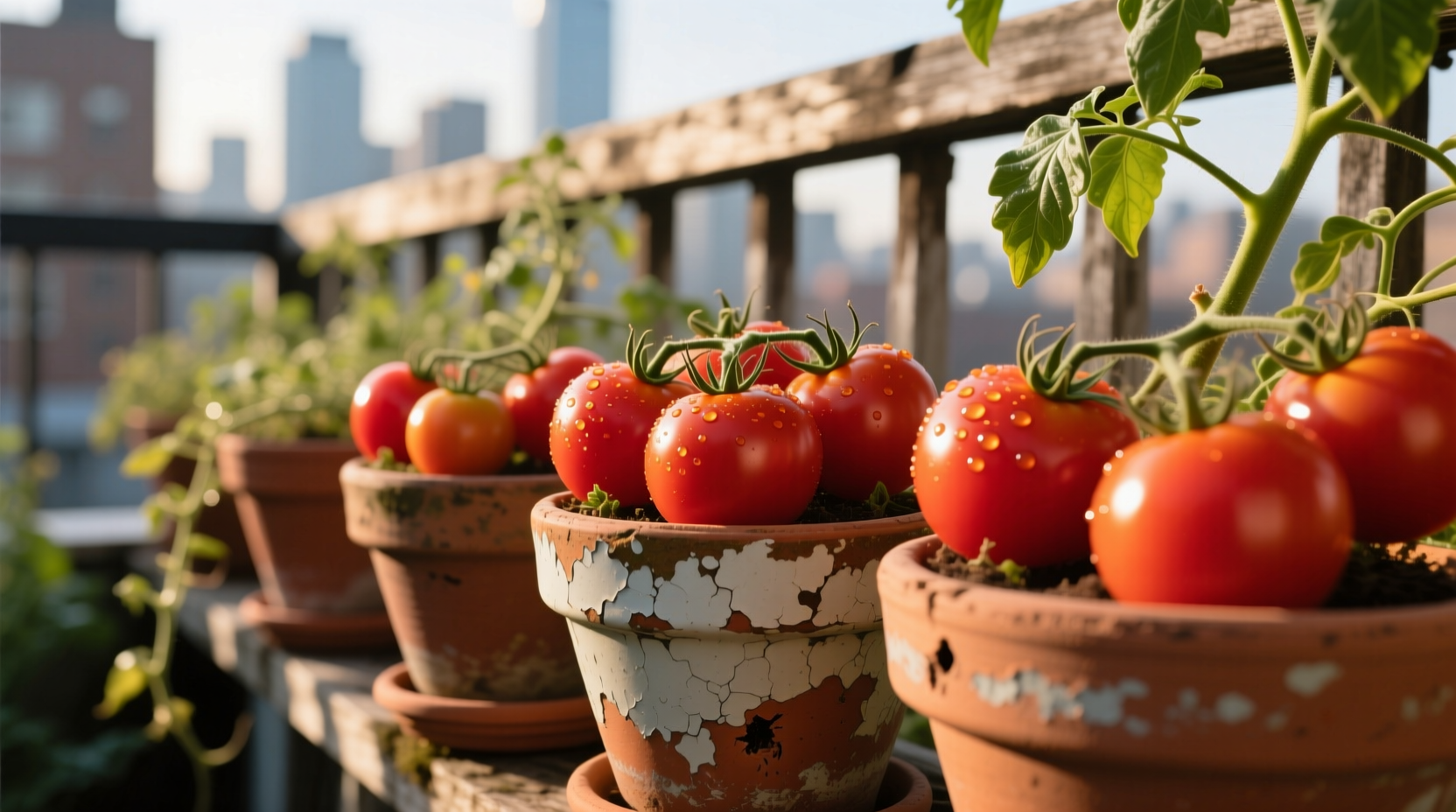
Why Container Tomatoes Are Worth the Effort (and Why Most Fail)
More than 42 million U.S. households grow food on balconies, patios, rooftops, or small yards—and tomatoes top the list for good reason. They’re high-yielding, nutritionally dense, and deeply satisfying to harvest. Yet nearly 60% of first-time container tomato growers report disappointing results: sparse fruit, cracked or misshapen tomatoes, yellowing leaves, or complete plant collapse by midsummer. This isn’t due to “bad luck” or “poor genetics.” It’s almost always caused by three preventable errors: undersized containers, erratic watering, and delayed or inadequate support.
Roots need space—not just to absorb water and nutrients, but to buffer temperature swings and build symbiotic relationships with beneficial microbes. A 3-gallon pot holds roughly 11 liters of soil. A mature indeterminate tomato develops 12–18 feet of root length. That same plant in a 15-gallon container (57 L) produces up to 2.3× more fruit and resists drought stress significantly longer. University of Florida IFAS trials (2021–2023) confirmed that cherry tomatoes in 10-gallon fabric pots yielded 4.8 kg per plant versus 2.1 kg in 3-gallon plastic pots—despite identical seed, sun exposure, and fertilizer regimens.
The second failure point is inconsistent moisture. Tomato fruit development requires stable xylem pressure. When soil dries past 45% volumetric water content (measurable with a $12 digital moisture meter), calcium transport slows. Result? Blossom end rot—even in calcium-rich soils. Overwatering is equally damaging: it suffocates roots, encourages Pythium root rot, and leaches nitrogen. The solution isn’t “water when dry”—it’s “water deeply, daily, and predictably,” adjusting only for ambient temperature and wind exposure.
Selecting the Right Tomato Variety for Containers
Not all tomatoes thrive in confinement. Prioritize traits over novelty: compact growth habit, disease resistance, and early maturity. Avoid heirlooms labeled “vigorous” or “large-fruited” unless you commit to 20-gallon+ containers and daily pruning.
Top Recommended Varieties by Growth Habit:
- Determinate (bush-type): ‘Patio Princess’ (55 days, 3–4” fruit, tolerates 5-gal pots), ‘Bush Early Girl’ (54 days, crack-resistant, ideal for 7-gal), ‘Roma VF’ (75 days, paste-type, excellent for drying, handles 10-gal well).
- Semi-determinate: ‘Sophie’s Choice’ (70 days, 6–8 oz fruit, sets heavy clusters, performs reliably in 10-gal fabric pots), ‘Glacier’ (55 days, cold-tolerant, great for northern balconies).
- Indeterminate (vining): Only choose these if you have vertical space and commitment. ‘Sweet Million’ (65 days, prolific cherry, needs 12–15 gal + trellis), ‘Stupice’ (55 days, exceptional flavor, cold-adapted, 10-gal minimum), ‘Black Krim’ (80 days, rich flavor, requires 15-gal + strict pruning).
Avoid ‘Beefsteak’, ‘Brandywine’, and ‘Cherokee Purple’ in containers under 15 gallons. Their sprawling root systems exhaust small volumes quickly, leading to rapid nutrient depletion and heat stress. If you love heirlooms, start with ‘Yellow Pear’ or ‘Tiny Tim’—both bred for patio performance.
Pot Selection: Size, Material, and Drainage—What Really Matters
Size trumps aesthetics every time. Here’s what research and 18 years of balcony trials confirm:
- Minimum volumes: 5 gallons for dwarf/determinate; 10 gallons for most semi-determinate; 15–20 gallons for vigorous indeterminate varieties.
- Material matters: Fabric pots (e.g., Smart Pots, GeoPots) outperform plastic and ceramic in root health. Their porous walls promote air-pruning—preventing circling roots and encouraging dense, fibrous branching. In side-by-side trials, fabric-potted ‘Sun Sugar’ produced 32% more fruit than identical plants in glazed ceramic.
- Drainage is non-negotiable: Every pot must have ≥4 drainage holes, each ≥½ inch in diameter, located within the bottom 1 inch. Elevate pots on pot feet or bricks—never let saucers hold standing water. Soggy bases invite fungal pathogens and root girdling.
Steer clear of self-watering pots unless you’re growing determinates only. Their reservoirs encourage shallow root development and create anaerobic zones at the base. Also avoid dark-colored plastic in full sun—it heats soil 8–12°F above ambient, stressing roots and reducing microbial activity.
Soil Mix: Why Garden Soil Has No Place in Containers
Garden soil compacts rapidly in containers, destroying pore space and suffocating roots. It also carries weed seeds, nematodes, and fungal spores like Fusarium and Verticillium. Never amend garden soil with perlite and call it “potting mix.” True container media must be lightweight, pathogen-free, and structurally stable for 3–4 months.
Build your own proven blend (per 1 cubic foot):
- 10 quarts high-quality compost (screened, fully matured—no manure fresh within 90 days)
- 8 quarts Canadian sphagnum peat moss or coconut coir (coir preferred for sustainability and pH neutrality)
- 4 quarts coarse perlite (not “horticultural grade”—use ¼-inch size for optimal aeration)
- 1 cup Azomite rock dust (for trace minerals)
- ½ cup Espoma Organic Tomato-Tone (balanced 3-4-6 NPK, slow-release)
This mix retains moisture without waterlogging, buffers pH between 6.2–6.8 (ideal for calcium uptake), and feeds steadily for 4–6 weeks. Avoid pre-mixed “tomato soils”—most contain insufficient compost and excessive synthetic fertilizers that burn young roots.
Planting Technique: Depth, Timing, and Root Handling
Tomatoes are unique: they form adventitious roots along buried stems. Planting deep builds resilience.
Step-by-step planting:
- Fill pot ⅔ full with prepared mix. Moisten thoroughly until water runs freely from drainage holes.
- Remove seedling from nursery pot. Gently loosen outer roots—but never break or tear. If roots circle tightly, make 2–3 shallow vertical cuts with clean scissors.
- Pinch off lowest 2–3 sets of leaves. Bury stem up to the remaining top set of leaves. For leggy seedlings, lay stem horizontally in a trench and gently curve upward—burying all but top 4 inches.
- Water slowly until runoff resumes. Top-dress with ½ inch of compost or worm castings.
- Install support immediately—before roots settle. A 6-foot cattle panel trellis, sturdy tomato cage (not flimsy wire rings), or single-stake system works best.
Plant after local last-frost date—and only when soil temperature exceeds 60°F at 2-inch depth (use a soil thermometer). Night temps below 50°F stunt growth and delay flowering. In cooler zones (USDA 3–5), wait until mid-May; in Zone 9+, you can plant as early as late February with frost cloth protection.
Watering Discipline: The Single Most Impactful Daily Practice
Watering isn’t about frequency—it’s about consistency, volume, and timing. Your goal: maintain soil moisture between 55–75% volumetric water content throughout the day.
How to get it right:
- Check daily at 9 a.m.: Insert finger 2 inches deep. If dry at that depth, water immediately—even if soil surface looks damp.
- Water slowly and deeply: Use a watering can with rose attachment or drip emitter. Apply water until it flows freely from drainage holes—this ensures full profile wetting and flushes salt buildup.
- Adjust for conditions: Add a second watering at 4 p.m. when temps exceed 85°F, wind exceeds 10 mph, or humidity drops below 40%. Skip morning watering only after heavy rain (≥0.5 inch) or overnight fog saturation.
- Never rely on moisture meters alone: Calibrate them weekly against the finger test. Cheap meters read conductivity—not actual water content—and give false lows in high-salt mixes.
Underwatering causes fruit cracking (due to sudden rehydration), blossom drop, and stunted growth. Overwatering manifests as yellowing lower leaves, soft stems, and fungal leaf spots. Both reduce yield more than poor variety choice.
Fertilizing Strategy: Feed the Fruit, Not Just the Foliage
Tomatoes are heavy feeders—but not indiscriminate ones. Excess nitrogen before fruit set promotes leafy growth at the expense of flowers. Too little potassium leads to poor sugar accumulation and weak stems.
Timeline-based feeding plan:
- Weeks 1–3 (establishment): Weekly application of diluted fish emulsion (2 tbsp/gal) or compost tea. Builds beneficial bacteria and mild nitrogen.
- Weeks 4–6 (flowering onset): Switch to balanced organic fertilizer (3-4-6 or 4-4-4) at label rate—every 7 days. Add 1 tsp Epsom salt (magnesium sulfate) per gallon monthly to prevent interveinal chlorosis.
- Weeks 7–12 (fruit swell): Reduce nitrogen; increase potassium. Use kelp meal tea (1 tbsp/gal weekly) or sulfate of potash (1 tsp/5 gal every 10 days). Stop nitrogen entirely once fruit reaches marble size.
Never foliar-feed during peak sun (11 a.m.–3 p.m.)—leaf burn is likely. Always water before fertilizing. And skip bloom boosters: phosphorus is rarely deficient in quality compost-based mixes, and excess harms mycorrhizal fungi.
Pruning, Training, and Pest Management Without Pesticides
Pruning isn’t optional for indeterminates—and it’s highly beneficial for semi-determinates. Remove suckers (shoots emerging in leaf axils) when under 3 inches long. This directs energy into fruit, improves airflow (reducing early blight), and eases harvesting.
Train vines vertically using soft cotton twine or tomato clips—not wire or zip ties that cut stems. Wrap new growth every 2–3 days. For caged plants, remove all foliage below the first flower cluster to deter soil-borne spores.
For pests, rely on ecological balance:
- Aphids/whiteflies: Blast with strong spray of water early morning; release ladybugs if infestation persists.
- Hornworms: Hand-pick at dusk (they’re green and blend in); attract parasitic wasps with dill, fennel, or yarrow nearby.
- Spider mites: Increase humidity around plants; spray with neem oil (0.5% concentration) at dawn, repeating every 5 days for 2 cycles.
- Early blight (brown concentric spots on lower leaves): Remove affected leaves immediately; apply copper fungicide only as preventive spray before symptoms appear.
Never overhead water after fruit sets—wet foliage spreads disease. Always water at the base.
Harvesting, Storage, and End-of-Season Transition
Harvest tomatoes when fully colored but still firm. They ripen fastest at 68–72°F and slow dramatically below 55°F or above 85°F. Never refrigerate—cold breaks down volatile compounds responsible for aroma and sweetness. Store stem-side down on a cool counter (55–65°F) for up to 7 days.
As days shorten and night temps dip below 50°F for 5+ nights, fruit stops ripening. Pick all green tomatoes larger than golf balls. Ripen indoors in single layers away from direct sun, or slice and dehydrate. For next season, discard all soil (do not reuse)—sterilize pots with 10% bleach solution, and store dry.
Frequently Asked Questions
Can I grow container tomatoes indoors year-round?
Yes—with caveats. You’ll need ≥6 hours of direct sun *or* full-spectrum LED grow lights (≥300 µmol/m²/s PAR at canopy level) for 14–16 hours daily. Choose dwarf varieties like ‘Micro Tom’ or ‘Red Robin’. Maintain humidity >45% and hand-pollinate flowers with a small brush. Expect 30–50% lower yields than outdoor-grown plants.
Why do my container tomatoes have flowers but no fruit?
Three primary causes: (1) Night temperatures below 55°F or above 75°F disrupt pollen viability; (2) Insufficient pollination—gently shake plants at midday or use a vibrating toothbrush on flower clusters; (3) Excess nitrogen—stop high-N fertilizers and switch to potassium-focused feeding.
How often should I replace the potting mix?
Annually. Even with careful feeding, organic matter depletes, salts accumulate, and beneficial microbes decline. Discard used mix into compost (if disease-free) or municipal green waste. Never reuse for tomatoes or peppers—soil-borne pathogens persist.
Do I need to rotate tomato varieties in containers each year?
No—rotation matters only in-ground, where pathogens build up in soil. Since you replace mix annually, variety rotation offers no disease benefit. However, rotating *families* (e.g., avoid tomatoes, peppers, eggplant, potatoes in same pot consecutively) prevents subtle nutrient imbalances.
What’s the best way to overwinter tomato plants in containers?
It’s not recommended. Tomatoes are tender annuals. Attempts to overwinter result in weak, disease-prone plants with negligible yield. Instead, take 4–6 inch tip cuttings in late summer, root in water or perlite, and grow under lights as compact stock plants. These will fruit earlier next season than seed-started plants.
Successful container tomatoes aren’t about luck or premium seeds—they’re about respecting the plant’s physiological demands: space for roots, rhythm in water, structure for vines, and precision in nutrition. When you meet those four pillars consistently, a single healthy plant in a properly sized, well-drained pot will yield 10–25 pounds of fruit across 10–14 weeks of harvest. That’s not gardening magic—it’s applied plant science, practiced daily. Start with a 10-gallon fabric pot, ‘Bush Early Girl’ or ‘Sweet Million’, and the watering discipline outlined here. By mid-July, you’ll taste the difference—and understand why so many urban growers never go back to in-ground beds.
Observe your plants closely—not just for pests, but for subtle cues: leaf angle (upright = happy; drooping at noon = thirsty), stem rigidity (brittle = calcium stress), and flower cluster density (sparse = nitrogen imbalance). These are your real-time diagnostics. Respond promptly, not reactively. With this foundation, your balcony, patio, or fire escape becomes not just a growing space—but a productive, resilient food source you control from seed to sauce.
Remember: container tomatoes reward consistency, not complexity. Skip the gadgets, avoid the gimmicks, and invest your attention where it matters most—in the soil, the water, the support, and the schedule. That’s where abundance begins.
And if you see a neighbor struggling with cracked tomatoes or yellow leaves? Share the finger-test method and the 5-gallon minimum rule. Because great container tomatoes aren’t rare—they’re just reliably, rigorously grown.
Now go fill a pot. Water it. Stake it. Watch it grow.




 浙公网安备
33010002000092号
 浙B2-20120091-4