
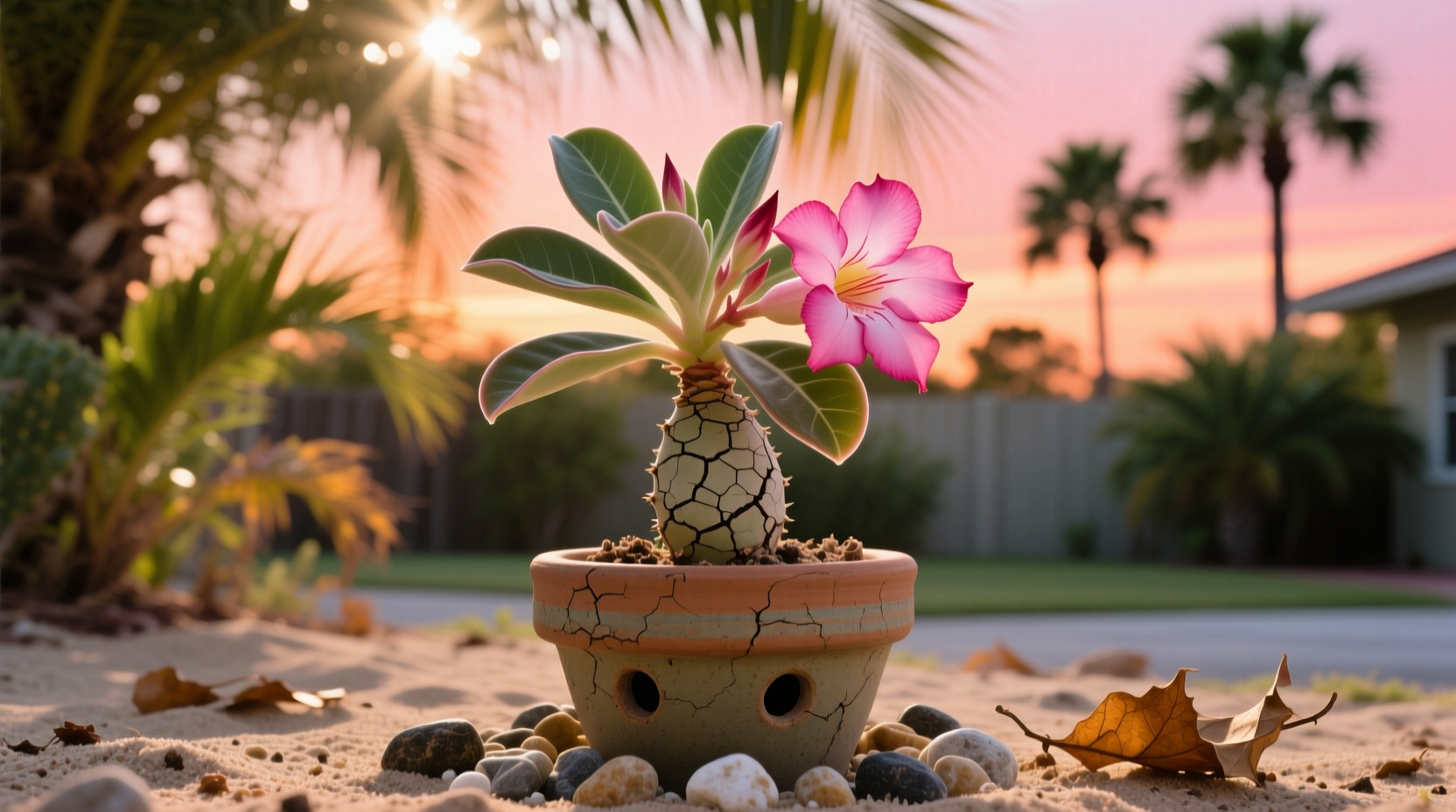
Why Generic Desert Rose Advice Fails in Florida
Most online articles on desert rose care originate from arid Southwest U.S. climates (e.g., Phoenix or Tucson) or controlled greenhouse settings. They assume low humidity, negligible summer rainfall, and predictable winter dormancy. Florida delivers none of that. Here’s what makes Florida distinct:
- Humidity averages 65–85% year-round—slowing evaporation, extending soil moisture retention, and inviting fungal pathogens like Phytophthora and Fusarium.
- Summer rainfall totals 30–60 inches annually, often delivered in torrential 2–4 inch downbursts—flooding even well-drained containers overnight.
- Winter temperatures fluctuate wildly: 32°F freezes in Tallahassee one night, then 75°F the next in Naples—disrupting natural dormancy cues and triggering premature growth vulnerable to late frosts.
- Soil pH runs alkaline to neutral (6.8–7.8) in coastal and limestone-rich areas—impacting iron and manganese availability, which directly affects leaf color and flower set.
Applying Arizona-based watering schedules—or trusting “well-draining potting mix” labels without verifying composition—leads directly to yellowing leaves, mushy caudexes, and sudden collapse. Florida requires adaptation, not replication.
Optimal Planting Time & Seasonal Timing
The single most impactful decision you’ll make is when to plant, repot, or prune. In Florida, timing isn’t flexible—it’s physiological.
Best planting window: Late April through early June. Why? Soil temperatures have stabilized above 65°F, nighttime lows consistently exceed 60°F, and the rainy season hasn’t yet intensified. Roots establish rapidly in warm, moist (but not soggy) conditions. Avoid planting in July–September—the combination of high heat, heavy rain, and fungal pressure overwhelms young root systems.
Repotting should occur only in May or early June. Never repot during active rain events or when humidity exceeds 90%. Always use fresh, sterile, mineral-based mix (see next section). Repotting in fall or winter invites slow decay: roots won’t regenerate in cool soil, yet moisture lingers.
Pruning is strictly a spring activity—mid-March to mid-April. This aligns with the natural flush of new growth triggered by warming days and longer photoperiods. Prune too early (February), and frost-damaged tips won’t heal; prune too late (May), and you sacrifice flower buds already forming on new wood. Make clean, angled cuts ¼ inch above outward-facing nodes using sterilized bypass pruners (rubbed with 70% isopropyl alcohol).
Soil & Container Selection: Non-Negotiable Foundations
Florida’s native soils—sandy, rocky, or limestone-heavy—are poorly suited for desert roses unless amended. But commercial “cactus & succulent” mixes often contain too much peat moss or coconut coir, which retain excessive water in humid conditions. Your goal is rapid drainage and minimal organic decomposition.
Recommended DIY Mix (by volume):
- 40% coarse horticultural sand (not play sand—use #16 silica sand or crushed granite)
- 30% pumice (¼–½ inch grade; provides air pockets and prevents compaction)
- 20% baked clay granules (Turface MVP or similar—holds trace nutrients without retaining water)
- 10% aged compost or worm castings (only for initial planting; omit for mature plants or repots)
This blend achieves zero water retention beyond 24 hours after irrigation—even under 90% humidity. It resists compaction for 2+ years and buffers pH naturally.
Container requirements are equally specific:
- Material: Unglazed terra cotta or porous concrete—never plastic or glazed ceramic unless drilled with 6+ drainage holes.
- Shape: Wide and shallow (saucer-shaped) rather than deep and narrow. Desert roses develop horizontal root mats, not taproots.
- Drainage: Minimum three ½-inch holes in the base—and one additional hole near the rim on the side wall (to release excess moisture vapor during prolonged humidity).
A 5-gallon container is ideal for a 2–3 foot tall specimen. Never “size up” to a larger pot hoping to reduce watering frequency—that guarantees soggy soil and root death.
Watering Protocol: Precision Over Habit
Watering is where most Florida growers fail—not from ignorance, but from misreading environmental cues. Use this three-step protocol:
- Check soil moisture at 3-inch depth using a wooden chopstick or moisture meter (calibrated for mineral soils, not peat). If damp or cool to touch, wait.
- Water only when top 3 inches are completely dry AND surface is visibly cracked or dusty. In summer, this may mean every 5–7 days; in fall, every 10–14 days; in winter, never unless temperatures stay above 60°F for 10+ consecutive days.
- When watering, drench thoroughly until water exits all drainage holes—then empty the saucer within 30 minutes. Never allow standing water.
Red flag signs of overwatering: soft, spongy caudex base; translucent or yellowing lower leaves (not just dropping); blackened leaf petioles; white fungal bloom on soil surface. At first sign, stop watering, move to full sun, and gently remove 1–2 inches of topsoil to accelerate drying.
Underwatering symptoms are milder and reversible: wrinkled caudex (not mushy), crisp brown leaf edges, slowed growth. Rehydrate slowly—don’t flood.
Sunlight & Placement: More Than Just “Full Sun”
“Full sun” means different things in Miami versus Jacksonville. Desert roses require direct, unfiltered sunlight for minimum 6 hours daily, but intensity matters:
- In South Florida (Zones 10B–11), provide morning sun + light afternoon shade (e.g., under a high-canopy avocado or live oak) June–August to prevent leaf scorch and caudex sunburn.
- In Central/North Florida (Zones 9A–10A), full-day exposure is safe year-round—but protect from cold winds in winter with a south-facing wall or temporary frost cloth.
Avoid placing pots directly on concrete or asphalt surfaces—they radiate heat above 120°F in summer, baking roots. Elevate pots on feet or gravel beds. Rotate containers weekly to ensure even light exposure and symmetrical caudex development.
Fertilizing Strategically: Less Is More
Over-fertilization causes weak growth, reduced flowering, and salt buildup—especially damaging in Florida’s low-rainfall winter months. Use only water-soluble, low-nitrogen formulas:
- Spring (March–June): Balanced 5-5-5 or 3-3-3 every 14 days—diluted to half label strength.
- Summer (July–September): Switch to bloom-booster 0-10-10 or 2-10-10 every 21 days. Nitrogen suppresses flowering; phosphorus supports bud formation.
- Fall/Winter (October–February): No fertilizer. Flush soil monthly with plain water to prevent salt accumulation.
Never use granular time-release fertilizers—they continue leaching nutrients during rainy periods, fueling algae and fungus. Always apply fertilizer to moist (not dry) soil to prevent root burn.
Pest & Disease Management: Early Detection Saves Plants
Florida’s warmth enables year-round pest activity. Key threats—and precise interventions:
- Spider mites: Fine webbing, stippled yellow leaves. Treat immediately with insecticidal soap spray (Safer Brand) every 3 days for 2 weeks. Avoid neem oil in >85°F—it can cause phytotoxicity.
- Mealybugs: White cottony masses in leaf axils and caudex crevices. Dab individually with 70% isopropyl alcohol on a cotton swab. Follow with systemic dinotefuran (Safari) soil drench once per season—never more.
- Root rot: Caused by Phytophthora or Fusarium. No cure. Prevention is absolute: perfect drainage, no winter water, and sterile tools. If suspected, remove plant, wash roots, inspect for black/brown mushiness, and discard affected tissue with sterile cut. Replant in fresh mix only if >50% healthy white roots remain.
Prevent fungal leaf spot (brown concentric rings) by avoiding overhead watering and ensuring airflow—space plants ≥3 feet apart and prune interior crossing branches.
Winter Care: Dormancy Without Death
True dormancy occurs when soil temps drop below 55°F for 10+ days. In Florida, this happens erratically—so rely on observation, not calendars:
- Leaves yellow and drop gradually (not suddenly)
- New growth ceases
- Caudex feels firm but slightly less turgid
At this point, move container to a covered, south-facing porch or garage window with bright indirect light. Stop watering. Do not cover with plastic or mulch—this traps humidity and invites rot. Lightly mist caudex surface once every 3 weeks only if it appears deeply wrinkled. Resume watering only when consistent 65°F+ soil temps return and new pink leaf buds emerge at branch tips.
Freeze protection: If forecast drops below 35°F, wrap caudex base (not foliage) in frost cloth or burlap. Never use plastic—it traps condensation. Move indoors only as last resort—low light indoors triggers etiolation.
Propagation & Grafting: Florida-Specific Success Tips
Seed propagation works—but germination rates in Florida humidity hover around 40% unless seeds are surface-sown on sterile pumice and covered with clear plastic dome (removed daily for air exchange). Better for beginners: stem cuttings.
Stem cutting protocol (best done April–May):
- Select 6–8 inch semi-hardwood tip cutting with 2–3 nodes.
- Remove all leaves; dip cut end in rooting hormone (IBA 0.3%) and fungicide (thiophanate-methyl).
- Insert 2 inches into pre-moistened pumice/sand mix. Place in bright, indirect light—not direct sun.
- Mist lightly every 2 days. Roots form in 4–6 weeks. Wait until 3+ true leaves appear before potting into soil mix.
Grafting (common for variegated or rare cultivars) succeeds best in late March. Use healthy, disease-free rootstock from local Florida-grown adeniums—imported stock often carries latent pathogens incompatible with our soil microbiome.
Common Mistakes to Avoid
These practices consistently cause failure—even among experienced gardeners:
- Using “potting soil” or “miracle-gro cactus mix” — contains peat, vermiculite, or moisture crystals that hold water for days in humidity.
- Watering on a schedule instead of by soil condition — leads to chronic overwatering during rainy spells.
- Planting in-ground without raised mounds or berms — even sandy Florida soil becomes saturated during prolonged rain; elevate root zone 8–12 inches above grade.
- Ignoring microclimate effects — a balcony facing west in Tampa receives brutal afternoon heat and reflected pavement radiation; east-facing is safer.
- Applying copper fungicides prophylactically — builds resistance and harms beneficial microbes. Use only after confirmed fungal diagnosis.
Frequently Asked Questions
Can I grow desert rose in Florida ground soil?
Yes—but only with significant amendment. Dig a 24-inch wide × 18-inch deep hole. Replace all native soil with the recommended mineral mix (pumice/sand/clay). Mound soil 6–8 inches above grade and mulch with 1 inch of crushed oyster shell—not bark or pine straw—to improve drainage and deter pests.
Why are my desert rose leaves turning yellow and dropping in summer?
In Florida, this is almost always overwatering combined with high humidity—not nutrient deficiency. Check soil moisture at depth. If damp, withhold water for 10 days, increase airflow, and prune any soft stems. Yellowing rarely indicates nitrogen need; adding fertilizer worsens root stress.
How often should I repot my desert rose in Florida?
Every 2–3 years maximum—and only in May. Signs you need repotting: roots circling tightly inside pot, water running straight through without absorption, or visible salt crust on soil surface. Never repot a stressed or flowering plant.
Do desert roses attract bees or hummingbirds in Florida?
Yes—strongly. Their trumpet-shaped, nectar-rich flowers (especially pink, red, and bicolor cultivars) attract native carpenter bees, bumblebees, and ruby-throated hummingbirds from March through November. Avoid spraying pesticides during bloom.
What’s the best desert rose cultivar for Florida humidity?
‘Kuara Pink’ and ‘Texas Red’ show superior fungal resistance and consistent flowering under high humidity. Avoid highly double-flowered or pale pastel cultivars (e.g., ‘Snow White’)—they bloom less reliably and are more prone to petal blight in summer rains.
Desert rose care in Florida rewards attentiveness—not rigidity. It asks you to observe daily: Is the soil truly dry? Is that new leaf emerging from the caudex swollen or shriveled? Is the afternoon sun still gentle enough for that southern exposure? These small, repeated judgments—grounded in local climate reality, not textbook generalizations—build resilience. You’ll learn to read your adenium’s language: a slight tilt of the caudex signaling thirst, a flush of crimson at branch tips heralding bloom, the faint scent of jasmine-like fragrance at dusk confirming health. With this guide as your baseline, your desert rose won’t merely survive Florida’s extremes—it will thrive, swell, and bloom with astonishing vigor, season after season. And when neighbors ask how you do it, you’ll know the answer isn’t magic. It’s precision, patience, and respect for the place where you grow.
Final note on longevity: Well-sited, properly watered desert roses in Florida regularly live 25+ years and exceed 6 feet in height with trunk girths over 18 inches. Their caudexes become living sculptures—textured, gnarled, and deeply rooted in the rhythm of our subtropical world. That’s not just gardening. That’s stewardship.




 浙公网安备
33010002000092号
 浙B2-20120091-4