
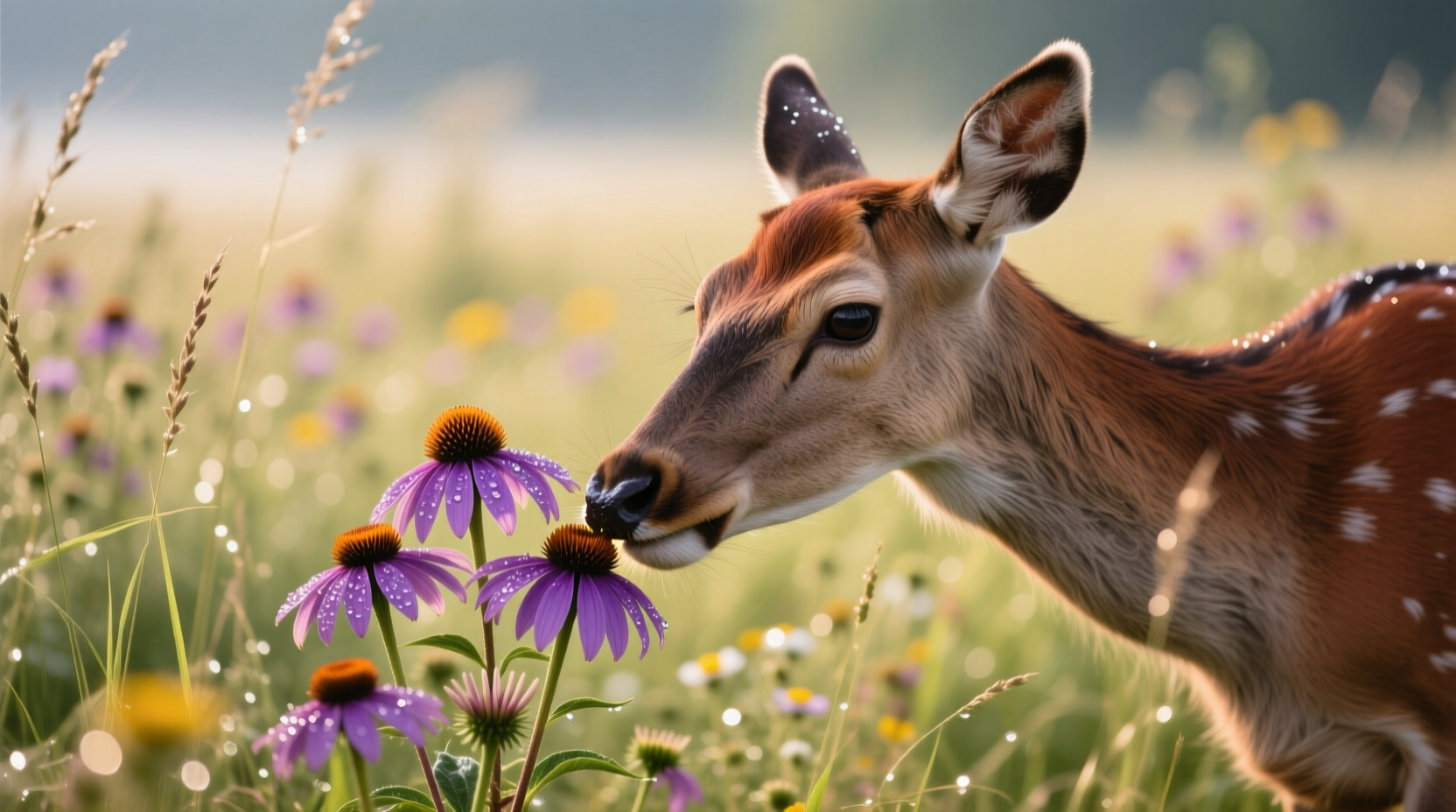
Why the Confusion? Untangling “Deer Resistant” from “Deer Proof”
The term “deer resistant” is widely misused—and often misunderstood—in horticultural marketing and casual gardening advice. It does not mean “never touched.” Rather, it reflects a relative preference ranking based on field observations, controlled feeding trials, and extension service reports. In practice, resistance is a spectrum influenced by three interlocking factors: plant chemistry, environmental pressure, and local deer population dynamics.
Echinacea purpurea, the most common native coneflower, contains sesquiterpene lactones and phenolic compounds that impart a sharp, bitter taste—deterring many herbivores. But deer palates adapt. A 2018 Rutgers University Cooperative Extension survey across New Jersey, Pennsylvania, and New York found that while only 12% of surveyed gardens reported consistent coneflower browsing in low-deer-density areas, that figure jumped to 63% in suburban zones bordering forest edges during late summer droughts. Why? Because when preferred forage like clover, wild strawberries, and young maple saplings dries up or becomes scarce, deer expand their diet. They’ll sample even marginally palatable plants—not out of preference, but necessity.
This explains why gardeners in rural Minnesota may report untouched ‘Magnus’ coneflowers year after year, while neighbors just 15 miles south in a fragmented woodland-suburb interface see repeated bud-stripping every June. It’s not that the plant changed—it’s that the deer’s options narrowed.
When Are Coneflowers Most at Risk? Timing Matters
Deer don’t browse coneflowers uniformly across the year. Vulnerability peaks during specific physiological and ecological windows:
- Early Spring (March–April): Tender new shoots—especially those emerging before leaf expansion—lack mature defensive compounds and are succulent and nitrogen-rich. This is the single highest-risk period for young transplants and bare-root divisions.
- Pre-Bloom Bud Swell (May–June): Flower buds contain concentrated sugars and amino acids. Deer often nip off unopened buds before petals unfurl, leaving stalks with clean, angled cuts—a telltale sign distinct from slug or earwig damage.
- Late Summer Drought (August–September): When native grasses brown and understory forbs wilt, deer turn to any remaining green foliage. Established coneflower leaves may be stripped from the base upward, particularly on plants growing in partial shade or poor soil (which produce less bitter secondary metabolites).
- Winter (December–February): Rare—but documented—especially in northern zones where snow cover exposes lower stems and dried seed heads. Deer may paw through snow to reach basal rosettes of evergreen cultivars like E. tennesseensis.
Note: Flowering stage matters. Fully open, pollen-rich blooms attract pollinators—not deer. But the pre-floral phase is dangerous. If your ‘White Swan’ coneflowers consistently lose buds in mid-June but bloom fully later, you’re witnessing targeted pre-bloom browsing—not random chewing.
Cultivar Differences: Not All Coneflowers Are Equal
Resistance varies significantly among species and cultivars. Assuming all coneflowers behave identically is one of the most common—and costly—mistakes gardeners make. Here’s what field data and extension trials confirm:
| Cultivar / Species | Observed Deer Resistance Level | Key Observations |
|---|---|---|
| Echinacea purpurea ‘PowWow Wild Berry’ | Moderate-High | Dense, compact habit; high leaf hairiness; strong bitterness. Rarely browsed except under extreme pressure. |
| E. pallida (Pale Purple Coneflower) | High | Narrow, stiff, gray-green foliage; very low palatability. Preferred by pollinators, avoided by deer. |
| E. paradoxa (Yellow Coneflower) | High | Distinctive waxy leaf cuticle; alkaloid profile deters browsing. One of the most reliably untouched species. |
| E. angustifolia | High | Native to dry prairies; extremely coarse, sandpapery leaves. Browsed only in prolonged famine conditions. |
| E. purpurea ‘Alba’ (white) | Low-Moderate | Softer foliage texture; reduced phenolic concentration vs. purple types. Frequently targeted for buds and young shoots. |
| E. purpurea ‘Fatal Attraction’ (double pink) | Low | Heavy petal mass increases sugar load in buds; lush growth habit signals higher nitrogen. High incidence of bud loss. |
Takeaway: Choose cultivars bred for toughness—not just aesthetics. ‘PowWow Wild Berry’, ‘Cheyenne Spirit’, and native straight species (E. pallida, E. paradoxa) consistently outperform double-flowered, pastel, or highly vegetative selections in deer-prone landscapes.
Proven, Science-Backed Protection Strategies (That Actually Work)
Forget myths: hanging bars of soap, human hair clippings, or ultrasonic devices have zero peer-reviewed efficacy against deer. What does work combines behavioral deterrence, physical barriers, and ecological context. Here’s what university extension trials validate:
1. Fencing: The Gold Standard (When Feasible)
A 7.5- to 8-foot-tall woven-wire or polypropylene mesh fence remains the only 100% reliable solution. Deer jump up, not over—they assess height visually and rarely clear 6 feet unless panicked. An 8-foot barrier interrupts their visual assessment and forces hesitation. For small beds, consider 5-foot-tall “deer netting” supported by 7-foot posts—angled outward at 15 degrees. This exploits deer’s reluctance to leap into uncertain space. Install in late winter, before spring green-up begins.
2. Repellents: Use Strategically, Not Routinely
Two classes hold merit: contact repellents (bitter-tasting sprays like Bobbex or Liquid Fence) and odor-based repellents (putrescent egg solids, coyote urine analogs). Effectiveness hinges on application timing and consistency:
- Apply contact repellents before first browsing occurs—not after damage appears.
- Reapply after rain or every 10–14 days during active growth (spring/summer).
- Rotate between bitter-taste and odor-based formulas to prevent habituation.
- Never spray directly on open blooms—this harms pollinators and reduces nectar quality.
Important caveat: Repellents protect only the treated surface. They won’t stop deer from stepping into a bed and eating untreated lower stems.
3. Companion Planting & Landscape Design
This isn’t about “masking scent”—it’s about creating sensory overload and reducing approach confidence. Interplant coneflowers with strongly aromatic, textured, or spiny perennials:
- Lavender (Lavandula angustifolia): Volatile oils confuse deer olfaction; dense gray foliage creates visual clutter.
- Lamb’s ear (Stachys byzantina): Silvery, fuzzy leaves are physically unappealing to lick or chew.
- Yarrow (Achillea millefolium): Bitter foliage + feathery texture = low desirability.
- Barberry (Berberis thunbergii—where not invasive): Thorns deter close approach; avoid near natural areas.
Also critical: eliminate “deer highways.” Avoid planting coneflowers along fence lines, wood edges, or open lawns where deer feel exposed yet can easily access beds. Instead, place them within mixed borders, surrounded by taller grasses (Panicum virgatum) or shrubs (Viburnum dentatum) that break line-of-sight and reduce landing confidence.
What Doesn’t Work—And Why Gardeners Keep Trying
Despite decades of evidence, certain practices persist due to anecdote, convenience, or misinformation. Avoid these:
- “Just plant more”: Increasing coneflower quantity doesn’t reduce browsing—it often increases visibility and accessibility. Deer learn patterns; a mass planting is a dinner bell.
- Spreading cayenne pepper or garlic spray weekly: No credible trial shows sustained efficacy beyond 48 hours. Rain, dew, and UV degrade capsaicin rapidly. Worse, it harms beneficial insects and soil microbes.
- Using motion-activated sprinklers alone: Effective short-term (first 2–3 weeks), but deer habituate quickly—especially does with fawns who learn to ignore the “hiss.” Pair with scent or taste repellents for longer effect.
- Pruning damaged stems and expecting recovery: While coneflowers tolerate some defoliation, repeated bud removal depletes root reserves. Plants become stunted, bloom less, and eventually decline. Prevention beats pruning.
Regional Nuances: Adjusting Strategy by Zone
Deer pressure isn’t uniform. Your USDA Hardiness Zone correlates strongly with both deer density and seasonal stressors:
- Zones 3–5 (Northern Midwest/Northeast): Highest risk in April–May (green-up scarcity) and September–October (pre-rut energy demand). Prioritize fencing + early-season repellent. Choose E. angustifolia or E. pallida.
- Zones 6–7 (Mid-Atlantic, Lower Midwest): Year-round pressure, peaking in June (bud swell) and August (drought). Rotate repellents monthly. Interplant heavily with lavender and yarrow.
- Zones 8–9 (Southeast, Pacific Northwest): Lower overall pressure, but browsing spikes during summer humidity stress or winter mild spells. Focus on soil health—well-drained, slightly alkaline soil boosts bitter compound production in E. purpurea.
- Zones 10+ (South Florida, Southern California): Mule deer or black-tailed deer may browse, but urban coyotes and smaller populations reduce risk. Still, never assume immunity—monitor early spring shoots.
Always consult your state’s cooperative extension service for localized deer pressure maps. Many (e.g., Penn State, UMass Amherst, Texas A&M) publish annual browse surveys updated with gardener-submitted photos and GPS-tagged incidents.
Soil, Health, and Chemistry: Strengthening the Plant’s Own Defenses
Healthy coneflowers resist browsing better—not because they’re “stronger,” but because they allocate more resources to chemical defense. Key levers:
- Avoid high-nitrogen fertilizers: Excess N promotes lush, soft growth low in defensive phenolics. Use composted manure sparingly—or none at all. Coneflowers thrive in lean, well-drained soil.
- Maintain neutral to slightly alkaline pH (6.5–7.5): Acidic soils reduce uptake of calcium and magnesium, both co-factors in bitter compound synthesis.
- Water deeply but infrequently: Shallow, frequent watering encourages shallow roots and succulent top growth. Deep soakings (1–2 inches/week in absence of rain) promote deep rooting and drought resilience—traits linked to higher cynarin concentration.
- Leave spent blooms intact through fall: Seed heads provide winter food for birds (reducing competition for other garden resources) and signal plant maturity to deer—making it less likely they’ll target the crown.
Recognizing Deer Damage vs. Other Pests
Accurate diagnosis prevents wasted effort. Deer damage has unmistakable hallmarks:
- Clean, ragged cuts at 45-degree angles—no saw-tooth edges (caterpillars) or slime trails (slugs).
- Browsing limited to heights above 2 feet—deer rarely graze below knee level unless snow-covered.
- Entire buds or terminal shoots removed, often leaving bare stems with no chewed leaf fragments.
- No fecal pellets or tracks nearby? Don’t rule it out—deer often defecate away from feeding sites. Look instead for flattened vegetation paths or hoof prints in soft soil.
If you find chewed leaves with irregular holes and frass (insect droppings), suspect beetles or caterpillars. If stems are cleanly severed at ground level overnight, voles or rabbits are more likely culprits.
Frequently Asked Questions
Will deer eat coneflowers in winter?
Rarely—but possible in northern zones during deep snow cover, especially if plants are growing in sheltered microclimates or mulched heavily (which retains warmth and encourages tender growth). Evergreen rosettes of E. tennesseensis are occasionally nibbled.
Are purple coneflowers more deer resistant than white ones?
Yes—consistently. Purple and orange cultivars contain higher concentrations of anthocyanins and sesquiterpene lactones, contributing to greater bitterness. White and pale-yellow forms tend to be softer-textured and less chemically defended.
Can I transplant coneflowers to a safer location if they’re being eaten?
Yes—but only in early spring (as soil thaws) or early fall (6+ weeks before first frost). Transplanting stressed, browsed plants in summer almost guarantees failure. Always water deeply for 2 weeks post-move and apply a bitter-taste repellent to new shoots.
Do deer eat coneflower roots?
No documented cases. Deer are browsers, not root-diggers. If you find excavated soil around coneflowers, suspect voles, skunks, or raccoons seeking grubs—not deer.
Will planting coneflowers near a bird feeder attract more deer?
Indirectly—yes. Spilled seed attracts rodents, which attract predators—including coyotes—that may then habituate to your yard. More critically, bird feeders draw deer seeking fallen sunflower seeds or millet. Place feeders >100 feet from coneflower beds and use squirrel-proof, no-waste designs.
Ultimately, managing deer and coneflowers isn’t about winning a battle—it’s about cultivating awareness, adjusting expectations, and working with ecological reality. Coneflowers aren’t fragile ornaments; they’re resilient native perennials evolved alongside herbivores. Your role isn’t to shield them completely, but to tip the balance—through smart selection, timely intervention, and respectful observation—so both deer and gardeners thrive. Start this season by auditing your site: map deer trails, note spring emergence dates, and choose two high-resistance cultivars. Then, protect the first six weeks aggressively. By July, you’ll likely see buds swelling, pollinators buzzing, and—most importantly—no clean, angled cuts on your stems. That’s not luck. That’s informed horticulture.
Remember: No strategy eliminates risk entirely. But combining cultivar choice, seasonal vigilance, physical barriers where appropriate, and soil stewardship reduces damage from near-certain to occasional—and keeps your coneflowers blooming boldly, year after year.
Observe. Adapt. Grow.




 浙公网安备
33010002000092号
 浙B2-20120091-4