
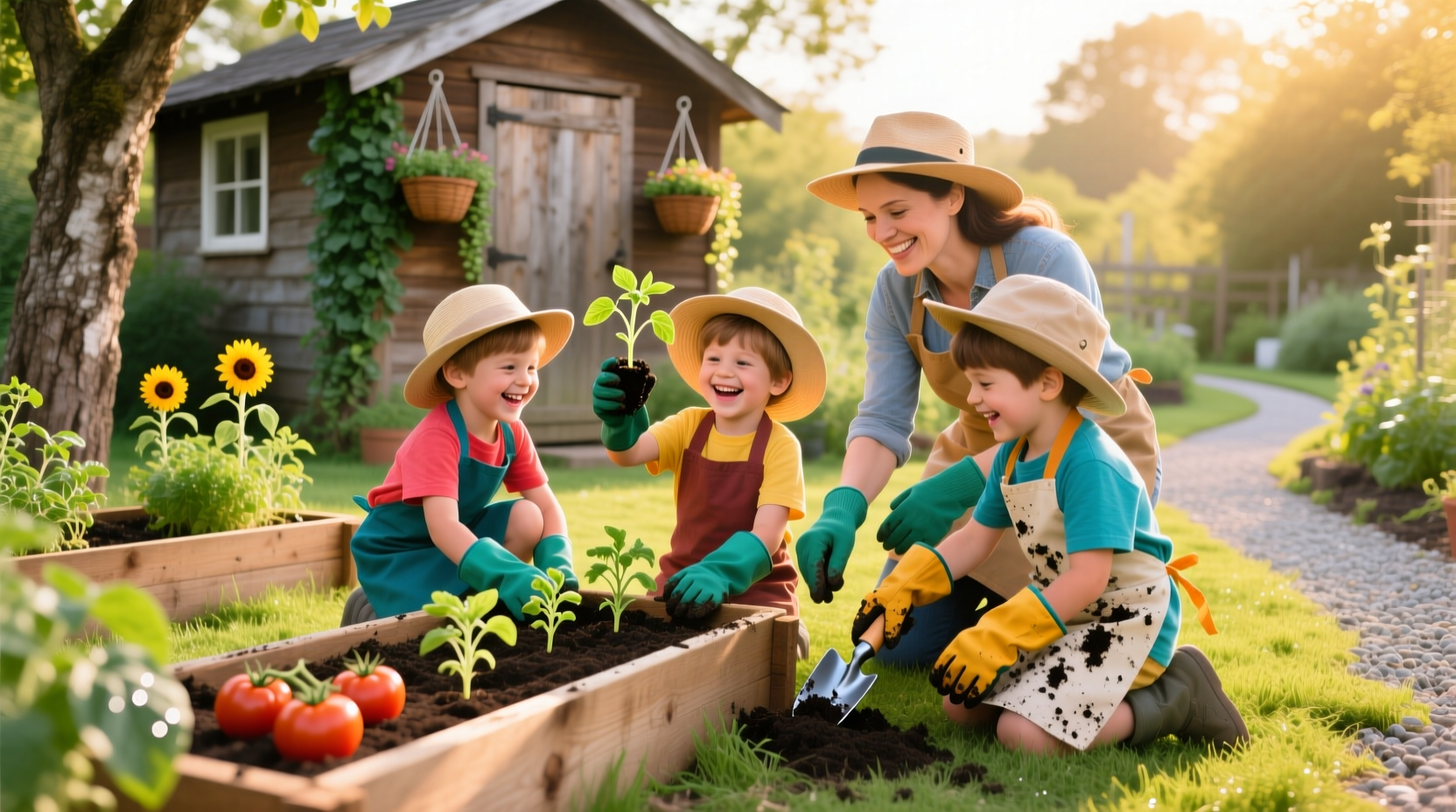
Why Gardening with Children Delivers Unique Developmental Benefits
Unlike structured classroom learning, gardening offers what developmental psychologists call “authentic scaffolding”: real-world problems with immediate, tangible feedback. When a child plants a bean seed, waters it daily, and watches the first green shoot pierce the soil, they are not memorizing facts—they are internalizing cause-and-effect, patience, and biological agency. Neuroimaging studies (University of Washington, 2020) show heightened activity in the prefrontal cortex and hippocampus during soil-based tactile tasks—regions directly linked to executive function and memory consolidation. More concretely, gardening with children improves:
- Fine and gross motor development: Scooping soil, twisting seed packets, carrying watering cans, and digging all strengthen hand-eye coordination, grip strength, and core stability.
- Sensory integration: The scent of basil, the crunch of dry soil, the cool weight of a cucumber, the sticky sap of tomato stems—these multi-sensory inputs help regulate nervous systems, especially for neurodivergent children.
- Scientific reasoning: Children naturally ask, “Why did this wilt?” or “What made that flower open?” These questions become entry points for hypothesis testing—not abstract lessons, but lived experiments.
- Emotional literacy: Caring for a living thing teaches empathy and grief management. A failed seedling isn’t a failure—it’s data. That distinction builds resilience far more effectively than praise alone.
Importantly, these benefits are dose-dependent—not tied to garden size or yield. A 2023 meta-analysis in Frontiers in Psychology found that just 45 minutes of weekly, adult-facilitated gardening produced statistically significant improvements in classroom behavior and self-reported mood among 5–9-year-olds across 17 urban schools.
Age-Appropriate Tasks: Matching Activity to Developmental Readiness
Assigning inappropriate tasks is the most common reason gardening with children becomes frustrating—for both parties. Here’s what’s developmentally realistic—and why:
Ages 2–4: Sensory Exploration & Simple Repetition
At this stage, attention spans last 3–8 minutes. Focus on texture, smell, sound, and color—not outcomes. Avoid expectations of “planting correctly.” Instead:
- Fill shallow trays with damp potting mix and let them press seeds (large, easy-to-handle ones like nasturtiums or peas) into the surface—no burying required.
- Provide spray bottles filled with water for misting leaves; the rhythmic motion is calming and controllable.
- Let them harvest cherry tomatoes or snap peas directly into a small basket—no cutting, no waiting.
- Avoid: Small seeds (like carrots or lettuce), complex tools (trowels with sharp edges), or multi-step instructions (“First dig, then place, then cover…”).
Ages 5–7: Cause-and-Effect Experimentation
Children now grasp basic sequences and can hold two variables in mind (“If I water more, will it grow faster?”). They thrive on visible change and personal ownership.
- Assign one “responsibility plant”—a sunflower, basil, or zinnia—in a labeled pot they decorate themselves.
- Introduce simple record-keeping: draw the plant every Tuesday, measure height with a paper ruler, note leaf count.
- Let them mix their own soil blend (⅔ potting mix + ⅓ compost) using measuring cups—math and science in action.
- Avoid: Overloading with too many plants; assigning chores without context (“Water the garden” vs. “Your basil looks thirsty—see how the leaves curl? Let’s give it a cup of water.”)
Ages 8–12: System Thinking & Problem Solving
This group grasps interdependence—pollinators, soil microbes, weather patterns. They benefit from design challenges and troubleshooting.
- Design a pollinator corner: choose three native flowers, sketch a layout, calculate spacing, research which bees or butterflies each attracts.
- Troubleshoot real issues: “The lettuce is bolting—what temperature triggers that? How can we shade it?”
- Build a simple rain gauge or soil moisture tester (using a wooden skewer or digital meter) and log data for two weeks.
- Avoid: Doing the thinking for them. Ask “What do you notice?” before “What should we do?” Let them fail safely—e.g., overwatering one pot while another stays dry teaches more than perfect care ever could.
Plant Selection: Safety, Speed, and Sensory Appeal First
Choosing plants for gardening with children requires three non-negotiable filters: non-toxicity, rapid visible response (germination ≤7 days), and high sensory engagement. Avoid ornamental “showpieces” that take months to bloom or require precise conditions. Prioritize edible, aromatic, textural, or movement-rich species.
Top 7 Proven Starter Plants for Children
| Plant | Days to Germination | Key Child Appeal | Safety Notes |
|---|---|---|---|
| Radishes (‘Cherry Belle’) | 3–5 | Crisp, colorful roots ready in 25 days; fun to pull | Non-toxic; leaves edible but slightly peppery |
| Green Beans (‘Provider’ bush type) | 5–7 | Vigorous vines, abundant harvest, easy to pick | Must be cooked; raw pods contain lectins |
| Sunflowers (‘Teddy Bear’ or ‘Little Becka’) | 7–10 | Tall, fuzzy stems, giant faces, edible seeds | Non-toxic; seeds require roasting before eating |
| Nasturtiums | 7–12 | Peppery flowers & leaves, bright colors, ant-repellent trait | Entire plant edible; avoid if child has mustard allergy |
| Cherry Tomatoes (‘Sweet 100’ or ‘Yellow Pear’) | 6–10 (transplants recommended) | Abundant, bite-sized fruit; climbing habit fascinates | Fruit safe; stems/leaves mildly toxic—teach “fruit only” rule |
| Basil (‘Genovese’ or ‘Lemon’) | 5–8 | Strong scent, soft leaves, fast regrowth when pinched | Non-toxic; excellent for making pesto together |
| Strawberries (day-neutral varieties like ‘Tristar’) | 14–21 (from runners or plugs) | Low-growing, sweet fruit, multiple harvests | Non-toxic; ensure soil is free of lead (test if urban) |
Plants to strictly avoid with young children: Daffodils (all parts toxic), foxgloves (cardiac glycosides), lantana (unripe berries cause vomiting), castor bean (ricin in seeds), and English ivy (skin irritant and toxic if ingested). Always cross-check with the ASPCA Toxic and Non-Toxic Plant List or your regional extension service before planting.
Tool & Space Setup: Function Over Form
Child-sized tools are not a luxury—they are a safety and efficacy necessity. Adult trowels cause wrist strain and poor control; oversized gloves muffle tactile feedback. Invest in three essentials:
- One-piece stainless steel trowel (no rivets to trap dirt or pinch fingers); length no longer than child’s forearm.
- Soft-grip, breathable gardening gloves (not oversized cotton)—look for reinforced fingertips and adjustable wrists.
- Watering can with detachable rose (fine spray for seedlings, open spout for deep watering); capacity ≤1.5 gallons for ages 3–7.
Space requirements are minimal. A 2' x 2' raised bed (12" deep), four 5-gallon fabric pots, or even a sunny windowsill with three 6" pots suffices. Key setup principles:
- Soil must be safe and biologically active. Never use topsoil or garden soil in containers—it compacts, drains poorly, and may harbor pathogens or heavy metals. Use OMRI-listed organic potting mix blended with 20% finished compost (not manure-based for young children).
- Containers must drain freely. Drill extra holes if needed. Standing water breeds mosquitoes and drowns roots—common cause of “why won’t my beans grow?” frustration.
- Label everything—visually. Use waterproof markers on popsicle sticks, or print laminated photos with plant names. Children remember images faster than text.
Common Mistakes That Derail Success (and How to Fix Them)
Most gardening-with-children failures stem from well-intentioned but misaligned practices. Here are the five most frequent errors—and their precise corrections:
Mistake #1: Prioritizing “Success” Over Process
The error: Choosing slow-maturing, finicky crops (like cauliflower or artichokes) to impress relatives, then expressing disappointment when nothing appears for weeks.
The fix: Define success as consistent engagement—not harvest volume. Celebrate cracked soil, first root emergence, or an earthworm spotted in the mix. Keep a “Garden Wonder Journal” where children draw or dictate observations—not just “big plant,” but “shiny bug on leaf,” “rain made soil dark brown,” “my finger fit in hole.”
Mistake #2: Inconsistent Watering Routines
The error: Letting children “water whenever they remember,” leading to drought-stress or root rot. This causes stunted growth and confusion (“I watered it! Why is it yellow?”).
The fix: Establish a ritual—not a chore. Use a clear 1-cup measuring cup and a visual chart: “Basil needs 1 cup every morning after breakfast. Put a sticker on the chart when done.” Teach checking soil moisture: “Stick your finger in up to the first knuckle—if it’s dry, it drinks. If damp, wait.”
Mistake #3: Skipping Soil Health Basics
The error: Using cheap, peat-heavy “potting soil” that dries into concrete or repels water, then blaming the child for “not watering enough.”
The fix: Pre-moisten all potting mix before planting. Fill container ¾ full, slowly add warm water while stirring with fingers until uniform dampness (like a wrung-out sponge) is achieved. Let sit 1 hour before planting. This prevents hydrophobic pockets.
Mistake #4: Ignoring Microclimate Realities
The error: Planting sun-lovers like tomatoes on a north-facing balcony, then wondering why they’re leggy and flowerless.
The fix: Track sunlight for 3 consecutive days: mark hours of direct light on a printed grid. Full sun = 6+ hours unobstructed; partial = 3–6 hours; shade = <3 hours. Match plants accordingly—e.g., mint, parsley, and lettuce thrive in partial shade.
Mistake #5: Not Preparing for Pests & Problems
The error: Reacting to aphids with chemical sprays or panic, scaring children away from future observation.
The fix: Normalize insects as part of the system. Show children how to blast aphids off with a strong spray of water (safe, immediate, effective). Introduce ladybug larvae as allies. Keep a magnifying glass handy to examine “good bugs” vs. “chewers.” Frame pests as data—not enemies.
Extending the Learning: From Garden to Curriculum
Gardening with children naturally bridges disciplines. Anchor concepts in real experience:
- Math: Count seeds planted vs. sprouted; calculate germination rate; measure growth in cm/inches; compare harvest weights week-to-week.
- Language Arts: Write plant “biographies” (first-person narratives: “I am a radish seed…”); keep seasonal poetry journals; interview a neighbor gardener and transcribe quotes.
- Social Studies: Research origin stories of foods (tomatoes: Andes; carrots: Afghanistan); map global spice routes; discuss food justice—“Why do some neighborhoods have gardens and others don’t?”
- Environmental Science: Test pH with litmus strips; observe decomposition in a worm bin; track local pollinator sightings via iNaturalist.
These extensions require no lesson plans—just curiosity and a few open-ended questions: “What do you think happens underground right now?” “How might this plant help another creature?” “What would change if it rained every day for a month?”
Frequently Asked Questions
How do I handle a child who refuses to get dirty?
Respect sensory boundaries. Start with above-soil activities: arranging stones as “fairy paths,” painting rocks for markers, or pressing leaves into clay. Offer textured tools (wooden rakes, woven baskets) before introducing bare-hand contact. Never force touch—build trust through observation first. Many children gradually initiate contact once they see peers or adults enjoying it without pressure.
What if we live in an apartment with no outdoor space?
Indoor gardening with children is highly effective. Prioritize south- or west-facing windows. Grow microgreens in recycled containers (ready in 7–10 days), dwarf citrus in 5-gallon pots, or herbs under LED grow lights (use full-spectrum, 12-hour timers). Balconies—even 3' x 3'—support tomatoes, peppers, and strawberries in large pots with proper support.
Are raised beds safer than in-ground plots for kids?
Yes—for three reasons: reduced back strain for adults, better drainage control, and minimized exposure to contaminated soil (critical in urban areas or near old homes with lead paint). Build beds from untreated cedar or recycled plastic lumber. Fill with tested, certified clean soil—never municipal compost unless verified lead-free.
How do I explain plant death without causing distress?
Use factual, non-anthropomorphic language: “This plant didn’t get enough water for five days, so its cells dried out. That’s called wilting. We learned that next time, we’ll check the soil every morning.” Avoid “It’s sleeping” or “It went to plant heaven”—these confuse biological reality and delay understanding of cause-and-effect. Grief is appropriate; mystification is not.
Can gardening help children with ADHD or autism?
Robust evidence says yes. A 2021 clinical trial in JAMA Pediatrics showed 32% greater improvement in sustained attention among children with ADHD who participated in weekly school garden programs versus controls. For autistic children, the predictable routines, tactile input, and non-verbal communication pathways (observing insect behavior, tracking growth patterns) reduce anxiety and increase initiation of social interaction. Always co-create structure—e.g., “First we water, then we count ladybugs, then we sketch”—and allow exit options without stigma.
Gardening with children is not about cultivating perfect vegetables or flawless flower beds. It is about cultivating attention, agency, and awe—one handful of soil, one sprouting seed, one shared moment of wonder at a ladybug’s spotted shell at a time. The science is unequivocal: when children nurture life, life nurtures them back—deeper roots, stronger stems, and a quiet, enduring resilience that no standardized test can measure. Start small. Stay consistent. Watch closely. The rest will grow.




 浙公网安备
33010002000092号
 浙B2-20120091-4