
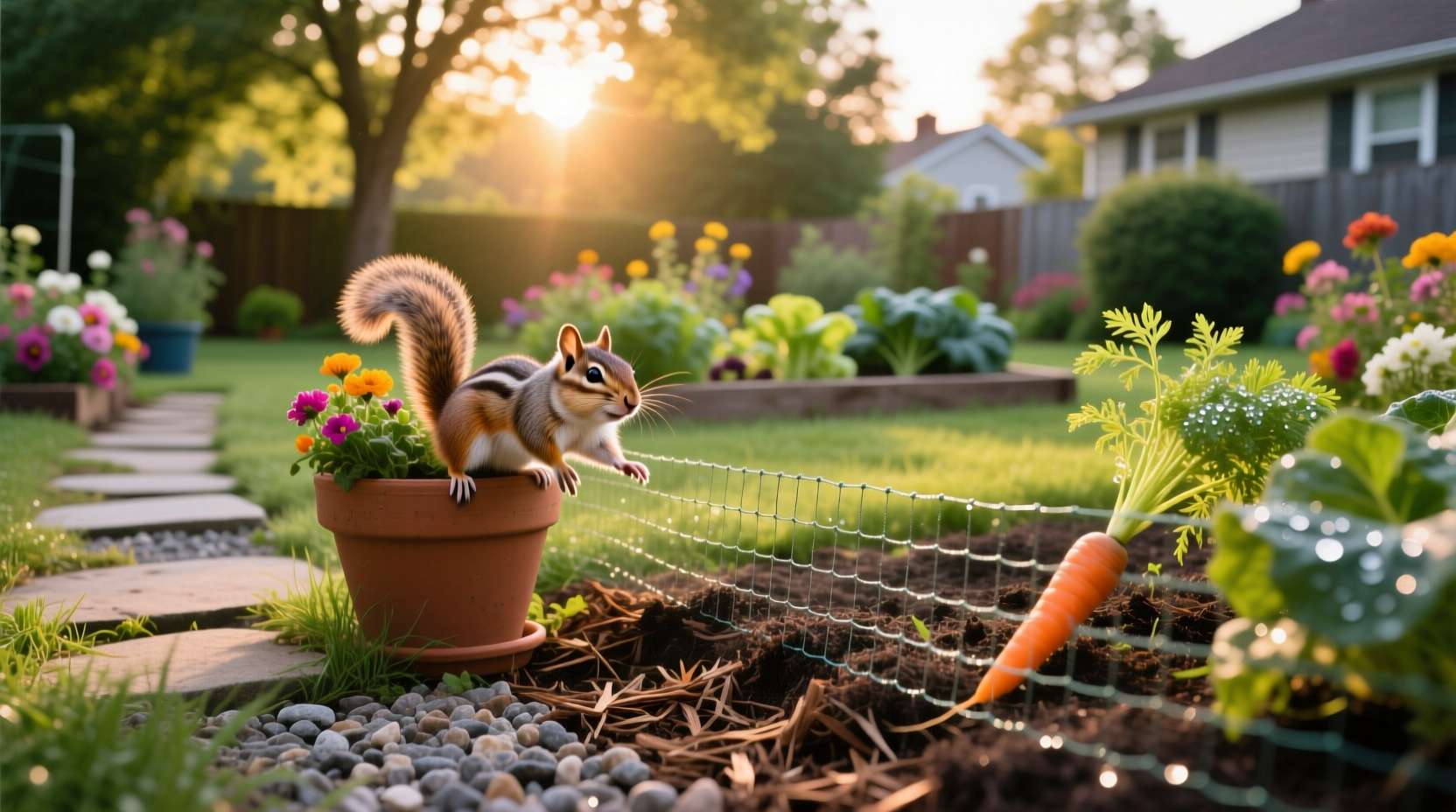
Why Chipmunks Target Gardens—and Why “Just One” Isn’t Harmless
Eastern chipmunks (Tamias striatus) and least chipmunks (Neotamias minimus) are native North American rodents with exceptional spatial memory, high reproductive capacity (1–2 litters per year, 4–6 young each), and a natural instinct to cache food. Unlike deer or rabbits—which browse aboveground—chipmunks dig. They excavate shallow tunnels (2–4 inches deep) to bury nuts, seeds, and bulbs. What looks like random holes in your mulch may be deliberate caches—or worse, the entrance to a complex burrow system extending beneath your raised bed or perennial border.
In gardens, chipmunks cause four distinct types of damage:
- Bulb theft: Tulips, crocuses, and hyacinths are prime targets—often dug up days after planting, leaving no trace but a small crater.
- Seedling predation: Newly emerged lettuce, spinach, bean, and pea seedlings vanish overnight; stems are cleanly severed at soil level.
- Fruit pilfering: Strawberries, blueberries, and low-hanging cherry tomatoes disappear just before ripening—sometimes with only the calyx left behind.
- Soil disruption: Repeated tunneling under pathways, edging stones, or container bases destabilizes structures and exposes roots of established perennials.
A common misconception is that chipmunks “only take what they need.” In reality, a single adult chipmunk can cache 5,000+ food items per season—and rarely retrieves them all. Those forgotten tulip bulbs sprout elsewhere, yes—but the digging itself damages neighboring plants’ root systems, compacts soil, and creates entry points for fungal pathogens. Worse, chipmunk burrows near foundations or retaining walls can undermine structural integrity over time, especially in clay-heavy soils that swell when wet.
What Doesn’t Work—And Why Well-Meaning Gardeners Keep Trying
Before investing time or money, understand which widely shared tactics lack scientific support or real-world reliability:
- Ultrasonic repellers: Multiple university extension trials (e.g., Cornell Cooperative Extension, 2018; University of Nebraska-Lincoln, 2021) found zero statistically significant reduction in chipmunk activity near emitters—even when placed directly at burrow entrances. Chipmunks hear frequencies up to ~45 kHz, but they rapidly habituate, and sound doesn’t penetrate soil or dense vegetation.
- Cayenne pepper or garlic sprays: These irritate mucous membranes on contact—but chipmunks avoid treated surfaces only while the residue remains potent (typically <48 hours after rain or dew). They simply shift foraging to untreated zones. Worse, repeated spraying harms beneficial soil microbes and can burn tender foliage.
- Mothballs: Toxic (naphthalene or paradichlorobenzene), illegal for outdoor vertebrate control in all 50 U.S. states per EPA regulations, and dangerous to pets, children, and groundwater. They do not repel chipmunks long-term and degrade into carcinogenic compounds.
- “Humane” traps followed by relocation: Relocating chipmunks beyond 1 mile is often fatal due to territorial aggression from resident chipmunks, starvation, or exposure. Most states prohibit relocation without permits—and survival rates drop below 20% beyond 0.5 miles.
These methods persist because they’re inexpensive, easy to deploy, and offer psychological reassurance. But they delay adoption of strategies with documented efficacy—and sometimes worsen the problem (e.g., scattering birdseed while “testing” repellents).
Physical Barriers: The Gold Standard for Protection
When installed correctly, physical barriers are >90% effective and require minimal maintenance. Success hinges on material choice, depth, and seam integrity—not just height.
Hardware Cloth: Your First Line of Defense
Use ¼-inch galvanized hardware cloth—not chicken wire (too wide-meshed) or plastic netting (easily chewed). For raised beds:
- Line the entire bottom before filling with soil, overlapping seams by at least 2 inches.
- Bury the perimeter edge vertically 6 inches deep, then bend it outward 3 inches horizontally (like an “L”) before backfilling. This prevents digging underneath.
- Secure edges with landscape staples every 12 inches.
For in-ground bulb plantings, create “cages”: cut hardware cloth into 12×12-inch squares, fold into loose cubes, place over planted bulbs, and cover completely with soil. This protects tulips and crocuses through their entire dormancy-to-emergence cycle.
Container Gardening Adjustments
Chipmunks climb surprisingly well. Prevent access to pots by:
- Raising containers onto stands at least 18 inches tall with smooth, non-grippable legs (e.g., metal or glazed ceramic—not rough wood or terra cotta).
- Wrapping the pot’s outer rim and upper 2 inches with aluminum foil (deters climbing via texture and reflectivity).
- Placing saucers filled with 1 inch of coarse gravel or crushed oyster shell around base—creates an unstable, noisy surface they avoid.
Habitat Modification: Making Your Garden Uninviting—Not Just Unpalatable
Chipmunks seek three things: food, water, and shelter. Remove two, and they’ll move on. Food removal is covered elsewhere—but shelter modification is frequently overlooked.
Ground Cover & Mulch Management
Dense, low-growing plants (pachysandra, vinca, ajuga) and thick layers of shredded bark or pine straw provide ideal nesting cover. Replace these within 10 feet of vegetable beds or prized ornamentals with:
- Gravel or decomposed granite paths (2–3 inches deep)
- Ornamental grasses with upright, open growth (e.g., Muhlenbergia capillaris, Schizachyrium scoparium)
- Low, sprawling herbs like thyme or woolly yarrow (Achillea tomentosa)—their fuzzy foliage deters nesting
Avoid rock piles, stacked firewood, or unsealed sheds within 15 feet of garden zones. Chipmunks nest in crevices as narrow as 1 inch—so seal foundation gaps with copper mesh (which they won’t chew) and caulk exterior vents.
Bird Feeder Discipline
Birdseed is the #1 unintentional chipmunk attractant. To break the link:
- Switch to safflower seed (bitter-tasting to chipmunks but loved by cardinals and chickadees).
- Install feeders on poles with 18-inch diameter baffles positioned below the feeder—chipmunks can’t jump upward more than 3 feet from flat ground.
- Use tube feeders with weight-activated perches that close ports when >1.5 lbs is applied (excludes chipmunks but allows most songbirds).
- Sweep fallen seed daily—and place feeders >30 feet from shrubbery or structures they can leap from.
Strategic Repellents: When and How to Use Them Effectively
Repellents work best as short-term deterrents during high-risk periods (bulb planting in fall, seedling emergence in spring) and only when combined with barrier and habitat methods. Two categories have consistent field validation:
Taste-Aversion Repellents
Products containing bitrex (denatonium benzoate)—the most bitter substance known—cause immediate rejection upon tasting. Apply granular formulations (e.g., Liquid Fence Deer & Rabbit Repellent Granules, which also deters chipmunks) around bulb beds and seedling rows at planting time, then reapply after heavy rain. Do not use on edible crops within 7 days of harvest.
Olfactory Deterrents with Predator Cues
Chipmunks respond strongly to the scent of predators. Coyote or fox urine (synthetic or naturally sourced, dehydrated) triggers vigilance behavior. Apply every 7–10 days along perimeter borders and near burrow entrances—but only in cool, dry weather (heat volatilizes active compounds). Avoid spraying directly on plants; instead, soak cotton balls and place at tunnel openings or scatter granules along runways.
Homemade alternatives lack consistency: predator scat is difficult to source legally, and essential oil blends (peppermint + clove) show <15% efficacy in controlled trials (Ohio State Extension, 2020) due to rapid evaporation and variable concentration.
Timing Matters: Aligning Tactics with Chipmunk Behavior Cycles
Understanding seasonal patterns prevents wasted effort:
- Early spring (March–April): Focus on protecting emerging seedlings and newly planted peas/beans. Install hardware cloth cages over early bulbs still dormant underground. Trim ground cover now—before nesting begins.
- Mid-spring to early summer (May–June): Peak foraging for protein-rich insects and tender greens. Monitor for new burrow entrances near compost bins or stone walls. Refresh repellents weekly.
- Fall (September–October): Critical for bulb protection. Plant tulips and crocuses only after soil temps drop below 55°F (13°C) at 6-inch depth—this reduces immediate caching instinct. Always cage bulbs at planting.
- Winter: Minimal activity, but don’t relax. Seal all entry points to sheds, decks, and foundations now—chipmunks seek warm shelter and will exploit gaps opened by frost heave.
Note: Chipmunks do not hibernate but enter torpor—brief, energy-conserving naps—waking every few days to eat stored food. So winter burrows remain active.
Plant Selection: Building a Naturally Resistant Garden
No plant is 100% chipmunk-proof—but some are consistently avoided. Prioritize species with strong odors, fuzzy or prickly textures, or toxic compounds:
- Herbs: Lavender, rosemary, sage, oregano (volatile oils deter digging)
- Perennials: Lamb’s ear (Stachys byzantina), Russian sage (Perovskia atriplicifolia), yarrow (Achillea millefolium)
- Bulbs: Daffodils, alliums, snowdrops, fritillaria (contain alkaloids unpalatable to rodents)
- Vegetables: Tomatoes (stems too woody), peppers (capsaicin deters), brassicas (mustard oils)
Avoid planting “chipmunk magnets” near high-traffic zones: sunflowers (seeds), corn (kernels), squash (seeds and flesh), and strawberries (fruit and runners).
Mistakes That Escalate the Problem
Even experienced gardeners inadvertently reinforce chipmunk presence:
- Leaving compost piles uncovered: Chipmunks dig into warm, food-rich piles for both nutrition and nesting warmth. Use enclosed tumblers or bins with tight-fitting lids and ¼-inch ventilation mesh.
- Overwatering lawns near garden edges: Soggy soil is easier to dig—and attracts earthworms and grubs, which chipmunks hunt.
- Using mulch that retains moisture and hides tunnels: Cypress or hardwood bark holds water and conceals activity. Switch to gravel, crushed stone, or cocoa hulls (bitter and mildly toxic to rodents).
- Ignoring early signs: One fresh hole is manageable. Five holes in a week signals an established colony requiring integrated intervention—not just a new repellent.
When to Call a Professional—And What to Ask
Consult a licensed wildlife biologist or Nuisance Wildlife Control Operator (NWCO) if you observe:
- Burrows larger than 2 inches in diameter or >12 inches deep
- Multiple entrances within a 10-foot radius
- Damage to irrigation lines, wiring, or structural foundations
- Chipmunks entering garages, sheds, or homes regularly
Ask these three questions before hiring:
- “Are you licensed by the state wildlife agency to handle live-trapped chipmunks?” (Required in 47 states)
- “Do you use exclusion methods—sealing entry points—rather than just trapping?” (Trapping without exclusion guarantees return)
- “Can you provide references from residential clients with similar garden layouts?”
Never hire operators who offer “guaranteed eradication”—it violates ecological ethics and state law. Ethical NWCOs aim for coexistence, not elimination.
Frequently Asked Questions
Will coffee grounds keep chipmunks out of my garden?
No. While coffee grounds alter soil pH and suppress some fungi, multiple field trials (University of Vermont, 2019; Rutgers NJAES, 2022) found zero deterrent effect on chipmunks. They walk, dig, and nest freely in coffee-amended beds. Save grounds for compost or acid-loving plants like azaleas—but don’t rely on them for pest control.
Are chipmunks dangerous to pets or children?
Direct attacks are extremely rare. Chipmunks carry fleas and ticks that may transmit diseases (e.g., tularemia, plague in western states), but transmission to humans or pets requires direct handling or bites. Their primary risk is indirect: undermining patios or causing falls by collapsing soil beneath stepping stones. Supervise toddlers around active burrows.
Can I plant bulbs deeper to avoid chipmunks?
Planting deeper than recommended (e.g., tulips at 10 inches instead of 6–8) delays emergence and stresses bulbs—reducing flower size and longevity. Depth alone doesn’t prevent digging; chipmunks excavate precisely where they smell or see planting disturbance. Hardware cloth cages are far more reliable.
Do motion-activated sprinklers work against chipmunks?
Yes—but only short-term. Models like the Orbit Yard Enforcer show 70% initial reduction in activity (Penn State Extension, 2020), but chipmunks adapt within 10–14 days, especially if food is abundant. Use them as a temporary tool during critical 2-week windows (e.g., right after bulb planting), then discontinue.
What’s the difference between chipmunks and voles?
Chipmunks are diurnal, striped, bushy-tailed, surface-dwellers that create visible mounds and 2-inch-wide holes. Voles are nocturnal, mouse-like, short-tailed, and create hidden 1–2-inch surface runways under grass or mulch. They girdle tree roots and eat bulbs from below. Control differs: voles require different barriers (buried hardware cloth must extend 12 inches down) and bait stations (with caution around pets). Confirm species before acting.
Keeping chipmunks out of your garden isn’t about warfare—it’s about thoughtful stewardship. By respecting their role in seed dispersal and insect control while thoughtfully limiting access to resources we cultivate, we maintain ecological balance without sacrificing beauty or yield. Start with one raised bed lined in hardware cloth this weekend. Observe the difference in two weeks. Then expand. Consistency—not intensity—is what transforms frustration into quiet, resilient abundance.
Remember: A garden free of chipmunk damage isn’t sterile—it’s intelligently designed. It has clean edges, clear sightlines, layered textures that discourage nesting, and plant choices aligned with local ecology. That kind of garden doesn’t just resist pests—it thrives because it works with nature, not against it. And that, ultimately, is the most sustainable form of protection.
Observe closely. Act deliberately. Adapt annually. Your garden—and the chipmunks—will both be healthier for it.




 浙公网安备
33010002000092号
 浙B2-20120091-4