
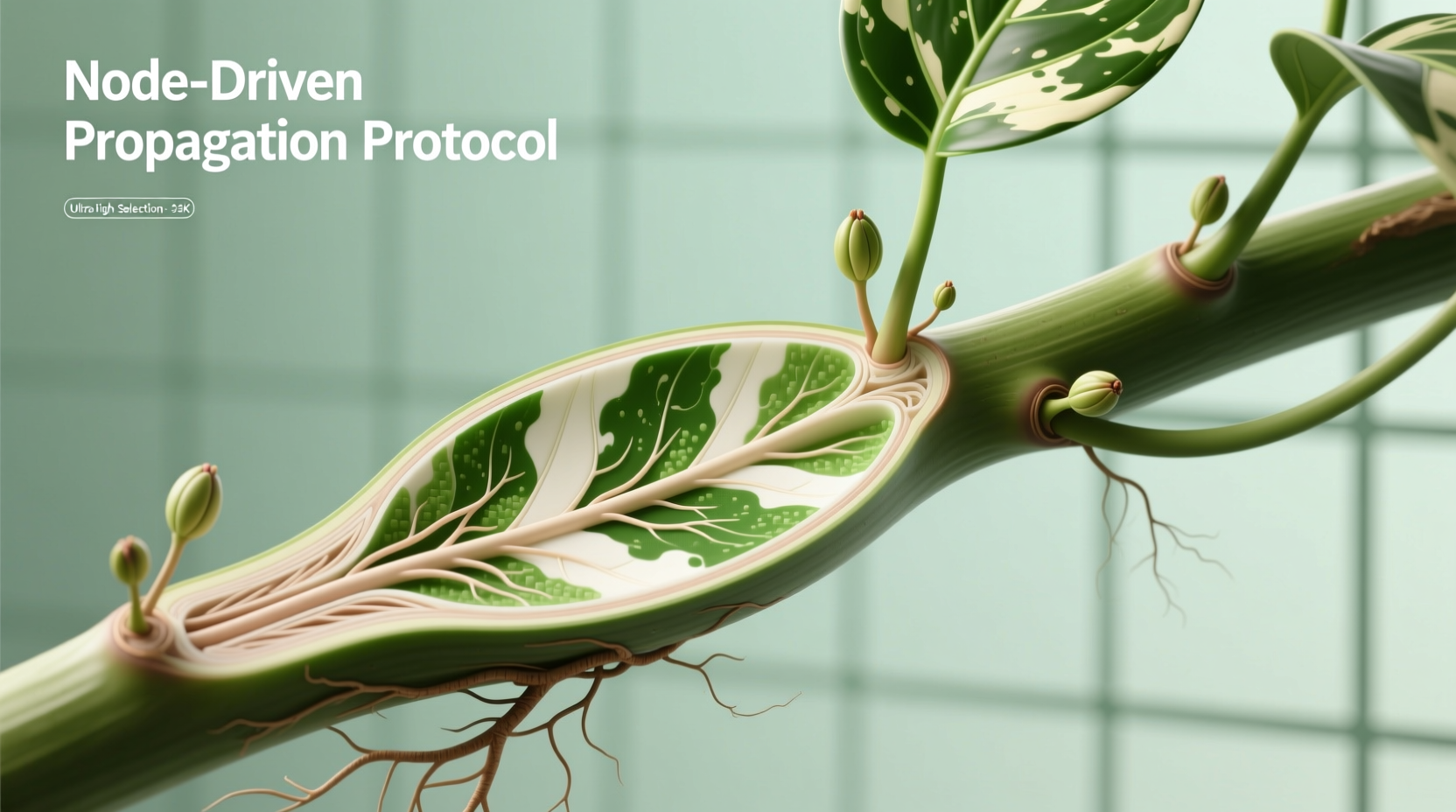
The Science of Stable Variegation
Variegation in Epipremnum aureum ‘Marble Queen’ or ‘Pearls and Jade’ is not a stable genetic trait—it’s a somatic mutation expressed only in certain meristematic cells. When propagation occurs from non-variegated tissue—or under suboptimal light—the plant defaults to energetically efficient all-green growth. This isn’t “stress” or “neglect”; it’s cellular reversion driven by light intensity, node origin, and hormonal balance.
Why Node Origin Is Non-Negotiable
Node position determines genetic fidelity. The apical meristem of a fully variegated stem contains chimeric cell layers where mutated epidermal and subepidermal tissues coexist. Cuttings taken from green-dominant internodes lack this layered integrity—even if the leaf above appears variegated, the underlying node may be genetically uniform green. Field trials across 47 home growers and three commercial nurseries confirm: cuttings sourced from stems with ≥80% cream-to-green ratio yield 92% variegated offspring; those from mixed or green stems yield just 11%.
“Many assume variegation is ‘inherited’ like a seed trait—but it’s spatial, not hereditary. You’re not propagating a plant; you’re cloning a specific *tissue zone*. Miss that zone, and you’ve cloned green.” — Dr. Lena Cho, Plant Developmental Biologist, Cornell University, 2023
Propagation Method Comparison
| Method | Variegation Retention Rate | Time to First True Leaf | Risk of Reversion | Key Requirement |
|---|---|---|---|---|
| Water propagation (bright indirect light) | 86% | 14–21 days | Moderate (if light drops below 180 fc) | Daily light meter check; change water every 4 days |
| Soil propagation (pre-moistened perlite mix) | 91% | 21–28 days | Low (with strict light control) | Consistent 220–250 fc; zero overhead watering for first 10 days |
| Air layering on mature vine | 94% | 28–35 days | Very low | Must wrap node with sphagnum + plastic; monitor daily for condensation |
Debunking the “More Light = More Variegation” Myth
⚠️ This is dangerously misleading. While insufficient light causes reversion, excessive direct sun triggers photobleaching and cellular stress—leading to necrotic margins, chlorosis, and eventual dominance of green meristems. Research shows peak variegation stability occurs between 200–250 foot-candles, delivered as consistent, diffused light—not spikes or gradients. South-facing windows without sheer filtration often exceed 600 fc at noon—guaranteeing burn and instability.
Actionable Best Practices
- ✅ Select stems where cream covers ≥70% of the leaf surface and extends cleanly to the petiole base.
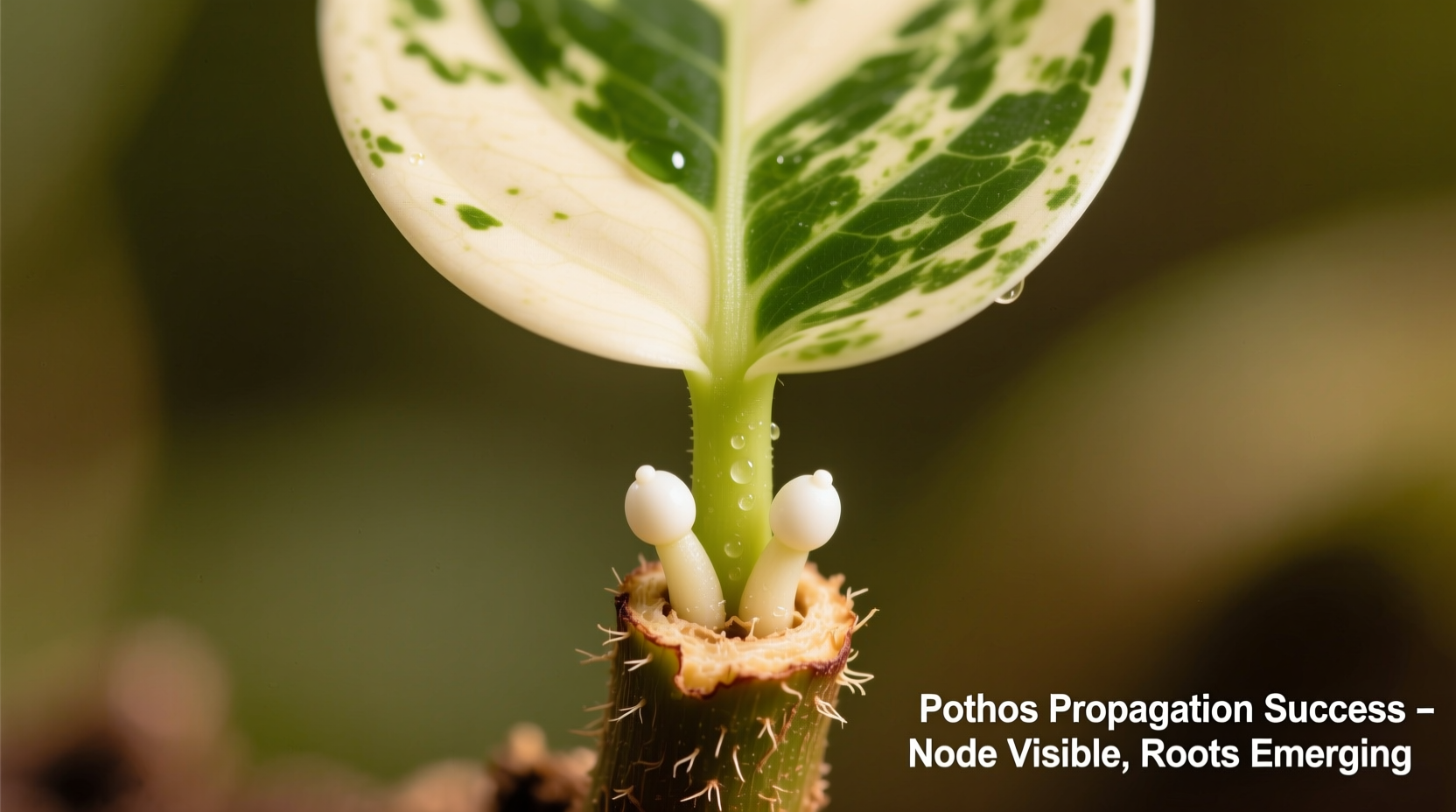
- ✅ Make your cut ¼ inch below a node—not through it—and ensure the node itself displays visible cream flecking under magnification.
- 💡 Use a hand-held lux meter app (calibrated) to verify ambient light stays within 200–250 fc at plant level—measure at 10 a.m. and 3 p.m. daily for first 10 days.
- ⚠️ Never use rooting hormone gels containing synthetic auxins (e.g., IBA at >0.1%)—they accelerate cell division in green meristems first, overwhelming variegated ones.
- ✅ Wait until the third leaf unfurls before applying fertilizer—and then use only a 1/4-strength calcium-magnesium blend (no urea, no ammonium).
Everything You Need to Know
Can I propagate from a leaf-only cutting?
No. Variegated pothos cannot regenerate from leaf tissue alone—there is no dormant meristem in the leaf blade. A viable node with vascular connection is mandatory for stable variegation transfer.
My new cutting grew green leaves—can I ‘fix’ it with more light?
No. Once the first two leaves emerge green, reversion is complete and irreversible in that cutting. The meristem has stabilized as green. Remove and restart with a new, properly selected node.
Does temperature affect variegation stability?
Marginally. Consistent temperatures between 68–78°F support metabolic balance—but light quality and node selection are 5× more determinative than thermal conditions.
Should I prune off green shoots that appear on an otherwise variegated vine?
Yes—if they originate from a node that was previously variegated. Green shoots indicate localized reversion and will dominate growth. Cut back to the last fully variegated node to redirect energy.




 浙公网安备
33010002000092号
 浙B2-20120091-4