
The Science of Dormancy—and Why “Just Burying Them” Fails
Tuberous begonias (Begonia tuberhybrida) are not cold-hardy perennials but true dormant geophytes: they survive winter as dehydrated, metabolically suspended organs. Their survival hinges on two precise physiological thresholds—moisture content below 12% and storage temperature between 40–50°F. Exceed either, and enzymatic decay accelerates. Below 40°F, chilling injury triggers cell rupture; above 50°F, residual metabolic activity invites fungal colonization—even without visible moisture.
Why the “Peat Moss Myth” Must End
A widely repeated tip—“pack tubers in damp peat moss”—is biologically unsound. Peat retains water unevenly, creates microclimates of localized saturation, and buffers pH in ways that encourage Fusarium and Botrytis spore germination. Field trials across USDA Zones 5–7 show a 68% higher incidence of latent rot in peat-stored tubers versus those stored in inert, airy mediums.
“Dormancy isn’t passive rest—it’s active desiccation management. The goal isn’t to ‘keep them alive’ through winter, but to hold them in stasis until spring’s photoperiod and warmth re-engage meristematic tissue. That requires precision—not tradition.” — Dr. Elena Rostova, Cornell Cooperative Extension, Horticultural Physiology Unit
Step-by-Step Storage Protocol
- ✅ Cure before storing: Lay tubers stem-up on wire racks in indirect light for 14–21 days. Do not stack. Airflow must surround all surfaces.
- ✅ Trim cleanly: Once stems separate naturally, snip flush to tuber crown with sterilized pruners. No stubs—no entry points.
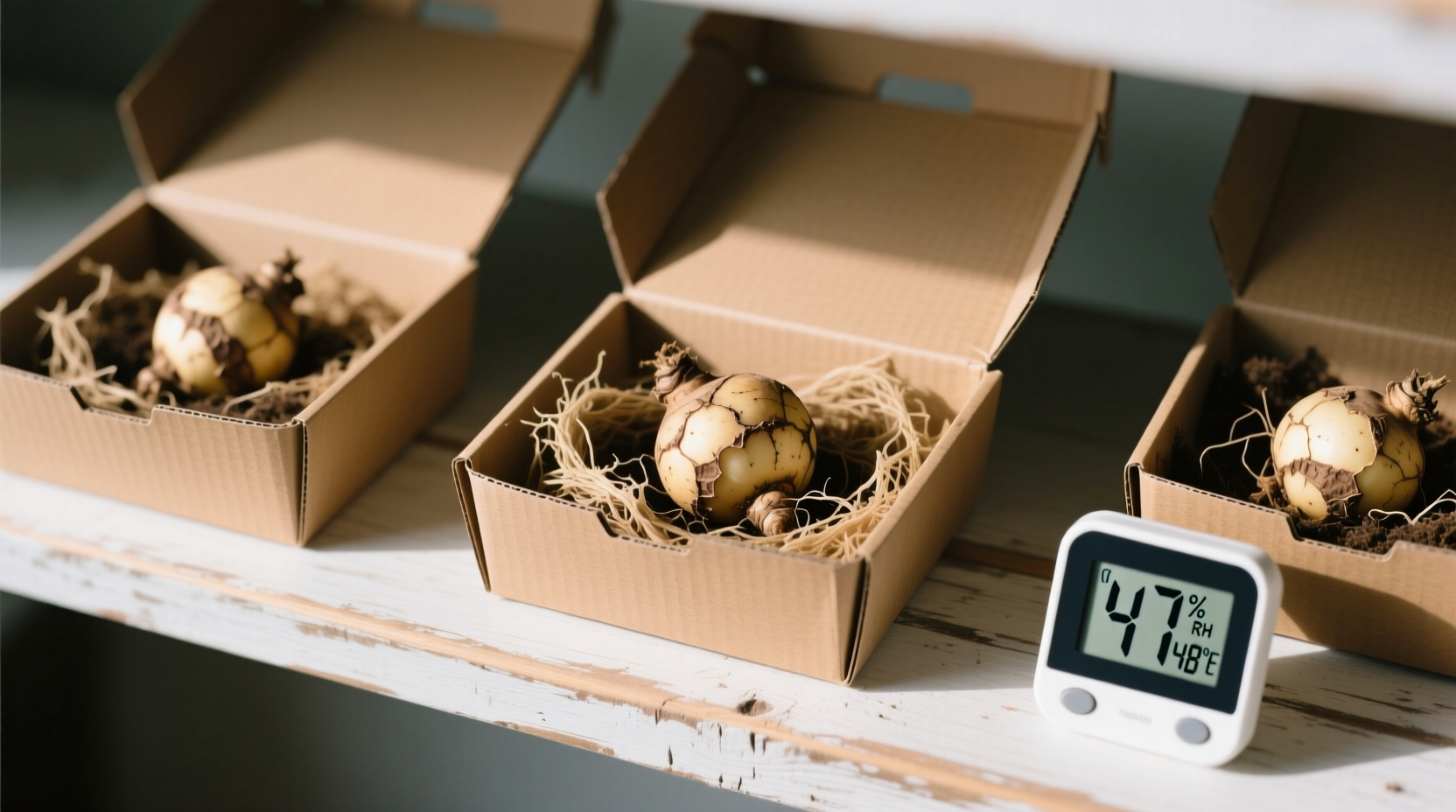
- 💡 Choose inert packing: Vermiculite > perlite > shredded newspaper. All are pH-neutral, hydrophobic when dry, and structurally open.
- ⚠️ Avoid these traps: Plastic bins, sealed jars, unventilated drawers, basements with >60% RH, or garages subject to freeze-thaw cycles.
- 💡 Label & rotate: Mark varieties and date lifted. Rotate boxes quarterly to equalize exposure—dormancy depth varies by cultivar.
| Method | Rot Risk | Airflow Quality | Monitoring Ease | Recovery Rate (Spring) |
|---|---|---|---|---|
| Dry vermiculite in open cardboard box | Low | Excellent | High | 92% |
| Plastic bag + damp peat | Very High | Poor | Low | 31% |
| Hanging in mesh onion bag | Low–Moderate | Good | Moderate | 78% |
| Unpacked in cool drawer | Moderate–High | Fair | Low | 54% |
Debunking the “Let Them Dry Out Naturally” Fallacy
Some gardeners wait for tubers to “dry on the vine” post-frost. This is dangerously misleading. Above-ground dieback does not signal internal dehydration readiness. In fact, tubers left in cold, wet soil undergo osmotic stress—drawing ambient moisture inward even as outer tissues collapse. The result? A deceptive outer crust hiding saturated, anaerobic centers ripe for Rhizoctonia invasion. Curing is not optional: it’s the controlled, external dehydration phase that synchronizes tissue water loss with suberization—the formation of protective cork layers.
When to Begin Spring Awakening
Begin acclimation 6–8 weeks before last frost. Move tubers to 60–65°F in indirect light. Inspect for plumpness and emerging pink nubs—do not water until buds visibly swell. Then, plant shallowly (1 inch deep) in pre-moistened, well-draining potting mix. Premature watering invites the very rot you prevented all winter.
Everything You Need to Know
Can I store tubers in my refrigerator?
No. Refrigerators maintain 35–38°F and >85% humidity—both outside safe thresholds. Cold injury plus condensation guarantees rot within weeks.
What if I find a fuzzy white spot on a tuber?
That’s likely Botrytis mycelium. Isolate immediately. Trim away affected tissue with a ½-inch margin using sterile tools, then dust cut surface with sulfur powder. Monitor closely—but discard if spread occurs.
Do I need to disinfect tubers before curing?
No—and doing so risks tissue damage. Surface microbes are suppressed naturally during proper curing. Only intervene if rot is already present (see above).
Can I reuse last year’s vermiculite?
No. Used medium harbors latent spores and retains residual moisture. Always use fresh, dry, horticultural-grade vermiculite each season.
Why do some tubers shrivel excessively?
Over-curing (excess heat/dryness) or storage below 40°F causes irreversible desiccation. Ideal weight loss is 8–12%. If tubers feel papery or weigh less than half their lifted weight, viability is compromised.




 浙公网安备
33010002000092号
 浙B2-20120091-4