
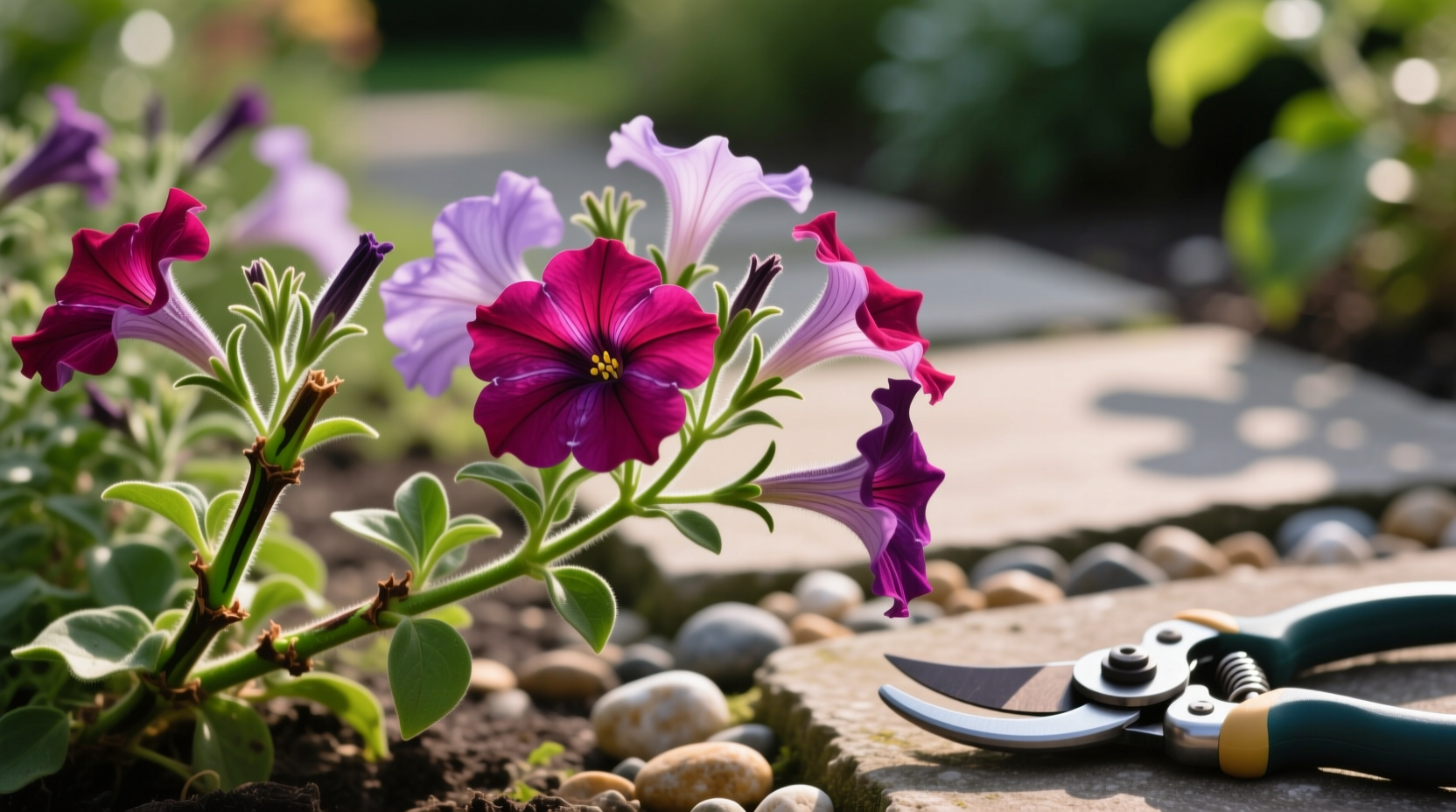
Why Pruning Is Non-Negotiable for Petunias (Not Optional)
Unlike many annuals that bloom reliably without intervention, petunias respond dramatically—and predictably—to pruning. Their natural growth habit is vining and sprawling, not mounding. In the wild, they trail along groundcover layers, relying on frequent mechanical disturbance (like grazing or wind abrasion) to stimulate lateral bud break. In cultivation, that disturbance is replaced by intentional pruning.
Without it, petunias undergo rapid internode elongation—stems stretch upward and outward in search of light, especially under warm temperatures (>75°F/24°C) or lower light conditions (e.g., east-facing balconies or shaded patios). This results in “leggy” growth: long, bare stems with foliage and flowers only at the tips. Legginess isn’t merely cosmetic. It compromises structural integrity (increasing flop and breakage), creates humid microclimates near the soil line (favoring botrytis blight and root rot), and starves lower nodes of energy needed for new branch development.
Crucially, petunias produce flowers on new growth—not old wood. Once a stem matures and sets seed pods (even tiny, inconspicuous ones), apical dominance suppresses lateral buds. Pruning removes that dominance and redirects plant hormones (auxins and cytokinins) toward dormant axillary buds located where leaves meet the stem. Within 5–10 days, those buds swell and develop into vigorous, flower-ready shoots.
This physiological response is consistent across all major petunia types—grandiflora, multiflora, milliflora, and spreading (supertunia-type) cultivars—though timing and frequency vary slightly by growth rate and environmental stressors.
When to Prune Petunias: Timing by Season, Climate, and Growth Stage
Timing isn’t arbitrary—it’s tied directly to temperature, photoperiod, and plant physiology. Here’s how to align pruning with your conditions:
- Early Season (Planting to Early June): Wait until plants are established—typically 2–3 weeks after transplanting outdoors, once roots fill the pot or garden bed and new growth appears. Perform a light “pinch”: remove just the tip (¼–½ inch) above the topmost leaf node. This encourages basal branching before summer heat accelerates stretching.
- Peak Season (Late June through August): This is the core pruning window. Prune every 14–21 days. In hot, humid climates (USDA Zones 8–10), increase frequency to every 10–14 days—heat intensifies internode elongation and accelerates flower senescence. In cooler coastal or high-elevation zones (Zones 4–6), 21-day intervals are usually sufficient.
- Late Season (September into First Frost): Reduce intensity but don’t stop. A light trim (¼–⅓ stem length) in early September helps redirect energy into flower production before cooling nights slow metabolism. Avoid heavy pruning after September 15 in Zones 3–6 or after October 1 in Zones 7–9—plants won’t have time to harden off or produce meaningful blooms before frost.
- Post-Frost Recovery (for overwintered specimens): Rare in most gardens, but some gardeners overwinter trailing petunias indoors. If you do, prune hard in late February—cutting back to 4–6 inches—then move to bright light and resume feeding to trigger spring flush.
Note: Never prune during prolonged rain, high humidity (>85%), or when plants show drought stress (wilting, gray-green foliage). Wait for 2–3 days of dry, mild weather post-watering.
How to Prune Petunias Correctly: Step-by-Step Technique
Proper technique ensures rapid recovery and avoids collateral damage. Follow these five steps precisely:
- Prepare clean tools: Wipe bypass pruners (not anvil types—they crush stems) with 70% isopropyl alcohol before and between plants. Disinfecting prevents spread of viruses like tobacco etch virus (TEV), which causes mottling and stunting in petunias.
- Identify the cut point: Locate a leaf node—where two small leaves (or a leaf pair) emerge opposite each other on the stem. Always cut ¼ inch above that node, at a 45-degree angle sloping away from the node. This angle sheds water and minimizes stem tissue exposure.
- Determine cut depth: For routine maintenance, remove ⅓ of the stem length. For severely leggy plants (bare stems >6 inches), cut back to within 4–6 inches of the soil or pot rim—but only if green cambium is visible beneath the bark. Avoid cutting into brown, woody, or hollow stems; those won’t regenerate.
- Remove spent flowers and seed pods daily: While not “pruning” per se, deadheading is essential companion care. Pinch off faded blooms just above the first set of true leaves below the flower. Skip this step, and seed formation diverts up to 30% of photosynthetic energy from new blooms.
- Clean up immediately: Rake or pick up all clippings and fallen flowers. Leaving debris invites thrips, aphids, and fungal spores. Do not compost diseased material—discard in municipal green waste or burn.
Tools You Actually Need (and Which Ones to Avoid)
You don’t need specialty gear—but using the wrong tool guarantees poor results.
Essential:
- Bypass pruners (4–6 inch size): Sharp, stainless-steel blades with ergonomic handles. Brands like Felco #2 or Corona SP 6220 deliver clean cuts without crushing vascular tissue. Replace blades annually or sharpen every 3–4 months.
- Fine-point tweezers: For precise deadheading in tight clusters or removing thrips eggs from leaf undersides.
- Small handheld broom + dustpan: For immediate debris removal—critical for disease prevention.
Avoid:
- Anvil pruners: Their single-blade design crushes petunia stems instead of slicing, damaging xylem and phloem and inviting rot.
- Scissors or kitchen shears: Dull quickly, slip on succulent stems, and create ragged wounds.
- Electric hedge trimmers: Far too aggressive—even on “light” settings. They shear indiscriminately, removing healthy foliage and buds alongside spent parts.
- Fingers alone for mature stems: While pinching works for young seedlings, mature petunia stems become fibrous and resist clean breaks. Tearing invites pathogens.
Common Pruning Mistakes—and Why They Backfire
Even experienced gardeners make these errors—often because advice is oversimplified or misapplied:
- Mistake: Pruning too infrequently (“I’ll do it once in July”).
Why it fails: Petunias grow rapidly—up to 1 inch per day in ideal conditions. Waiting 6+ weeks means cutting through hardened, semi-woody tissue with minimal dormant buds left. Recovery takes 3–4 weeks, not 10 days, and often yields weak, spindly regrowth. - Mistake: Cutting straight across (90°) or below the node.
Why it fails: A flat cut traps moisture, encouraging fungal canker. Cutting below the node removes the meristematic tissue needed for branching—resulting in a single, dominant shoot instead of multiple laterals. - Mistake: Pruning during extreme heat (>90°F/32°C) or drought.
Why it fails: Plants divert resources to survival—not regeneration. Stressed petunias respond with yellowing, leaf drop, or complete dieback of pruned stems. - Mistake: Using dirty tools across multiple plants.
Why it fails: Petunias are highly susceptible to Petunia Vein Clearing Virus and Tomato Spotted Wilt Virus, both spread mechanically via contaminated blades. One infected plant can doom an entire balcony collection in under a week. - Mistake: Confusing pruning with “hardening off” seedlings.
Why it fails: Pruning young transplants before root establishment (under 3 true leaf pairs) causes shock, stunting, or mortality. Hardening off is acclimation to sun/wind—not stem reduction.
Species-Specific Considerations: Grandiflora vs. Spreading vs. Multiflora
While all petunias benefit from pruning, growth rates and architecture differ significantly:
| Type | Growth Habit | Pruning Frequency | Key Tip |
|---|---|---|---|
| Grandiflora (e.g., ‘Dreams’, ‘Ultra’) | Upright, large-flowered, moderately vigorous | Every 18–21 days | More prone to bud blast in high humidity—prune earlier in morning to improve airflow through dense flower clusters. |
| Spreading/Trailing (e.g., Supertunia®, Wave®, Tidal Wave®) | Fast-growing, vine-like, aggressive horizontal spread | Every 10–14 days | Can tolerate heavier pruning—cut back 50% if stems exceed 18 inches. Responds well to “rejuvenation pruning” midsummer. |
| Multiflora (e.g., ‘Celebrity’, ‘Primetime’) | Compact, floriferous, rain-tolerant | Every 16–20 days | Less leggy than grandiflora—focus more on deadheading than stem reduction unless grown in shade. |
| Milliflora (e.g., ‘Fantasy’, ‘Pocketful’) | Miniature, naturally dwarf, fine-textured | Rarely needs pruning—pinch only if sparse | Over-pruning causes stunting. Best practice: pinch tip once at transplant, then rely on regular feeding and full sun. |
What to Do Immediately After Pruning: Post-Prune Care Protocol
Pruning is only 50% of the process—the other half is supporting recovery. Within 2 hours of cutting:
- Water deeply at the base—never overhead. Wet foliage combined with fresh wounds invites Botrytis cinerea. Deliver water slowly until it drains freely from pot holes or soaks 6 inches into garden soil.
- Apply balanced fertilizer (e.g., 10-10-10 or 14-14-14) at half label strength. Full strength risks burning tender new growth. Nitrogen fuels leaf expansion; phosphorus supports flower initiation.
- Move containers into dappled shade for 24–36 hours. Especially critical in full-sun locations. Direct UV stress on exposed vascular tissue delays healing.
- Monitor for pests daily for 5 days. Aphids and thrips congregate on tender new shoots. Spray with insecticidal soap (1 tsp per quart water) at dawn if found—avoid neem oil during hot days, as it can cause phototoxicity.
When NOT to Prune: Red Flags and Contraindications
Pruning is powerful—but inappropriate timing or context turns it harmful:
- Active pest infestation: If you see sticky honeydew, white wax masses (mealybugs), or silvery leaf trails (leaf miners), treat first. Pruning spreads sap-feeding insects and stresses plants further.
- Visible disease symptoms: Yellow mosaic patterns, black stem lesions, or fuzzy gray mold mean halt all pruning. Sterilize tools, isolate the plant, and apply copper fungicide before considering any cut.
- Soil saturated for >48 hours: Oxygen-deprived roots cannot support new growth. Wait until surface is dry and crumbly.
- Less than 6 weeks before first expected frost: In USDA Zone 6, that’s roughly October 10. Late pruning triggers soft, frost-vulnerable growth.
- Plants recently transplanted (<10 days) or repotted: Roots need time to re-anchor. Disturbing the canopy before root recovery causes disproportionate stress.
Long-Term Benefits Beyond More Flowers
Consistent pruning delivers compound advantages that extend far beyond aesthetics:
- Disease resistance: Open architecture reduces relative humidity around stems by up to 40%, making conditions inhospitable for Phytophthora and Pythium.
- Pest deterrence: Dense, bushy growth physically impedes thrips from reaching flower buds and discourages spider mite colonization on undersides.
- Water-use efficiency: Compact plants transpire less overall. Trials at Cornell Cooperative Extension showed pruned petunias used 22% less water per bloom cycle than unpruned controls.
- Extended season: Well-pruned plants in containers often bloom 3–4 weeks longer than neglected ones—commonly into mid-October in Zones 5–7.
- Reduced fertilizer dependency: Because pruning redirects internal nutrients toward flowering rather than stem elongation, weekly feeding can be reduced to biweekly without bloom loss.
Frequently Asked Questions
Can I prune petunias with my fingers instead of pruners?
Yes—for young, tender stems under 6 inches tall and less than 2 weeks old. Pinch firmly between thumb and forefinger just above a leaf node. But once stems lignify (turn green-brown and stiff), fingers cause tearing and incomplete node removal. Use pruners for reliability and plant health.
My petunias are already leggy—can pruning fix them?
Yes—if green tissue remains. Cut back hard to 4–6 inches above soil, water deeply, fertilize lightly, and place in full sun. New shoots will emerge from surviving nodes in 7–12 days. If stems are entirely brown and hollow, replacement is more efficient than rehabilitation.
Do self-cleaning petunias still need pruning?
Absolutely. “Self-cleaning” only means they don’t require daily deadheading—their flowers abscise cleanly. It does not eliminate legginess, reduce disease risk, or stimulate branching. All modern petunias, including ‘Easy Wave’ and ‘Shock Wave’, benefit from scheduled pruning.
Should I prune petunias in hanging baskets differently?
Yes—more frequently and slightly more aggressively. Trailing types in baskets experience accelerated stretching due to gravity and restricted root space. Prune every 10–12 days, cutting stems back by 40–50%, and always remove tangled or crossing branches to prevent rot in the basket’s center.
Is there a difference between pruning and trimming petunias?
Yes—pruning is horticulturally intentional: it targets specific nodes to alter plant architecture and physiology. Trimming is cosmetic: shearing outer foliage without regard to nodes or growth points. Trimming creates puffy, flower-poor balls and increases disease susceptibility. Always prune—never just trim.
Pruning petunias isn’t about control—it’s about collaboration. You’re not cutting back life; you’re inviting more of it. Each snip signals the plant to invest in branching, flowering, and resilience. Done consistently and correctly, it transforms a seasonal filler into a dynamic, responsive partner in your garden ecosystem. Whether you’re nurturing a single pot on a city balcony or a hundred-foot mixed border, the rhythm of pruning—observing, cutting, supporting, repeating—builds not just better petunias, but deeper horticultural intuition. Start this weekend. Choose one plant. Make three clean cuts. Watch what happens in 8 days. That’s where real gardening begins.
Remember: the goal isn’t perfection—it’s responsiveness. Petunias tell you what they need through stem length, node spacing, flower density, and leaf color. Your job isn’t to force a shape, but to read those cues and act with precision. With practice, pruning becomes second nature: a quiet, confident dialogue between hand and plant, repeated all season long.
And finally—don’t wait for “the right time.” There is no universal perfect moment. There is only the next dry morning, a sharp tool in hand, and a plant ready for renewal. Go prune.




 浙公网安备
33010002000092号
 浙B2-20120091-4