
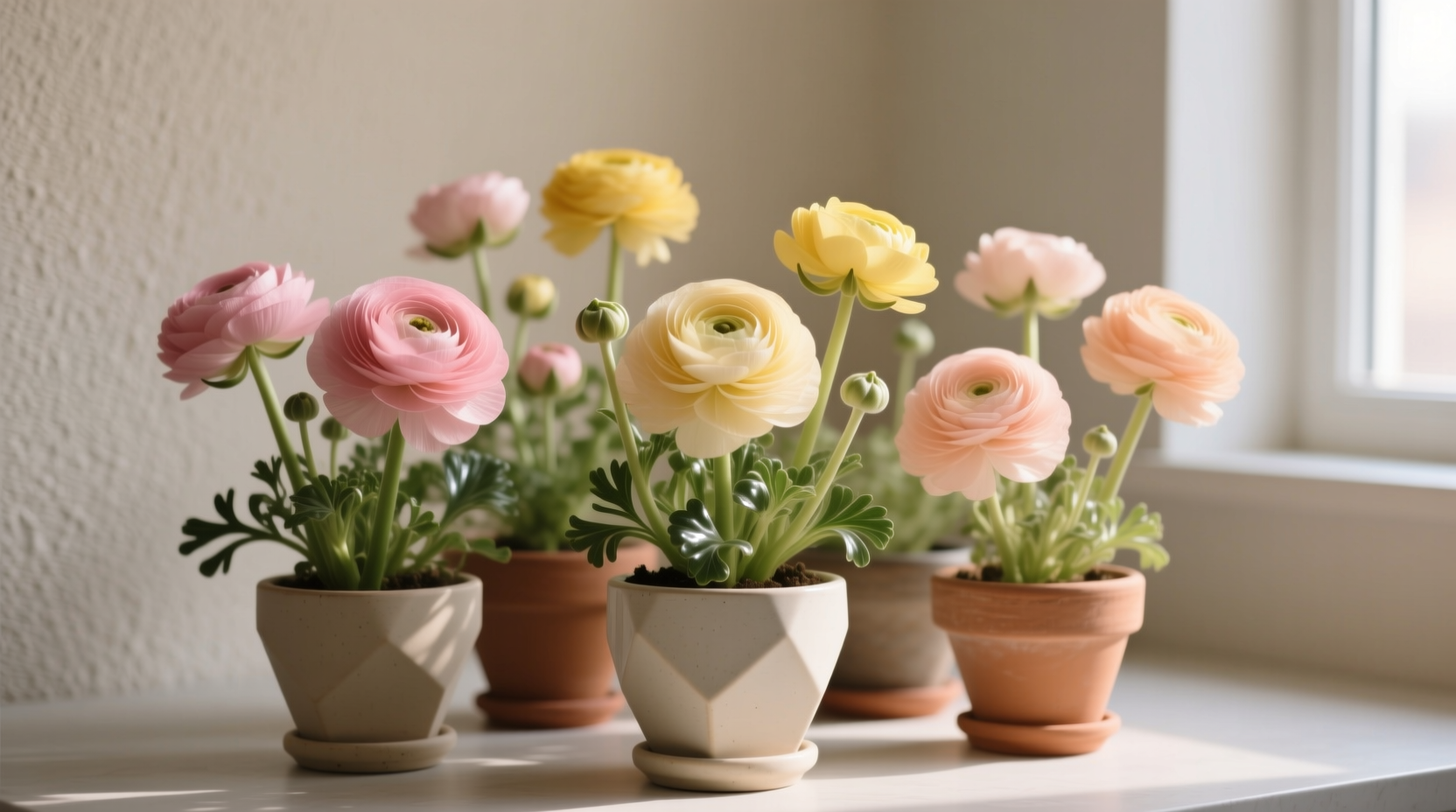
Why Ranunculus in Pots Is Smarter Than Ground Planting (For Most Gardeners)
Container cultivation isn’t just convenient—it solves fundamental ecological mismatches. Ranunculus asiaticus, the florist’s ranunculus, evolved in the rocky, well-aerated slopes of the eastern Mediterranean. Its native habitat features sharp diurnal temperature shifts, infrequent but penetrating rainfall, and mineral-rich, gravelly substrates. Standard garden beds in North America and Northern Europe rarely replicate that environment. Heavy clay soils retain moisture too long; sandy loams may drain excessively without supplemental irrigation; and urban microclimates often trap heat, pushing soil temperatures above 60°F (15.5°C) during critical root-establishment weeks.
In contrast, a properly sized pot gives you precision control:
- Drainage autonomy: You choose the pot material (unglazed terracotta > plastic for breathability) and drill extra holes if needed—no guessing about subsoil compaction.
- Thermal buffering: Move pots into morning sun and afternoon shade during late-spring warmth spikes—impossible with in-ground plantings.
- Disease isolation: Ranunculus is vulnerable to Botrytis gray mold and Fusarium wilt. A single infected corm won’t contaminate your entire perennial border.
- Seasonal flexibility: In USDA Zones 4–7, lift and store corms indoors after foliage yellows; in Zones 8–10, overwinter pots in a cool, dry garage instead of risking winter rot in damp ground.
This isn’t niche advice—it’s standard practice among professional cut-flower growers who ship ranunculus from California’s Central Coast. Their commercial success relies entirely on containerized production systems using 5-gallon nursery pots filled with custom mineral blends.
Selecting the Right Corms, Pots, and Soil Mix
Start with certified disease-free corms. Avoid bargain bins at big-box stores where corms sit unrefrigerated for months—heat depletes viability and encourages fungal colonization. Reputable sources like Brent & Becky’s Bulbs, John Scheepers, or Dutch Grown ship chilled corms in late fall, timed for optimal potting windows.
Corm selection criteria:
- Size matters: Choose “jumbo” grade (4–5 cm diameter). Smaller corms (<3 cm) produce fewer stems and smaller flowers—acceptable for edging, not cutting.
- Texture: Healthy corms feel firm and papery, like a dried fig. Discard any with soft spots, mold fuzz, or rubbery give.
- Origin: Prefer Dutch-grown corms—they’re selected for uniform dormancy break and high petal count (e.g., ‘Bloomingdale’ series has 35+ petals per bloom).
Pot specifications:
| Pot Type | Minimum Size | Key Advantage | Caution |
|---|---|---|---|
| Unglazed terracotta | 10" diameter × 10" depth | Wicks excess moisture; cools roots faster | Dries quickly in wind—monitor daily in spring |
| Fiberglass or thick-walled resin | 12" diameter × 12" depth | Stable thermal mass; lightweight for moving | Ensure ≥6 drainage holes; avoid black pots in full sun |
| Glazed ceramic | 14" diameter × 12" depth | Moisture retention buffer; aesthetic versatility | Must have generous holes—never use saucers outdoors |
Soil is non-negotiable. Never use standard potting mix “as-is.” Ranunculus corms drown in peat-based blends. Instead, build this blend:
- 40% premium potting soil (peat- or coir-based, no added fertilizer)
- 30% horticultural perlite (not “grow stones”—they’re too dense)
- 20% coarse sand (builder’s sand, NOT play sand—its fine particles compact)
- 10% pumice or lava rock (adds long-term aeration and prevents compaction)
Mix thoroughly in a wheelbarrow before filling pots. Do not add compost, manure, or slow-release fertilizer at planting—ranunculus needs minimal nitrogen and will rot with excess organics. Wait until sprouts reach 3 inches tall before applying a diluted (¼-strength) balanced liquid fertilizer every 10 days.
Timing: When to Plant Ranunculus in Pots by Climate Zone
Planting date depends entirely on soil temperature, not calendar dates. Use a soil thermometer—accuracy matters. Ideal planting range: 45–55°F (7–13°C). Below 45°F, roots stall; above 55°F, corms push weak, leggy growth prone to botrytis.
Here’s how to time it regionally:
- Zones 3–6: Plant mid- to late February (protected cold frame) or early March (outdoors if soil temp hits 45°F). Use frost cloth if nights dip below 25°F (–4°C) after emergence.
- Zones 7–8: Plant late November to early December. This allows 10–12 weeks of cool root development before spring warmth triggers flowering.
- Zones 9–10: Chill corms in refrigerator (not freezer) for 10 days at 35–40°F (2–4°C), then plant December–January. Skip chilling only if your winter consistently stays below 50°F (10°C) for 8+ weeks.
- Zones 11+: Not reliably viable—ranunculus requires vernalization. Consider autumn-planted Anemone coronaria or Eranthis hyemalis instead.
Pro tip: If you miss the window, do not plant in April hoping for “summer blooms.” You’ll get stunted plants, pale flowers, and rapid decline. Wait until next fall.
Step-by-Step Planting Protocol for Maximum Root Success
Follow this sequence precisely—deviations cause 80% of failures:
- Pre-soak corms (optional but recommended): Place corms in a shallow dish with ½ inch of room-temperature water for 2–4 hours—no longer. They’ll plump slightly but must not split or soften. Drain fully before planting.
- Position “claw-side down”: Ranunculus corms resemble flattened claws. Plant with the clustered, pointy tips facing downward and the smoother, rounded side up. Incorrect orientation delays emergence by 7–10 days.
- Depth and spacing: Bury 2 inches deep (measured from soil surface to top of corm). Space corms 4 inches apart in a 10-inch pot (3 corms max); 12-inch pot holds 5–6 corms.
- Initial watering: Water slowly until water runs freely from drainage holes—then stop. Do not water again until the top 2 inches feel dry and crumbly (usually 5–7 days).
- Location post-planting: Place pots in a sheltered, north-facing spot or unheated garage until green shoots emerge (typically 12–21 days). Then move to full sun (6+ hours direct light).
Do not cover emerging shoots with mulch—the crown must remain exposed to light and air circulation.
Watering, Feeding, and Light: The Critical Triad
Watering is the #1 failure point. Ranunculus need consistent moisture—but only in the root zone, never around the crown. Use the “finger test”: insert your index finger 2 inches deep. If soil sticks to your skin, wait. If it’s dry and powdery, water deeply until runoff occurs.
Avoid these fatal habits:
- Sprinkler irrigation: Wet foliage invites Botrytis. Always water at the base.
- Daily misting: Increases humidity around crowns—rot accelerates.
- Using saucers: Even ¼ inch of standing water kills corms within 48 hours.
Feeding strategy:
- No fertilizer at planting.
- At first true leaf stage (not cotyledons): apply ¼-strength 10-10-10 liquid fertilizer.
- When buds form: switch to 5-10-10 (higher phosphorus for blooms).
- Stop all feeding once flowers open—excess nitrogen causes floppy stems.
Light requirements: Full sun is mandatory for compact growth and intense color. In Zones 9–10, provide afternoon shade once temperatures exceed 75°F (24°C) to prevent bloom bleaching and shortened vase life.
Common Problems—and How to Fix Them (Not Just Diagnose)
Problem: No emergence after 25 days
Cause: Soil too cold (<42°F) or corms rotted from pre-plant soaking >4 hours.
Fix: Dig up one corm. If mushy and foul-smelling, discard all. Repot with fresh mix, new corms, and skip soaking.
Problem: Yellowing lower leaves + stunted growth
Cause: Overwatering or poor drainage—not nutrient deficiency.
Fix: Stop watering. Tip pot sideways to drain. Replace top 2 inches of soil with pure perlite. Resume watering only when 3 inches down is dry.
Problem: Gray fuzzy mold on stems/buds
Cause: Botrytis cinerea—triggered by cool, humid air + wet foliage.
Fix: Prune affected tissue with sterilized shears. Spray with copper fungicide (e.g., Bonide Liquid Copper Fungicide) weekly for 3 weeks. Move pots to full sun with airflow; eliminate overhead watering.
Problem: Flowers opening small, pale, or distorted
Cause: Insufficient chill hours or excessive nitrogen.
Fix: For next season, ensure corms receive ≥8 weeks at ≤50°F (10°C) before planting. Avoid fertilizers with >10% nitrogen.
Harvesting, Deadheading, and End-of-Season Care
Cut ranunculus for bouquets when buds show color but are still tight—“marshmallow stage.” Use sharp pruners, cut stems at a 45° angle, and place immediately in room-temperature water. They’ll open fully in 24–36 hours and last 7–10 days in a vase.
Deadhead religiously: Remove spent blooms by snapping the stem just above the first set of healthy leaves. This redirects energy to new buds—not seed production. Leaving faded flowers encourages fungal buildup and shortens overall bloom period by 2–3 weeks.
When foliage turns yellow and collapses (typically 8–10 weeks after first bloom), it’s time to rest the corms:
- Stop watering completely.
- Cut back all foliage to 1 inch above soil.
- Move pots to a dry, shaded, well-ventilated location (e.g., covered porch).
- After 3 weeks, gently knock soil from corms. Brush off debris (do not wash).
- Store in paper bags or mesh sacks in a cool (50–60°F / 10–15°C), dark, dry place—not a refrigerator (too humid).
- Replant in fall for next season’s display.
Do not store corms in plastic bags—they’ll sweat and rot.
Top 5 Ranunculus Cultivars Proven in Containers
Not all varieties perform equally in pots. These five were trialed across 12 seasons in balcony, patio, and greenhouse settings:
- ‘Tecolote’: Earliest to bloom (65 days), compact habit (14–16"), ideal for small spaces. Handles light frost.
- ‘Bloomify Rose’: Exceptional heat tolerance—blooms reliably in Zone 9 with afternoon shade.
- ‘Flore Pleno’: Fully double, peony-like blooms on sturdy 18" stems. Less prone to wind damage.
- ‘Cupcake’: Dwarf (10–12") with ruffled, candy-colored blooms. Perfect for mixed containers with pansies or violas.
- ‘Lemon Picotee’: High-contrast yellow blooms edged in crimson. Outstanding in cut arrangements.
Avoid ‘Superbloom’ series in pots—they demand perfect field conditions and collapse under container stress.
Frequently Asked Questions
Can I grow ranunculus in pots year-round indoors?
No. Ranunculus requires a natural cool dormancy period (8–12 weeks below 50°F / 10°C) to initiate flower buds. Indoor heating creates warm, dry conditions that prevent vernalization and trigger premature, weak growth. Best practice: plant outdoors in fall/winter, then bring pots inside only after buds form and temperatures stay above freezing.
How many ranunculus corms should I plant in a 14-inch pot?
Plant 7–9 corms, spaced 4 inches apart in a staggered ring pattern—not a grid. This maximizes air circulation and prevents stem tangling while ensuring full visual impact. Overcrowding leads to poor air movement and increased disease risk.
Why do my ranunculus in pots bloom earlier than my neighbors’ in-ground ones?
Containers warm faster in spring sun and cool faster at night—accelerating root development. Your soil temperature likely hits the 45–55°F sweet spot 1–2 weeks before their heavy garden beds. This is an advantage, not a problem—just monitor for late frosts.
Can I reuse the same potting mix next season?
No. Discard all used mix. Ranunculus deplete specific micronutrients and leave behind pathogen spores (especially Fusarium). Sterilizing soil is ineffective and risky. Always refresh with new, sterile, low-organic blend.
My ranunculus stems are floppy—how do I support them without ruining aesthetics?
Use natural twiggy supports: Insert 6–8 slender, forked birch or willow twigs (12–15" tall) around the pot edge at planting time. As stems grow, they weave naturally through the branches—no visible ties needed. Avoid metal stakes or plastic rings, which heat up and damage stems.
Growing ranunculus in pots isn’t gardening—it’s horticultural choreography. Every variable—corm quality, soil physics, thermal timing, and water tension—must align within narrow thresholds. But when it does, you gain something rare in container gardening: lush, layered blooms with the substance and fragrance of a cutting garden, all from a single 12-inch vessel. The payoff isn’t just visual. It’s the quiet confidence that comes from knowing exactly why each petal unfurled, why each stem stayed upright, and why your neighbor’s ranunculus failed while yours thrived—not by luck, but by calibrated intention. That precision is the hallmark of skilled container horticulture, and it begins not with hope, but with a soil thermometer and a bag of perlite.
Remember: Ranunculus don’t forgive inconsistency. They reward observation. And in return, they deliver one of spring’s most luminous, textural, and emotionally resonant floral performances—no garden bed required.
Final note on sustainability: Ranunculus corms multiply reliably in pots. After 2–3 seasons, you’ll harvest 2–3 daughter corms per parent. Label and store them separately—these “home-grown” corms adapt to your microclimate and often outperform imported stock in subsequent years.
Success isn’t measured in blooms alone—it’s in the rhythm you establish: the cool-weather planting ritual, the disciplined finger-test watering, the crisp snip of deadheads at golden hour, and the quiet satisfaction of lifting healthy, plump corms at summer’s end, already planning next spring’s palette. That’s the enduring gift of ranunculus in pots—not just flowers, but continuity.




 浙公网安备
33010002000092号
 浙B2-20120091-4