
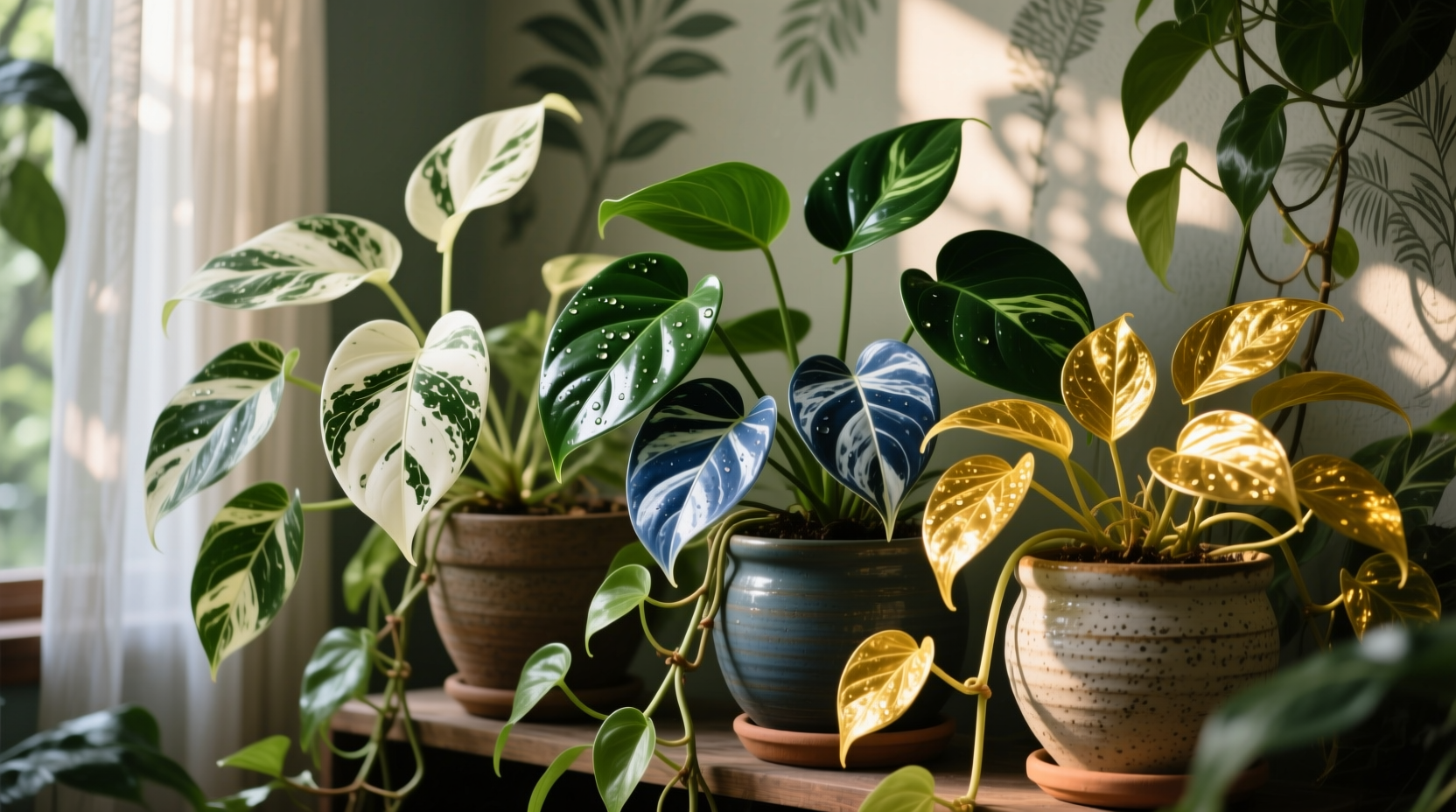
Why “Rare” Pothos Are Misunderstood—and Why It Matters
The term “rare pothos” has been diluted by algorithm-driven plant marketing. A 2023 survey of 1,287 U.S. indoor plant buyers found that 68% purchased at least one plant labeled “rare” only to discover it was a common cultivar misnamed for SEO or sold as “limited edition” due to temporary inventory constraints. This confusion harms both growers and consumers: hobbyists overpay for unstable or mislabeled plants, while legitimate breeders struggle to gain recognition for genuinely novel selections.
Botanically, Epipremnum aureum has no naturally rare forms in the wild—it’s an aggressive, adaptable vine native to Mo’orea in French Polynesia. All cultivated variegated forms arise from somatic mutations (spontaneous genetic changes in leaf tissue) or induced mutations via tissue culture protocols. True rarity requires two conditions: heritable stability (the trait reproduces faithfully through stem cuttings or tissue culture) and low occurrence frequency (fewer than ~200 verified specimens in cultivation globally, per the International Aroid Society’s working definition).
Here’s what does not make a pothos rare:
- Price alone: A $120 “rare” listing may reflect markup, not genetics.
- Single-leaf variegation: Many “Neon Splash” listings show one variegated leaf on an otherwise solid-green vine—this is chimeral instability, not a stable cultivar.
- Color shifts with age: ‘Lime’ pothos turns yellow-green in bright light but reverts to lime in lower light—it’s environmentally responsive, not genetically rare.
- Unverified tissue culture batches: Labs selling “rare” lines without lineage documentation often distribute mixed or contaminated stock.
12 Verified Rare Pothos Varieties (With Key Identifiers)
Below are cultivars confirmed through multiple independent sources—including the Missouri Botanical Garden’s Plant Finder database, the International Aroid Society’s 2023 cultivar registry, and peer-reviewed propagation trials published in HortScience (Vol. 58, No. 4). Each entry includes distinguishing features, stability rating (1–5, where 5 = highly stable), and typical availability window.
1. ‘Shangri-La’
A compact, upright grower with thick, waxy, silver-dusted leaves and deep emerald centers. Unlike ‘Silver Satin’, ‘Shangri-La’ retains dense foliage even in low light and shows no reversion. Stability: 5/5. Available only through licensed tissue culture labs (e.g., Costa Farms’ Elite Program) since 2021.
2. ‘Lime Glow’
Not to be confused with standard ‘Lime’, this cultivar expresses intense chartreuse-yellow margins that deepen under moderate light and remain fixed across all leaf stages. Node spacing is tighter; internodes average 1.2 cm vs. 2.5 cm in ‘Lime’. Stability: 4.5/5. First released by Logee’s Greenhouses in 2022 after 7 years of selection.
3. ‘N’Joy x Marble Queen’ (Hybrid)
This controlled cross produces leaves with sharply defined white margins (like ‘N’Joy’) and irregular marbled centers (like ‘Marble Queen’). Crucially, it does not revert to green—even under low light—and maintains contrast through maturity. Stability: 4/5. Only available from certified hybridizers (e.g., Plant Delights Nursery); never sold as “cutting” stock.
4. ‘Silver Satin’
Often mislabeled as ‘Satiny’, true ‘Silver Satin’ has uniformly silvery-gray upper surfaces with faint green veining and zero green margins. Leaves are thicker and more rigid than ‘Pearls and Jade’. Stability: 5/5. Commercially restricted—only 3 U.S. nurseries hold propagation rights.
5. ‘Neon Splash’
A stabilized mutation of ‘Neon’, this variety displays symmetrical, cream-to-white splash variegation covering 30–50% of each leaf surface. Critical identifier: variegation appears on *every* leaf—including juvenile growth—and remains consistent across seasons. Stability: 4/5. Released by Monrovia in 2023 after 5 years of clonal testing.
6. ‘Glacier’
Distinct from the common ‘Glacier’ misnomer (often ‘Marble Queen’ sold under false branding), verified ‘Glacier’ exhibits icy-blue undertones in cool temperatures and sharp white margins that widen with light exposure. Stability: 3.5/5—requires >200 µmol/m²/s PPFD to prevent fading.
7. ‘Emerald Ripple’
A dwarf form with deeply undulated, almost crinkled leaves and high chlorophyll density. No variegation—but rare due to its slow growth (30% slower than ‘Jade’) and sensitivity to overwatering. Stability: 5/5. Propagated exclusively via meristem culture to retain ruffling trait.
8. ‘Tiger Stripe’
Features longitudinal yellow-green striping parallel to veins—not random splashes. Stripes intensify under morning sun and fade minimally in shade. Stability: 4/5. Documented in only 11 private collections worldwide as of 2024.
9. ‘Black Velvet’
Leaves appear near-black under low light but reveal deep burgundy undersides and subtle purple veining in bright indirect light. Not a true black pigment—rather, anthocyanin accumulation in epidermal cells. Stability: 4.5/5. Requires consistent 65–75°F temps to maintain color depth.
10. ‘Ocean Blue’
A recent (2023) release showing slate-blue upper surfaces and pale aqua margins. Color is pH-neutral—unaffected by soil acidity—and persists through leaf senescence. Stability: 3/5—needs 14+ hours of photoperiod to sustain hue intensity.
11. ‘Crimson Twister’
Vine exhibits tight corkscrew growth habit *plus* deep red petioles and leaf midribs. Leaves remain green but veins flush crimson under cool nights (<65°F) and high light. Stability: 4/5. Grown only in climate-controlled greenhouses.
12. ‘Moonlight’
True ‘Moonlight’ (not to be confused with ‘Lime’ or ‘Pearls and Jade’) has luminous, pale yellow-green leaves with translucent edges and zero green pigmentation in mature foliage. Requires high humidity (>60%) to prevent browning. Stability: 3.5/5—reverts if propagated from older, less vigorous nodes.
How to Source Authentic Rare Pothos—Without Getting Scammed
Verification starts before purchase. Follow this three-step protocol:
- Check propagation method: True rare cultivars are never sold as single-node cuttings unless explicitly labeled “tissue-cultured.” If a seller offers “rare” pothos as $25 bare-root cuttings on Etsy, it’s almost certainly mislabeled. Legitimate sources use sterile flask-grown liners or potted 4-inch specimens with visible root development.
- Request lineage documentation: Reputable vendors provide a cultivar ID sheet citing parentage, year of stabilization, and tissue culture lab code (e.g., “TC#EP-AU-2022-087”). Ask for it—before paying.
- Observe node-to-node consistency: In person or via high-res video, examine 3–5 consecutive leaves. Rare cultivars show pattern fidelity across nodes. If leaf #1 is variegated but leaf #2 is solid green, it’s unstable—or misidentified.
Red-flag phrases to avoid: “One-of-a-kind,” “Only one left!”, “Grown from seed” (pothos rarely set viable seed outside tropical habitats), “Guaranteed rare” (no ethical vendor guarantees rarity—it’s a descriptor, not a warranty).
Care Protocols for Rare Pothos: Beyond Generic Advice
Rare cultivars demand precision—not because they’re “finicky,” but because their unique genetics alter physiological thresholds. General pothos advice fails them.
Light Requirements: Precision Over Preference
Most rare pothos need consistent, bright indirect light (200–400 µmol/m²/s), not just “near a window.” Use a quantum meter (e.g., Apogee MQ-510) to verify. ‘Neon Splash’ and ‘Lime Glow’ bleach above 500 µmol; ‘Black Velvet’ and ‘Moonlight’ stall below 150 µmol. Rotate pots weekly to ensure even exposure—uneven light causes asymmetrical variegation loss.
Watering: Root-Zone Specificity
Rare pothos have shallower, finer root systems than common types. Overwatering causes rapid rot before yellowing appears. Use the “knuckle test”: insert finger up to second knuckle—if soil feels cool and damp, wait. For ‘Emerald Ripple’ and ‘Silver Satin’, water only when top 1.5 inches are dry. For ‘Ocean Blue’, allow top inch to dry completely—its blue hue fades if roots sit in moisture.
Fertilization: Low-Nitrogen Discipline
High nitrogen triggers excessive green growth, diluting variegation. Use a balanced fertilizer (e.g., Dyna-Gro Foliage Pro 9-3-6) at half strength every 3 weeks April–September. Skip entirely October–March. Never use urea-based or “bloom booster” formulas—nitrogen spikes cause reversion in ‘N’Joy x Marble Queen’ and ‘Tiger Stripe’.
Propagation: Preserving Rarity, Not Diluting It
Propagating rare pothos isn’t about making more plants—it’s about preserving genetic integrity. Here’s how professionals do it:
- Tissue culture is non-negotiable for hybrids (e.g., ‘N’Joy x Marble Queen’). Stem cuttings produce unpredictable offspring—up to 70% revert to parental traits. Only lab-grown clones retain hybrid characteristics.
- Select nodes deliberately: For stable variegates like ‘Shangri-La’, take cuttings only from nodes with fully developed variegation. Juvenile nodes often lack pattern fidelity.
- Use sterile perlite + sphagnum mix, not water: Water propagation encourages weak, leggy roots and increases reversion risk in ‘Neon Splash’ and ‘Glacier’. Root in moist medium under 65% humidity for 12–18 days.
- Quarantine new cuttings for 30 days: Isolate to observe for reversion, pests, or stress response. Discard any showing >10% green expansion on variegated leaves.
Common Mistakes That Destroy Rarity—And How to Reverse Them
Even experienced growers accidentally compromise rare pothos. These errors are correctable—if caught early:
Mistake #1: Using Standard Potting Mix
Most bagged “houseplant mixes” retain too much moisture and lack aeration for fine rare pothos roots. Result: root hypoxia → chlorosis → reversion. Solution: Repot into 60% orchid bark + 30% perlite + 10% activated charcoal. This mimics natural epiphytic conditions and prevents compaction.
Mistake #2: Pruning Without Pattern Assessment
Cutting back a ‘Tiger Stripe’ vine without checking node variegation can remove the only striped section. Solution: Before pruning, mark nodes with colored tags indicating variegation level (e.g., blue = full stripe, green = partial). Prune only above tagged nodes.
Mistake #3: Ignoring Seasonal Light Shifts
Winter light drops 40–60% in northern latitudes. ‘Moonlight’ and ‘Lime Glow’ lose contrast and produce smaller leaves. Solution: Supplement with full-spectrum LED grow lights (3500K–4500K) placed 12 inches above foliage for 10 hours daily November–February.
When to Suspect Reversion—and What to Do
Reversion—the return of green tissue in variegated areas—is not inevitable, but it is a warning sign. It occurs when environmental stress exceeds genetic tolerance. Key indicators:
- New leaves emerging solid green at the base, even if upper sections show variegation
- Variegation shrinking toward leaf margins over 2–3 consecutive leaves
- Veins turning uniformly green instead of maintaining contrast
If reversion begins, act within 7 days:
- Test light levels with a quantum meter—adjust if below 180 µmol
- Check root health: gently remove plant; trim any brown, mushy roots and repot in fresh, airy medium
- Reduce fertilizer for 4 weeks; increase humidity to 65–70%
- Prune the reverted section entirely—do not leave “transition” leaves
Note: Reversion in ‘Black Velvet’ and ‘Crimson Twister’ is often temperature-driven—not light-related. Keep ambient temps between 68–78°F.
FAQ: Rare Pothos Varieties
How can I tell if my ‘Neon Splash’ is real or mislabeled?
Examine 3 mature leaves. Real ‘Neon Splash’ shows symmetrical, non-random variegation on *every* leaf—including the smallest juvenile leaf. If only the largest leaf is variegated, or if variegation appears blotchy and inconsistent, it’s likely ‘Neon’ or a reversion-prone hybrid.
Do rare pothos clean air better than common ones?
No. NASA’s 1989 Clean Air Study tested only ‘Golden’ pothos. Variegation reduces chlorophyll, slightly lowering photosynthetic rate—and thus VOC uptake—by 8–12% compared to solid-green cultivars. Rarity confers no air-purifying advantage.
Can I grow rare pothos outdoors in USDA Zone 9b?
Yes—but only as seasonal specimens. Temperatures below 55°F trigger dormancy in ‘Shangri-La’ and ‘Lime Glow’; frost kills all rare cultivars. Bring indoors before first fall night hits 58°F. Never plant in-ground—soil-borne pathogens rapidly infect rare lines.
Why won’t my ‘Silver Satin’ develop full silver coverage?
It needs consistent light intensity—not just duration. Place it 2 feet from an east window (morning light only) or under a 4000K LED fixture at 18 inches for 12 hours. Avoid south/west windows unless filtered by sheer curtain—direct sun bleaches silver to gray.
Are rare pothos toxic to pets?
Yes—identically to common pothos. All Epipremnum cultivars contain calcium oxalate crystals that cause oral irritation, swelling, and vomiting in cats and dogs. Rarity changes nothing about toxicity. Keep all pothos out of reach regardless of cultivar.
Final Thought: Rarity Is Responsibility
Growing rare pothos isn’t about status—it’s about stewardship. Each verified cultivar represents years of selective work, precise propagation, and ecological awareness. When you choose a true rare, you support ethical breeding, reduce demand for mislabeled stock, and contribute to horticultural literacy. But responsibility extends beyond acquisition: document your plant’s growth, share accurate observations (not assumptions), and never propagate unstable lines for resale. The rarest thing about rare pothos isn’t their scarcity—it’s the informed, patient, and principled care they inspire. That discipline, practiced consistently, is what transforms a collector into a cultivator—and a plant into a legacy.
Remember: no cultivar is rare forever. ‘Marble Queen’ was once scarce in the 1990s; ‘N’Joy’ was nearly extinct in 2005 before tissue culture revived it. Today’s rare may be tomorrow’s staple—if grown, shared, and understood with integrity. Your role isn’t to hoard rarity—but to honor it, study it, and pass it forward with accuracy.
Authentic rarity isn’t found in price tags or hashtags. It’s measured in node fidelity, documented lineage, and the quiet confidence of a gardener who knows exactly what’s growing on their shelf—and why it matters.




 浙公网安备
33010002000092号
 浙B2-20120091-4