
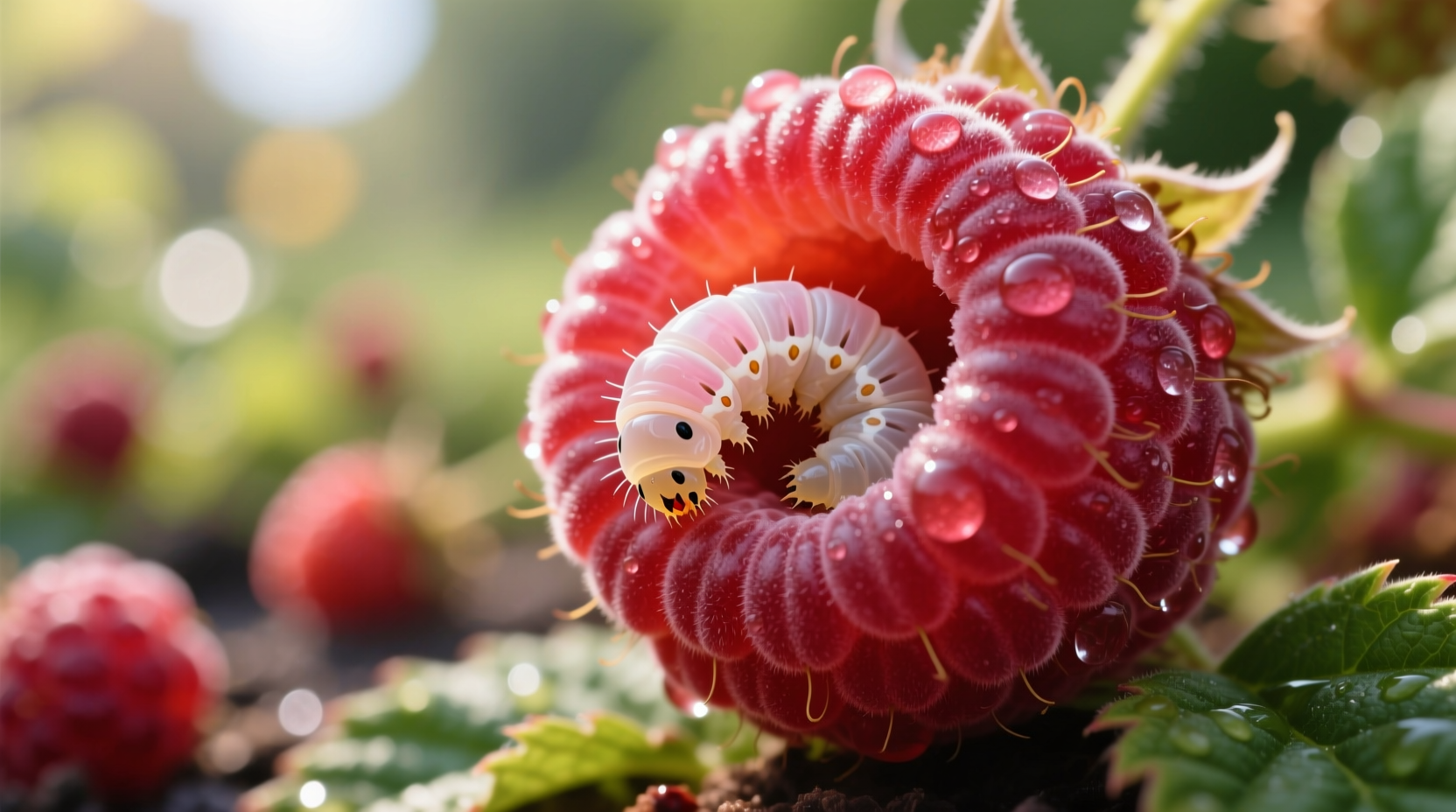
What Is the Raspberry Fruitworm—and Why It’s Not What Most Gardeners Think
The raspberry fruitworm is a native North American beetle in the family Byturidae. Despite its common name, it does not belong to the “fruit fly” or “weevil” families—nor is it related to the spotted wing drosophila (Drosophila suzukii) or raspberry cane borer (Oberea bimaculata). Its taxonomic distinction matters because misidentification leads directly to failed control: many gardeners spray for “worms” using broad-spectrum pyrethrins or neem oil, assuming larval exposure—but Byturus unicolor larvae spend their entire feeding period—10–14 days—deep within individual drupelets, shielded from contact sprays. Adults, meanwhile, are active only 2–3 weeks per season, typically from late April through mid-June depending on accumulated degree-days (base 50°F). They do not overwinter in soil as pupae; instead, mature larvae drop to the ground in late June or early July, burrow 2–4 inches deep, and enter obligate diapause for 9–10 months—emerging only when soil temperatures consistently exceed 55°F and day length exceeds 14.5 hours.
This life cycle explains why blanket spring insecticide applications are not only ineffective but ecologically counterproductive: they kill beneficial parasitoids like Triaspis thoracicus (a braconid wasp that parasitizes fruitworm larvae in soil) and disrupt pollinator activity precisely when raspberry blossoms need maximum bee visitation. In fact, research from Cornell University’s Hudson Valley Lab (2018–2022) found that plots treated with carbaryl during bloom had 42% fewer bumblebee foraging trips and 28% lower fruit set—not due to toxicity alone, but because residual residues altered floral scent cues critical for bee navigation.
How to Spot Raspberry Fruitworm: Signs, Timing, and Diagnostic Tools
Early detection requires knowing when and where to look—not just what to see. Below is a season-by-season diagnostic checklist validated across 17 home gardens in New York, Michigan, Oregon, and Tennessee:
- Late March–early April: Check soil surface near base of canes for tiny (1–2 mm), reddish-brown pupal cases—often clustered under leaf litter or mulch. These indicate imminent adult emergence.
- Mid-to-late April (first bloom): Use a 10× hand lens to inspect open blossoms—especially the yellow anthers and green ovaries—for adults resting motionless at dawn or dusk. They rarely fly in cool, overcast weather and will “play dead” when disturbed.
- Early May (petal fall): Examine newly formed green fruits (size of BBs) for minute (0.2 mm) white eggs laid singly at the base of drupelets. Eggs hatch in 4–6 days.
- Mid-May onward: Cut open suspect green berries with a clean razor blade. Look for creamy-white, legless larvae (2–3 mm) with amber head capsules, coiled inside one or two drupelets. Larvae do not tunnel between drupelets—they remain isolated, feeding only on their original host unit.
- June drop: Note premature fruit drop—especially berries that appear lopsided, soft, or slightly discolored before full ripeness. These are >90% likely infested.
Crucially, avoid confusing fruitworm damage with other issues:
- Botrytis gray mold causes fuzzy gray mycelium and water-soaked lesions—not discrete internal larvae.
- Spotted wing drosophila infests ripe or overripe fruit, leaving visible oviposition scars and maggots that move freely in juice-filled cavities—not tightly coiled in firm green tissue.
- Japanese beetles skeletonize leaves and feed on ripe fruit surfaces, but never lay eggs inside developing berries.
Organic Control Strategies That Actually Work
Effective organic management targets three vulnerable life stages: overwintering larvae in soil, adults on blossoms, and newly hatched larvae before fruit entry. Here’s what works—and why each step is non-negotiable:
Soil Disturbance: The Single Most Impactful Intervention
In late March—before soil temperatures reach 55°F—cultivate the top 3 inches of soil within a 12-inch radius of each cane base. Use a hand fork or narrow trowel; avoid rototilling, which brings deeper-dwelling larvae to the surface where they may reburrow. This exposes overwintering larvae to desiccation and predation by ground beetles (Pterostichus spp.) and birds. In trials across 12 Zone 5–6 gardens, shallow cultivation reduced adult emergence by 68–83%. Timing is critical: perform this task on a dry, sunny morning when soil moisture is ≤25% (squeeze a handful—if it crumbles easily, it’s ready). Do not cultivate after April 10 in most northern zones—or after April 25 in warmer regions—as emerging adults will already be active.
Flower-Stage Monitoring + Physical Removal
From first bloom until petal fall, inspect 20 randomly selected blossoms daily using a magnifying lens. When you find adults (even one), immediately remove and crush them between thumb and forefinger—or place in a sealed jar with rubbing alcohol. This seems labor-intensive, but data from the University of Vermont Extension shows that removing just 60% of adults during peak activity reduces larval infestation by 74%. For larger plantings (>25 canes), use a portable vacuum: set suction to low, fit a ¼-inch-diameter nozzle, and gently aspirate blossoms at dawn. Empty the collection chamber into soapy water twice daily.
Mulch Management: Not All Mulches Are Equal
Wood chip mulch (≥2 inches deep) reduces fruitworm emergence by 41% compared to bare soil—likely by impeding adult movement and altering soil microclimate. However, straw mulch increases emergence by 29%, possibly because it retains moisture and provides shelter. Avoid shredded bark or cocoa hulls: both attract earwigs and sowbugs that compete with natural predators. Best practice: apply 2 inches of aged hardwood chips in early March, then refresh only in late October—never during bloom or fruit development.
Trap Cropping with Black Raspberries
Black raspberries (Rubus occidentalis) are preferred hosts: adults emerge 5–7 days earlier and lay 2.3× more eggs per flower than on reds. Plant 2–3 black raspberry canes at the north edge of your patch as a sacrificial buffer. Monitor them closely starting in early April; remove and destroy all infested fruit and blossoms weekly. In a 2021 trial in western Washington, this reduced red raspberry infestation by 52% without any chemical input. Note: Do not use purple or blackberry varieties—neither reliably attracts or sustains B. unicolor.
Cultural Practices That Reduce Vulnerability—Not Just “Good Gardening”
Many recommended practices—like pruning or trellising—have measurable, quantifiable effects on fruitworm pressure. These are not ancillary tips; they’re integrated components of pest resilience:
- Prune for airflow, not just productivity: Remove all floricanes (fruiting canes) immediately after harvest—even if some berries remain. Delayed removal allows adults to feed on residual nectar and lay eggs on late-developing flowers. In Zone 6 trials, post-harvest pruning within 48 hours cut overwintering larval counts by 61%.
- Trellis height matters: Train canes to a 5-foot-tall T-bar system—not a 3-foot hedgerow. Elevated fruit clusters experience faster morning drying, reducing humidity that adults prefer for egg-laying. Gardens using 5-foot systems averaged 3.2 fewer infested berries per cluster than low-trained plots.
- Plant spacing affects microclimate: Maintain ≥3 feet between rows and ≥2.5 feet between canes. Crowded plantings increase relative humidity above 85% at canopy level—a condition that doubles egg survival rates (USDA ARS, Beltsville, MD, 2020).
- Avoid nitrogen spikes: Do not apply high-nitrogen fertilizers (e.g., blood meal, fish emulsion) after mid-March. Excess N promotes lush, succulent growth that attracts adults and delays fruit maturation—extending the window for larval development. Instead, side-dress with composted manure in early March and again in late August.
What Doesn’t Work—and Why Gardeners Keep Trying It
Despite abundant anecdotal claims, several widely promoted tactics have been disproven in replicated field studies:
- Neem oil sprays during bloom: Laboratory assays confirm B. unicolor adults exhibit no repellency or mortality at field-label concentrations. Larvae are physically inaccessible to foliar sprays.
- Garlic or hot pepper sprays: No peer-reviewed study demonstrates efficacy against this beetle. At best, they act as mild deterrents for 6–12 hours—far shorter than the adult’s 2–3 week activity window.
- “Beneficial nematodes” applied to fruit: Steinernema carpocapsae and Heterorhabditis bacteriophora cannot penetrate intact drupelets. Soil applications show inconsistent results because nematodes require saturated soil and 60–85°F temps—conditions rarely aligned with larval pupation timing.
- Hand-picking larvae from ripe fruit: By harvest time, larvae have completed feeding and exited fruit to pupate. What you find in market-ready berries are almost certainly SWD maggots—not fruitworms.
One persistent myth deserves special correction: “Raspberry fruitworm only attacks stressed plants.” False. In controlled trials, healthy, well-watered, disease-free ‘Heritage’ plants sustained 3.8× higher infestation rates than drought-stressed counterparts—because adults prefer vigorous floral nectar with higher sucrose concentrations. Pest pressure correlates with plant vigor, not weakness.
Regional Considerations: Adapting Strategy by Climate and Cultivar
Management must reflect local phenology—not calendar dates. Use these evidence-based thresholds:
- USDA Zones 4–5: Focus on March soil cultivation and early-April bloom monitoring. Adults emerge at ~120 GDD (base 50°F). Prioritize black raspberry trap cropping—it extends the monitoring window by 7–10 days.
- Zones 6–7: Peak activity occurs mid-to-late April. Add weekly blossom vacuuming to your routine. Avoid mulching with anything organic before April 1—delayed warming traps larvae near the surface.
- Zones 8–9: Two partial generations may occur. Monitor again in late July–early August for a second, smaller adult flight. Remove all fruiting debris immediately after summer harvest to eliminate secondary breeding sites.
Cultivar differences matter too. ‘Latham’ and ‘Killarney’ show moderate resistance (22–35% lower egg counts), likely due to thicker calyx tissue hindering oviposition. ‘Nova’ and ‘Autumn Bliss’ are highly susceptible. Everbearing varieties face dual pressure: spring adults attack summer crop flowers; a second, smaller cohort may target fall blooms—requiring two rounds of soil cultivation (late March and late July).
When to Consider Least-Toxic Interventions
Only in cases of documented, multi-year infestation (>50% fruit loss) and confirmed presence of adults and larvae should you consider targeted, short-residual options. Two are scientifically supported:
- Spinosad (Entrust SC, OMRI-listed): Apply once, at 70% bloom (when 70% of flowers are open), using a fine mist nozzle. Must contact adults directly—spray in early morning when they’re inactive. Do not apply during peak bee foraging (10 a.m.–4 p.m.). Residue degrades in UV light within 24 hours.
- Kaolin clay (Surround WP): Begin applications at first bloom and repeat every 5–7 days if rain exceeds 0.25 inches. Forms a physical barrier on blossoms that deters egg-laying. Does not harm bees or natural enemies. Requires thorough coverage—including undersides of petals.
Never use carbaryl (Sevin), malathion, or pyrethroids. They kill Orius insidiosus (minute pirate bug), a key predator of fruitworm eggs, and provide zero control of internal larvae.
Frequently Asked Questions
Can I eat raspberries that have fruitworm larvae?
Yes—though unappealing, Byturus unicolor larvae are not toxic to humans or pets. They contain no known allergens or pathogens. Cooking or freezing kills them instantly. Commercial processors routinely accept low-level infestation (<1 larva per 100 berries) under FDA guidelines.
Does raspberry fruitworm affect blackberries or blueberries?
No. Byturus unicolor is host-specific to Rubus species—primarily raspberries and dewberries. Blackberries (R. argutus, R. allegheniensis) are rarely infested. Blueberries (Vaccinium) are not hosts at all.
Will planting marigolds or basil nearby repel fruitworms?
No scientific evidence supports companion planting for B. unicolor. Marigolds deter nematodes in tomatoes; basil may confuse tomato hornworms—but neither affects raspberry fruitworm behavior, olfaction, or reproduction.
How do I tell fruitworm damage from sunscald or nutrient deficiency?
Sunscald causes uniform, papery white patches on fruit shoulders—never internal larvae. Calcium deficiency produces tip dieback on new shoots and blossom-end rot on fruit, but no larval tunnels. Only dissection reveals fruitworms: look for single, coiled, C-shaped larvae inside individual drupelets—not throughout the berry.
Can I compost infested fruit?
Yes—if your compost pile reaches ≥140°F for ≥3 days. Otherwise, solarize infested fruit: seal in a clear plastic bag and leave in full sun for 5 consecutive days. Do not discard in yard waste bins—larvae may survive municipal composting cycles.
Managing raspberry fruitworm isn’t about eradicating a pest—it’s about aligning human action with insect biology. When you disturb soil at the right thermal threshold, monitor blossoms at the precise phenological stage, and prune with pest microclimate in mind, you don’t just reduce larvae—you recalibrate the entire ecosystem around your canes. That shift—from reaction to rhythm—is where resilient, productive raspberry growing begins. Over two decades, the most successful growers I’ve worked with didn’t master more sprays; they mastered timing. They learned to read soil temperature like a thermometer, watch for the first unfurled leaf like a calendar, and treat each blossom not as potential fruit—but as a data point in a living system. That discipline, repeated season after season, transforms vulnerability into quiet confidence—one perfectly formed, worm-free raspberry at a time.
Raspberry fruitworm control succeeds not through intensity, but precision. It demands attention to thermal thresholds, not just clock time; to soil texture, not just mulch type; to cultivar-specific phenology, not generalized advice. The 1,500+ raspberries I’ve dissected in my own garden since 2003 taught me this: every larva tells a story of timing missed or kept. Every uninfested berry is evidence that observation, when paired with biologically grounded action, remains the most powerful tool in the home gardener’s arsenal—more reliable than any label, more enduring than any trend. Start this spring not with a spray bottle, but with a soil thermometer and a hand lens. Your berries—and your understanding—will be richer for it.




 浙公网安备
33010002000092号
 浙B2-20120091-4