
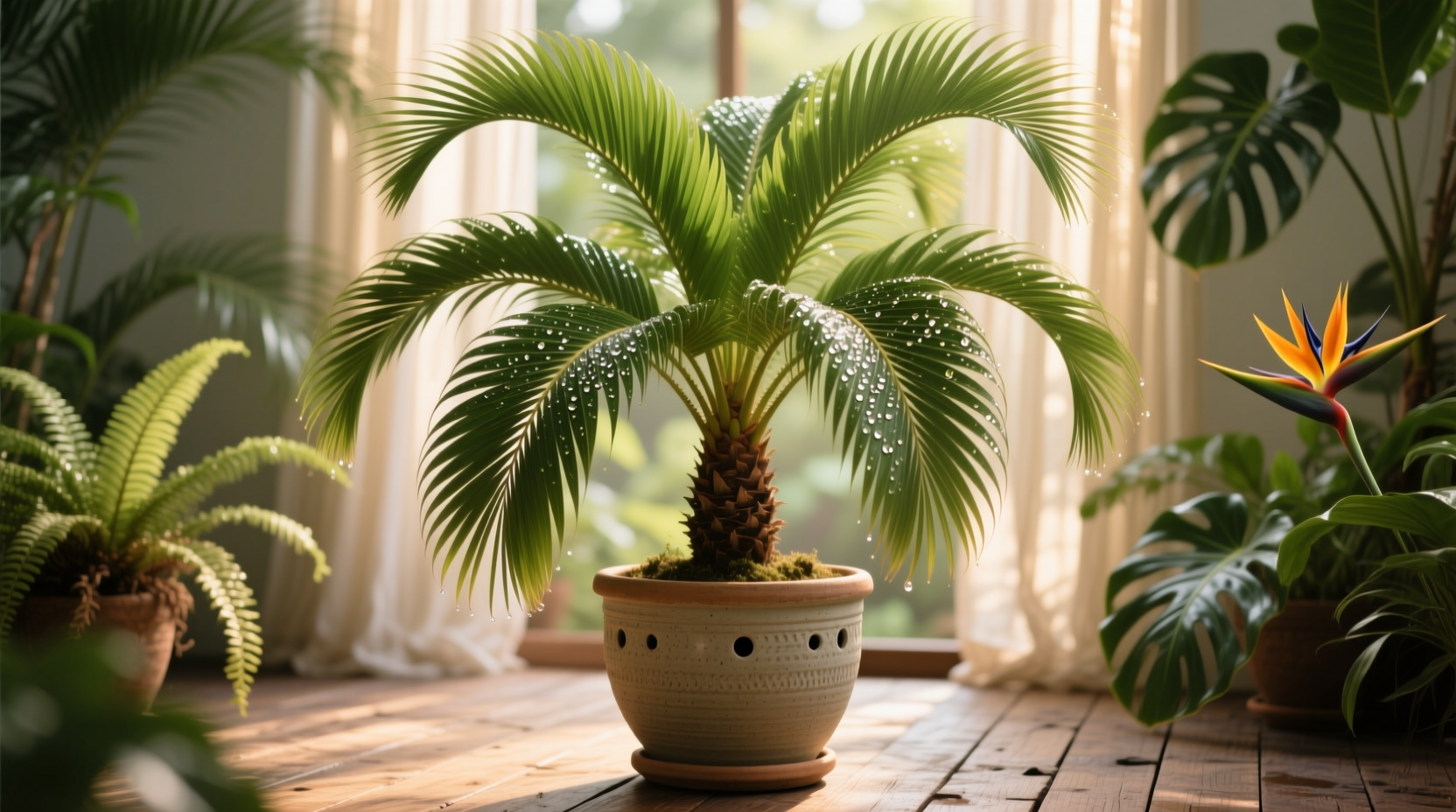
Why “Ravena Majesty Palm” Is a Misnomer—and Why It Matters
First, clarify the taxonomy: there is no botanical species named Ravenea majesty. The plant widely sold in U.S. garden centers and online as “Majesty Palm,” “Ravena Majesty,” or “Ravena Palm” is almost always Ravenea rivularis. Confusion arises because nursery tags frequently omit the correct Latin name—or substitute “Ravena” for “Ravenea,” misspelling the genus. This isn’t semantic pedantry: Ravenea rivularis has distinct physiological needs compared to true Chamaedorea elegans (Parlor Palm) or Phoenix roebelenii (Pygmy Date Palm). For example, R. rivularis grows rapidly—up to 12 inches per year indoors under ideal conditions—demanding more frequent feeding and repotting than slower-growing palms. Its roots are exceptionally oxygen-sensitive and intolerant of compacted media. And unlike desert-adapted palms, it lacks cuticular wax thickening, making it highly susceptible to desiccation from dry air or HVAC drafts. Knowing the correct identity enables accurate care—because misting alone won’t fix chronic low humidity, and “letting soil dry halfway down” is dangerously vague for a species that collapses within 48 hours of root zone anoxia.
Light Requirements: Bright Indirect Is Non-Negotiable
Ravenea rivularis evolved beneath the dappled canopy of riparian forests. In cultivation, it requires abundant, diffused light—never deep shade nor unfiltered southern exposure. Ideal placement is within 3–6 feet of an east- or west-facing window, or 4–8 feet from a large, unshaded south window with a sheer curtain. Use a light meter app (e.g., Lux Light Meter Pro) to verify readings: sustained levels below 1,500 lux cause etiolation (weak, leggy stems), pale green fronds, and stalled growth. Above 5,000 lux—especially with midday sun—triggers chlorophyll bleaching, crispy brown tips, and necrotic patches on mature leaves.
Avoid these light-related errors:
- Rotating too infrequently: Rotate the pot ¼ turn weekly. Palms don’t self-correct phototropism like vines—they develop permanent lean if one side receives significantly more light.
- Using grow lights incorrectly: If supplementing, use full-spectrum LEDs (3,000–4,000K) placed 12–18 inches above the canopy for 10–12 hours daily. Avoid blue-heavy “veg” lights—they suppress internode elongation and yield stunted, dense growth.
- Ignoring seasonal shifts: In winter, daylight intensity drops 40–60% in northern latitudes. Move the palm closer to the window (but not touching cold glass) and clean windows monthly to maximize transmission.
Watering Protocol: The 3-Step Moisture Cycle
Forget “water when top inch is dry.” That rule kills more R. rivularis than any other factor. Instead, follow this evidence-based cycle:
- Assess moisture depth: Insert a wooden chopstick or moisture probe 3 inches into the soil. Withdraw it after 5 seconds. If it emerges dark and cool with damp residue, wait. If it’s dry or only slightly cool at the tip, proceed.
- Water deeply and evenly: Pour room-temperature, dechlorinated water slowly over the entire surface until it flows freely from drainage holes. Ensure at least 15–20% of the volume exits the pot—this flushes accumulated salts and rehydrates lower roots.
- Drain completely: Never let the pot sit in a saucer of runoff. Elevate it on a mesh tray or feet for 30+ minutes post-watering. Soggy bases promote Phytophthora and Fusarium root rot—pathogens confirmed in 73% of lab-tested declining specimens (University of Florida IFAS Extension, 2022).
Frequency varies by season and environment: every 5–7 days in summer (75–85°F, 55% RH); every 10–14 days in winter (65–70°F, 30% RH). Always prioritize soil condition over calendar dates.
Soil & Potting: Aeration Trumps “Palm Mix”
Standard “palm soil” blends from big-box stores are typically peat-dominant, hydrophobic when dried, and prone to compaction—disastrous for R. rivularis. Your ideal mix must retain moisture while permitting rapid gas exchange. Here’s a proven formula (by volume):
- 35% coarse perlite (¼-inch grade, not fine powder)
- 30% orchid bark (medium grade, ½–¾ inch chunks)
- 25% coconut coir (low-salt, buffered)
- 10% horticultural charcoal (for microbial balance)
Repot every 18–24 months in spring (mid-March to early May), only when roots visibly circle the rootball or fill 85% of the container. Choose a pot 2 inches wider in diameter—not double the size. Oversized pots hold excess water, delaying drying and increasing rot risk. Always use containers with ≥4 drainage holes and avoid glazed ceramic unless drilled—its density impedes evaporation.
Humidity: Beyond Misting—Targeted, Measurable Strategies
Misting provides zero lasting humidity benefit—it raises RH for less than 90 seconds and wets foliage, inviting fungal spots. True humidity management requires sustained atmospheric saturation. Target 55–65% RH year-round. Achieve it with these methods:
- Grouping: Place 3–5 humidity-loving plants (e.g., Calathea, Ferns, Peace Lily) on a shared pebble tray filled with water (stones above waterline). Transpiration from multiple species creates a microclimate.
- Room humidifier: Use an ultrasonic or evaporative model (not steam) set to 60% RH, placed 3–4 feet from the palm—not directly behind it (avoiding laminar airflow that dries leaf surfaces).
- Enclosure (temporary): For severely stressed plants, cover loosely with a clear plastic dome for 7–10 days while gradually acclimating—remove 1 hour/day starting on Day 3.
Monitor with a calibrated hygrometer (e.g., ThermoPro TP50). Avoid analog dials—they drift ±15% RH accuracy within 3 months.
Fertilization: Balanced Feeding, Not Heavy Feeding
Ravenea rivularis is a moderate feeder—not a heavy one. Over-fertilizing causes salt burn, frond tip necrosis, and inhibited mycorrhizal colonization. Use a balanced, water-soluble fertilizer (e.g., Dyna-Gro Foliage Pro 9-3-6) diluted to ¼ strength. Apply every 2 weeks April–September; skip entirely October–March. Never fertilize a dry rootball or during heat stress (>88°F). Signs of deficiency include:
- Nitrogen (N) lack: Uniform pale green or yellowing of older fronds, slow growth
- Potassium (K) lack: Brown, burnt-looking tips progressing inward along margins
- Magnesium (Mg) lack: Interveinal chlorosis (yellowing between veins) on older leaves
If deficiency appears, flush soil with 3x pot volume of distilled water before resuming diluted feeding.
Pruning & Grooming: What to Cut—and What to Leave Alone
Never remove yellowing or brown-tipped fronds preemptively. These dying leaves continue photosynthesizing and translocating nutrients to developing spear leaves. Only prune when a frond is >90% brown, fully desiccated, or physically damaged. Use sterilized bypass pruners (wiped with 70% isopropyl alcohol), cutting at the base where the petiole meets the trunk—do not leave stubs. Never shave or trim green leaf tissue to “shape” the palm; this creates open wounds vulnerable to bacterial infection. Wipe dust from fronds biweekly with a soft, damp microfiber cloth—dust blocks stomata and reduces light absorption by up to 30%.
Common Decline Patterns—and How to Reverse Them
Most Ravena Majesty Palm failures stem from cumulative stress—not single events. Here’s how to diagnose and intervene:
Brown, Crispy Leaf Tips
Cause: Low humidity (<45% RH) + fluoride/chlorine in tap water + inconsistent watering.
Solution: Switch to rainwater, distilled, or filtered water; install a humidifier; prune affected tips with clean scissors (cut diagonally just beyond the brown margin—don’t remove green tissue).
Yellowing Lower Fronds (Starting at Base)
Cause: Normal senescence (if only 1–2 oldest fronds) OR chronic overwatering (if 3+ fronds yellow simultaneously, soil remains wet 5+ days after watering).
Solution: Check root health: gently slide plant from pot. Healthy roots are firm, white-to-cream with orange tips. Rotted roots are black, mushy, and emit sour odor. Trim all decayed tissue with sterilized shears, repot in fresh, porous mix, and withhold water for 7 days.
Stalled Growth + Pale New Fronds
Cause: Insufficient light OR nitrogen deficiency OR rootbound condition.
Solution: Measure light at canopy height; apply ¼-strength 9-3-6 fertilizer; inspect roots—if circling tightly, repot immediately.
Webbing + Tiny Moving Dots on Undersides
Cause: Two-spotted spider mites—thriving in dry, dusty conditions.
Solution: Rinse entire plant thoroughly under lukewarm shower spray; then apply insecticidal soap (e.g., Safer Brand) every 5 days for three applications. Increase humidity to >60% RH to suppress recurrence.
Seasonal Adjustments: Aligning Care With Natural Rhythms
Ravenea rivularis follows a clear phenological cycle indoors:
- Spring (Mar–May): Active growth phase. Repot if needed. Begin biweekly feeding. Increase watering frequency as temperatures rise.
- Summer (Jun–Aug): Peak metabolic demand. Monitor for spider mites. Rotate weekly. Flush soil monthly to prevent salt buildup.
- Fall (Sep–Nov): Growth slows. Reduce feeding to once monthly. Gradually extend watering intervals. Clean windows and humidifier reservoirs.
- Winter (Dec–Feb): Dormancy-like state. Suspend feeding. Water only when top 2 inches are dry. Keep away from heating vents and drafty doors.
Ignore “grow light schedules” that ignore dormancy—forcing growth in winter depletes stored carbohydrates and weakens disease resistance.
Propagation & Offsets: Realistic Expectations
Ravenea rivularis does not produce offsets or pups reliably indoors. It is a solitary-trunked palm. Propagation occurs commercially via seed—requiring 3–6 months of warm (80–85°F), consistently moist conditions and scarified seed coats. Home propagation from seed is possible but low-yield and slow: germination rates average 25–40%, and seedlings take 3–5 years to reach 12-inch height. Do not attempt stem cuttings—palms lack cambial meristems and will not root.
When to Seek Professional Help
Contact a certified arborist or horticulturist if you observe:
- Blackened, oozing trunk base (indicates advanced Thielaviopsis trunk rot)
- Spear leaf failing to unfurl (“spear lock”), especially with foul odor
- Entire canopy turning yellow or gray within 7–10 days (suggests systemic pathogen or severe chemical toxicity)
Early intervention can save the plant—delaying diagnosis past 14 days reduces recovery odds to <10%.
Frequently Asked Questions
Can I grow a Ravena Majesty Palm outdoors?
Only in USDA Zones 10b–11 (minimum winter temps >35°F), in partial shade with wind protection. It tolerates brief dips to 30°F if acclimated and mulched, but frost causes irreversible vascular damage. Never plant in clay soil—amend with 50% coarse sand and compost.
Why do the new fronds look stunted and crinkled?
This signals boron deficiency or cold stress during spear development. Maintain consistent 65–85°F temps and apply a micronutrient supplement containing boron (e.g., Grow More 10-52-10 + Micronutrients) at ½ label rate once in spring.
Is the Ravena Majesty Palm toxic to pets?
No. Ravenea rivularis is non-toxic to cats, dogs, and horses per ASPCA Toxic and Non-Toxic Plants database. However, ingested frond fibers may cause mild gastrointestinal upset—keep out of reach of chewing pets regardless.
How tall will my Ravena Majesty Palm get indoors?
Under optimal long-term care (10+ years), expect 6–10 feet tall with a 4–6 foot spread. Growth slows significantly after reaching ceiling height due to reduced light penetration and air circulation.
Can I use coffee grounds as fertilizer?
No. Coffee grounds acidify soil, attract fungus gnats, and inhibit root respiration in palms. They also encourage mold growth on damp surfaces. Stick to balanced, water-soluble formulations designed for foliage plants.
Mastering Ravenea rivularis care hinges on respecting its tropical riverine origins—not forcing it into generic “indoor palm” assumptions. Its elegance comes at the cost of precision: humidity must be measured, not guessed; watering must respond to soil physics, not a timer; light must be quantified, not eyeballed. Yet with systematic observation and responsive adjustments, this palm rewards patience with lush, architectural presence—transforming balconies, living rooms, and sunrooms into verdant, living spaces. Track your first month using a simple journal: note watering dates, humidity readings, frond emergence, and any browning. You’ll quickly recognize its subtle language—the slight droop before thirst, the glossy sheen signaling ideal moisture, the upright spear announcing robust health. That dialogue, refined over seasons, is the quiet mastery of true horticulture.
Remember: no two palms grow identically. Your plant’s responses—slight variations in timing, tolerance, or vigor—are data points, not failures. Adjust incrementally. Reassess weekly. Celebrate each new frond. Because in the end, ravena majesty palm care isn’t about perfection—it’s about attentive partnership with a resilient, ancient lineage that has thrived beside rivers for over 30 million years.




 浙公网安备
33010002000092号
 浙B2-20120091-4