
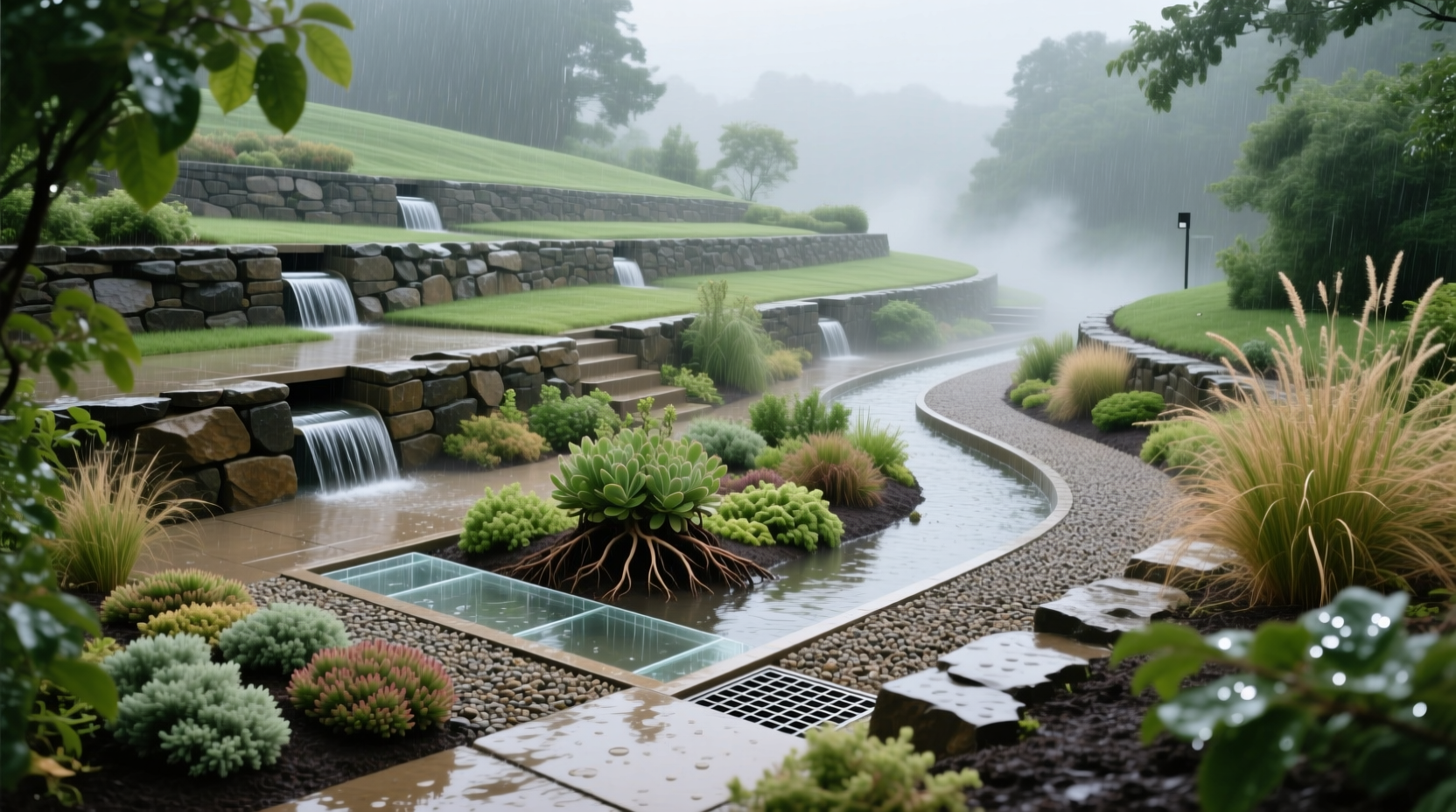
Why “Preventing Flooding” Is Really About Water Management—Not Just Rain
Garden flooding rarely results from a single downpour. It’s almost always the cumulative effect of poor drainage design, soil degradation, inappropriate irrigation habits, and microtopography that traps water. In fact, 83% of flooded residential gardens studied by the American Society for Horticultural Science (2021) had no history of extreme rainfall—but did have compacted subsoil, ungraded planting beds, or clogged downspouts directing 60+ gallons per inch of rain directly onto flower beds. Flooding doesn’t just drown plants; it suffocates beneficial soil microbes, leaches nitrogen and potassium, creates anaerobic conditions that favor Phytophthora and Fusarium, and encourages mosquito breeding. Crucially, what looks like “standing water” may actually be perched water tables—saturated layers trapped above dense subsoil—where roots drown even when the surface appears dry. That’s why prevention starts not with pumps or barriers, but with understanding where water *wants* to go—and guiding it deliberately.
12 Actionable Tips to Prevent Flooding Your Garden
1. Map Your Garden’s Natural Drainage Flow First
Before installing anything, observe your site for at least three rain events. Use a notebook or smartphone app to record: where puddles form and how long they persist; which slopes channel water fastest; whether gutters or AC condensate lines empty near plantings; and if neighboring properties drain into yours. Mark flow paths with biodegradable flags. This reveals “hot spots”—areas where water converges—not just where it pools. Many homeowners mistakenly assume high ground is safe; in reality, shallow-rooted shrubs on slopes often flood due to rapid sheet flow undercutting root zones. A simple 5-minute walk after rain saves weeks of misdirected effort.
2. Test Soil Percolation—Not Just Texture
Clay isn’t always slow-draining; sandy soil isn’t always fast. Conduct a percolation test: dig a 12-inch-deep, 6-inch-wide hole; fill with water; let drain completely; refill and time how long it takes to drop 1 inch. Ideal: 0.5–2 inches/hour. Below 0.25 inch/hour = severe restriction. Above 6 inches/hour = potential leaching risk. If results show poor infiltration, don’t rush to add sand—that creates concrete-like layering. Instead, incorporate 3–4 inches of well-aged compost *and* biochar (1:10 ratio by volume), then till only to the depth of restriction (usually 6–10 inches). This boosts aggregate stability without sealing pores.
3. Build Raised Beds with Integrated Drainage Channels
Raised beds prevent flooding only if built correctly. Avoid solid-bottom containers or beds lined with plastic—they create bathtub effects. Instead, construct beds with open gravel bases: lay 4 inches of ¾-inch crushed stone, top with landscape fabric, then 10–12 inches of amended soil. For in-ground raised beds, slope the base 1–2% toward a designated outlet (e.g., a dry well or swale). Line side walls with perforated corrugated pipe (4-inch diameter) buried 6 inches deep along the lowest edge, backfilled with gravel and covered with filter fabric. This intercepts lateral seepage before saturation occurs.
4. Install French Drains Where Gravity Does the Work
A French drain is not a pipe in a trench—it’s a gravel-filled conduit that captures subsurface flow. Dig a trench 18–24 inches deep and 12 inches wide, sloping 1 inch per 8 feet toward an outlet (never into a sewer or neighbor’s yard). Line with non-woven geotextile fabric, add 2 inches of washed gravel, lay perforated PVC or corrugated pipe (holes facing down), cover with more gravel, then wrap fabric ends over the top before backfilling with native soil. Critical: connect roof downspouts to this system via solid pipe *before* the perforated section—otherwise, roof runoff overwhelms the drain. Maintain annually by flushing with a garden hose.
5. Replace Impervious Surfaces with Permeable Alternatives
Driveways, patios, and walkways contribute up to 45% of urban garden runoff. Swap concrete or asphalt for permeable pavers set in sand bedding over 6 inches of ¾-inch gravel base—or use stabilized gravel with resin binders. Even mulched pathways (using 2–3 inches of shredded hardwood or pine bark) absorb 70% of light rain. For decks, install joist gaps of at least ¼ inch and use composite decking with drainage channels underneath. Never pave right up to foundation walls—leave a 12-inch gravel apron sloped away at 5%.
6. Use Swales and Rain Gardens Strategically—Not Decoratively
A swale is a shallow, vegetated ditch; a rain garden is a depressed basin planted with flood-tolerant species. Both work only when sized correctly: calculate runoff volume using your roof and paved area square footage × average rainfall depth (in inches) × 0.623 = gallons. A typical residential rain garden should hold 1.5x that volume and drain within 48 hours. Place swales *uphill* of problem areas—not beside them—to intercept flow. Plant with Iris versicolor, Eutrochium fistulosum, Chelone glabra, and Andropogon gerardii: all proven to survive 72+ hours of saturation while filtering pollutants. Avoid Canna or Hibiscus unless you’re in Zone 8+—they tolerate standing water but not cold, saturated soil.
7. Redirect Roof and HVAC Runoff Away From Beds
A 1,000-square-foot roof sheds ~620 gallons per inch of rain. Yet 68% of flooded gardens have downspouts terminating within 3 feet of perennial beds. Extend leaders with flexible aluminum or PVC extensions (minimum 6 feet), or connect to buried solid pipe leading to a dry well or rain barrel (with overflow routed to a swale). For air conditioners, install a condensate pump or gravity-fed line that empties into a gravel-filled infiltration trench—not onto clay soil. Add splash blocks made of recycled rubber (not concrete) to prevent erosion at discharge points.
8. Choose Plants That Signal Drainage Health—And Those That Don’t
Some plants thrive in wet soil but are terrible indicators of *healthy* drainage. Typha latifolia (cattail) or Scirpus cyperinus (woolgrass) grow in true wetlands—where water is moving, oxygenated, and nutrient-rich. Their presence in a home garden usually signals chronic saturation, not adaptation. Better indicators: earthworm castings (abundant in well-aerated, moist soil), dandelions with thick taproots (penetrate compacted layers), and mosses that appear only on north-facing, shaded surfaces—not widespread on flat beds. For flood-prone zones, prioritize Lobelia cardinalis, Asclepias incarnata, Aruncus dioicus, and Alnus glutinosa (black alder)—which host nitrogen-fixing bacteria *and* tolerate periodic inundation.
9. Time Irrigation Using Real-Time Soil Moisture Data
Overwatering causes more localized flooding than rain in 7 out of 10 suburban gardens. Drip emitters running on timers ignore evapotranspiration rates, soil type, and recent precipitation. Install wireless soil moisture sensors (e.g., those measuring volumetric water content at 6- and 12-inch depths) and set irrigation to trigger only when readings fall below 18% VWC for loam or 12% for clay. Pair with ET-based controllers that adjust runtimes daily using local weather feeds. Never water between 10 a.m. and 6 p.m.—peak evaporation increases surface tension, slowing infiltration and raising runoff risk by up to 35%.
10. Aerate Compacted Soil—But Only When Dry Enough
Core aeration works only when soil moisture is at “friable” stage—crumbly, not sticky or dusty. Test by squeezing a handful: if it holds shape but crumbles with light pressure, it’s ideal. Aerate in early fall (Zone 3–6) or late spring (Zone 7–10) using a manual or gas-powered coring tool—not spikes, which compact further. Remove cores and leave on lawn to decompose naturally. Follow within 48 hours with topdressing: ¼ inch of compost blended with 10% greensand (for potassium and trace minerals). This fills holes while improving hydraulic conductivity without sealing surface pores.
11. Maintain Gutters, Downspouts, and Grading Year-Round
Leaf debris clogs gutters in fall, causing overflows that saturate foundation plantings. Clean gutters twice yearly—spring and late fall—and install micro-mesh guards to block seeds and fine particulates. Check grading annually: use a 6-foot level and string line to verify 1 inch of fall per 4 feet away from foundations. Reseed bare patches on slopes immediately—exposed soil erodes 10x faster and fills drainage paths with silt. Inspect French drains every April: probe with a stiff wire to detect sediment buildup; flush if resistance exceeds 3 feet.
12. Monitor Microclimate Shifts—Especially After Construction or Tree Removal
Removing mature trees reduces transpiration by up to 200 gallons/day per large specimen—increasing surface moisture. New driveways or additions alter runoff vectors, often concentrating flow in previously stable zones. After any hardscape change, re-map drainage paths and install temporary diversion berms (mounded soil wrapped in jute netting) until vegetation reestablishes. In urban heat islands, nighttime condensation on cool surfaces (like foundation walls) adds measurable moisture—install weep holes or vapor-permeable insulation to manage this “invisible” flooding source.
Common Misconceptions That Worsen Flooding
- “Adding sand to clay improves drainage.” False. Sand + clay = concrete. Sand particles fill clay voids, eliminating pore space. Always use organic matter—not mineral amendments—for clay remediation.
- “If water stands for less than 24 hours, it’s fine.” False. Many pathogens (Pythium, Thielaviopsis) infect roots within 6 hours of saturation. Healthy soil should drain to field capacity within 12 hours.
- “Mulch prevents flooding.” Partially true—but only if applied correctly. Thick, matted mulch (especially fresh wood chips) forms hydrophobic crusts. Apply 2–3 inches of shredded bark or composted leaf mold, keeping it 3 inches away from stems.
- “Native plants always handle wet soil.” Not universally. Echinacea purpurea tolerates occasional wetness but rots in prolonged saturation. Verify species’ native habitat: prairie natives ≠ bottomland natives.
Species-Specific Considerations for Flood-Prone Areas
Plant selection must match both hydrology *and* soil chemistry. In alkaline clay soils (common in Midwest and Southwest), avoid Vaccinium (blueberries) and Rhododendron—they’ll yellow and decline even with perfect drainage due to iron lock-up. Instead, choose Spiraea douglasii, Physocarpus opulifolius, or Salix discolor (pussy willow), all adapted to high pH and intermittent flooding. In acidic, sandy coastal zones, Ilex verticillata (winterberry) and Leucothoe fontanesiana thrive where Miscanthus sinensis fails due to salt spray and poor nutrient retention. Always cross-reference USDA Plant Hardiness Zone, NRCS Soil Survey maps, and local extension flood-tolerant species lists—not generic “wet soil” recommendations.
When to Call a Professional—And What to Ask
Hire a certified professional if: water stands >48 hours in >25% of your garden after moderate rain; you suspect a perched water table (confirmed by digging a 3-foot test pit that fills with water overnight despite dry surface); or municipal codes require engineered drainage for slopes >5%. Ask contractors for: soil percolation test reports, stamped engineering drawings for French drains or swales, proof of liability insurance, and references with photos taken 12+ months post-installation. Avoid firms that recommend “drain tile without gravel” or “sand backfill around foundations”—both violate ASCE and NRCS best practices.
Frequently Asked Questions
How do I know if my garden is flooding—or just has poor drainage?
Flooding involves temporary surface ponding (minutes to hours) after rain; poor drainage means persistent saturation (days to weeks) even without rain. Test by digging a 12-inch hole, filling with water, and checking after 24 hours—if water remains, it’s poor drainage. If soil feels spongy, smells sulfurous, or shows gray mottling, anaerobic conditions are present.
Can I fix flooding in containers or balcony gardens?
Absolutely. Use pots with drainage holes covering ≥15% of base area; place on pot feet or gravel-filled trays (never saucers holding standing water); mix potting soil with 20% perlite and 10% rice hulls (not vermiculite, which collapses when wet); and group containers to create shared runoff channels—avoid isolating them on flat, impervious surfaces.
Will rain barrels help prevent flooding?
Only if properly integrated. A single 55-gallon barrel captures runoff from just 90 sq ft of roof per 0.3 inches of rain. To meaningfully reduce flooding, install multiple barrels (min. 3) with linked overflow hoses feeding into a gravel infiltration trench. Never rely on barrels alone—they overflow during sustained rain and do nothing for subsurface flow.
Do drought-tolerant plants help with flooding control?
Indirectly—yes. Deep-rooted species like Penstemon digitalis, Baptisia australis, and Helianthus maximiliani improve soil structure over time, increasing infiltration rates by up to 40% in 3 years. But they won’t solve acute flooding; pair them with structural fixes first.
Is flooding worse in winter—and how do I protect plants?
Yes—frozen soil cannot absorb water, turning snowmelt into sheet flow. Protect by applying 3–4 inches of coarse, airy mulch (shredded bark or straw) *after* ground freezes—this insulates roots without trapping moisture. Avoid plastic covers or heavy tarps, which create ice lenses and suffocate crowns. For marginally hardy perennials, mound soil 6 inches around crowns in late fall, then remove in early spring.
Preventing garden flooding is neither a one-time fix nor a passive hope—it’s an ongoing practice rooted in observation, soil science, and responsive design. Every garden has its own hydrological signature, shaped by geology, climate, and human intervention. The most resilient gardens aren’t those that resist water, but those that welcome it wisely: slowing its rush, spreading its load, filtering its contents, and releasing it gradually back to the atmosphere and aquifer. Start small—map one rain event, test one soil sample, redirect one downspout—and build from there. Within a single growing season, you’ll see fewer yellowed leaves, stronger root systems, richer earthworm activity, and noticeably deeper green foliage. Because when water moves with purpose, plants don’t just survive—they thrive. And that’s not luck. It’s cultivated intelligence, applied one thoughtful choice at a time.




 浙公网安备
33010002000092号
 浙B2-20120091-4