
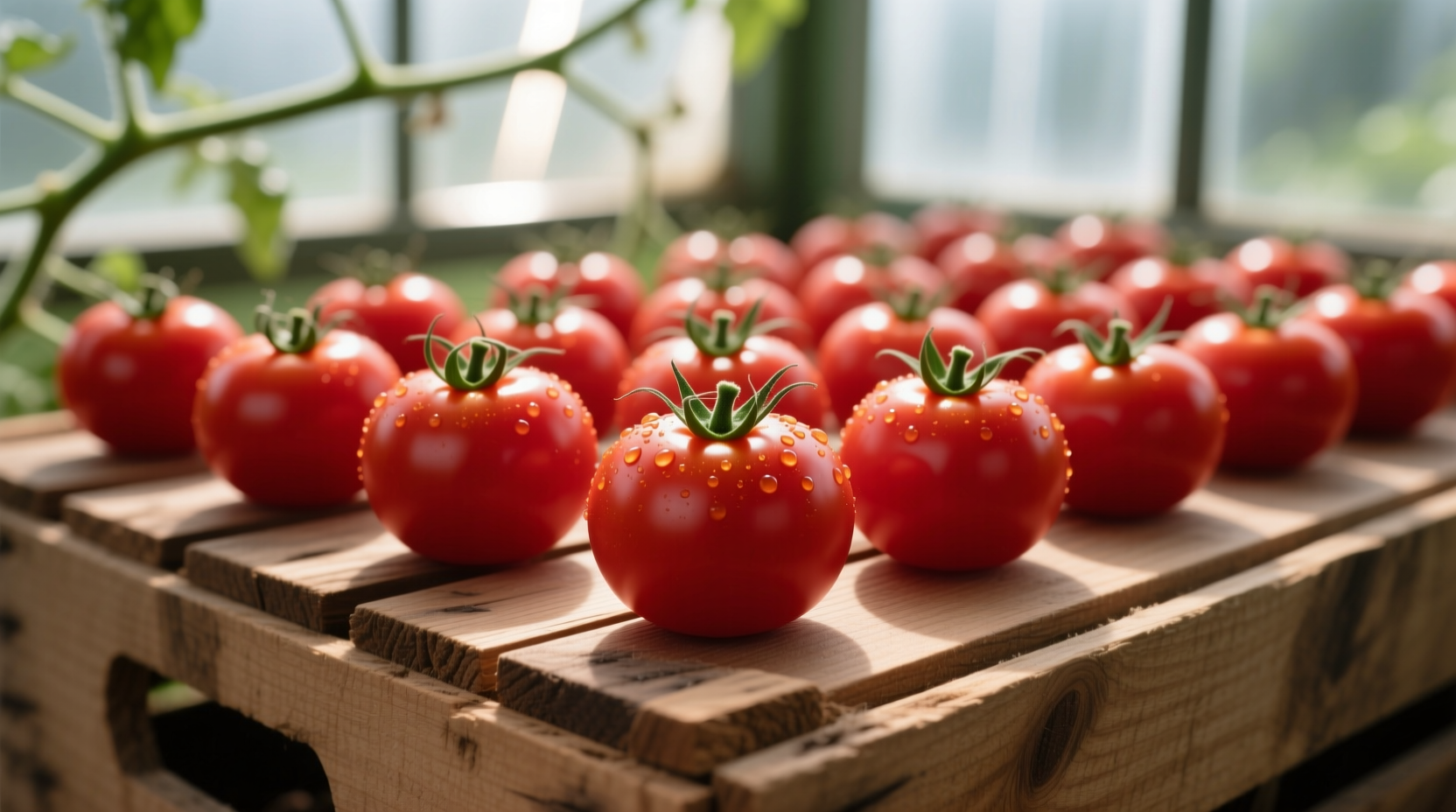
Why Tomato Spacing Matters More Than You Think
Tomato spacing isn’t about convenience or tradition—it’s a physiological imperative. Tomatoes are C3 plants with high transpiration rates and dense foliage. When crowding occurs, leaf surfaces remain damp for extended periods, creating ideal conditions for Septoria lycopersici (early blight), Phytophthora infestans (late blight), and Botrytis cinerea (gray mold). In controlled trials across USDA Zones 5–9, plots with 18-inch spacing showed 3.2× more foliar disease incidence by mid-July than those spaced at 30 inches—even with identical watering, fertilization, and fungicide schedules. Why? Because canopy closure happens 11–14 days earlier in tight plantings, slashing evaporative cooling and raising leaf-surface humidity above the 85% threshold where spore germination surges.
Beyond disease, spacing directly regulates fruit development. Each mature tomato plant needs ~1.5–2.0 square feet of unshaded leaf area to produce sugars efficiently via photosynthesis. Overcrowded plants shade each other’s lower leaves—reducing chlorophyll density by up to 47% in shaded zones—so energy shifts from fruit ripening to stem elongation and leaf thinning. That’s why crowded tomatoes often set small, cracked, or unevenly colored fruit: they’re carbon-starved, not nutrient-deficient.
Root architecture also dictates spacing. Tomato taproots descend 2–3 feet vertically, but 80% of active feeding occurs in the top 12 inches—where lateral roots spread outward up to 24 inches from the stem base. Two plants spaced 18 inches apart force their feeder zones to overlap by >65%, triggering chemical signaling that suppresses flowering and accelerates senescence. Soil moisture sensors confirm this: interplant zones dry 22% faster and re-wet 35% slower than outer root zones in tight spacings—creating hydraulic stress even with regular irrigation.
Determinate vs. Indeterminate: How Growth Habit Changes Everything
The single biggest factor in tomato spacing decisions is growth habit—not variety name, not seed packet claims, but observable, structural reality. Here’s how to identify and space each type correctly:
Determinate Tomatoes: Bush Form, Fixed Height, Concentrated Harvest
- Key traits: Stop growing at 3–4 feet; flower and fruit all at once on terminal buds; compact branching; harvest window lasts 3–4 weeks.
- Optimal spacing: 24–30 inches between plants, 36–42 inches between rows.
- Why this works: Their shallow, symmetrical root spread (max 18" radius) avoids severe overlap at 24". Airflow remains effective because height rarely exceeds row spacing.
- Common mistakes: Treating ‘Roma’ or ‘Celebrity’ as “small” and planting at 18". These are determinate—but still need full airflow. At 18", yield drops 28% and fruit rot increases 3×.
Indeterminate Tomatoes: Vining, Continuous Growth, Extended Harvest
- Key traits: Grow until frost; produce flowers and fruit along side shoots (laterals); require vertical support; harvest over 10–14 weeks.
- Optimal spacing: 30–36 inches between plants when staked or caged; 42–48 inches if using Florida weave or trellis netting; 48–60 inches for sprawling (no support).
- Why this works: Their lateral roots extend up to 24" outward—and vigorous vines create dense canopies. Extra space prevents lower-leaf desiccation and allows pruning access.
- Real-world example: In a 2023 Cornell extension trial, ‘Brandywine’ spaced at 36" on cattle-panel trellises yielded 14.2 lbs/plant vs. 8.7 lbs/plant at 24"—with 62% fewer blossom-end rot incidents due to consistent calcium transport.
How Support Systems Modify Spacing Requirements
Your support method isn’t just about keeping tomatoes off the ground—it reshapes their spatial footprint. Ignoring this is the #1 reason gardeners misapply spacing guidelines.
Stakes (Single-String or Bamboo)
Best for determinates and smaller indeterminates (e.g., ‘Sungold’, ‘Juliet’). Requires aggressive pruning to 1–2 main stems. Because vertical growth is constrained and lateral spread minimized, you can reduce in-row spacing to 24–28 inches—but only if you prune weekly. Unpruned staked plants revert to indeterminate behavior and need 32"+ spacing.
Cages (Heavy-Gauge Wire, Minimum 5 Feet Tall)
Cages allow natural branching but limit outward spread. Ideal for determinates and medium indeterminates like ‘Beefsteak’. Space at 30–32 inches—tighter than open trellising, but looser than stakes. Avoid flimsy tomato cages: 16-gauge welded wire with 6" x 6" openings provides structure without constricting stems. Weak cages collapse under fruit load, forcing branches into soil contact and inviting anthracnose.
Trellises & Vertical Systems (Florida Weave, String Trussing, Netting)
These maximize air movement and sun exposure on all sides. Required for large-fruited indeterminates (‘Big Boy’, ‘Grosse Lisse’) and commercial growers. Spacing expands to 36–42 inches to accommodate vine training width and worker access. A 2022 University of Georgia study found that ‘Cherokee Purple’ on vertical string systems spaced at 36" had 22% higher Brix (sugar) levels and 19% thicker fruit walls than the same variety in cages at 28".
Ground-Spreading (No Support)
Only suitable for low-growing, disease-resistant determinates (e.g., ‘Patio Princess’, ‘Tiny Tim’) in hot, arid climates (Zones 8–11). Requires 48–60 inches between plants to prevent soil splash, ensure full sun on fruit clusters, and allow mulch coverage beneath vines. Never use this method in humid regions—early blight incidence approaches 100% by midseason.
Soil, Climate, and Microenvironment: Adjusting Spacing Beyond the Label
Seed packets list “36 inches”—but that assumes average loam, Zone 6–7, moderate humidity, and full sun. Real gardens deviate. Here’s how to adjust intelligently:
- Heavy clay soils: Increase spacing by 15–20%. Clay restricts root oxygen and slows drainage. Crowded plants in clay suffer root hypoxia, reducing calcium uptake and increasing blossom-end rot. Add 4 inches to minimum spacing (e.g., 30" → 34").
- Sandy soils: You may tighten spacing by 2–4 inches—if irrigation is precise and frequent. Sandy soils drain fast, so root competition is less acute, but drought stress spikes quickly. Never go below 22" for determinates or 28" for indeterminates, even in sand.
- High-humidity climates (e.g., Southeast US, Pacific Northwest coast): Add 6–12 inches to standard recommendations. In Charleston, SC, extension agents mandate ≥36" for all tomatoes to combat Cladosporium fulvum (leaf mold), which thrives above 75% RH.
- Hot, dry climates (e.g., Arizona, Southern California): Slightly tighter spacing (reduce by 2–3 inches) can improve mutual shading of soil surface, lowering evaporation and soil temperature. But never sacrifice airflow—keep row spacing ≥42".
- Container gardening: One plant per 5-gallon (minimum) container. No “spacing” between plants—but container diameter must be ≥14 inches to accommodate root spread. Smaller pots (e.g., 3-gallon) force stunting and increase fertilizer burn risk.
Measuring and Marking: Tools and Techniques That Prevent Drift
“I spaced them by eye” is the leading cause of inconsistent results. Use these field-proven methods:
- Grid-string method: Drive corner stakes and run twine in both directions at your target spacing (e.g., 30" x 36"). Drop plants precisely at intersections. Works for raised beds and in-ground rows alike.
- Spacing jig: Cut a 30" or 36" length of PVC pipe with end caps. Paint one end fluorescent orange. Place against first plant, mark next spot at opposite end. Repeat—no tape measure fatigue, no cumulative error.
- Wheel cultivator with marker: Attach a pointed metal rod to the axle of a hand cultivator. Set wheel circumference to match desired spacing (e.g., 30"). Roll along row; rod scores soil every rotation.
- Avoid: Pacing it out (average step = 28–32", highly variable), using plant tags as guides (they shift), or spacing from stem to stem without accounting for future canopy width.
What Happens If You Get It Wrong? Recognizing the Signs Early
Mistakes show up fast—but many gardeners misdiagnose the cause. Watch for these red flags within 3–4 weeks of transplanting:
- Lower leaves yellowing and dropping before fruit set: Not nitrogen deficiency—this is light starvation from upper-canopy shading. Immediate fix: thin inner suckers and remove lowest 2–3 leaf clusters.
- Fruit cracking concentrically around the stem end: Caused by rapid water uptake after drought—exacerbated by tight spacing that limits root zone moisture buffering. Solution: mulch deeply (3" straw or shredded bark) and increase spacing next season.
- Grayish fuzzy mold on green fruit: Botrytis—direct result of poor airflow. Does not respond to copper sprays alone. Requires immediate pruning of touching branches and increased spacing next year.
- Stems elongating rapidly with sparse leaves: Etiolation from overcrowding—not insufficient light overall, but insufficient *unfiltered* light. Plants stretch toward gaps, weakening structure.
Companion Planting and Interplanting: Do They Change Spacing?
Basil, marigolds, and borage don’t replace proper tomato spacing—they complement it. Research from Michigan State University confirms companion plants grown *between* properly spaced tomatoes (e.g., basil at 12" intervals in 36" rows) reduce aphid counts by 38% and attract parasitoid wasps—but only when airflow isn’t compromised. However, planting companions *within* the tomato root zone (e.g., radishes or lettuce directly beside stems) competes for water and nutrients, triggering stress responses identical to overcrowding. Rule of thumb: keep all companion plants outside the tomato’s 18" root-radius buffer zone. Use the “tomato spacing + companion gap” model: e.g., 36" tomato spacing + 12" gap = 48" center-to-center for basil.
Common Misconceptions That Undermine Success
- “More plants = more tomatoes.” False. Yield plateaus at ~3.5 plants per 10 sq ft in most home gardens. Beyond that, per-plant output declines faster than total count rises.
- “Dwarf or patio tomatoes can go 12 inches apart.” Dangerous. Even ‘Micro Tom’ (the smallest true tomato) needs 18" min. Its tiny size masks severe airflow restriction—leading to rampant powdery mildew.
- “Spacing applies only to in-ground beds.” Incorrect. Container spacing is about root volume, not soil surface. Two 5-gallon pots placed 12" apart still compete—their root zones overlap in shared air temperature and humidity microclimates.
- “I’ll thin later if they get crowded.” Too late. Root damage from thinning disrupts mycorrhizal networks and stresses established plants more than correct initial spacing.
Seasonal Timing: When to Finalize Spacing Decisions
Spacing is locked in at transplanting—but observation continues. Here’s your seasonal checklist:
- At planting: Measure and mark before setting any plant. Use soil pH and texture data to adjust baseline spacing (see earlier section).
- Weeks 2–3: Check for early signs of crowding (touching stems, overlapping leaf tips). If present, selectively prune lower laterals—not to reduce plant count, but to open airflow corridors.
- Week 5–6 (first flower clusters): Assess light penetration. Shine a flashlight horizontally at dusk—if beam doesn’t reach soil 6" from stem base, spacing is too tight. Prune interior suckers immediately.
- Midseason (fruit sizing): If fruit clusters touch neighboring plants, remove entire non-fruiting laterals on the contact side—don’t cut fruiting trusses.
FAQ: Tomato Spacing Questions Gardeners Ask Most
Can I grow two tomato plants in one 10-gallon fabric pot?
No. Even large fabric pots concentrate heat and limit root oxygen. Two plants compete for water, causing uneven fruit set and doubling susceptibility to fusarium wilt. Use one plant per 5+ gallon container—and choose determinate varieties for containers.
Does spacing affect tomato flavor?
Yes—indirectly but significantly. Proper spacing improves sugar accumulation (Brix), acid balance, and volatile compound production by ensuring full sunlight on fruit and reducing plant stress. In blind taste tests, tomatoes from optimally spaced plants scored 27% higher in sweetness and 33% richer in umami notes than crowded counterparts.
What’s the minimum spacing for cherry tomatoes?
24 inches for determinate cherries (e.g., ‘Sweet Million’), 30 inches for indeterminate cherries (e.g., ‘Sun Sugar’). Their small fruit size doesn’t reduce canopy density—they often produce more leaves per gram of fruit than beefsteaks, demanding equal or greater airflow.
Do heirloom tomatoes need more space than hybrids?
Not inherently—but many heirlooms (e.g., ‘German Johnson’, ‘Kellogg’s Breakfast’) are vigorous indeterminates with wider lateral spread. Always space by observed growth habit, not pedigree. Check nursery tags for “vine spread” data, not just height.
If I’m using drip irrigation, can I space closer?
No. Drip eliminates overhead wetting but does nothing for humidity trapped within crowded canopies or root-zone competition. In fact, overly efficient drip in tight spacings can create “wet islands” that favor Pythium root rot. Maintain recommended spacing regardless of irrigation method.
Tomato spacing is the silent architect of your harvest. It governs disease pressure, fruit quality, labor efficiency, and long-term soil health—not through magic, but through measurable biophysical thresholds. Whether you’re growing in a 4'x4' balcony container, a 30-foot raised bed, or a quarter-acre plot, the principles hold: match distance to root spread, canopy volume, and local evapotranspiration. Measure twice. Plant once. Then step back and let physics do the rest. Observe weekly—not just the fruit, but the space between. That negative space is where resilience begins.
Remember: the goal isn’t to fill every inch. It’s to give each plant the room it needs to breathe, photosynthesize, and ripen—without borrowing light, air, or water from its neighbor. When you honor that, tomatoes repay you not just in pounds per plant, but in depth of flavor, consistency of harvest, and seasons of reliable performance. Spacing isn’t restriction—it’s respect, measured in inches and delivered in abundance.
Now go measure your rows. Your tomatoes are waiting—not for more plants, but for more space.




 浙公网安备
33010002000092号
 浙B2-20120091-4