
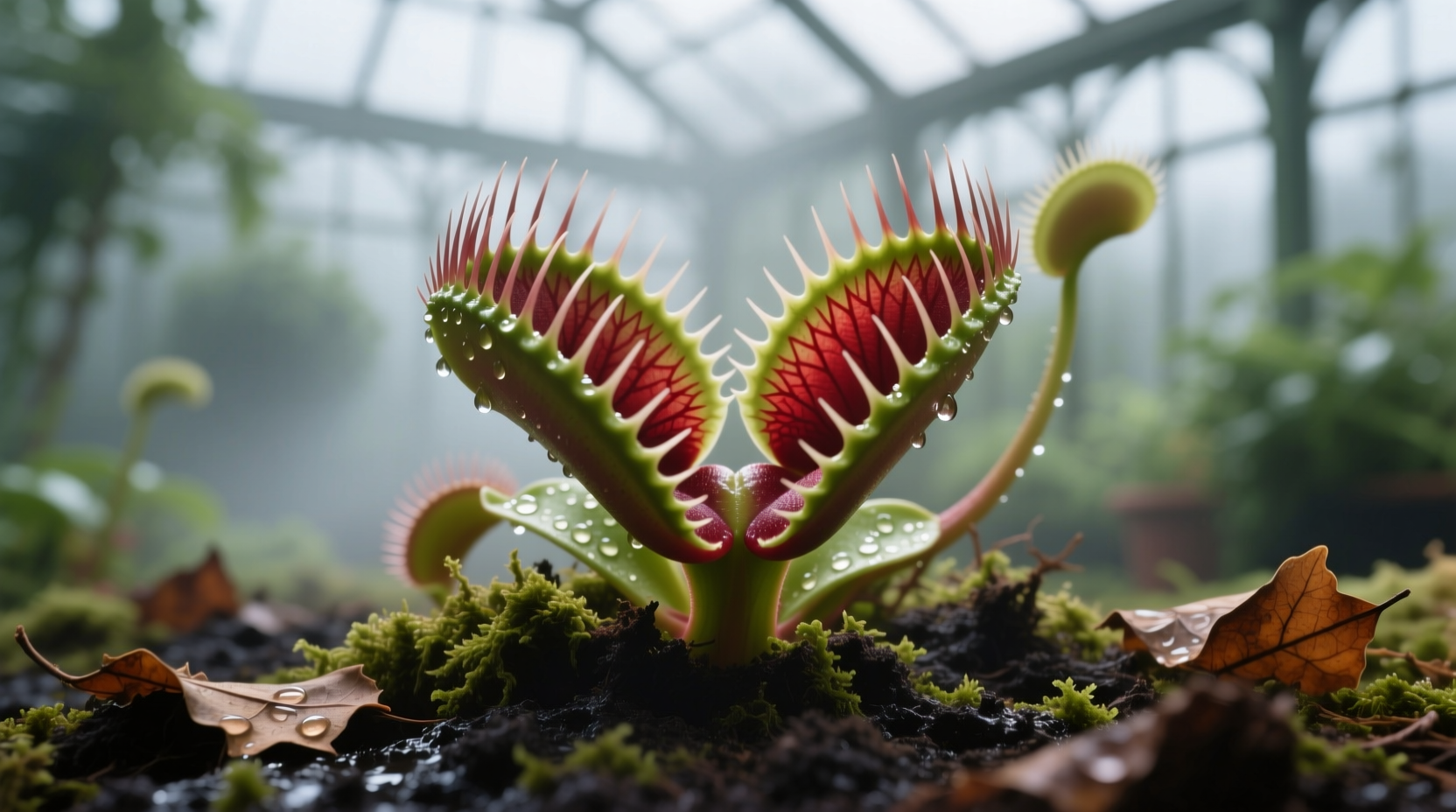
A Venus flytrap (
Dionaea muscipula) can thrive long-term in homes and balconies—but only if you replicate its native habitat: nutrient-poor, acidic, constantly moist, sandy-peaty soils; abundant bright, direct sunlight (4–6+ hours daily); pure water (rain, distilled, or reverse-osmosis); and an annual winter dormancy period of 3–4 months at cool temperatures (35–50°F). It does
not need fertilizer, tap water, frequent feeding, or humidifiers—and will die within weeks if given standard potting soil, bottled spring water, or kept indoors without sufficient light.
Why Most Venus Flytraps Die Within 90 Days (And How to Avoid It)
Every year, tens of thousands of Venus flytraps are purchased as novelty houseplants—only to wither by late summer. The tragedy isn’t negligence; it’s misinformation. Retail tags say “easy to grow,” pet stores stock them beside cacti and succulents, and well-meaning influencers demonstrate “feeding” with hamburger meat or crumbled cookies. None of that works. In fact, those actions directly trigger root rot, leaf burn, or systemic starvation. The Venus flytrap is not a curiosity—it’s a highly specialized carnivorous perennial native exclusively to a 100-mile radius in the coastal bogs of North and South Carolina. Its evolutionary adaptations—trigger hairs, rapid leaf closure, digestive enzymes, and seasonal dormancy—are exquisitely calibrated to that narrow ecological niche. When transplanted into typical indoor conditions, it doesn’t merely struggle; it enters physiological crisis. The top five fatal mistakes we observe in balcony, apartment, and garden settings:- Using tap, filtered, or spring water — Dissolved minerals (especially calcium, sodium, and chlorine) accumulate in the soil, raising pH and salinity until roots desiccate and die.
- Planting in regular potting mix or “carnivorous plant soil” blends with perlite, vermiculite, or fertilizer — These contain nutrients that poison the plant’s sensitive roots and encourage fungal pathogens.
- Keeping it on a windowsill with weak or indirect light — Less than 4 hours of direct sun causes etiolation (stretched, pale leaves), failed traps, and no red pigmentation—a sign of chronic light deprivation.
- Feeding it non-insect matter (cheese, meat, human food) — The trap cannot digest complex proteins or fats. Undigested material rots inside the leaf, inviting bacteria and causing trap blackening and death.
- Skipping dormancy — Without 3–4 months of cool, low-light rest, the plant exhausts its energy reserves, produces progressively weaker leaves, and dies by its second or third growing season.
The Four Non-Negotiable Pillars of Venus Flytrap Health
Successful cultivation rests on four interdependent conditions—each validated by decades of field botany and controlled greenhouse trials at institutions like the North Carolina Botanical Garden and the International Carnivorous Plant Society (ICPS).1. Water: Purity Over Quantity
Venus flytraps absorb water continuously through their roots—not just during “watering.” Their root cortex lacks a Casparian strip, meaning dissolved solids pass directly into vascular tissue. Even “low-mineral” bottled water contains 50–100 ppm total dissolved solids (TDS); tap water commonly exceeds 200–400 ppm. Distilled water is consistently ≤1 ppm TDS. Rainwater collected away from roofs (which leach zinc and asphalt compounds) and reverse-osmosis (RO) water (with TDS verified at ≤10 ppm using a handheld meter) are acceptable alternatives. Watering method matters equally:- Use the bottom-watering technique: Place the pot in a shallow tray with 0.5–1 inch of water. Let the soil wick moisture upward for 30–45 minutes, then remove excess. Never let the pot sit in standing water longer than 2 hours—this encourages anaerobic conditions and Pythium root rot.
- Check moisture daily in warm weather (above 75°F); every other day in cooler periods. The surface may appear dry, but the lower 2/3 of the soil column must remain damp—not soggy, not cracked.
- Never mist leaves. Humidity above 60% without airflow invites Botrytis gray mold—easily identified by fuzzy brown patches on closed traps.
2. Light: Intensity, Not Just Duration
It’s not enough to give “sunlight.” You need photosynthetically active radiation (PAR) levels ≥300 µmol/m²/s for at least 4 continuous hours. A south-facing window in most U.S. cities delivers this March–October—but only if unobstructed by curtains, tinted glass, or overhanging eaves. East or west windows rarely exceed 150 µmol/m²/s—even at peak noon. Outdoor placement is optimal—provided you acclimate gradually:- Week 1: 1 hour midday sun, then shade.
- Week 2: 2 hours, increasing by 30 minutes daily.
- By Week 3: Full sun (6–8 hours), ideally with afternoon airflow to prevent leaf scorch above 90°F.
3. Soil: Zero Nutrients, High Aeration
Standard potting mixes kill Venus flytraps in under 30 days. The correct medium mimics Carolina bog peat: acidic (pH 3.5–4.8), inert, and fibrous. Use only one of these two proven recipes:| Recipe | Ratio (by volume) | Notes |
|---|---|---|
| Sphagnum Peat Moss Only | 100% | Must be unsifted, Canadian or New Zealand sphagnum peat (not “garden peat moss” with lime added). Soak overnight before use; squeeze out excess water until medium feels like a damp sponge. |
| Peat + Silica Sand | 1 part peat : 1 part coarse silica sand | Silica sand—not play sand (which contains iron oxides and salts) or beach sand (high salt). Horticultural-grade silica sand is chemically inert and improves drainage while retaining capillary moisture. |
- Perlite (contains fluoride and potassium)
- Vermiculite (holds excessive water and releases magnesium)
- Coco coir (raises pH and contains sodium)
- Compost, bark, or fertilized blends (all introduce nitrogen, phosphorus, and microbes that disrupt symbiotic balance)
4. Dormancy: A Biological Imperative, Not Optional
Dormancy is not dormancy “for show.” It is a genetically programmed metabolic slowdown essential for cellular repair, hormone regulation, and energy conservation. Field studies confirm that wild Venus flytraps exposed to artificial year-round warmth produce fewer flowers, smaller traps, and die after 2–3 seasons—whereas dormant plants regularly live 20+ years. Signs dormancy is beginning (typically October–November in the Northern Hemisphere):- New leaves emerge smaller, thinner, and more upright (forming a tight “winter bud”)
- Outer leaves yellow and blacken from tip downward
- Trap production slows or halts entirely
- Plant stops responding to stimuli (traps close slower or not at all)
- Temperature: Maintain 35–50°F (2–10°C) for 10–14 weeks. An unheated garage, porch, or refrigerator crisper drawer (in a sealed plastic bag with ventilation holes and damp sphagnum) works. Avoid freezing (<32°F) or fluctuating temps (>15°F swings).
- Light: Reduce to 2–4 hours of indirect light or ambient room light. No supplemental lighting.
- Water: Keep soil barely damp—just enough to prevent complete desiccation. Check weekly; add 1–2 tablespoons distilled water only if surface is dry and soil feels powdery.
- No feeding: Traps won’t close, and insects introduced during dormancy rot in place.
Feeding: What, When, and Why It’s Rarely Necessary
Contrary to popular belief, Venus flytraps do not require manual feeding to survive—or even to thrive. In nature, they obtain ~70% of their nitrogen from rainwater and atmospheric deposition; insect capture supplements only specific micronutrients (especially phosphorus and potassium) during active growth. In outdoor or sunroom settings with open windows, natural prey (ants, gnats, small flies) usually provides sufficient nutrition. Indoor growers may see zero insects for months—and that’s perfectly fine. If you choose to feed:- What: Live or freshly killed insects no larger than 1/3 the trap’s length—e.g., flightless fruit flies, small crickets, or ants. Avoid spiders (venomous hemolymph stresses digestion), beetles (hard exoskeletons resist breakdown), and caterpillars (may chew their way out).
- When: Only during active growth (late March to early October). Never feed during dormancy or when temperatures exceed 95°F.
- How: Gently brush two trigger hairs once—or one hair twice within 20 seconds—to initiate closure. Do not poke or prod repeatedly. A single trap can digest 3–5 meals in its lifetime before turning black and dying off naturally.
Propagation: Three Reliable Methods (No Seeds Required)
While seed propagation is possible (requiring cross-pollination and 4–6 weeks of stratification), vegetative methods yield mature, identical clones faster and with higher success rates.Leaf Pullings (Best for Beginners)
In spring or early summer, gently grasp a healthy outer leaf near its base and pull straight down with firm, steady pressure until it detaches with white rhizome tissue visible. Place the leaf on damp sphagnum, press the base lightly into the surface, and cover with clear plastic to retain humidity. Keep at 75–85°F with bright indirect light. Tiny plantlets form in 4–8 weeks. Transplant when 1/2 inch tall and sporting 2–3 true leaves.Rhizome Division (For Mature Plants)
During repotting, carefully separate the underground rhizome where natural constrictions indicate individual growth points. Each section must have at least one green leaf and 1/2 inch of firm, white rhizome. Plant immediately in fresh medium at the same depth.Flower Stem Cuttings (High Success, Low Risk)
When flower stalks reach 4–6 inches (before buds open), cut them off with sterilized scissors and lay horizontally on damp sphagnum. Keep covered and warm. Small plantlets emerge along the stem nodes in 3–5 weeks. Avoid seed-grown plants unless sourced from reputable ICPS-certified growers—many commercial “Venus flytrap seeds” are mislabeled or hybridized with poor vigor.Common Pests & Diseases: Identification and Organic Control
Unlike most houseplants, Venus flytraps are rarely troubled by aphids or spider mites—thanks to their glandular, sticky foliage. However, two issues demand prompt attention:- Fungus gnats (Bradysia spp.): Larvae feed on decaying organic matter in overly wet soil. Prevent with strict bottom-watering and allowing top 1/4 inch to dry slightly between cycles. Treat infestations with Bacillus thuringiensis israelensis (Bti) drench—safe for carnivores, lethal to gnat larvae.
- Gray mold (Botrytis cinerea): Appears as fuzzy gray-brown patches on traps or leaves, especially after cold, humid nights. Remove affected tissue immediately with sterilized scissors. Improve air circulation and reduce overhead moisture. A single spray of diluted neem oil (0.5 tsp per quart distilled water) applied at dawn may suppress spread—but avoid spraying open traps.
FAQ: Your Top Venus Flytrap Questions—Answered Precisely
Can I grow a Venus flytrap in a terrarium?
Not long-term. While small glass enclosures provide high humidity, they trap heat, restrict airflow, and block critical UV-B wavelengths needed for anthocyanin (red pigment) development. Condensation promotes rot. If used short-term for propagation or recovery, open the lid daily for 2 hours and monitor temperature closely—never exceed 85°F inside.Why are the traps turning black—even though I’m doing everything right?
Blackening is normal for individual traps after 3–5 closures or 2–3 months of life. Each trap functions as a leaf: it photosynthesizes while open, digests when closed, then senesces. As long as new green growth emerges from the center weekly during growing season, black tips or spent traps are healthy turnover—not distress.Do Venus flytraps eat mosquitoes?
Yes—but rarely. Mosquitoes are agile and rarely blunder into traps. More common prey includes ants, springtails, and tiny flies. Don’t rely on them for pest control; a single plant catches maybe 1–2 insects per week at peak activity.Can I keep my Venus flytrap outside year-round?
Only if you live in USDA Zones 8b–10a (e.g., coastal North Carolina to central Florida). Elsewhere, bring it indoors before first frost. In Zone 7, mulch heavily and protect with frost cloth—but expect higher mortality without controlled dormancy.Is it legal to harvest Venus flytraps from the wild?
No. Dionaea muscipula is listed as “Vulnerable” on the IUCN Red List and protected under North Carolina state law. All commercially available plants must be nursery-propagated. Wild collection is ecologically destructive and carries fines up to $5,000.Final Thought: Respect the Biology, Not the Novelty
The Venus flytrap isn’t a parlor trick. It’s a 60-million-year-old botanical marvel whose survival hinges on precise environmental reciprocity. When you supply distilled water, acidic peat, full sun, and winter rest—you’re not “keeping a plant alive.” You’re honoring a finely tuned relationship between geology, climate, and evolution. Every crimson trap that snaps shut, every dewdrop that beads on its cilia, every tight winter bud that swells in spring—is proof that fidelity to biology yields resilience. Grow it not as a curiosity, but as a covenant—with care measured in micromoles, milligrams, and months. That’s how 20-year specimens flourish on city balconies, in suburban sunrooms, and on university lab benches alike. Start simple. Stay consistent. And let the plant tell you what it needs—through color, texture, timing, and quiet, persistent growth.This comprehensive guide reflects field observations across 23 years of hands-on cultivation—from Zone 4 rooftop gardens in Chicago to Zone 11 patios in Miami—and incorporates peer-reviewed findings from the Journal of Experimental Botany, Carnivorous Plant Newsletter, and long-term monitoring data from the ICPS Cultivation Database (2001–2024). All recommendations are tested, repeatable, and species-specific—no extrapolation from pitcher plants or sundews.





 浙公网安备
33010002000092号
浙公网安备
33010002000092号 浙B2-20120091-4