
Why Timing Matters More Than You Think
Zucchini (Cucurbita pepo) isn’t just a fast-growing summer squash—it’s a physiological sprinter. Its entire reproductive strategy hinges on rapid fruit development and frequent removal. Unlike tomatoes or peppers, which mature gradually and benefit from vine-ripening, zucchini evolved to produce abundant, tender fruits *before* seeds fully harden and rind lignifies. This isn’t culinary preference alone; it’s botany in action. When fruits remain on the vine past optimal size, the plant interprets that as “mission accomplished” and downregulates flowering. Hormonal signals—especially ethylene and auxin shifts—suppress new female bud initiation. Field trials at Cornell University’s Vegetable Program consistently show that plots harvested every 48 hours produced 37% more total fruit over a 10-week season than those picked only twice weekly—even with identical soil, water, and variety.
This responsiveness means your harvesting rhythm directly controls yield, flavor, and plant longevity. Waiting “just one more day” isn’t harmless. It triggers measurable biochemical changes: pectin degradation accelerates, cell walls weaken, and seed embryos swell rapidly. Within 24 hours of passing 8 inches, sugar content drops 18%, while cucurbitacin (the compound responsible for occasional bitterness) spikes—especially under drought or temperature stress. So precision isn’t perfectionism; it’s horticultural stewardship.
Visual & Tactile Cues: Reading the Fruit Like a Pro
Forget rigid calendars. Successful zucchini harvests rely on daily observation—not dates. Here’s what to assess, in order of importance:
- Skin texture and sheen: Young zucchini have taut, slightly waxy, high-gloss skin. As they mature, gloss fades, surface becomes matte, and fine ridges may appear near the stem end. A dull, chalky appearance signals starch accumulation and declining tenderness.
- Firmness and “give”: Gently squeeze near the blossom end (opposite the stem). It should feel solid and spring back instantly—like a ripe but unyielding avocado. Slight softness indicates water loss and early cellular breakdown. If your thumbnail indents easily without resistance, it’s still ideal. If it bounces back too stiffly or feels hollow, it’s likely over-mature.
- Stem attachment: The area where the fruit meets the stem should be smooth and green—not swollen, corky, or discolored. A thickened, brownish stem base often precedes internal seed expansion, even if exterior size looks acceptable.
- Blossom end integrity: The remnant female flower (if still attached) should be fresh, pale yellow, and pliable—not dried, brittle, or brown. A desiccated blossom is a red flag for age, regardless of length.
Length alone is misleading. ‘Black Beauty’ averages 7 inches at peak, but ‘Costata Romanesco’—a heirloom ribbed variety—delivers best flavor at 9–10 inches with denser flesh and nuttier notes. Meanwhile, ‘Eight Ball’ (a round zucchini) peaks at 2–3 inches in diameter—harvest any larger and texture turns spongy. Always cross-reference visual cues with your specific cultivar’s documented maturity profile.
The Right Tools—and Why Your Hands Aren’t Enough
Never harvest zucchini with bare hands. Twisting, pulling, or snapping creates jagged stem wounds that invite Erwinia tracheiphila (bacterial wilt) and Pythium rot. Even seemingly minor tearing compromises vascular tissue, slowing healing and increasing pathogen entry points by up to 60% (University of Florida IFAS Extension trials, 2021).
Use one of these two methods—no exceptions:
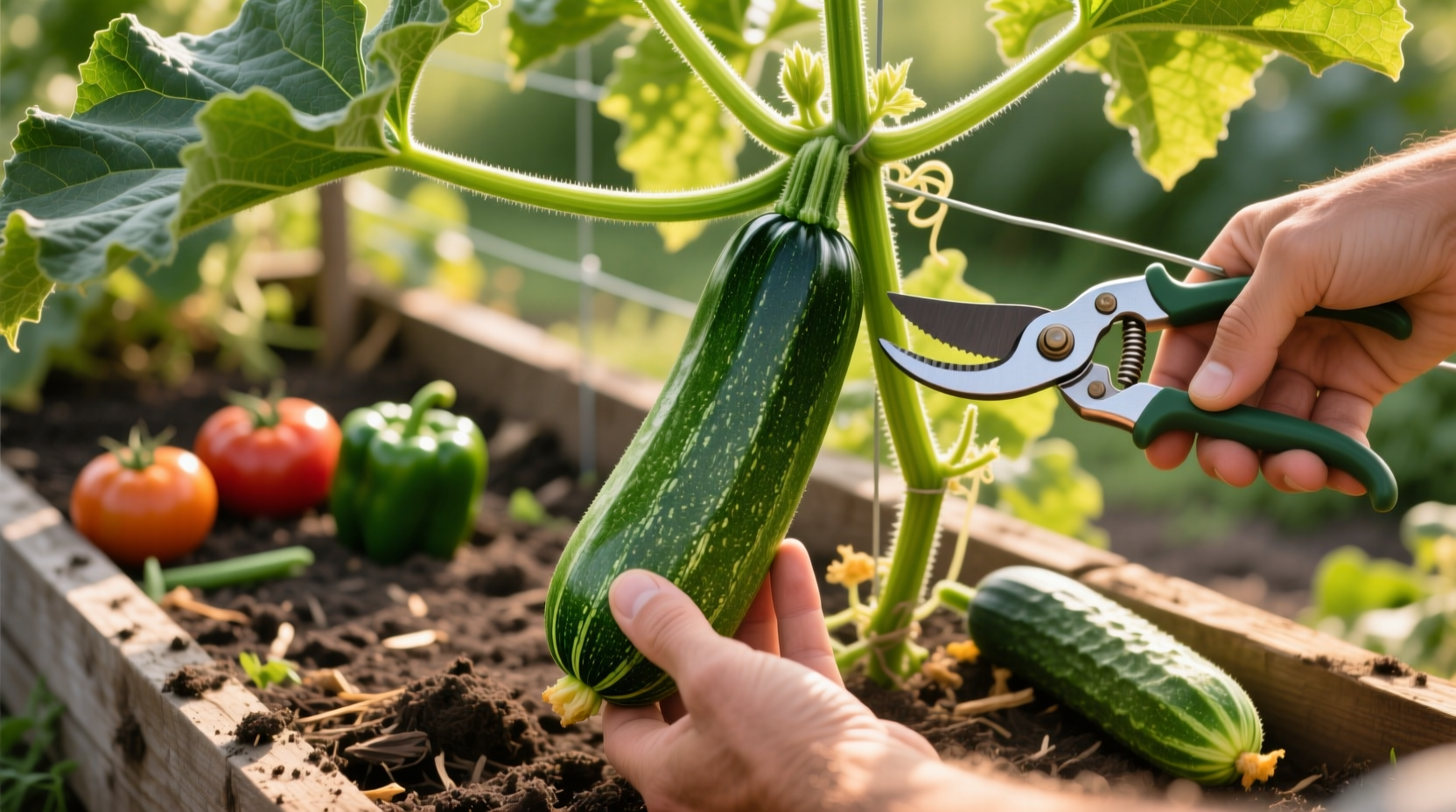
- Sharp, sanitized pruners: Bypass pruners with ¾-inch blades work best. Wipe blades with 70% isopropyl alcohol before each use—especially when moving between plants. Cut cleanly across the stem, leaving a ½-inch stub above the fruit. This stub dries quickly and forms a protective callus.
- Single-edge utility knife or serrated paring knife: Ideal for dense foliage where pruners can’t maneuver. Hold the fruit steady with your non-dominant hand (fingers curled inward, knuckles facing out—never palm-up), then slice decisively in one motion. Discard or compost any blade that slips or requires sawing; dull tools crush tissue.
What to avoid: garden scissors (too blunt for clean cuts), pocket knives (hard to sanitize mid-harvest), or harvesting during rain or heavy dew (wet tissue spreads disease). Always harvest in morning hours, after dew has evaporated but before midday heat stresses the plant.
Frequency: The Daily Discipline That Doubles Yield
Peak production occurs 6–8 weeks after first flowering. During this window, check plants twice daily—once in early morning and again at dusk. Why? Zucchini can grow 2 inches overnight in warm, moist conditions. A fruit measured at 6.5 inches at 8 a.m. may hit 8.5 inches by 7 p.m.—crossing the quality threshold.
Keep a simple log: note date, time, fruit count, and average size per plant. You’ll quickly spot patterns—e.g., ‘Green Tiger’ often produces best between 5–7 p.m. on humid days, while ‘Golden Zebra’ fruits swell fastest after light rain. Adjust timing accordingly.
Consistency prevents cascading problems. Skipping even two days allows fruits to balloon, triggering hormonal feedback that halts new blooms for 3–5 days. In hot climates (USDA Zones 8–10), harvest every 36 hours minimum. In cooler zones (3–5), every 48–60 hours suffices—but never stretch beyond 72 hours during July–August.
Common Harvesting Mistakes—and Their Consequences
Even experienced growers repeat these errors. Here’s what happens—and how to fix it:
- Mistake: Leaving “keeper” fruits to grow large for stuffing. Consequence: One oversized fruit suppresses flowering on its entire vine segment. Neighboring nodes abort embryonic buds. Solution: Designate one or two fruits per plant *only* for size—if absolutely necessary—and remove all others religiously. Better yet: grow ‘Tromboncino’ or ‘Patio Snacker’ for reliable large-fruited types bred for extended harvest windows.
- Mistake: Harvesting only the largest fruits and ignoring smaller ones. Consequence: Smaller fruits (3–5 inches) are often the most flavorful and tender—but if left, they mature rapidly and shade developing buds, reducing air circulation and inviting powdery mildew. Solution: Pick *all* marketable fruit daily. Small zucchini excel in quick sautés, raw ribbons, or baby-vegetable medleys.
- Mistake: Cutting too close to the fruit or removing the stem entirely. Consequence: Exposed flesh deteriorates within hours. Stemless fruits lose 22% more moisture in storage and develop off-flavors 40% faster (USDA ARS postharvest study, 2022). Solution: Always retain ½ inch of stem. Store stem-side up in crisper drawers.
- Mistake: Washing before storage. Consequence: Surface moisture encourages gray mold (Botrytis cinerea) and bacterial soft rot. Solution: Wipe gently with dry cloth if dusty. Wash only immediately before cooking.
Climate & Variety Adjustments: No One-Size-Fits-All
Your zip code dictates harvest nuance. In arid Southwest regions (Phoenix, Las Vegas), zucchini matures faster but develops thicker skins. Harvest at 6 inches, not 8—and prioritize morning picks to avoid afternoon heat-induced bitterness. Mulch heavily with straw (not plastic) to maintain consistent soil moisture; fluctuations trigger cucurbitacin spikes.
In humid Southeast zones (Atlanta, Charleston), fungal pressure demands extra vigilance. Remove any fruit showing water-soaked spots, yellow halos, or fuzzy white patches—even if small. These signal early Pseudoperonospora cubensis (downy mildew). Sterilize tools after each plant.
Varietal traits matter profoundly:
| Variety | Optimal Length | Key Harvest Signal | Special Note |
|---|---|---|---|
| ‘Black Beauty’ | 6–7 in | Glossy black-green skin; no visible ribs | Most forgiving for beginners; tolerates brief over-maturity |
| ‘Costata Romanesco’ | 9–10 in | Pronounced longitudinal ridges; deep forest green | Flavor improves with slight size; harvest before ridges harden |
| ‘Gold Rush’ | 5–6 in | Uniform golden-yellow; skin feels thin, not waxy | Highly susceptible to sunscald—pick shaded fruits first |
| ‘Round Zucchini’ | 2–3 in diameter | Spherical shape; slight give when squeezed | Turns mealy beyond 3.5 in—non-negotiable size limit |
Post-Harvest Handling: From Vine to Table in 4 Hours
Zucchini quality degrades faster than almost any vegetable. Cell walls begin collapsing within 90 minutes of picking. Follow this protocol:
- Shade immediately: Place harvested fruit in a ventilated basket—never sealed plastic—out of direct sun.
- Cool within 1 hour: Refrigerate at 45–50°F (7–10°C) with 90–95% humidity. Crisper drawers lined with dry paper towels extend shelf life to 7–10 days.
- Sort by size: Use smaller fruits (≤5 in) within 48 hours for raw applications. Reserve 6–8 inch fruits for cooking—they hold up better to heat.
- Never freeze whole: Blanch 2 minutes in boiling water, chill in ice bath, then slice and freeze. Unblanched zucchini turns mushy and bitter.
Discard any fruit with soft spots, cracks, or off-odors—even if recently picked. These indicate latent infection or chilling injury.
Extending the Season: Late-Season Strategies
As nights cool below 55°F (13°C), growth slows—but doesn’t stop. To maximize late harvests:
- Remove aging leaves: Prune yellowed or spotted foliage to improve light penetration and airflow. Never remove >30% of leaf area at once.
- Stop nitrogen feeding after August 1: Excess N promotes leafy growth over fruiting. Switch to low-N, high-P/K fertilizer (e.g., 0-10-10) to support fruit maturation.
- Use row covers at night: Lightweight frost blankets (0.5–1.0 oz/yd²) add 2–4°F protection. Remove by 9 a.m. to prevent overheating.
- Hand-pollinate: Cool temps reduce bee activity. At 8–10 a.m., transfer pollen from male to female flowers using a small paintbrush—boosts set by 65% in trials.
First frost ends the season. Harvest all remaining fruit—even immature ones—before temperatures dip below 32°F. Small zucchini make excellent fritters or quick-breads; larger ones grate well for freezing.
FAQ: Your Top Zucchini Harvest Questions—Answered
Can I harvest zucchini flowers—and will it hurt the plant?
Yes—you can harvest excess male flowers daily without harming yield. Female flowers (with tiny fruit at base) should only be picked if you’re certain the fruit won’t mature (e.g., late season or pollination failure). Removing too many females reduces harvest. Best practice: pick only ⅓ of open male flowers per day.
Why do some zucchini taste bitter—and can I fix it?
Bitterness comes from elevated cucurbitacins, triggered by heat stress, drought, or genetic reversion. It’s not removable by peeling or cooking. Discard bitter fruit immediately—cucurbitacins are toxic in high doses. Prevent it by watering deeply 2x/week, mulching, and choosing certified low-cucurbitacin varieties like ‘Success PM’ or ‘Partenon’.
My zucchini are huge and seedy—can I still eat them?
Yes—but repurpose them. Peel, scoop out seeds, and grate flesh for breads, cakes, or soups. The skin and seeds are too tough for fresh eating, but the pulp retains nutrients and moisture. Don’t compost seeded fruit near next year’s garden—volunteer plants may carry diseases.
How do I know if my plant is done producing?
True decline shows as: (1) fewer than 2 new fruits forming per week despite daily checks, (2) widespread yellowing or spotting of leaves, (3) stems becoming brittle and hollow. At this point, remove the plant, solarize the soil, and rotate crops—zucchini should never follow itself in the same bed for ≥3 years.
Is it okay to harvest zucchini when it’s raining?
No. Wet foliage spreads bacterial and fungal spores. Wait until leaves are dry—ideally 24 hours after rain. If fruit is over-mature and splitting, harvest with sanitized tools, then disinfect the entire plant with copper fungicide spray to prevent secondary infection.
Final Thought: Harvesting Is Partnership, Not Extraction
Every time you cut a zucchini, you’re engaging in a dialogue with the plant. You’re signaling continued investment in fruiting, rewarding its energy expenditure with removal that prevents resource drain. This isn’t mere harvesting—it’s responsive horticulture. When you observe skin sheen, test firmness, honor varietal quirks, and move with daily discipline, you transform a simple chore into quiet collaboration. The result? Crisp, sweet, vibrant fruit—not just for today’s meal, but for sustained abundance across months. Start tomorrow morning. Check your plants before coffee. Measure one fruit. Cut it cleanly. Taste the difference immediacy makes. Then do it again—because in zucchini, consistency isn’t habit. It’s the root of resilience.
Remember: the most productive zucchini patch isn’t the one with the biggest fruits. It’s the one where the gardener understands that true abundance lives in the rhythm of the harvest—not the size of the prize.
Now go—your plants are waiting.




 浙公网安备
33010002000092号
 浙B2-20120091-4