
Why Plastic Safety Matters in Your Garden
Gardening plastics aren’t inert bystanders—they’re dynamic interfaces between synthetic materials and living soil ecosystems. When exposed to sunlight, moisture, temperature swings, and microbial activity, many plastics degrade, releasing additives and polymer fragments into the rhizosphere. Research published in Environmental Science & Technology (2022) confirmed that garden-grade black polyethylene mulch increased soil microplastic concentrations by 300% after one growing season—and elevated levels of lead and cadmium were detected in adjacent lettuce roots. Meanwhile, a 2023 study from Wageningen University found that PVC-coated irrigation hoses leached di(2-ethylhexyl) phthalate (DEHP) at rates up to 12 µg/L in warm water—well above the EU’s 1.3 µg/L drinking water limit.
This isn’t theoretical risk. It’s measurable contamination affecting plant health, soil biology, and human safety—especially in edible gardens. Balcony herb boxes, container tomatoes, and backyard salad greens absorb what their containers and mulches release. Children playing near treated landscape timbers or pets chewing on degraded plastic edging add another layer of exposure. Yet most gardeners select plastics based on price, color, or convenience—not chemical integrity.
So how do you navigate this invisible hazard zone? Not by avoiding plastic altogether—many essential tools (drip emitters, root trainers, frost fabric) rely on engineered polymers—but by choosing intelligently, verifying certifications, and understanding degradation triggers.
Decoding Resin Identification Codes: What the Numbers Really Mean
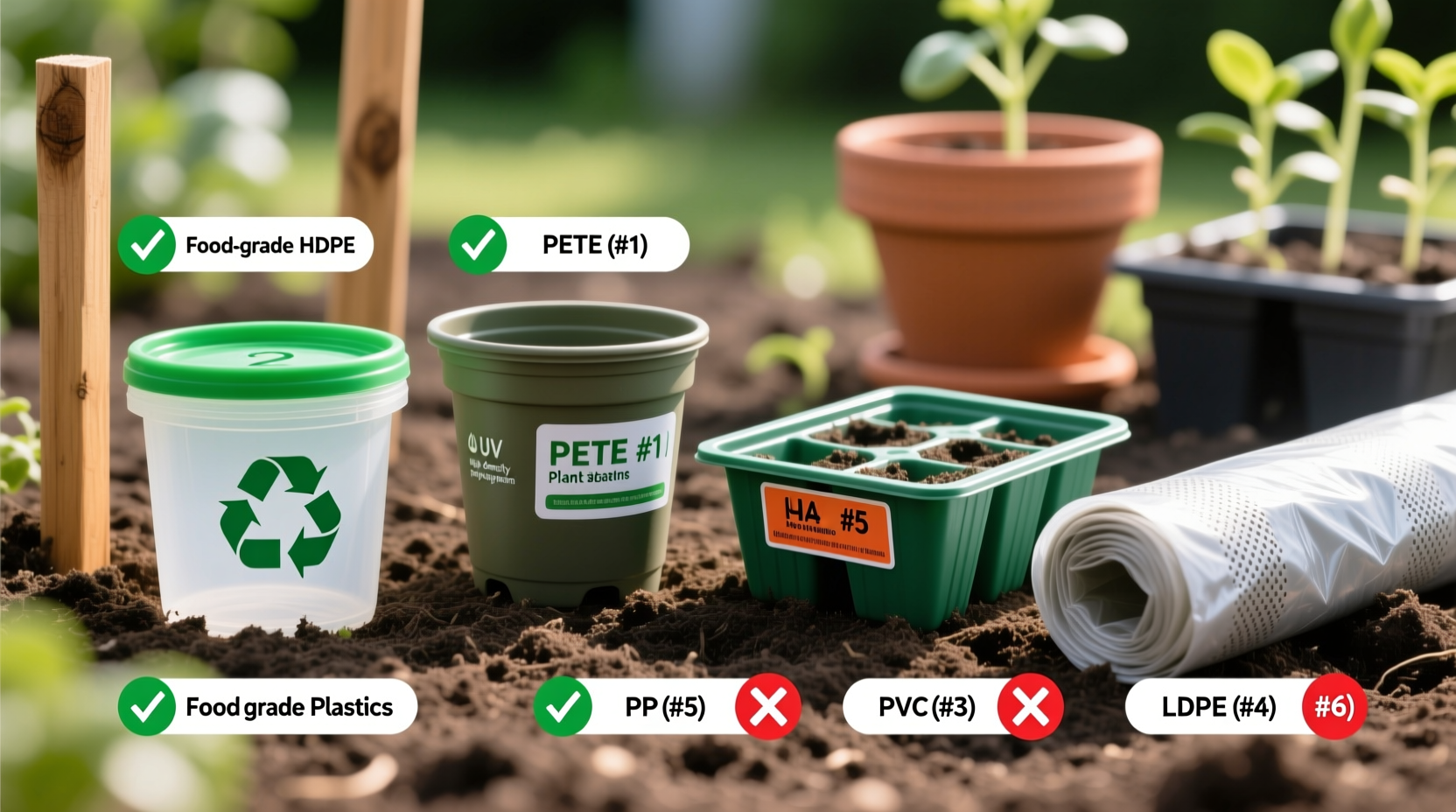
The triangular “chasing arrows” symbol with a number inside (1–7) is the Resin Identification Code (RIC), developed by the Society of the Plastics Industry—not a recycling guarantee. In gardening contexts, it’s your first line of chemical triage. Here’s what each code means for soil and plant safety:
- #1 PET (Polyethylene Terephthalate): Common in soda bottles and salad clamshells. Not safe for long-term gardening use. Degrades under UV light and heat; acetaldehyde and antimony leach into moist substrates. Never repurpose PET bottles as self-watering planters or hydroponic reservoirs.
- #2 HDPE (High-Density Polyethylene): Milk jugs, nursery pots, irrigation tubing. Safe for gardening when virgin and unpigmented. Highly resistant to acids, alkalis, and UV (especially with carbon-black stabilization). Look for “FDA-compliant” or “food-contact approved” labeling.
- #3 PVC (Polyvinyl Chloride): Vinyl fencing, clear greenhouse film, some hose reels. Avoid entirely for soil contact. Contains plasticizers (e.g., DEHP, DINP) and heavy metal stabilizers (lead, cadmium) that migrate readily—especially above 25°C (77°F).
- #4 LDPE (Low-Density Polyethylene): Bread bags, squeeze bottles, silage wrap, black plastic mulch. Conditionally safe—if virgin, thick (≥0.8 mil), and UV-stabilized. Thin LDPE mulch (<0.5 mil) degrades rapidly, fragmenting into microplastics within 6–8 weeks. Prefer biodegradable alternatives like PLA-blend mulch certified to ASTM D6400.
- #5 PP (Polypropylene): Yogurt tubs, seed starter cells, woven ground cover fabric. Excellent choice for containers and root pruning pots. High melting point (160°C), low leaching potential, and excellent resistance to rot and mold. Ensure no dye or slip agents are added for horticultural use.
- #6 PS (Polystyrene): Foam packing peanuts, disposable takeout containers, cheap seed trays. Unsafe for any soil application. Styrene monomer—a probable human carcinogen—leaches in warm, moist conditions. Breaks down into persistent microbeads.
- #7 Other (including polycarbonate, acrylic, bioplastics): Highly variable. Assume unsafe unless explicitly certified. Polycarbonate (#7 PC) may contain bisphenol-A (BPA); many “compostable” PLA products require industrial facilities (>60°C, 90% humidity) to degrade—and leave behind microplastic residues if buried in home soil.
Crucially: RIC alone doesn’t guarantee safety. A #2 HDPE pot made from 100% post-consumer recycled plastic may contain trace contaminants from prior uses (e.g., motor oil residue, pesticide containers). For edible gardening, always specify “virgin HDPE” or “food-grade PP.” Reputable suppliers like Bootstrap Farmer, Grower’s Solution, and Johnny’s Selected Seeds label these clearly.
Common Garden Plastics—Rated for Safety and Performance
Let’s move beyond codes to real-world applications. Here’s how everyday garden plastics stack up—not just for safety, but for longevity, functionality, and ecological impact:
| Item | Safer Options | Risks to Avoid | Pro Tip |
|---|---|---|---|
| Raised bed liners | Virgin HDPE pond liner (20–30 mil), food-grade PP geotextile | PVC pond liners, painted pressure-treated wood liners | Line only if using reclaimed railroad ties or CCA-treated lumber—never as a routine barrier. Unlined cedar or stone beds are safer overall. |
| Irrigation tubing | UV-stabilized HDPE drip line (e.g., Netafim Techline CV), FDA-grade LDPE soaker hose | PVC soaker hoses, vinyl-coated sprinkler risers | Flush new HDPE tubing with water for 15 minutes before connecting to edible crops to remove manufacturing lubricants. |
| Mulch films | Thick (1.25 mil) UV-stabilized LDPE (for season-long use), certified compostable mulch (TUV OK Compost HOME) | Thin black plastic (0.3–0.5 mil), colored mulches with unknown pigments | Remove LDPE mulch before tilling—do not bury. Compostable mulch must be turned into soil only after full fragmentation (check product specs for soil-burial timelines). |
| Seed starting trays | Virgin PP trays (e.g., Hummingbird Horticubes), rice hull pots, coir discs | Recycled PS trays, brittle #6 foam inserts | Wash PP trays in 10% vinegar solution between uses—no bleach—to preserve integrity and avoid biofilm buildup. |
| Greenhouse glazing | Polycarbonate twin-wall panels (BPA-free grade), UV-stabilized HDPE greenhouse film | PVC greenhouse plastic, old acrylic sheets with yellowing inhibitors | Replace polyethylene greenhouse film every 2–3 years—even if intact—to prevent additive leaching from prolonged UV exposure. |
When “Safe” Isn’t Enough: Heat, UV, and Soil Chemistry Amplifiers
A plastic labeled “food-safe” may become hazardous in your specific garden environment. Three key stressors dramatically accelerate leaching:
- Temperature: PVC leaching increases exponentially above 25°C. A black PVC irrigation pipe in full sun can reach 65°C (149°F)—triggering rapid phthalate migration. HDPE remains stable below 80°C; PP withstands up to 100°C.
- Ultraviolet Radiation: UV breaks polymer chains, freeing additives. Unstabilized LDPE mulch loses 40% of its tensile strength in 30 days of summer sun. Always choose UV-inhibited grades—look for “UV 1000+ hours” or “3-year UV warranty” on spec sheets.
- Soil pH and Organic Acids: Acidic soils (pH <5.5) and decomposing compost increase metal leaching from pigment carriers and stabilizers. Tomato roots exude organic acids that enhance uptake of leached cadmium from PVC-coated stakes. Neutral to slightly alkaline soils (pH 6.2–7.0) reduce this risk significantly.
Practical mitigation: Elevate plastic containers off hot pavement or concrete; shade irrigation lines with mulch or landscape fabric; test your soil pH annually with a calibrated meter (not strips); and rotate plastic use—replace mulch yearly, drip lines every 5 years, and trays every 3–4 seasons.
Beyond the Bin: Safer Alternatives and Smart Substitutions
Plastic isn’t mandatory—even for high-functionality needs. Consider these proven, scalable alternatives:
- For containers: Unglazed terracotta (ensure frost-resistant clay), food-grade stainless steel stock tanks (304 or 316 grade), or FSC-certified cedar half-barrels. Avoid treated pine unless stamped “micronized copper azole (MCA)” —older CCA (chromated copper arsenate) remains hazardous.
- For mulch: 3–4 inches of arborist wood chips (not dyed), shredded native bark, or straw (weed-seed free). These feed soil life, improve structure, and break down without residue. Avoid cocoa bean hulls if you have dogs—they contain theobromine.
- For irrigation: Copper tubing (naturally antimicrobial, inert in soil), braided stainless steel hoses (with lead-free brass fittings), or gravity-fed clay ollas buried beside plants.
- For seed starting: Cow manure pots (certified pathogen-free), bamboo fiber trays, or folded newspaper pots (use black-and-white newsprint only—avoid colored ink).
None are perfect—clay dries fast, wood chips attract slugs, ollas require refilling—but they eliminate polymer-related risks entirely. Prioritize substitution where exposure is highest: root zones of leafy greens, herbs, and berries.
Red Flags: 5 Plastic Practices to Stop Immediately
These common habits expose your garden—and your family—to unnecessary risk:
- Using black plastic trash bags as raised bed liners. Most municipal trash bags are #4 LDPE but contain heavy-duty slip agents and unknown pigments. They’re not formulated for soil contact—and often include zinc stearate, which accumulates in roots.
- Cutting up PVC pipes for edging or trellises. Sawing releases airborne PVC dust containing lead and phthalates. Even intact pieces leach when heated. Use galvanized steel, bamboo, or recycled HDPE edging instead.
- Reusing yogurt cups (#5 PP) without verification. Many “yogurt cups” are actually polypropylene copolymer blends with slip additives banned for food contact in the EU. Check the bottom stamp: “PP 5” alone isn’t enough—look for “FDA 21 CFR 177.1520” compliance.
- Applying plastic mulch over compost-rich soil without testing. High microbial activity + warm temps + acidic compost = accelerated plastic breakdown. Test soil pH and EC (electrical conductivity) before laying any synthetic mulch.
- Storing liquid fertilizer or compost tea in PET (#1) or PVC (#3) containers. Organic acids and salts catalyze leaching. Use HDPE carboys (labeled “UN-certified for corrosives”) or glass carboys with polypropylene lids.
How to Verify Safety: Labels, Certifications, and Supplier Questions
Don’t trust marketing terms like “eco-friendly,” “green,” or “non-toxic”—they’re unregulated. Demand verifiable proof:
- Ask suppliers for the Material Safety Data Sheet (MSDS) or Safety Data Sheet (SDS). Legitimate manufacturers provide them freely. Review Section 3 (Composition) for restricted substances (REACH SVHC list, California Prop 65 chemicals).
- Look for third-party certifications: NSF/ANSI Standard 61 (drinking water system components), FDA 21 CFR 177.1520 (PP), or ISO 10993-5 (biocompatibility testing). “BPA-free” is meaningless unless paired with broader certification.
- Check for lot numbers and manufacturing dates. Plastics degrade in storage. A 5-year-old HDPE reel may have lost 30% of its UV inhibitors. Prefer products manufactured within 18 months.
- Test pigments yourself. Soak a 1-inch square of colored plastic in distilled white vinegar for 72 hours at 35°C (95°F). If the vinegar discolors or develops an oily sheen, the pigment contains leachable heavy metals or plasticizers—discard immediately.
Frequently Asked Questions
Can I use PVC pipes for a vertical strawberry tower?
No. PVC poses unacceptable leaching risks for edible crops, especially shallow-rooted strawberries that absorb surface moisture and warmth. Use food-grade HDPE irrigation columns or untreated cedar posts with stainless steel mesh instead.
Are “biodegradable” plastic plant pots really safe?
Only if certified to ASTM D6400 or EN 13432 for industrial composting—or TUV OK Compost HOME for backyard conditions. Many “plantable pots” are just thin PE with starch filler; they fragment but don’t mineralize, leaving microplastics. Always verify certification logos—not marketing claims.
Is recycled HDPE safe for vegetable containers?
Virgin HDPE is strongly preferred. Recycled HDPE may contain trace contaminants from prior uses (e.g., motor oil, pesticides, cleaning solvents). If using recycled, confirm the feedstock source and request heavy metal assay reports from the supplier.
Does UV-stabilized plastic eliminate all leaching risk?
No—it only slows polymer degradation. Stabilizers (like HALS or carbon black) protect the plastic backbone but don’t bind plasticizers or pigments. Leaching of additives continues, albeit at lower rates. UV stability ≠ chemical inertness.
What’s the safest plastic for aquaponics or hydroponics?
Virgin, opaque HDPE (code #2) or PP (code #5), certified to NSF/ANSI 61. Avoid clear plastics—UV light promotes algae growth *and* accelerates additive migration. Never use PVC, PET, or polycarbonate in recirculating water systems.
Choosing safe plastics isn’t about perfection—it’s about informed prioritization. Every garden has constraints: space, budget, climate, mobility. But when it comes to what touches your soil, your food, and your children’s hands, uncertainty isn’t an option. Start small: replace your PVC soaker hose this season. Swap out that brittle PS seed tray. Verify the resin code on your next bag of mulch. These actions compound—building resilience not just in your plants, but in your entire growing ecosystem. Because safe gardening isn’t a luxury. It’s the quiet foundation beneath every tomato, basil leaf, and sun-warmed strawberry you’ll ever harvest.
Remember: The safest plastic is the one you don’t need. The next safest is the one you’ve verified—by code, by certification, and by chemistry. Choose deliberately. Grow confidently.




 浙公网安备
33010002000092号
 浙B2-20120091-4