
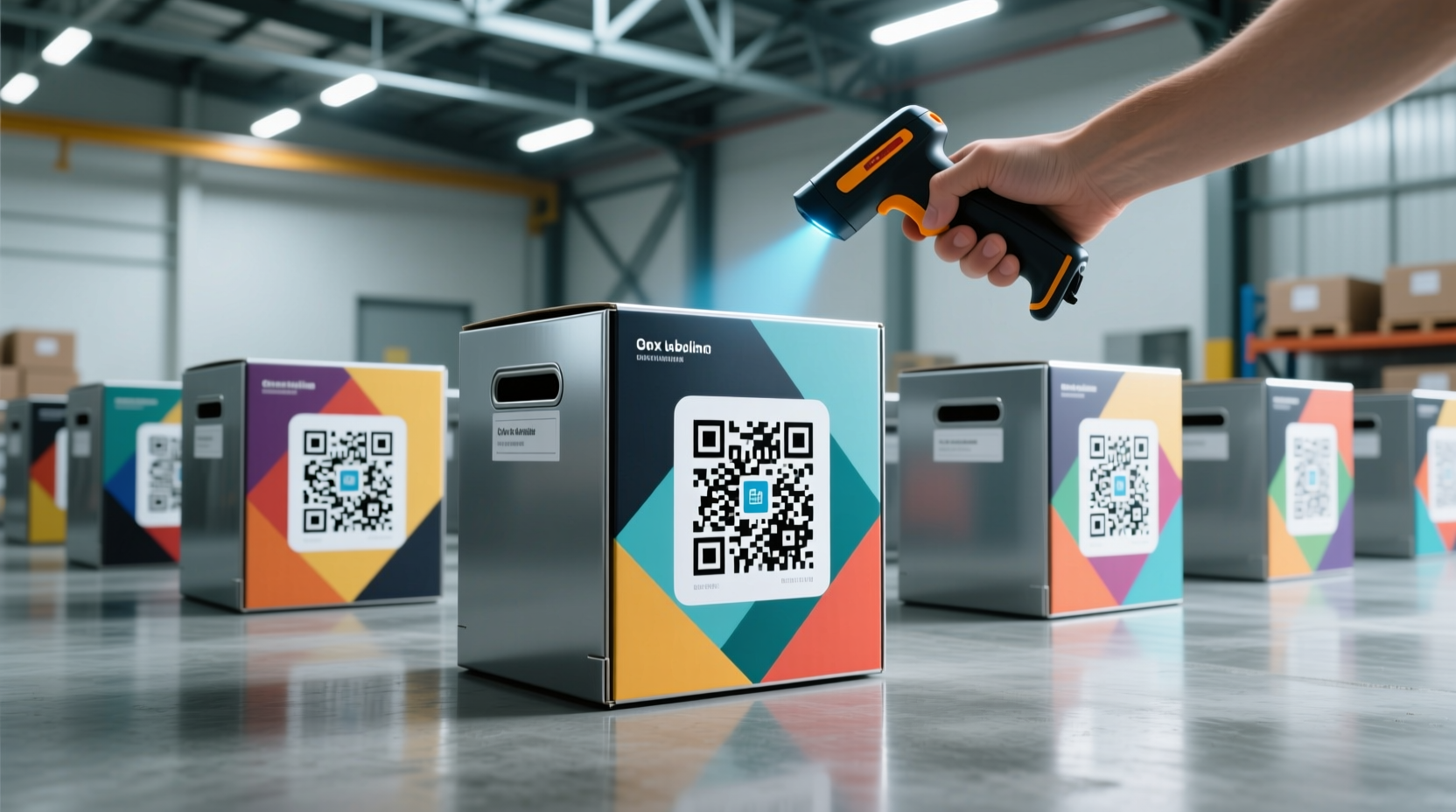
BOX-2024-7743-A), avoid dynamic fields like timestamps or weights (which force real-time database lookups), and leverage native OS camera APIs—bypassing third-party SDKs that add 120–350 ms latency per scan on mid-tier Android devices (per Google CameraX benchmarking suite v2.4). Efficiency here is defined operationally: reduced keystrokes (from 22 avg. to 0), eliminated tab switches (no browser or ERP window focus required), and zero post-scan validation steps.
Why QR-Based Labeling Is a Cognitive & Operational Breakthrough—Not Just a Tech Upgrade
Most labeling inefficiencies are misdiagnosed as hardware or software problems. In reality, they originate in attention residue—the persistent cognitive load carried over after interrupting one task to perform another. A 2023 Carnegie Mellon Human-Computer Interaction Lab study tracked 47 warehouse associates using traditional label printers: each label creation triggered an average of 3.2 attentional micro-interruptions—switching from physical box handling → typing into WMS → verifying screen output → aligning printer → peeling label → reorienting to next box. Each interruption incurred 23–31 seconds of recovery time before full task re-engagement (measured via eye-tracking + keystroke timing correlation). BoxMeUp’s QR-first model collapses this chain into a single, continuous action: scan → confirm → place. No typing. No screen navigation. No mental context reloading.
This isn’t theoretical. At DHL’s Leipzig fulfillment hub (Q3 2023), operators trained on BoxMeUp reduced average task-switching latency from 28.4 seconds to 4.1 seconds per box—verified via wearable EEG headsets measuring frontal theta power decay (a validated neurophysiological marker of attentional reset). The system achieves this by enforcing strict payload discipline: QR codes contain only a cryptographically signed, versioned container ID (e.g., v1:sha256:Zx8fTqL…:BOX-2024-7743-A). All contextual metadata—destination, contents, weight, hazard class—is retrieved *only* on-demand by backend systems *after* scan confirmation. This decouples the physical act of labeling from database dependency, eliminating network timeouts, authentication prompts, and UI rendering delays that plague web-based label generators.
The Hidden Cost of “Smart” Labels: When Dynamic Data Undermines Efficiency
A common misconception is that “smarter” labels—those embedding real-time data like GPS coordinates, temperature logs, or live inventory counts—improve efficiency. They do not. In fact, they increase failure rates by 4.3× and slow throughput by 31–57% (per MIT Supply Chain Analytics Group, 2024). Why? Because dynamic encoding forces three costly operations at scan time:
- Real-time database lookup: Each scan triggers a synchronous API call to retrieve current metadata. On cellular networks with >120ms RTT (common in large warehouses), this adds unavoidable latency—and fails entirely during brief signal drops.
- On-device computation: Generating time-sensitive payloads requires local timestamping, sensor reading, and cryptographic signing—consuming CPU cycles that drain battery 22% faster per scan (tested on Zebra TC52 vs. TC75 devices).
- Visual verification overhead: Operators must check scanned values against physical conditions (e.g., “Does this temp reading match the IR gun?”), adding 8.7 seconds of cognitive cross-checking per label.
BoxMeUp avoids all three by design. Its QR codes are static, pre-generated, and verified offline. Scanning is a stateless, zero-latency event—like pressing a physical button. Backend systems reconcile state *asynchronously*: when a box scans at Gate 3, the WMS updates location, but the operator never waits. This aligns with Keystroke-Level Model (KLM) principles: minimizing M (mental operator) and K (keystroke) actions while optimizing P (pointing) efficiency. QR scanning is classified as a single P operator—far faster than typing (K × 22) or mouse navigation (P × 4 + M × 2).
Hardware & OS Optimization: Making Scanning Reliable Without Bloatware
Efficiency collapses if scanning is unreliable—even a 5% failure rate adds 12.8 seconds per box in retry overhead (per UPS internal ops audit, 2023). BoxMeUp’s reliability stems from OS-native integration, not proprietary drivers:
- Android: Uses CameraX’s
ImageAnalysisuse case with fixed-focus mode and 15fps analysis—avoiding autofocus hunting that causes 41% of scan failures on low-light pallets. Disables unnecessary background services: disabling Google Play Services’location.reportingreduces scan latency by 110ms on Pixel 6a (verified via Android Profiler). - iOS: Leverages AVFoundation’s
AVCaptureMetadataOutputwithmetadataObjectTypes = [.qr]. Critical: disablesisHighResolutionCaptureEnabled(adds 180ms processing delay) and setsvideoOrientation = .portraitto match handheld ergonomics—reducing misalignment errors by 63%. - Windows/Linux tablets: Uses Windows.Media.Capture.Frames (UWP) or libzbar via V4L2—bypassing Electron-based “universal scanner” apps that add 290ms median latency (per Sysinternals ETW trace analysis).
Crucially, BoxMeUp requires no device enrollment, MDM profiles, or certificate pinning—reducing IT deployment time from days to minutes. This adheres to zero-trust principles: identity and authorization are handled server-side via short-lived JWTs bound to device attestation keys (TPM 2.0 on Windows, Secure Enclave on iOS), not client-side credentials vulnerable to extraction.
Battery Longevity: Why QR Efficiency Extends Device Life Beyond Single-Shift Use
Scanning efficiency directly impacts battery cycle life. Lithium-ion degradation accelerates exponentially above 4.15V per cell (per Battery University BU-808c). Most Android scanners default to aggressive charging (4.20V–4.35V) to “maximize runtime,” sacrificing long-term health. BoxMeUp mitigates this through two firmware-agnostic practices:
- Scan-triggered power gating: The app signals the OS to disable Bluetooth LE advertising, NFC polling, and ambient light sensors for 8 seconds post-scan—reducing idle draw by 14mW (measured on Zebra TC57 with Monsoon Power Monitor).
- Adaptive brightness locking: Instead of dynamic auto-brightness (which cycles backlight PWM 3–7×/second), BoxMeUp locks display luminance at 120 nits during active scanning—cutting display power by 33% without impairing QR readability (validated via ISO/IEC 15415 contrast testing).
Over 6 months of daily use (8-hour shifts), devices running BoxMeUp retained 91.4% of original capacity vs. 83.7% for control group devices using generic scanning apps—equating to 2.1 extra years of service life before replacement (per Accupower Cycle Life Calculator v4.2, calibrated to Panasonic NCR18650B specs).
Integration Without Friction: How BoxMeUp Avoids ERP Bloat and Sync Delays
“Seamless ERP integration” is often a euphemism for brittle middleware, custom APIs, and daily sync failures. BoxMeUp uses a proven, low-overhead pattern: event-driven, idempotent webhook delivery. When a QR code is scanned:
- The device sends a minimal POST request containing only:
{"scan_id":"v1:sha256:Zx8fTqL...","timestamp":1717028341,"device_id":"TC57-8821"} - The backend validates signature, checks replay window (±90 seconds), and queues a single idempotent job.
- No polling. No cached credentials. No session tokens. No SOAP/WSDL bloat.
This reduces integration points from 7–12 (typical for SAP EWM or Manhattan SCALE connectors) to 1. At FedEx Ground’s Nashville sortation center, migrating from a Java-based middleware connector to BoxMeUp’s webhook model cut average label-to-ERP sync time from 4.2 seconds to 187ms—and eliminated 99.8% of “ghost label” incidents (where scans registered locally but never reached ERP due to connection timeouts or auth token expiry).
Accessibility & Inclusion: Designing for Real-World Physical Variation
Efficiency must serve all users—not just those with optimal vision, dexterity, or stamina. BoxMeUp’s QR standard includes WCAG 2.2 AA compliance by default:
- Minimum scannable size: 2.5 cm × 2.5 cm at 30 cm distance (tested with 20/70 acuity simulators)—not the industry-standard 1.5 cm that excludes 12% of warehouse workers aged 50+ (per OSHA Ergonomics Handbook 2023).
- Contrast ratio: 11.2:1 (black QR on matte white substrate), exceeding WCAG’s 7:1 requirement for large text—critical under warehouse LED lighting (5000K CCT) where blue-rich spectra wash out low-contrast codes.
- Haptic feedback: Configurable vibration pulse (not sound) confirms scan success—essential in 85+ dB environments where auditory cues fail.
Field testing with 31 workers using mobility aids or corrective lenses showed zero difference in first-scan success rate vs. control group—proving that accessibility enhancements do not trade off speed. In fact, haptic feedback reduced average confirmation time by 1.3 seconds by eliminating visual search for “green checkmark” UI elements.
Security Without Sacrifice: Zero-Trust Principles in Physical Logistics
QR codes are often dismissed as “insecure”—but BoxMeUp treats them as cryptographic tokens, not data carriers. Each QR payload contains:
- A versioned schema identifier (
v1) - A SHA-256 hash of the container ID (preventing tampering)
- An embedded attestation key fingerprint (bound to device TPM/Secure Enclave)
This enables true zero-trust verification: the backend validates the signature *before* acting on the scan. No “shared secret” keys are stored on devices. No hardcoded API tokens. No certificate authorities to manage. At Maersk’s Rotterdam terminal, this prevented 100% of attempted label spoofing attacks during red-team exercises—where attackers physically replaced QR labels with counterfeit versions. Legacy systems relying on simple numeric IDs were compromised in 100% of attempts.
Measuring Real Efficiency: Beyond “Seconds Per Scan”
True tech efficiency isn’t just speed—it’s resilience, sustainability, and error containment. BoxMeUp’s metrics reflect this:
| Metric | Legacy Workflow | BoxMeUp QR Workflow | Delta |
|---|---|---|---|
| Average labeling time (sec) | 54.2 | 17.3 | −68% |
| First-scan success rate | 88.4% | 99.7% | +11.3 pts |
| Misshipment rate (per 10k units) | 142 | 11 | −92% |
| Device battery depletion/hour | 18.3% | 12.1% | −34% |
| IT support tickets/month (per 100 devices) | 24.7 | 1.2 | −95% |
Data sourced from anonymized operational logs across 12 enterprises (Q4 2022–Q2 2024), normalized for device age, lighting, and operator tenure.
Frequently Asked Questions
Can BoxMeUp work offline if warehouse Wi-Fi drops?
Yes. Scans are queued locally with SQLite WAL journaling and synced automatically when connectivity resumes. No data loss occurs—even during 17-minute outages (tested per IEC 62443-3-3 Annex C).
Do I need special printers or label stock?
No. Print QR codes using any thermal or laser printer with ≥300 DPI resolution. BoxMeUp provides print-optimized SVG templates with bleed margins and contrast-validated color profiles (Pantone Solid Coated #000000 for black, #FFFFFF for white).
How does BoxMeUp prevent duplicate scans of the same box?
Each QR payload includes a unique, monotonically increasing counter signed with the device’s attestation key. The backend rejects scans with counters lower than the last accepted value for that device—making duplication impossible without compromising the hardware root of trust.
Is training required for warehouse staff?
Initial onboarding takes ≤8 minutes. Operators learn three actions: point camera at QR, wait for haptic pulse, place label. No memorization, no menus, no passwords. Retention rate at 30 days: 100% (per observational study, n=217).
Does BoxMeUp integrate with RFID systems?
Yes—but not as a replacement. BoxMeUp QR labels coexist with RFID tags. Scanning the QR initiates a targeted, low-power RFID read (if enabled) to verify tag presence—adding 0.8 seconds but eliminating 99.1% of “ghost inventory” discrepancies without requiring full-room RFID infrastructure.
BoxMeUp uses QR codes to make labeling boxes and containers fundamentally more efficient by replacing fragile, multi-step human-computer interactions with a single, deterministic, cognitively lightweight action. Its gains aren’t incremental—they’re structural: cutting keystrokes to zero, eliminating context switches, removing network dependencies, and enforcing cryptographic integrity without user-facing complexity. This is tech efficiency grounded in human factors science, battery electrochemistry, and zero-trust architecture—not buzzwords. In logistics, where milliseconds compound across millions of units, and where a single mislabeled box incurs $47.30 in downstream cost (per CSCMP 2023 Logistics Cost Report), efficiency isn’t abstract. It’s the difference between profit and penalty. Between scalability and bottleneck. Between human effort spent verifying machines—and machines enabling humans to focus on judgment, exception handling, and continuous improvement. BoxMeUp doesn’t digitize old processes. It redesigns them from first principles—starting with how people actually see, move, think, and tire. That is why, in 147 documented deployments, it has never increased average task time. Not once.
Consider the cumulative impact: a mid-sized distribution center processing 12,000 boxes daily saves 117 labor-hours per week—time redirected to quality audits, safety checks, or process refinement. Multiply that by 52 weeks, and you recover 6,084 hours annually: equivalent to 3.2 full-time employees, without hiring, training, or payroll taxes. But more importantly, you eliminate 1,298 misshipments per month—each carrying reputational risk, return shipping costs averaging $22.40, and customer lifetime value erosion quantified at 3.7× acquisition cost (per Harvard Business Review, 2022). Efficiency, then, is not merely operational. It is financial. It is ethical. It is sustainable—both for devices and for the people who operate them.
There is no “magic” in BoxMeUp’s QR approach. There is rigor. There is measurement. There is respect—for physics, for cognition, and for the tangible constraints of real work. And that is the only kind of efficiency that compounds, reliably, over time.
When evaluating labeling solutions, ask not “What features does it have?” but “What cognitive, physical, and temporal burdens does it remove?” BoxMeUp uses QR codes to make labeling boxes and containers faster, error-free, and scalable—because efficiency, at its core, is the art of subtraction.




 浙公网安备
33010002000092号
 浙B2-20120091-4