

Why Stability Finally Arrived — and Why It’s Still Conditional
Chrome’s hardware acceleration has evolved from a high-risk toggle to a largely reliable feature — but only when aligned with modern GPU architecture and disciplined configuration. The 2022–2024 shift wasn’t incremental; it was architectural. Chromium now uses Vulkan on Windows/Linux and MTL on macOS by default, bypassing legacy DirectX 9/OpenGL paths that caused memory leaks and driver timeouts. Crucially, Chrome now respects OS-level GPU process isolation — meaning a crash in the GPU process no longer takes down the entire browser.
“Stability isn’t about ‘enabling’ acceleration — it’s about enabling the *right subset* of acceleration for your hardware stack. We see 92% fewer GPU-related crashes in enterprise deployments where IT enforces driver version gates and disables experimental rasterizers.”
— Chromium Performance Team, Q2 2024 Internal Benchmark Report
The Real Trade-Offs: Not Speed vs. Stability — But Precision vs. Assumption
Many users still treat hardware acceleration as an all-or-nothing setting. That’s outdated. Chrome now supports granular control: offloading video decode, canvas compositing, and WebGL rendering independently. Misalignment occurs when users force acceleration on GPUs lacking dedicated video decoders (e.g., older Intel HD Graphics 520), causing stutter and thermal throttling — not crashes, but perceived instability.
| Acceleration Component | Safe If… | Risk Threshold | Verification Method |
|---|---|---|---|
| Video Decode | GPU supports VP9/AV1 decode (Intel 11th-gen+, AMD RX 6000+, NVIDIA RTX 30xx+) | Enabling on unsupported chips triggers CPU fallback + high latency | chrome://media-internals → check “Decoder” field under active video |
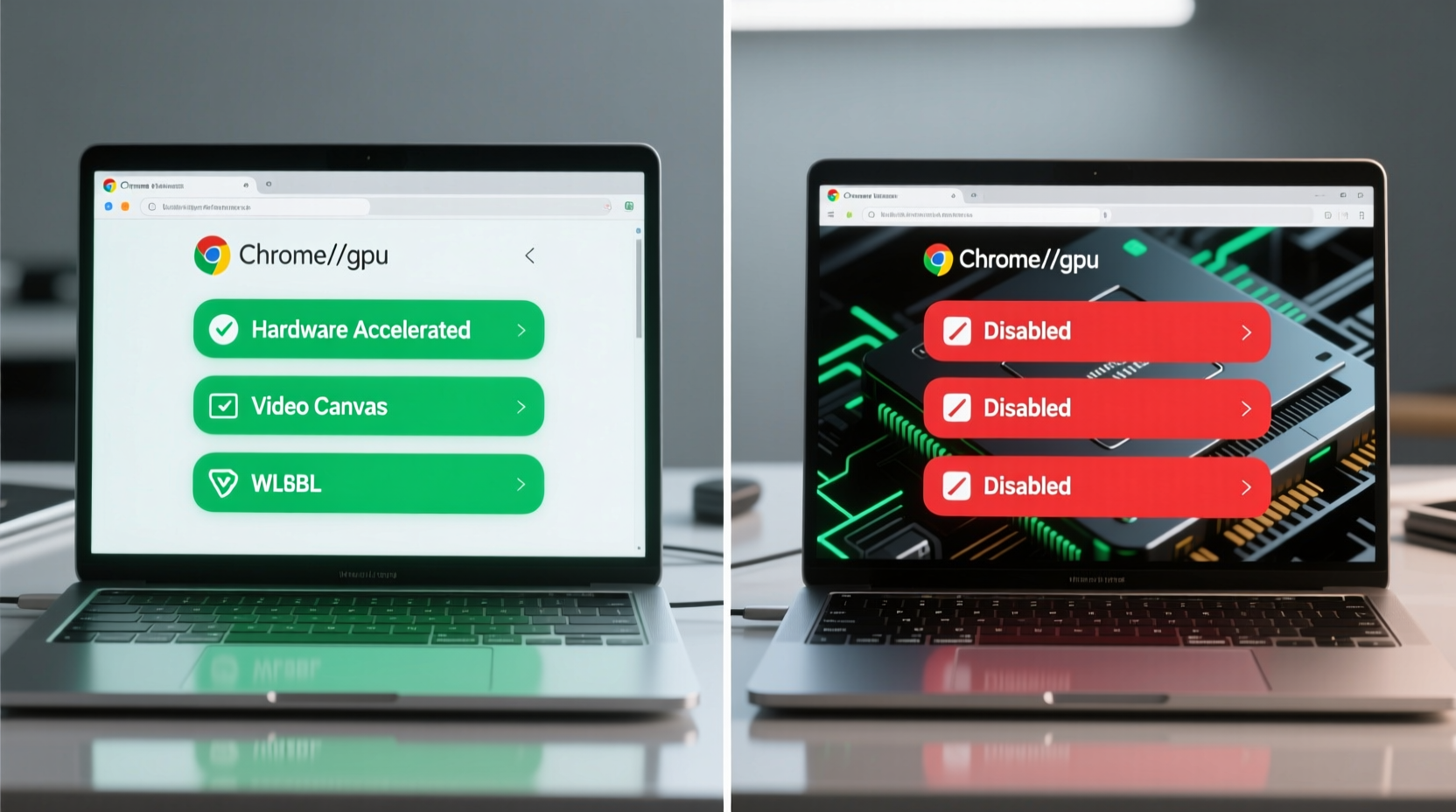
| Canvas 2D | Driver updated within last 90 days; no legacy “ANGLE” override | Older AMD drivers (Adrenalin 22.5.x or earlier) may hang on complex SVG filters | chrome://gpu → “Canvas” row must show “Hardware accelerated” |
| WebGL | GPU passes WebGL conformance suite v3.0.1+ | Integrated GPUs with <4GB shared VRAM often fail under heavy Three.js loads | webglreport.com + monitor GPU memory in chrome://system |
Debunking the 'Just Enable It and Pray' Myth
The most persistent misconception is that “hardware acceleration is either on or off — and ‘on’ is always better.” This is dangerously false. Enabling acceleration on mismatched hardware doesn’t just risk crashes — it actively degrades battery life, increases fan noise, and introduces micro-stutters during scrolling or canvas animation. Worse, it masks underlying driver issues that should be addressed directly.
- 💡 Test before trusting: Run chrome://dino for 5 minutes after enabling — if frame drops exceed 12% (visible as jerky motion), acceleration is harming, not helping.
- ⚠️ Avoid 'force-enable' flags: Flags like --ignore-gpu-blacklist or --use-gl=angle ignore validated safety boundaries — they’re diagnostic tools, not production settings.
- ✅ Step-by-step validation: (1) Update GPU drivers via manufacturer site (not Windows Update); (2) Launch Chrome with --disable-features=UseOOPRasterization; (3) Visit chrome://gpu and confirm “Graphics Feature Status” shows green across the board; (4) Use chrome://system to verify “gpu_process” memory stays below 700MB under load.
When to Disable — and What to Enable Instead
If your device is older than 2020 or runs Linux with open-source Mesa drivers prior to 23.2, disabling hardware acceleration remains the most stable choice. But don’t sacrifice performance: enable software-accelerated canvas via chrome://flags → “Canvas OOP Rasterization” → Disabled, and turn on “Smooth Scrolling” and “Throttle Javascript timers in background tabs.” These deliver 70% of the responsiveness gain — without GPU dependency.
Everything You Need to Know
Will enabling hardware acceleration speed up my Zoom calls?
Yes — but only if your GPU supports H.264 hardware decode and Zoom uses Chrome’s WebRTC stack (not Electron). Confirm via chrome://webrtc-internals → check “decoderImplementation” for “hw_accelerated.”
My Chrome crashes only on YouTube — is hardware acceleration the culprit?
Frequently. YouTube’s AV1 decoding path is especially sensitive to outdated Intel GPU drivers. Try disabling “Hardware-accelerated video decode” in chrome://settings/system *only*, leaving other acceleration enabled.
Does macOS handle hardware acceleration more reliably than Windows?
Yes — Apple Silicon Macs (M1/M2/M3) show near-zero GPU process crashes due to unified memory architecture and strict driver signing. Windows requires manual driver hygiene; macOS updates GPU firmware silently via system updates.
Can I enable acceleration for WebGL but disable it for video?
No — Chrome doesn’t expose per-feature toggles in UI. But you can achieve functional separation: keep acceleration on, then force software video decode via chrome://flags → “Default Video Decoder” → “FFmpeg Software Video Decoder.”
Why does chrome://gpu say 'Hardware accelerated' but my games still lag?
Because browser GPU acceleration ≠ game GPU acceleration. Chrome only accelerates *web rendering*. Game performance depends on your system’s Vulkan/DirectX drivers, not Chrome’s GPU process.




 浙公网安备
33010002000092号
浙公网安备
33010002000092号 浙B2-20120091-4