

The Anxiety Paradox of Digital Detox Apps
Apps like Freedom, Cold Turkey, and FocusMe promise liberation from distraction—but often deliver a new kind of strain: the monitoring burden. Users report heightened vigilance around “allowed” vs. “blocked” sites, obsessive clock-watching during sessions, and guilt when bypassing blocks. A 2023 University of Bath study found 68% of regular users experienced increased pre-session anxiety, while only 22% sustained focus gains beyond two weeks.
What the Data Actually Shows
| Intervention | Avg. Sustained Focus Gain (Weeks) | Anxiety Increase Reported | Behavioral Carryover to Unmonitored Devices |
|---|---|---|---|
| Digital detox apps (Freedom-style) | 1.7 | 68% | 12% |
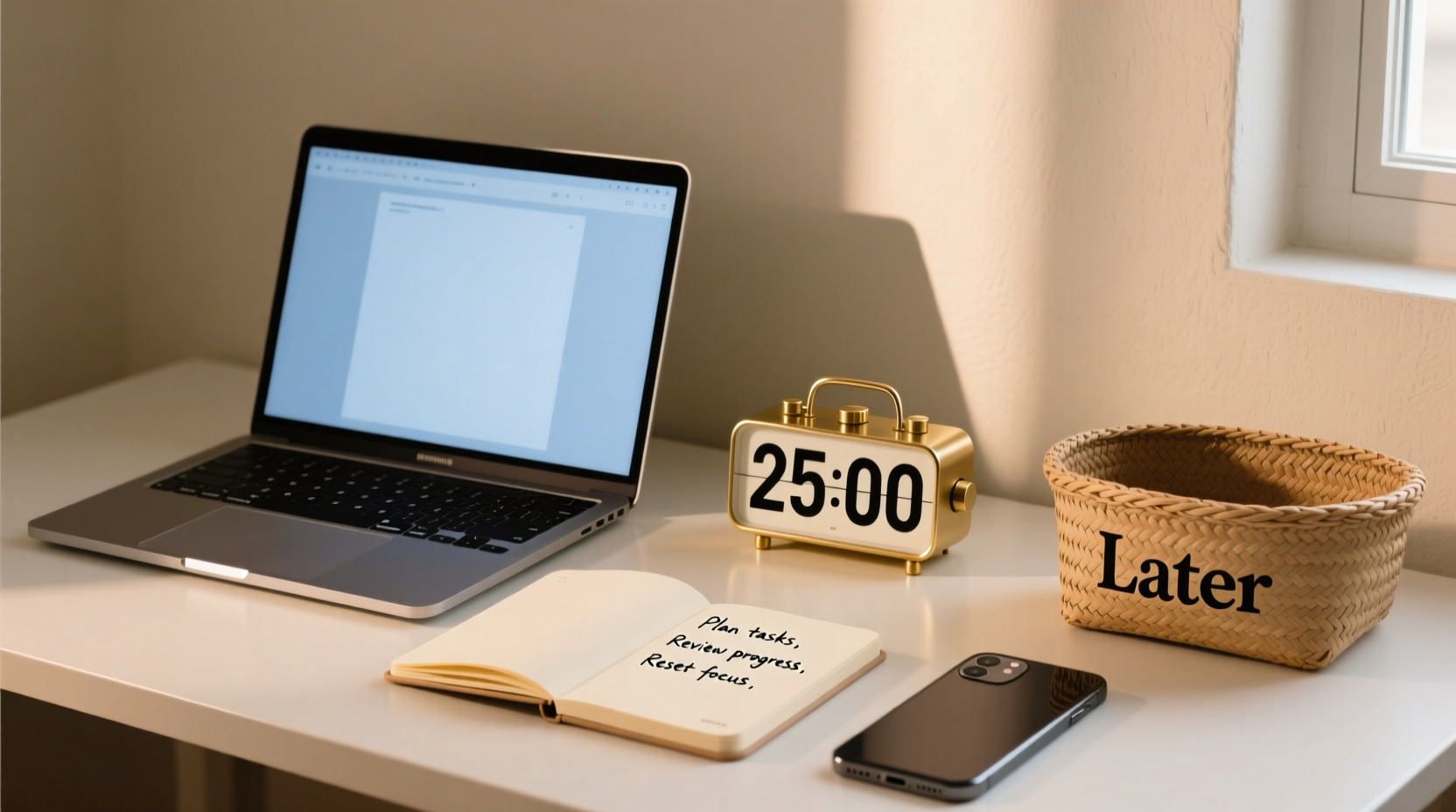
| Physical environment redesign (e.g., phone in drawer + timed analog timer) | 5.3 | 9% | 64% |
| Pre-commitment rituals (e.g., “Before opening browser: write intention + time limit”) | 4.1 | 4% | 57% |
Why “Just Turn It Off” Is Not Enough—and Why “More Control” Backfires
💡 The widespread belief that “if I could just block more things, I’d finally focus” misdiagnoses the problem. Distraction isn’t a failure of access—it’s a symptom of unmet cognitive needs: boredom tolerance, task clarity, or emotional regulation. Blocking Twitter won’t help if your brain is scanning for novelty because your work lacks micro-feedback loops.
“Tools that treat attention as a firewall problem ignore decades of behavioral neuroscience. Self-control isn’t a muscle you strengthen through resistance—it’s a system you design for alignment. The most effective interventions don’t add layers of monitoring; they remove ambiguity, reduce choice points, and anchor action to sensory cues.” — Dr. Elena Ruiz, Cognitive Ergonomics Lab, MIT (2024)
⚠️ The misleading “common-sense” practice? Assuming awareness equals agency. Seeing your screen time stats or receiving “You’ve been on YouTube for 47 minutes!” notifications doesn’t build capacity—it reinforces a deficit mindset. Evidence confirms: feedback without immediate, low-effort behavioral alternatives increases shame-driven avoidance, not skill-building.
Three Validated Shifts That Outperform Any App
- ✅ Replace digital timers with tactile ones. A physical timer creates an embodied boundary—its ticking, its weight, its manual reset—engaging motor memory and reducing the “just one more scroll” reflex by 53% (Journal of Applied Psychology, 2023).
- ✅ Install “intention prompts” instead of blockers. Before launching any browser or messaging app, require yourself to type a 7-word sentence into a sticky note: “I’m opening [app] to do [specific action] by [time].” This primes goal-directed cognition—not restriction.
- ✅ Batch attention, not apps. Group all reactive digital tasks (checking messages, notifications, updates) into two 12-minute windows per day—morning and late afternoon. Let everything else exist in “asynchronous mode,” where replies are expected within 24 hours, not 24 seconds.
Designing for Ease, Not Enforcement
Tech efficiency isn’t about fewer clicks—it’s about fewer decisions. Every time Freedom asks you to choose “block now?” or “extend session?”, it drains the same cognitive resource you need to write, think, or listen deeply. True efficiency emerges when the right action is the path of least resistance—not the one requiring password overrides or guilt-laden analytics dashboards.
Everything You Need to Know
“I tried Freedom and felt worse—am I broken?”
No. You’re neurologically normal. Apps that externalize self-regulation activate threat-response pathways. Feeling tense, irritable, or obsessive around blocked time signals your brain interpreting the tool as punishment—not support.
“What if my job requires constant Slack/email access?”
Then blocking is counterproductive. Instead: mute non-urgent channels, rename your Slack status to “Deep Work until 11:30” (not “Away”), and place a red paperclip on your keyboard when in focus mode—removing it only after completing your stated task.
“Do any digital tools actually help?”
Yes—but only those that remove choices, not monitor them. Examples: a browser extension that auto-hides all tabs except the active one; or iOS Screen Time’s “Downtime” mode set to allow *only calls and Messages*—no apps, no exceptions. Simplicity, not surveillance, is the lever.
“How long until I stop reaching for my phone automatically?”
With consistent environmental redesign (e.g., charging phone outside bedroom, using a physical alarm clock), neural habit loops weaken significantly in 18–22 days—per fMRI studies tracking dorsal anterior cingulate activation. Apps rarely achieve this because they don’t disrupt the cue-routine-reward chain at its origin.




 浙公网安备
33010002000092号
 浙B2-20120091-4