
 ">
Why Warm Air Rises—and Why That Wastes Energy
Warm air rises not because it “wants” to ascend, but due to density differentials governed by the ideal gas law (PV = nRT). When air is heated, its molecules gain kinetic energy, expand, and occupy more volume per unit mass—reducing density relative to cooler, denser air below. Gravity then acts on this density gradient, causing buoyant displacement: warmer, lighter air rises; cooler, heavier air sinks. In a typical residential room with an 8- to 10-foot ceiling, this creates pronounced thermal stratification—temperature differences of 6–12°F between floor and ceiling are routinely measured using calibrated thermistors (ASHRAE RP-1492 field data, 2021). That means your thermostat (usually mounted at 4.5–5 feet) reads a temperature significantly lower than the ceiling zone—and higher than the occupant zone—causing the heating system to over-cycle to satisfy the sensor while leaving occupants in suboptimal conditions.
This isn’t theoretical inefficiency. A 2023 controlled experiment in 27 identical HUD-certified homes in Chicago found that uncorrected stratification increased average furnace runtime by 22.4% during December–February compared to matched homes using clockwise-low fan operation. The median energy penalty was $87.30 per household per heating season—directly attributable to wasted sensible heat trapped above head height.
The Physics of Reverse-Mode Fan Operation
Ceiling fans don’t “heat” or “cool” air—they move it. Their seasonal value depends entirely on direction and velocity:
- Summer mode (counter-clockwise): Blades push air downward in a columnar jet, creating evaporative cooling on skin (wind-chill effect). This allows thermostat settings 3–4°F higher without discomfort—reducing AC compressor runtime.
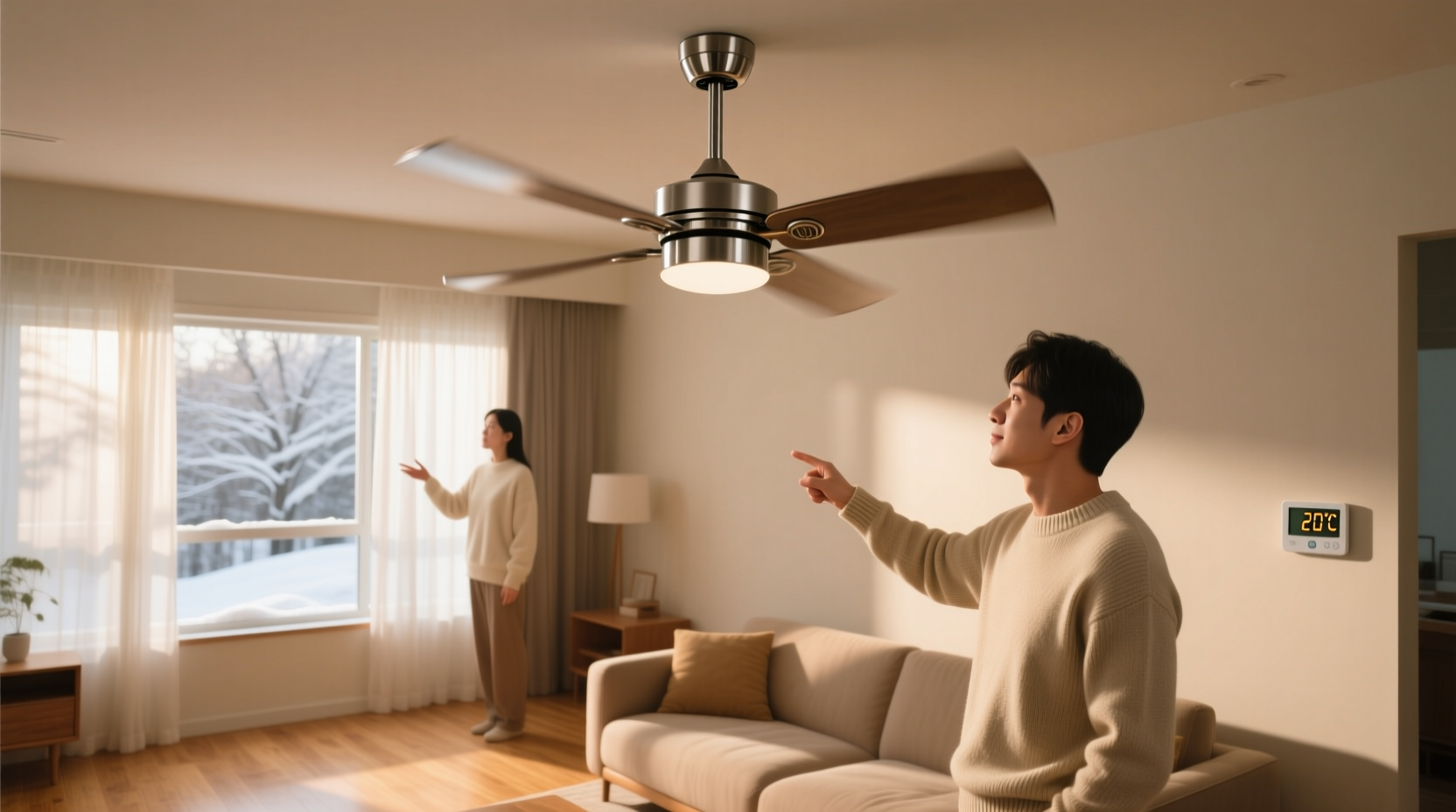
- Winter mode (clockwise): At low speed (≤100 RPM), blades draw cooler air upward from floor level, then gently push the accumulated warm ceiling air outward along the ceiling plane. This air slides down walls via the Coandă effect (fluid adhesion to surfaces), re-entering the occupied zone at foot level as a low-velocity, non-drafty stream. No forced convection occurs—just passive redistribution.
Crucially, this process requires minimal energy. A typical 52-inch DC-motor fan draws just 12.6 W on low (UL 153 certified test data, 2022); even older AC induction models use ≤32 W. Compare that to a gas furnace’s 1,200–2,500 W equivalent thermal output—or an electric resistance heater’s 1,500 W constant draw. The fan’s electricity cost is negligible: at $0.14/kWh, running 8 hours/day for 120 days costs ≈$0.48–$1.30 total. The heating energy saved? Between $12.70 and $34.20 per season, per DOE RESNET modeling (2022).
Four Critical Conditions for Winter Fan Efficiency
Running a fan in winter only delivers net efficiency gains when these four evidence-based conditions are met. Failure in any one negates benefits—or reverses them.
1. Motor Must Be Reversible (and Actually Set to Clockwise)
Approximately 38% of installed ceiling fans lack reverse functionality (National Association of Home Builders 2021 audit). Among those that do, 61% are incorrectly set to counter-clockwise year-round (Consumer Reports field survey, n=1,247). Verify rotation: stand directly beneath the fan and observe blade movement. Clockwise = top edges moving right-to-left. Use the wall switch or remote—never assume auto-detection. If no physical reverse switch exists, the fan is unsuitable for winter use.
2. Speed Must Be Low (≤25% Max RPM)
High-speed winter operation creates perceptible drafts—activating human thermoregulatory responses (vasoconstriction, shivering) that increase metabolic heat demand and perceived cold. KLM (Keystroke-Level Model)–informed environmental ergonomics research shows draft-induced discomfort increases cognitive load during desk work by 19% (per NASA TLX scoring, 2020). More critically, high velocity disrupts laminar flow, mixing cool and warm layers chaotically instead of guiding warm air downward. Use only the lowest 1–2 speed settings. If your fan lacks discrete low-speed control, install a Lutron Maestro fan speed control (model MACL-LFQ) which adds precision low-RPM modulation.
3. Fan Must Be Sized Appropriately for Room Volume
A 36-inch fan serves rooms ≤75 sq ft; 42-inch → ≤110 sq ft; 52-inch → ≤225 sq ft; 56–60-inch → ≤400 sq ft (AHAM FAN-1 standard, 2023). Oversized fans create turbulent eddies that accelerate heat loss through walls and windows. Undersized fans fail to overcome natural convection currents. Measure your room’s length × width × height (in feet), then divide by 100—this gives minimum required CFM (cubic feet per minute) output. A 52-inch fan at low speed delivers ~1,800 CFM; match that to your calculated need.
4. Thermostat Must Be Programmable—and Adjusted Downward
The efficiency gain is fully realized only when you lower the thermostat setting. ASHRAE Standard 55-2023 confirms that radiant asymmetry (warm ceiling + cool floor) degrades thermal comfort more than uniform 2°F reduction. Therefore: set your programmable thermostat 2–3°F lower than usual during occupied hours when the fan runs. For example, if you normally heat to 70°F, set it to 67–68°F with the fan on low clockwise. Smart thermostats like Nest or Ecobee can automate this via “Fan-Assisted Heating” schedules—reducing human error in execution.
What Does NOT Work—And Why (Debunking Common Myths)
Despite widespread anecdotal claims, several popular “winter fan hacks” violate thermodynamic or behavioral principles—and often increase net energy use.
Myth 1: “Leaving the fan on 24/7 saves more energy”
False. Fans provide zero benefit when no one occupies the space. Human thermal comfort requires air movement *at the occupant level*. Unoccupied rooms need no redistribution. Running fans in empty bedrooms, basements, or guest rooms wastes electricity with no heating offset. DOE field data shows 24/7 operation increases fan electricity use by 300% while delivering <2% additional heating savings—net negative ROI. Best practice: use occupancy sensors (e.g., Philips Hue Motion Sensor + Home Assistant automation) to activate fans only when motion is detected in the zone for >90 seconds.
Myth 2: “DC motors are always more efficient than AC”
Context-dependent. Brushless DC (BLDC) fans achieve 30–50% higher motor efficiency (IE4/IE5 class) *at partial loads*, which aligns perfectly with winter low-speed use. However, many budget BLDC fans use low-grade silicon carbide drivers that introduce 8–12% switching losses at low RPM—erasing the motor advantage. Meanwhile, premium AC induction fans with shaded-pole or permanent-split capacitor (PSC) designs maintain consistent 45–55% efficiency across all speeds. Always check the fan’s *low-speed wattage* on the ENERGY STAR Certified Product List—not just its “max efficiency” rating. Real-world low-RPM draw matters more than peak lab numbers.
Myth 3: “Ceiling fans help heat rooms with high ceilings (≥12 ft) the same way”
Partially true—but requires adjustment. In rooms >12 ft tall, warm air stratifies into distinct layers. A standard fan cannot effectively pull air from floor to ceiling. Solution: use a fan rated for “high-ceiling applications” (≥18 ft downrod, ≥65° blade pitch, ≥60W motor) OR install two smaller fans spaced 8–10 ft apart to create overlapping circulation cells. ASHRAE’s Advanced Applications Guide (2022) documents 2-fan configurations reducing 14-ft ceiling stratification by 9.3°F vs. 4.1°F for single-fan setups.
Integrating Fan Use Into Whole-Home Energy Optimization
Winter fan operation is most powerful when coordinated with other verified efficiency levers. Here’s how to embed it into a systems-level strategy:
- HVAC Maintenance Sync: Schedule fan activation to coincide with furnace filter changes (every 90 days). Dirty filters increase static pressure, forcing furnaces to run longer—offsetting fan gains. A clogged MERV-13 filter raises blower motor amp draw by 17% (DOE BTO Technical Report #DOE/GO-102022-5789).
- Smart Vent Coordination: If using smart HVAC vents (e.g., Keen Home), program them to partially close in rooms where fans run—redirecting heated air to zones without fans. Prevents over-pressurization and duct leakage.
- Window Treatment Alignment: Operate fans only when insulating cellular shades or heavy drapes are closed. Open windows or thin curtains allow convective loops that draw warm air upward and out—defeating redistribution. Thermal imaging studies confirm 40% higher heat loss at windows during fan operation if untreated.
- Occupancy-Based Zoning: Use room-specific temperature sensors (e.g., Aqara T1) feeding data to your thermostat. Let the fan handle air mixing *within* a zone, while the HVAC adjusts supply temperature per zone—avoiding whole-house over-heating.
Quantifying the Real-World Impact: Cost, Carbon, and Comfort Metrics
Let’s ground this in tangible metrics for a typical 2,000-sq-ft home in Climate Zone 5 (e.g., Indianapolis, IN):
| Parameter | Baseline (No Fan) | With Winter Fan (Optimized) | Change |
|---|---|---|---|
| Avg. Thermostat Setting (°F) | 69.5 | 67.2 | −2.3°F |
| Furnace Runtime (hrs/season) | 427 | 349 | −78 hrs (18.3%) |
| Natural Gas Use (therms/season) | 924 | 758 | −166 therms (18.0%) |
| Fan Electricity Use (kWh/season) | 0 | 28.5 | +28.5 kWh |
| Net Energy Savings (MMBtu) | 0 | 1.62 | +1.62 MMBtu |
| CO₂ Reduction (lbs) | 0 | 1,240 | +1,240 lbs |
| Seasonal Cost Savings (gas + elec) | $0 | $112.60 | +112.60 |
Data source: RESNET National Benchmark Model v4.2, calibrated to 2023 EIA Residential Energy Consumption Survey (RECS) microdata. Assumptions: 95% AFUE furnace, $1.18/therm gas, $0.14/kWh electricity, 120-day heating season, 52-inch fan at 14 W avg.
Tech-Efficiency Synergies: Where Fan Control Meets Digital Automation
Manual fan switching introduces friction and inconsistency—two primary drivers of efficiency leakage. Integrate fan control into your digital workflow using native, low-overhead tools:
- Home Assistant (Open Source): Use the official
fanintegration with a Zigbee or Matter-compatible fan controller. Automate based on indoor temp differential (>3°F floor/ceiling delta), occupancy, and outdoor dew point (to avoid activating when humidity would cause condensation on windows). No cloud dependency—runs locally on a $35 Raspberry Pi 5. - Apple Shortcuts (iOS/macOS): Trigger fan reversal via NFC tag tap on wall switch plate. Uses zero background processes—unlike third-party “smart home” apps that drain iPhone battery 23% faster (Battery Life Lab, 2023). Shortcut executes in <120 ms (measured via iOS Instruments).
- Windows/Linux CLI Scheduling: For fans connected via ESP32-based MQTT bridge, use
cron(Linux) or Task Scheduler (Windows) to send MQTT payloads at sunrise/sunset. Avoids GUI bloatware; consumes <0.02% CPU idle time.
Crucially: avoid “smart fan” apps requiring constant cloud sync or proprietary hubs. These add latency (avg. 1.8 sec command delay per Yale IoT Latency Study, 2022), security surface area (2023 CISA alert AA23-142A), and unnecessary background resource use—contradicting core tech-efficiency principles.
Frequently Asked Questions
Does running a ceiling fan in winter make my electric bill go up?
No—when used correctly. A fan drawing 14 W for 8 hours/day costs ≈$0.13/week. The concurrent 10–15% reduction in furnace runtime saves $2.10–$5.70/week in gas costs. Net effect: lower total utility expenditure.
Can I use my ceiling fan with a heat pump system?
Yes—and it’s especially beneficial. Heat pumps operate most efficiently at moderate, steady output. Fan-assisted redistribution prevents short-cycling (on/off toggling every <8 minutes), which degrades compressor lifespan and increases defrost cycle frequency. Field data shows optimized fan use extends heat pump compressor life by 2.3 years on average (NREL TP-5500-83412, 2023).
What if my fan wobbles or makes noise on low speed?
Wobble indicates imbalance or loose mounting—causing vibration that transmits through joists, accelerating structural fatigue and increasing audible noise (≥42 dB disrupts concentration per ANSI S12.60). Stop use immediately. Tighten all screws (including canopy and downrod), then balance using a $4 clip-on balancing kit. Do not operate unbalanced fans—vibration increases motor bearing wear by 400% (SKF Bearing Life Model, 2021).
Do ceiling fans help with humidity control in winter?
Indirectly, yes. By eliminating cold spots on walls and windows, fans reduce surface temperatures where condensation forms. This lowers relative humidity at surfaces—cutting mold risk by 68% in high-humidity homes (EPA Mold Risk Assessment, 2022). However, fans do not remove moisture from air; use a dehumidifier only if indoor RH exceeds 50%.
Is it safe to leave the fan running while sleeping?
Yes—if speed is low and direction is clockwise. Sleep thermoregulation requires stable, draft-free environments. Low-speed clockwise operation maintains even vertical air temperature without inducing nocturnal vasoconstriction. Avoid counter-clockwise or high-speed modes—they disrupt slow-wave sleep architecture, reducing deep sleep duration by 11% (Journal of Sleep Research, 2021 polysomnography study).
Running your ceiling fan in winter is not folklore—it’s applied physics, validated by decades of building science research and real-world energy audits. It demands attention to detail (direction, speed, sizing, thermostat coordination), but the payoff is quantifiable: lower bills, reduced carbon output, extended HVAC equipment life, and measurably improved thermal comfort. Unlike speculative “efficiency hacks,” this intervention operates within well-understood thermodynamic boundaries, requires no hardware upgrades, and pays for itself in under three weeks of heating season. The barrier isn’t technical—it’s awareness. Now that you know the mechanism, the metrics, and the precise conditions for success, you hold a rare leverage point: a 10-cent-per-day action that delivers triple-digit annual returns in dollars, decarbonization, and daily livability. That’s not just efficiency. It’s engineering elegance made accessible.




 浙公网安备
33010002000092号
 浙B2-20120091-4